Moulins – The Boys’ Teacher Training College and Its Tree-Lined Courtyard
Geographic description
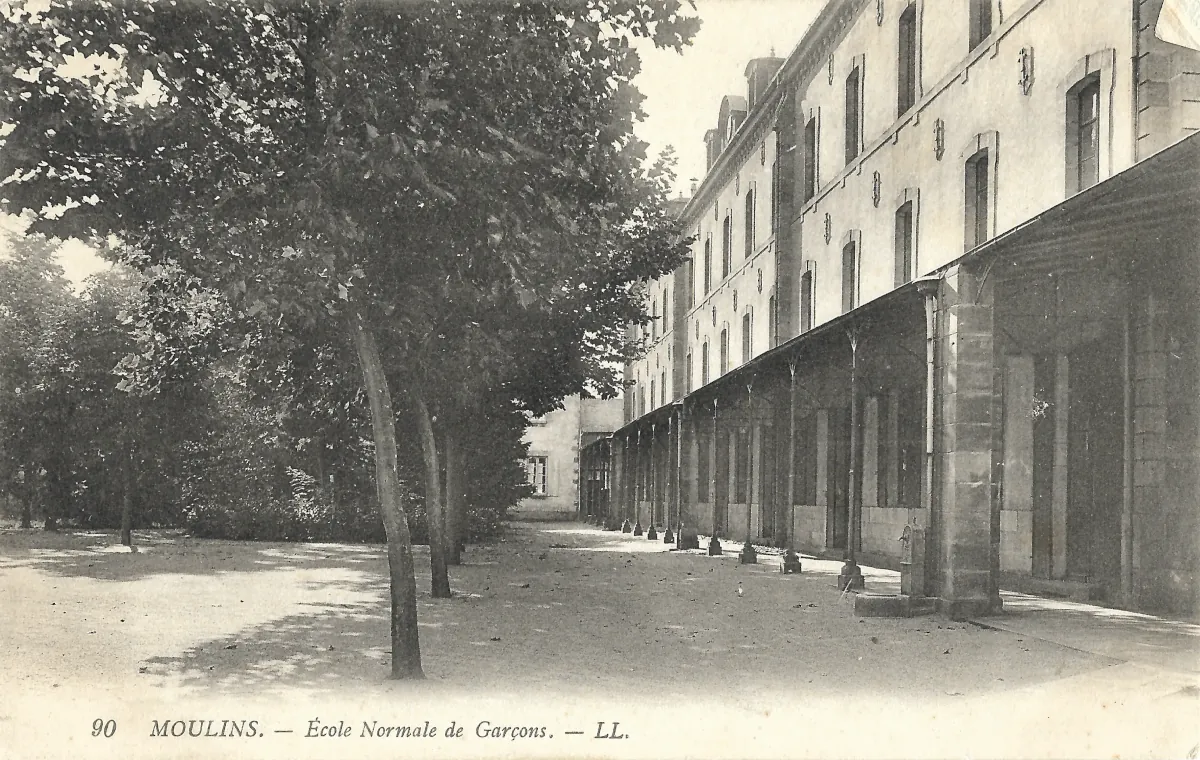
The Moulins teacher training college, located in the Allier department of central France, is depicted in this historic postcard through a view of its spacious tree-lined courtyard and one of its principal buildings. The institution stood in the northern part of Moulins, the historic capital of the Bourbonnais region and the administrative centre of the Allier department.
The former school occupied the site of today’s Moulins university campus, at 28 Rue des Geais. Historically associated with the road leading towards Decize, this location accommodated an institution devoted to preparing future teachers for service in French primary schools.
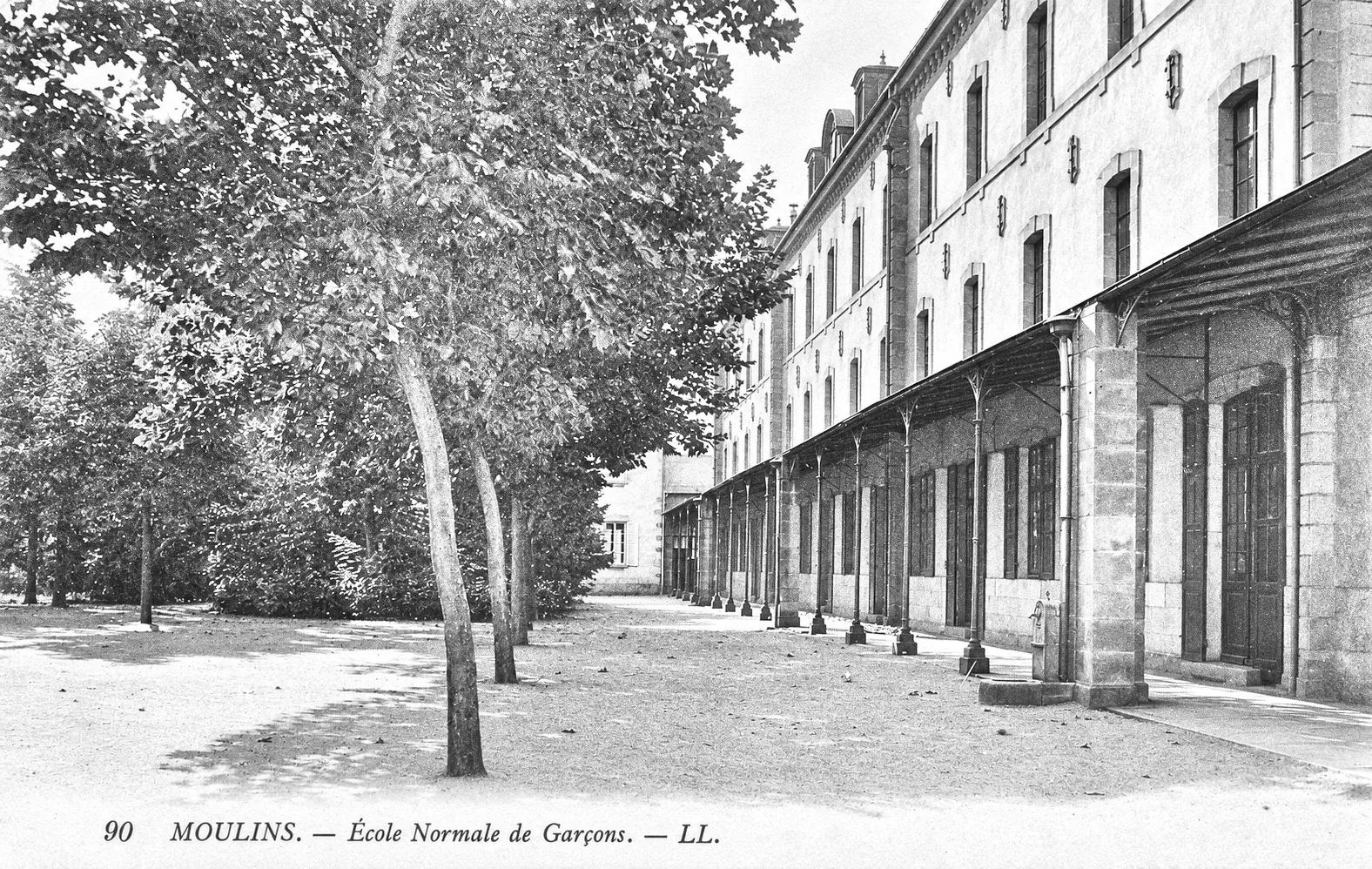
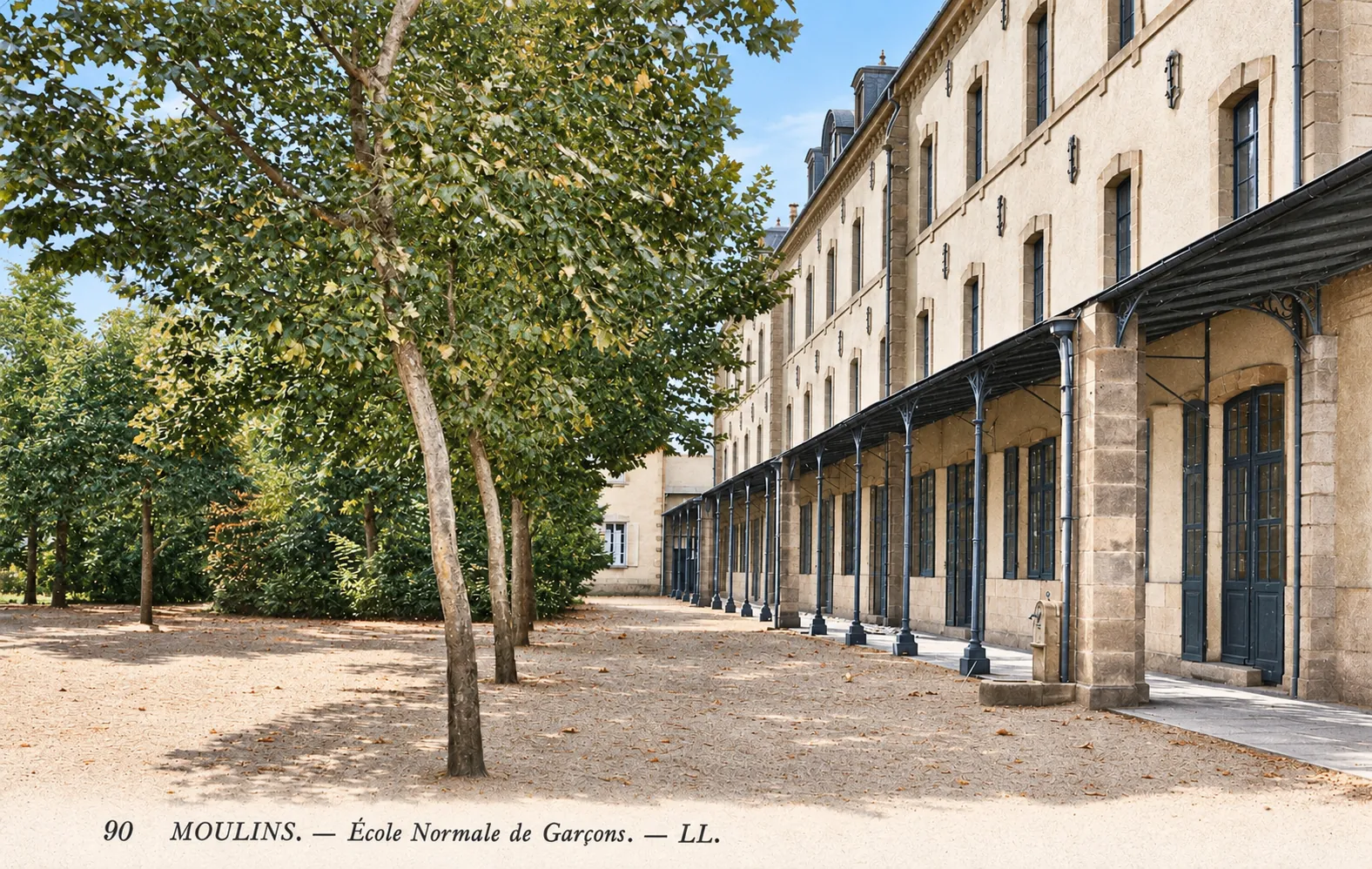
The photograph presents a carefully balanced architectural composition. On the right stands an imposing rectangular building extending far into the distance. Its restrained, symmetrical design reflects the architectural characteristics of many French public educational institutions constructed during the late nineteenth century.
The building rises through several levels, with tall vertical windows arranged at regular intervals. These openings provided natural light to the interior rooms, an important consideration in the design of educational buildings during this period.
One of the most distinctive architectural features is the long covered gallery running along the ground floor. Its projecting roof is supported by a succession of vertical pillars, creating a sheltered passage extending along the visible length of the building. Such an arrangement offered protection from rain and other adverse weather conditions while allowing movement between different parts of the premises.
In the foreground and to the left, several mature trees dominate the courtyard. Their tall trunks and abundant foliage create extensive shaded areas. The relatively regular arrangement of the trees gives the outdoor space an orderly yet pleasant appearance.
The courtyard surface appears to consist of compacted earth or gravel, without any visible modern paving. Small patches of vegetation and minor surface irregularities can be distinguished.
The absence of people, vehicles and outdoor furniture contributes to the peaceful atmosphere of the scene. Although the photograph captures a seemingly deserted courtyard, this space would normally have formed an important part of the institution’s daily activities.
In the background, another building is partially visible beyond the trees. Its presence suggests a larger architectural complex extending beyond the principal structure shown on the right.
The overall layout reflects the practical requirements of nineteenth-century educational institutions. Large buildings were needed to accommodate teaching facilities, while spacious outdoor areas provided room for circulation, recreation and group activities.
The courtyard may therefore have served several purposes, including movement between buildings, outdoor recreation and student gatherings. However, the photograph alone does not establish its precise uses.
The site underwent significant transformations throughout the twentieth century and into the early twenty-first century. Nevertheless, it has retained its educational purpose.
Today, the Moulins university campus accommodates several higher education and training facilities, including a branch of the Institut national supérieur du professorat et de l’éducation (INSPé), associated with Clermont Auvergne University.
This postcard consequently provides valuable evidence of the original architectural organisation and landscaped surroundings of a historic teacher training institution, before successive renovations transformed the premises into a modern university campus.
Historical description
The history of the Moulins teacher training college forms part of the broader development of public education in France during the nineteenth century and the growing effort to establish professional training for primary school teachers.
The Guizot Law of 28 June 1833 required every French department to maintain a teacher training institution, known as an école normale primaire. This legislation represented a major stage in the development of a more organised national system of public education.
A teacher training school was established in Moulins in 1833. After undergoing several changes, the institution moved in 1882 to the premises represented in this historic postcard.
The move coincided with a particularly important period in French educational history. The education laws introduced under Jules Ferry in 1881 and 1882 established free public primary education, compulsory schooling and the secular character of the curriculum.
These reforms considerably increased the importance of properly trained teachers. Teacher training colleges became essential institutions for preparing the personnel needed to implement the new educational system throughout France.
The Moulins establishment educated young male trainee teachers, traditionally known as normaliens, who were preparing to work in primary schools, particularly within the Allier department.
Despite its historic French name, École normale de garçons, the establishment was not an ordinary primary school for boys. It was a professional training institution for future male teachers.
Education in these colleges combined general academic subjects with preparation for teaching responsibilities. Trainees were expected to acquire a thorough knowledge of the school curriculum, develop appropriate teaching skills and understand the professional obligations associated with public education.
Teacher training colleges also played an important social role. They provided opportunities for young men, including those from modest backgrounds, to continue their education and enter a respected profession.
The architecture of the Moulins institution reflects this educational ambition. Its substantial buildings, orderly façades, covered gallery and extensive courtyard suggest an environment designed for a permanent and well-organised institution.
The photograph was probably taken during the opening decades of the twentieth century, although the exact date remains unknown.
The printed caption reads: “90 MOULINS. — École Normale de Garçons. — LL.”
The number 90 identifies the postcard within its publisher’s numbered series. The initials “LL” refer to the French photographic publishing company Léon et Lévy, whose trademark was registered in 1901.
Léon et Lévy became one of France’s leading producers of illustrated postcards during the early twentieth century. Its publications documented towns, monuments, railway stations, schools and other significant buildings throughout the country.
The publisher’s mark offers a useful chronological clue, but it cannot establish the precise date of the photograph or the printing of this particular postcard.
The French National Museum of Education also holds another Léon et Lévy postcard depicting the Moulins Normal School for Boys, catalogued as dating from approximately 1920. This provides additional context for the period during which the institution appeared in illustrated postcard collections.
The teacher training college continued operating throughout the twentieth century, adapting to changing educational requirements and developments in teacher preparation.
Its buildings underwent major restructuring between 1955 and 1960. Further substantial improvements followed during the early 2000s, when the site was modernised and additional university facilities were introduced.
Over time, the traditional teacher training colleges were replaced by newer institutional structures, including the university institutes for teacher training, followed by the higher schools of education and, eventually, today’s national higher institutes for teaching and education.
The present-day Moulins campus continues the educational tradition established on this site during the nineteenth century.
Beyond its architectural interest, this historic postcard preserves the memory of an institution that contributed to the development of French public education and the professional preparation of generations of primary school teachers.