Moulins – Rue d’Allier and Its Shops in the Early 20th Century
Geographic description
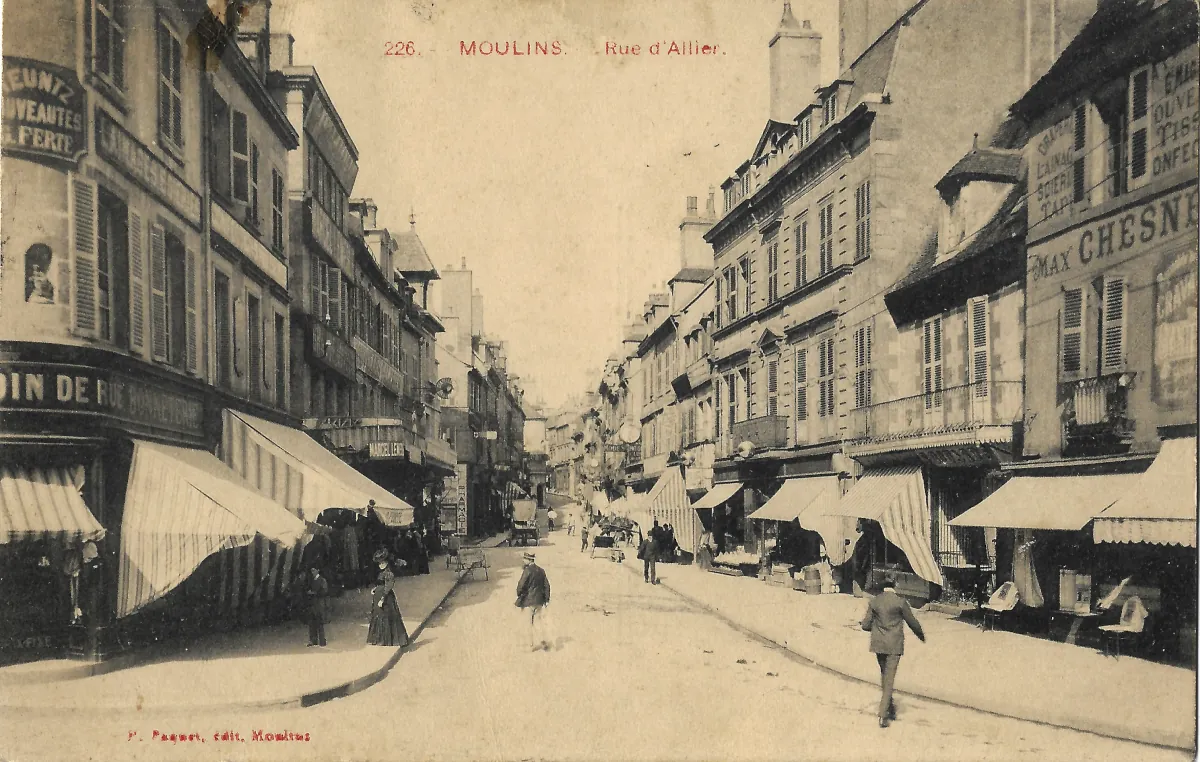
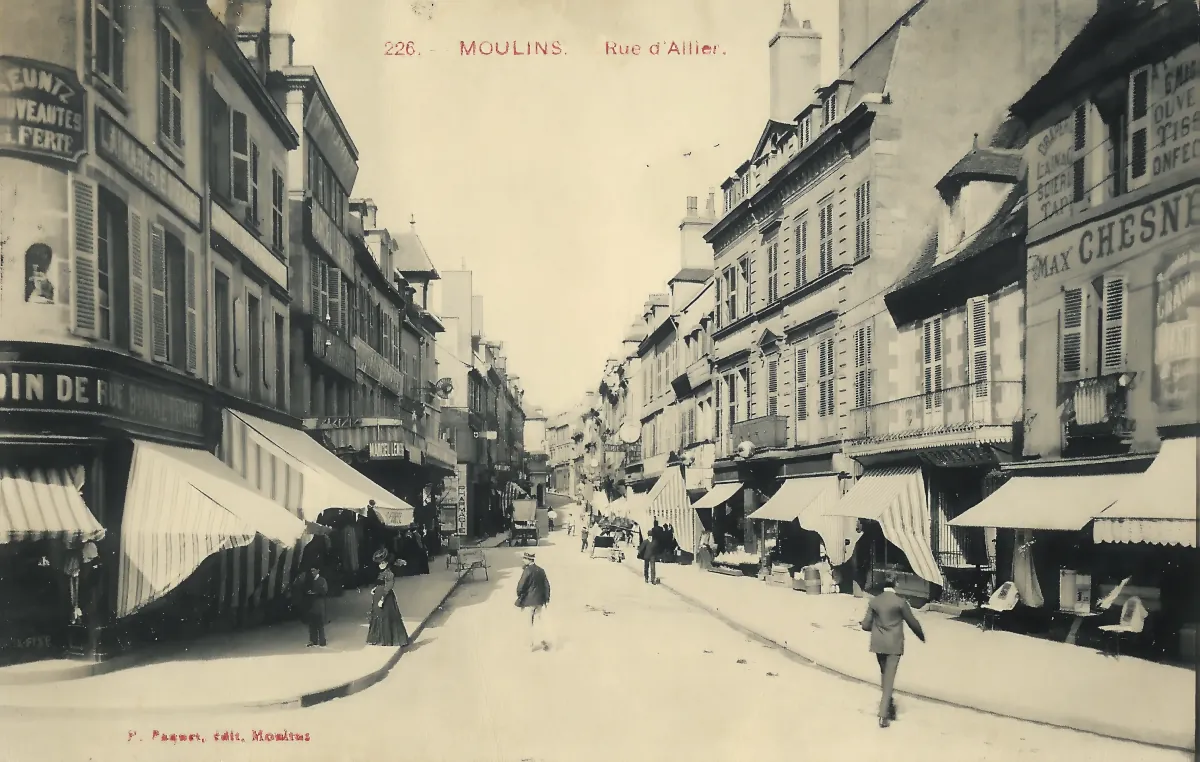
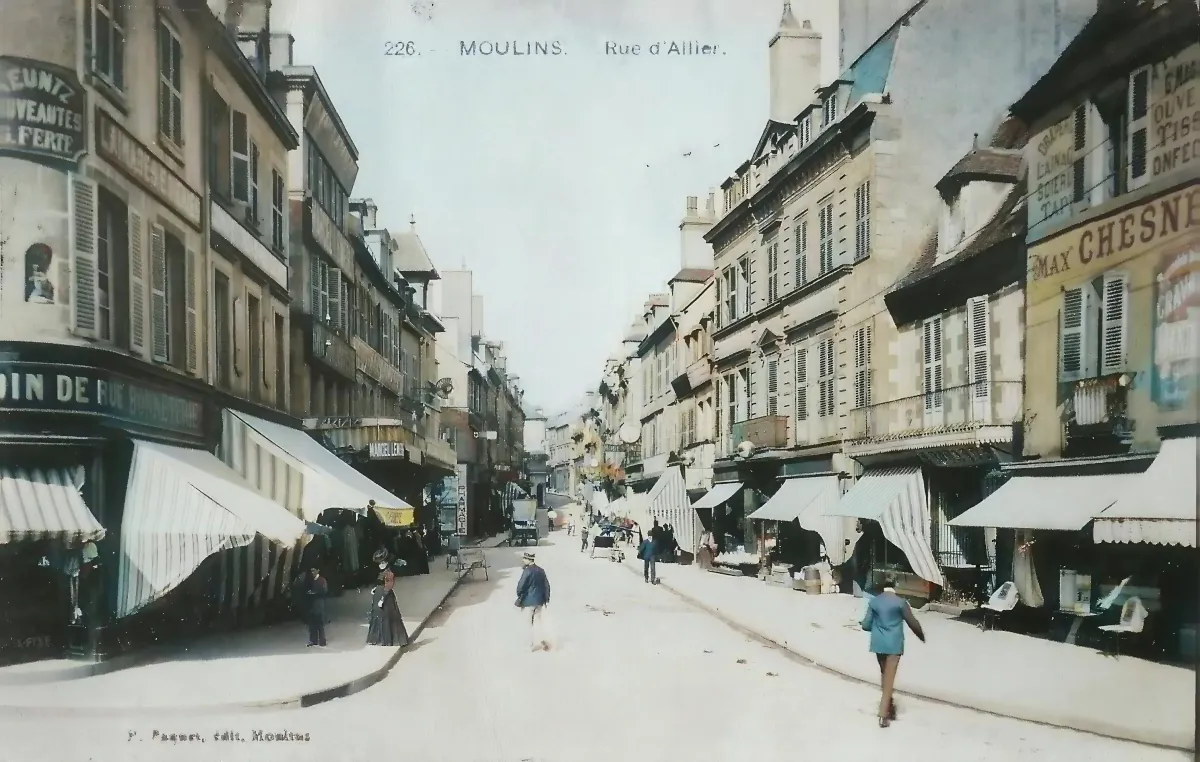
Rue d’Allier in Moulins is shown here as a lively commercial street in the historic town centre, lined almost continuously with houses and multi-storey buildings whose ground floors are occupied by shops. The photographer positioned the camera along the axis of the street, creating a strong perspective and providing a detailed view of the urban fabric extending into the distance.
One of the most striking features is the succession of large canvas awnings on both sides of the street. Some project far across the pavements and descend low enough to shelter substantial portions of the shop displays. Their number clearly reflects the commercial character of Rue d’Allier at the time. Goods also appear to have been displayed outside some shops, particularly along the right-hand side of the street.
Most buildings rise two or three floors above their shopfronts. Their relatively narrow façades and tall shuttered windows are typical of an old town centre that developed gradually rather than according to a single architectural plan. Several buildings appear comparatively formal, particularly the large façade on the right with its regular rows of windows and horizontal architectural detailing. Other properties are less uniform and may incorporate structures altered repeatedly over earlier centuries.
This mixture is consistent with the historic character of central Moulins. Municipal heritage documents note that the city has retained strong traces of its medieval urban development and that many historic street widths and layouts remain visible. Moulins also possesses an unusually rich architectural heritage. Rue d’Allier itself contains protected historic properties. The former Hôtel d’Orvilliers at number 57 includes elements dating from the 15th century, while the former Hôtel des Feydeau at number 61 retains a 15th-century stair turret. Neither building can be securely identified in this particular postcard view, however.
Commercial signs provide another valuable record of the street. On the right-hand side, the painted name “MAX CHESNE” can be clearly distinguished across a façade. Other advertisements and shop names are visible on buildings and storefronts, although they are not sufficiently legible to justify a reliable transcription. Together with the awnings and outdoor displays, these signs emphasise the street’s role as one of the town’s shopping areas.
The roadway remains open to traffic. Pedestrians can be seen both on the pavements and moving directly across the street. At least one early motor vehicle is visible farther along the road, while several more distant forms may be carts or other vehicles, although the photographic detail is insufficient to identify them confidently. No tram rails are visible. Overhead wires cross the street, another sign of the gradual arrival of modern urban infrastructure.
The street is busy without being crowded. Men and women move between the shops, while small groups appear to be standing near displays and entrances. The long skirts worn by the women, the hats worn by several figures and the overall organisation of the street create a scene strongly characteristic of an early-20th-century French provincial town.
Rue d’Allier remains part of the historic heart of Moulins today. The city’s heritage service is itself based at the Hôtel Demoret, 83 Rue d’Allier, underlining the street’s continuing place within the protected historic centre.
Historical description
The postcard bears the printed caption “226. – MOULINS. – Rue d’Allier.” Its visual characteristics suggest a date in the first quarter of the 20th century, probably around the 1910s or early 1920s. This remains an approximate dating, as no precise year is visible on the front of the card.
Several details support this estimate. Clothing provides an important clue. Women in the foreground still wear long skirts or dresses reaching close to the ankles, while hats are common among the male figures. These fashions are more consistent with the first decades of the century than with the later interwar period.
Traffic offers another chronological indication. An early motor vehicle can be distinguished in the middle distance, showing that cars had already become part of the urban scene, although they had not yet come to dominate the street. Pedestrians still use the roadway freely, and traffic is sparse compared with the increasingly motorised streets of later decades.
The commercial environment also fits the period of change experienced by Moulins around the Belle Époque. The local tourist office describes 1880–1914 as a period of architectural and social dynamism in the town, when new commercial and leisure buildings appeared, including the Nouvelles Galeries department store and the Grand Café. The postcard appears to record the immediate legacy of this period: a central shopping street filled with awnings, shop signs, displays and independent businesses.
This commercial activity formed part of a much older urban history. Moulins became the capital of the Bourbonnais in the late 14th century when the ducal administration was established there. Although the duchy was incorporated into the French Crown in 1531, the town retained an important administrative role and continued to develop. By the 19th and early 20th centuries, its centre therefore contained a complex mixture of medieval remains, private town houses, later residential buildings and modern commercial premises.
The postcard is particularly valuable as a record of everyday commercial life rather than simply as an architectural view. The extended awnings, goods displayed beside the shops, pedestrians moving between businesses and large painted advertisements all show how closely retail activity was connected with the public street.
It also illustrates elements of the traditional shopping environment that have largely disappeared or changed form. Advertising was painted directly onto façades; awnings could dominate the visual appearance of entire buildings; and individual businesses presented their goods directly toward the pavement. The cumulative effect was a street scene much more visually varied than that produced by standardised modern storefronts.
The printed number 226 almost certainly indicates that the postcard formed part of a numbered publishing series devoted to Moulins or the surrounding area. An editor or publisher’s credit is also present in the lower left corner, but the lettering is too indistinct in this copy to support a secure identification. Assigning a publisher solely from the visible inscription would therefore be speculative.
Rue d’Allier is captured here at a transitional moment. Its historic architecture still defines the street, traditional small-scale retail occupies most of the ground floors, and pedestrians remain central to the use of public space. At the same time, early motor vehicles and modern networks are beginning to alter the urban environment. The postcard consequently preserves a particularly detailed image of commercial Moulins during the opening decades of the 20th century.