Washerwomen on the Allier — The Timeless Gesture on the Banks at Moulins
Geographic description
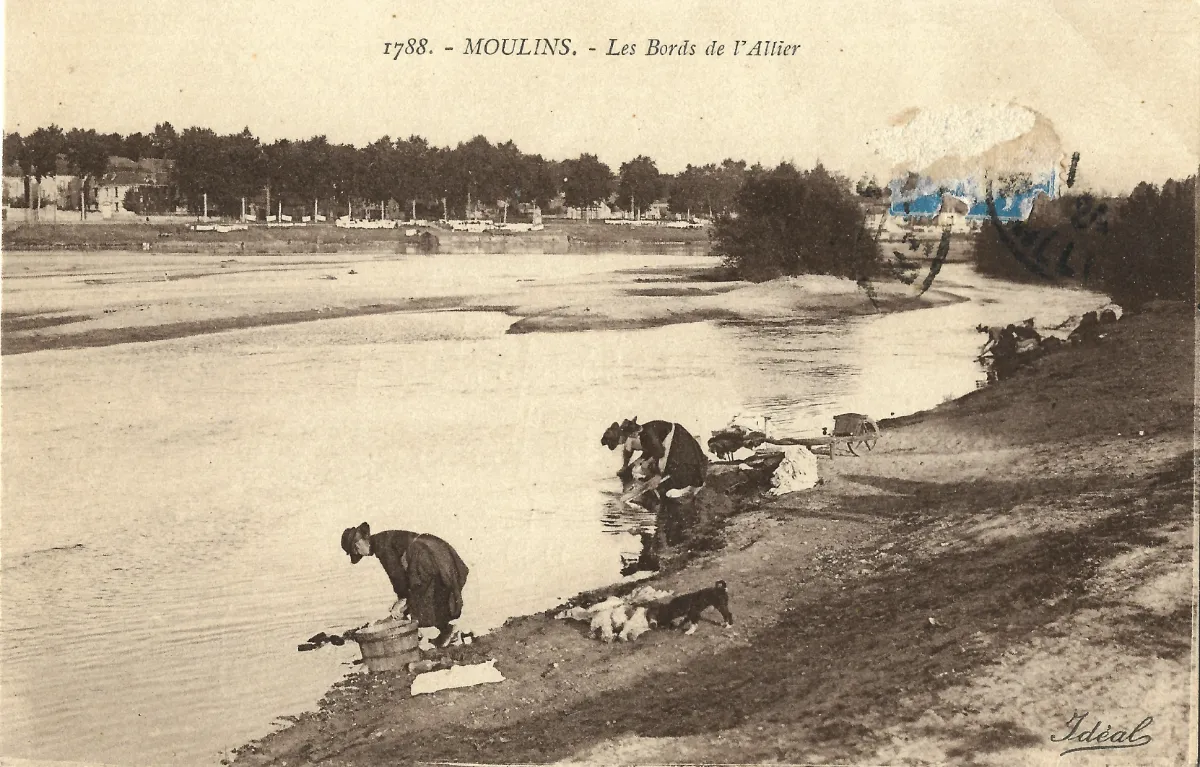
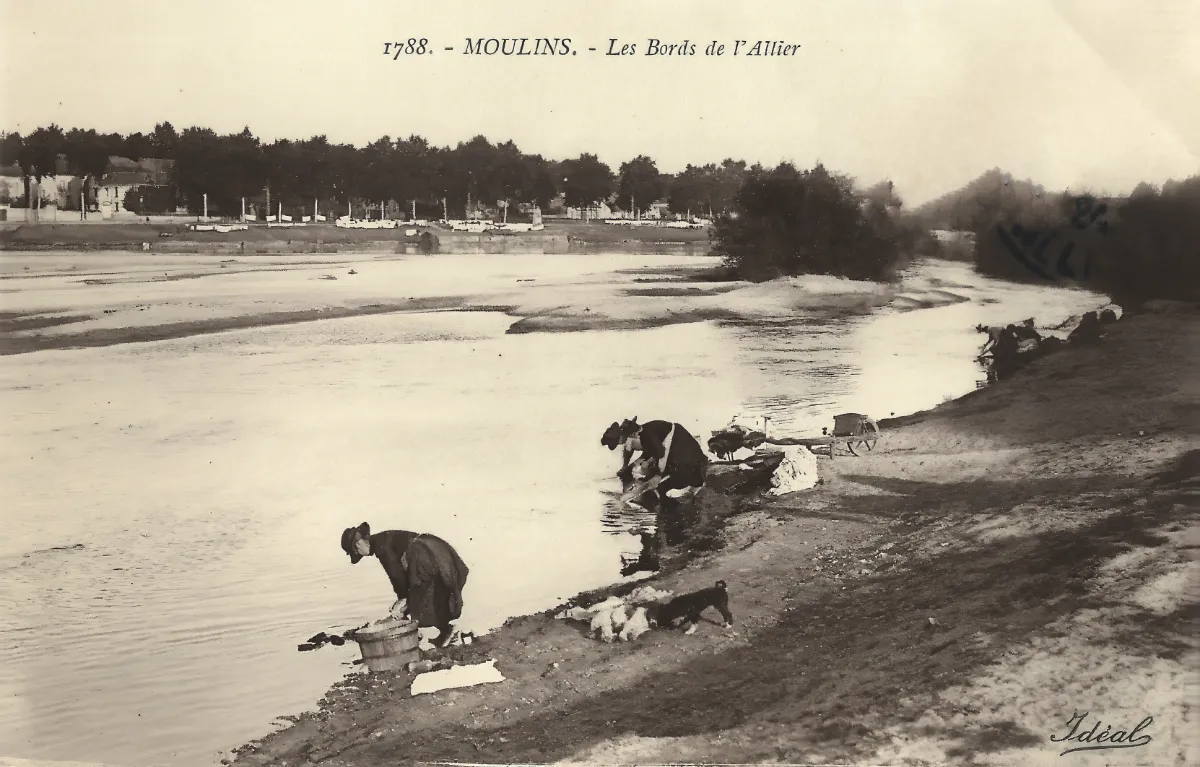
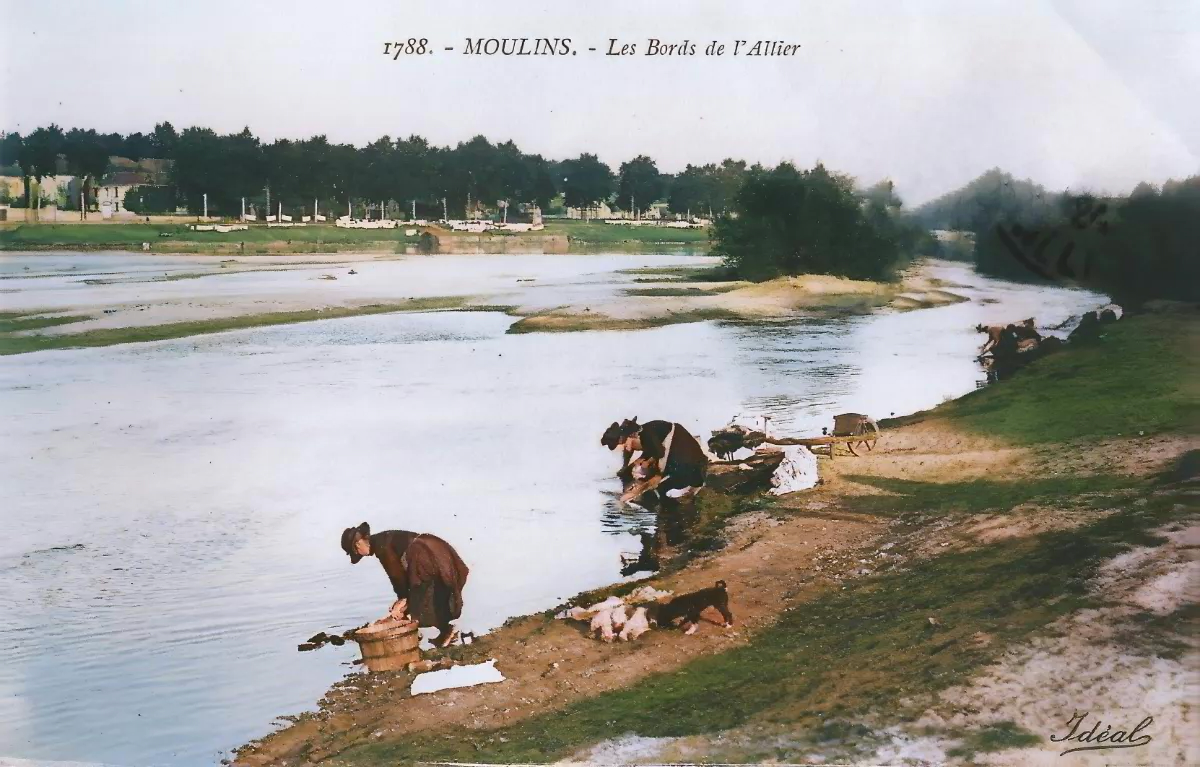
The banks of the Allier in Moulins appear here as a largely natural riverside landscape, dominated by the broad channel of the river and by everyday activities taking place directly along the water’s edge. The photograph was taken from a low, gently sloping bank. The Allier fills most of the view and seems to be at a relatively low level, with several exposed sand or gravel bars dividing the shallow channels.
In the foreground, a woman bends over the water while washing or rinsing clothes. A container stands beside her, and several pieces of fabric have been placed on the bank. Farther upstream, another woman is engaged in a similar task close to the water. These figures transform what might otherwise have been a conventional riverscape into a record of everyday working life. A small dog can also be seen beside the laundry, while what appears to be a wheelbarrow or small handcart stands a short distance behind the second woman.
Across the river, a long belt of trees extends along the opposite bank, with low buildings and various small structures visible beyond it. No major landmark of central Moulins can be identified clearly enough to establish the precise direction of the view. Historically, the town developed mainly on the right bank of the Allier, although that fact alone does not allow the photographer’s exact position to be determined with confidence.
The riverside itself remains remarkably open. There is no substantial masonry embankment or formal urban quay in the foreground, and the river is still closely connected to the gravel and alluvial ground along its edges. The exposed bars visible in the channel also illustrate the changing character of the Allier, whose flow and floods have repeatedly reshaped the river environment around Moulins.
The relationship between Moulins and the river has a long history. Frequent flooding once affected the lower parts of the town, while successive bridges were vulnerable to the power of the Allier. During the eighteenth century, engineer Louis de Régemortes carried out major works that widened and embanked the river channel and led to the construction of a more durable bridge. These works had a lasting influence on the development of both banks.
This postcard, however, is concerned less with monumental engineering than with ordinary riverside life. The Régemortes Bridge is not visible. Another postcard from what appears to be the same numbered “Idéal” series, no. 1783, is catalogued as “Les Bords de l’Allier au Pont Régemortes.” The present card bears the nearby number 1788 and therefore appears to belong to a broader sequence of views devoted to Moulins and its surroundings.
Historical description
The banks of the Allier in Moulins shown on this postcard provide an especially valuable record of the domestic and working uses of the river in the early twentieth century. The two women beside the water strongly evoke the traditional work of washerwomen, at a time when household laundry was still carried out manually.
Laundry could be washed in purpose-built washhouses, but rivers themselves also provided convenient washing and rinsing places. This photograph appears to record such a practice directly. The women bend or crouch at the water’s edge while garments and textiles are gathered on the nearby bank. Their long, dark clothing, together with the absence of modern domestic equipment or later riverside infrastructure, is consistent with an early twentieth-century scene.
The historical importance of these activities along the Allier is also reflected in local heritage material. Moulins Communauté includes washerwomen alongside boatmen, millers and other people whose livelihoods and daily activities once animated the section of river between the Régemortes Bridge and the railway bridge. The figures on the postcard therefore represent a genuine aspect of everyday riverside life rather than merely providing picturesque decoration for the photographer.
The exact date cannot be determined from the front of the card alone. Its typography, photographic treatment, clothing and overall style suggest the early years of the twentieth century, probably around 1900-1910. Comparable postcard records provide some supporting evidence. One Moulins view entitled “Les Bords de l’Allier” is catalogued around 1900, while another river scene featuring washerwomen is associated with a 1905 postal date. These examples help establish a plausible period but do not provide a definitive date for this particular card.
Two printed details are especially useful for identifying the edition. At the top is the number 1788, followed by the caption “MOULINS. – Les Bords de l’Allier.” At the lower right appears the name Idéal. Other Moulins postcards are catalogued as “Édition Idéal,” including a card numbered 1741, while the nearby number 1783 is also associated with an Idéal view of the banks of the Allier. This numerical proximity suggests that no. 1788 formed part of the same broader series, although the numbering itself cannot establish the printing date.
The postcard’s documentary importance lies in this combination of landscape and human activity. It preserves an image of the Allier not simply as scenery but as a practical working space integrated into daily life. Washing clothes, transporting materials, crossing the river and other routine activities once brought local residents into direct contact with the water.
The modern banks of the Allier around Moulins have since become increasingly associated with recreation, walking, cycling and environmental enhancement. The postcard records a very different relationship with the river: one in which the shoreline remained an informal workspace and the boundary between the town and the natural river environment was much less clearly defined. In this respect, the two washerwomen in the foreground are as historically significant as the landscape itself.