Moulins – Porte de Paris in the Early 20th Century
Geographic description
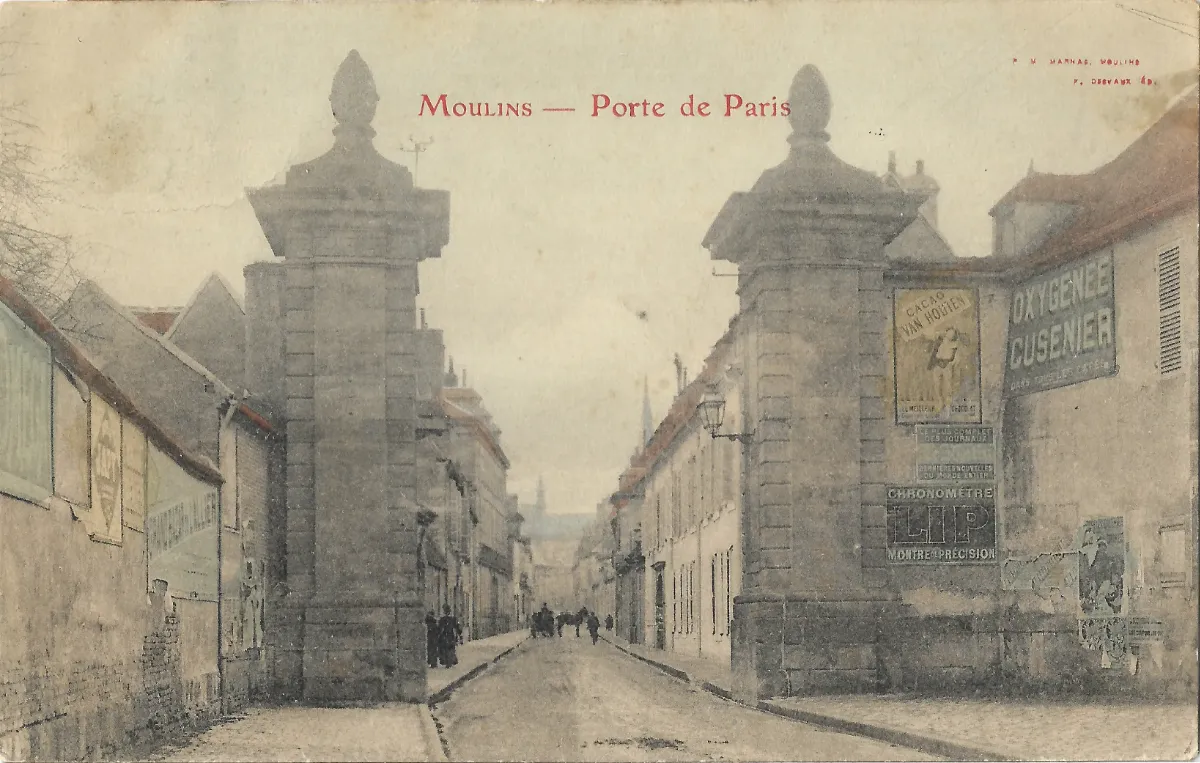
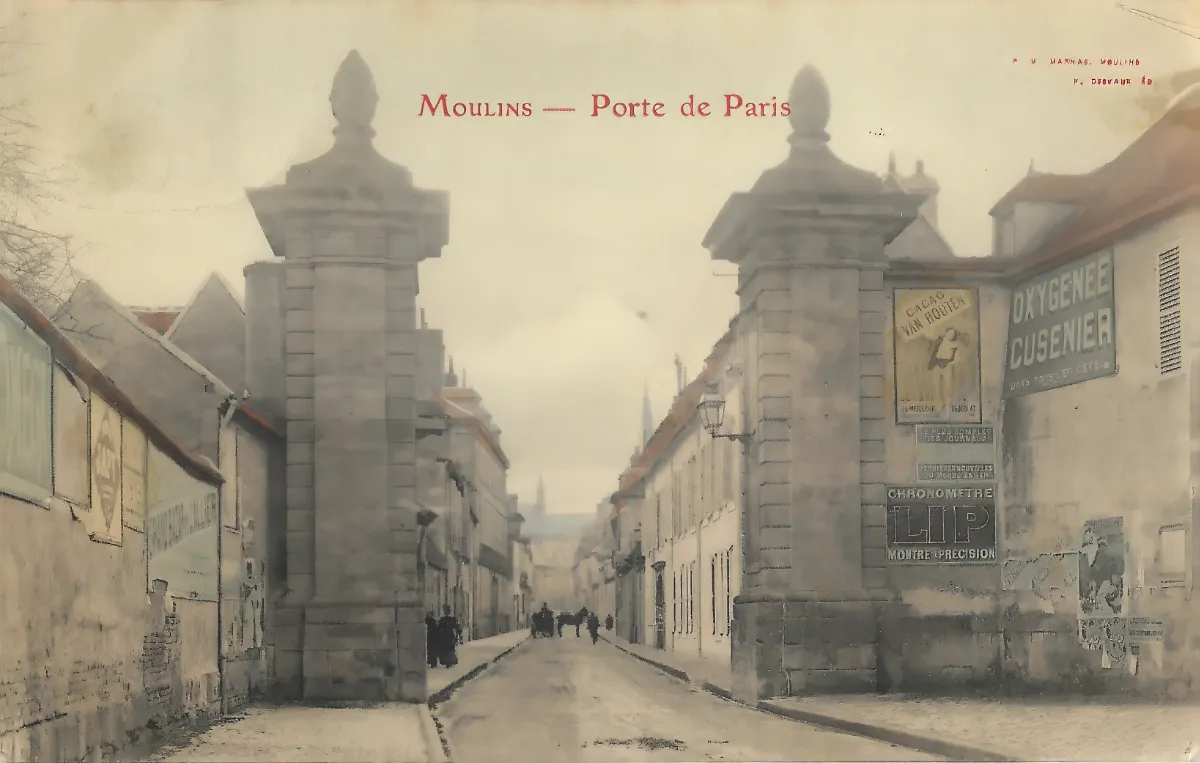
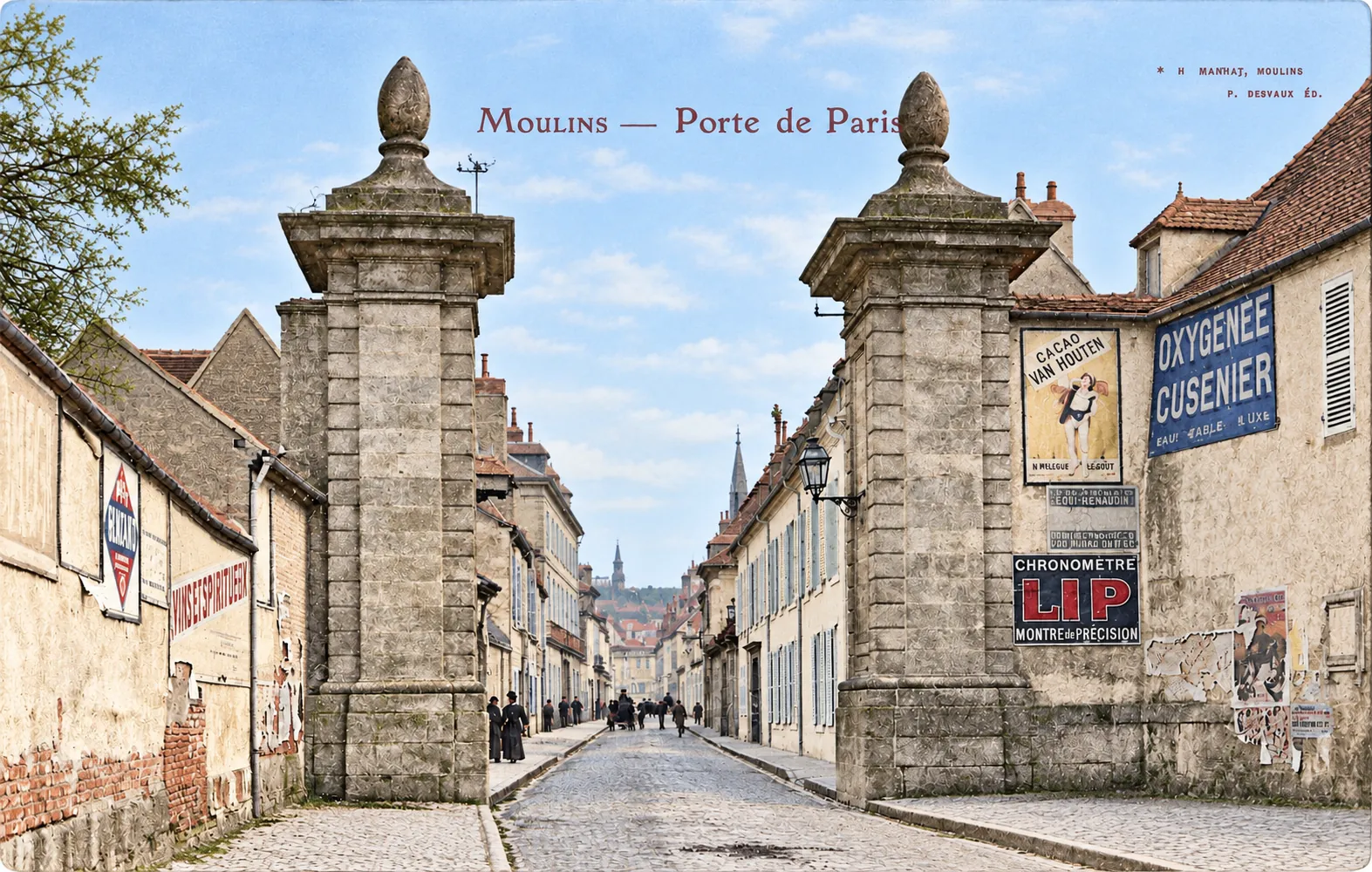
The Porte de Paris in Moulins marks one of the historic approaches to the town, on the road extending northward from the Rue de Paris. This vintage postcard shows the gateway from outside the old town, looking along the street toward the more densely built centre of Moulins.
The monument consists of two imposing square stone pillars positioned on either side of the roadway. Their architecture is deliberately monumental, with massive bases, carefully dressed stonework, projecting cornices and decorative finials resembling pine cones or stylised flames. Unlike a conventional fortified gateway, there is no arch or permanent door connecting the two structures. The Porte de Paris therefore functions primarily as an architectural landmark marking the transition from the outskirts into the town.
The roadway is still comparatively narrow and shows none of the infrastructure associated with modern motor traffic. Small pavements run alongside the buildings, while several pedestrians can be seen farther down the street. No motor vehicles are visible. Wall-mounted street lamps and the relatively uncluttered road provide additional evidence of an urban environment still largely shaped by nineteenth-century patterns.
The modest buildings immediately adjoining the gateway contrast strongly with its monumental pillars. On the left, long low walls border the street before taller houses begin. The right-hand side is particularly striking because its walls are covered with commercial advertising. Several signs remain sufficiently clear to identify, including an advertisement for Van Houten cocoa and another promoting LIP chronometers and precision watches. A large painted advertisement containing the words “Oxygénée” and “Cuisinier” also dominates the wall.
These advertisements are an important part of the scene. They illustrate how walls along busy entrances to French towns became valuable spaces for commercial publicity during the late nineteenth and early twentieth centuries. Historic architecture and modern advertising therefore occupy the same visual space.
Beyond the gateway, the Rue de Paris narrows between rows of adjoining multi-storey houses. The perspective leads toward central Moulins, with several taller silhouettes faintly visible in the distance. Pedestrians walking freely along or across the roadway and the absence of heavy traffic give the street a very different character from that of a modern urban thoroughfare.
Historical description
The Porte de Paris reflects the historical importance of Moulins as a town situated on a major route linking Paris with central France and, farther south, Lyon. Moulins was the historic capital of the Bourbonnais, and its suburbs gradually expanded beyond the older urban core along the principal roads entering and leaving the town.
The gateway shown on the postcard was not primarily designed as a defensive structure. Its two monumental pillars had a symbolic and architectural purpose, marking the entrance into Moulins for travellers arriving from the direction of Paris. Such monumental gateways became increasingly important as towns transformed their former defensive boundaries into prestigious approaches and urban promenades.
Historical sources do not entirely agree on the precise construction date. The official French heritage record associates the main building campaign with the seventeenth century, whereas several local historical publications connect the present monumental pillars with work carried out in 1764-1765 during the administration of Jacques de Flesselles. The mid-1760s date is therefore frequently associated with the form of the Porte de Paris known today. The monument was later officially listed as a historic monument in 1929.
The postcard itself is considerably later. Its appearance suggests the early twentieth century, probably the 1900s or early 1910s, although the front of the card does not provide enough evidence for a precise year. The photographic presentation, the clothing of the pedestrians, the street furniture and the extensive wall advertising are all compatible with this period. The complete absence of motor cars is also consistent with a view taken before automobiles became a common feature of everyday traffic in provincial French towns.
The commercial signs are among the most valuable historical details in the photograph. The Van Houten advertisement reflects the growing presence of nationally and internationally distributed consumer brands during the Belle Époque. The LIP advertisement similarly evokes the expanding market for industrially produced watches and precision timepieces. The entrance to the historic town had therefore become not only an architectural landmark but also a prominent location for modern commercial advertising.
This postcard captures Moulins during a period of transition. An eighteenth-century monumental entrance still dominates the street, while advertising, modern consumer goods and changing urban habits point toward the twentieth century. The combination of historic stone architecture and large painted advertisements makes the image an especially revealing document of everyday urban life in Moulins at the beginning of the modern era.