Moulins – Place du Théâtre in the Early 20th Century
Geographic description
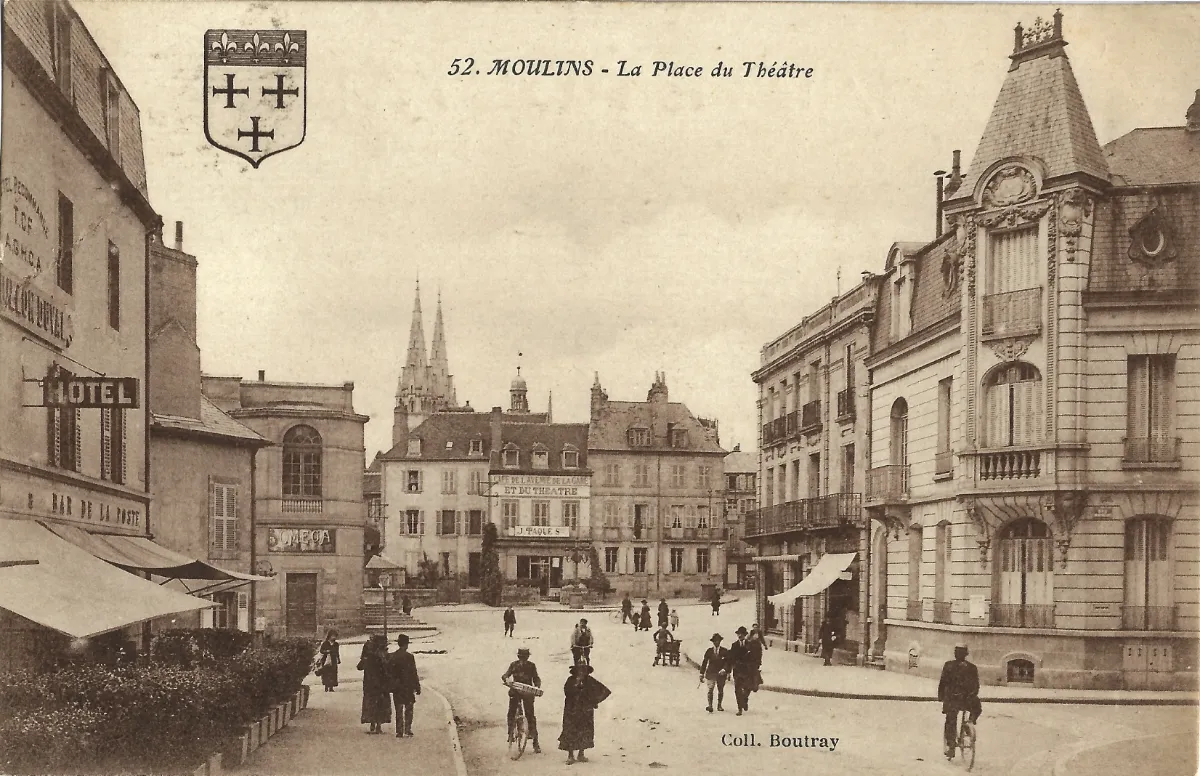
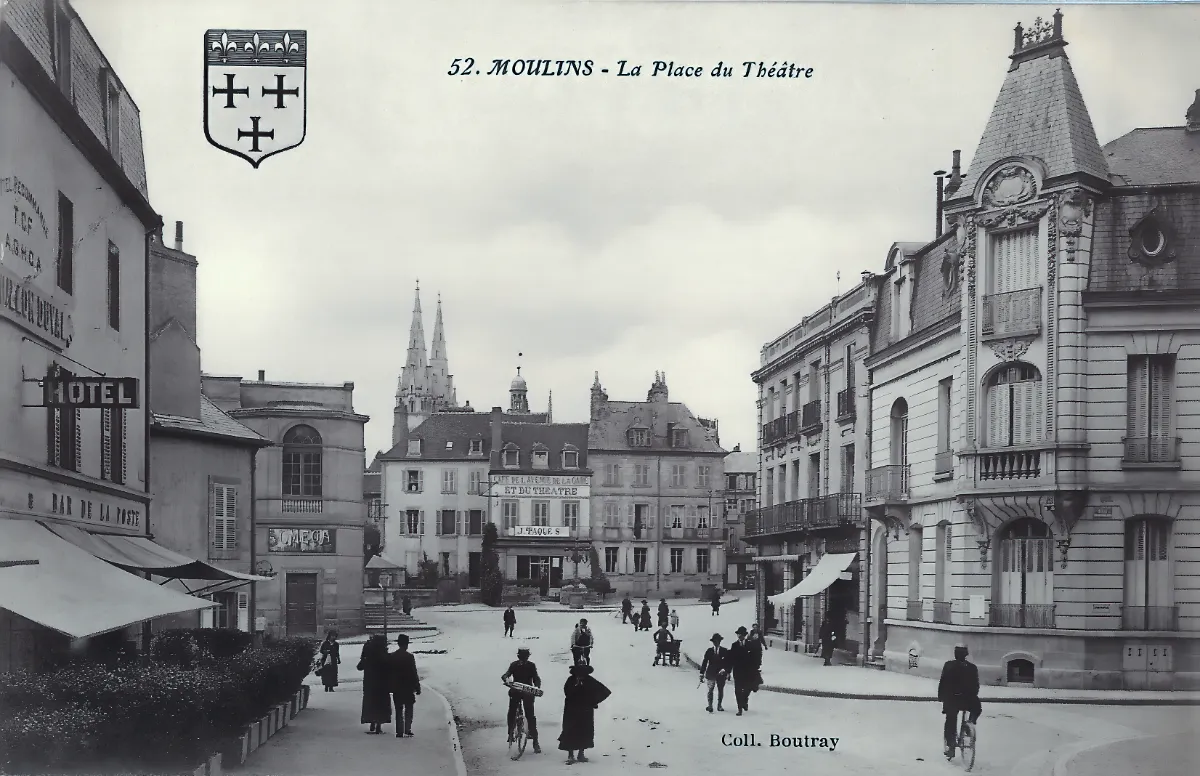
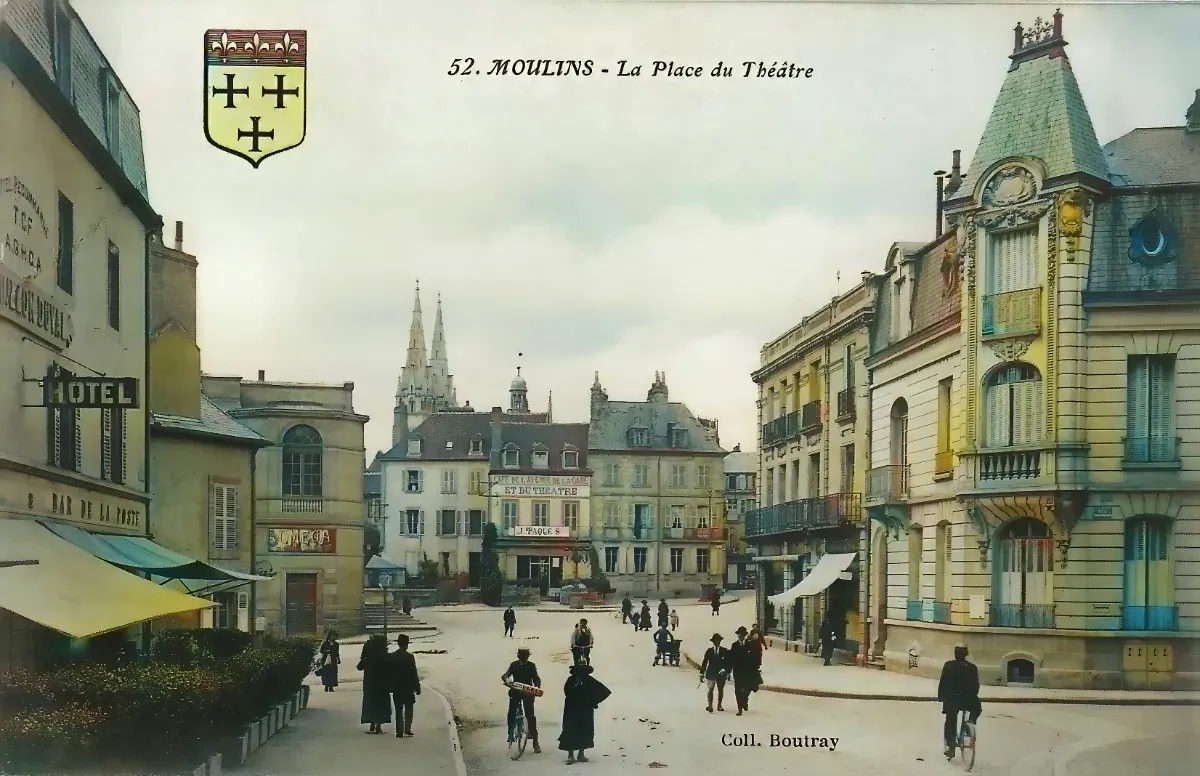
The Place du Théâtre in Moulins is shown on this vintage postcard as a lively urban space connecting the city’s broad avenues with its historic centre. The printed caption, “52. MOULINS – La Place du Théâtre,” identifies the location unambiguously. Moulins, the administrative capital of the Allier department and the historic capital of Bourbonnais, still has its municipal theatre near Cours Jean-Jaurès. The theatre was originally built at the end of the former Cours Bérulle, now known as Cours Jean-Jaurès.
The photographer is looking towards the square from a broad street. The roadway is still largely shared by pedestrians and cyclists rather than motor vehicles. Several bicycles can be seen in the foreground and farther across the square, while small groups of people walk freely in the street. The almost complete absence of motor traffic gives the scene a distinctly early-20th-century character.
On the left, the large sign “Hôtel de la Poste” is clearly legible. A series of awnings shelters the shopfronts or terraces below. Farther along, another building carries a conspicuous OMEGA advertisement, illustrating the increasingly visible role of commercial advertising in the urban landscape. A building facing the square also bears a large sign referring to the “Théâtre,” although the remaining wording is not sufficiently sharp to be transcribed with complete confidence.
The right side of the postcard is dominated by an imposing town house. Its elaborate façade combines dressed stone, a balustraded balcony, sculptural ornament, an arched window and a tall slate roof. The narrow projecting bay crowned by a curved pediment and steep roof creates a particularly striking silhouette. Its eclectic architecture is characteristic of the more decorative urban styles popular in France around the end of the 19th century.
Two tall Gothic Revival spires also rise above the rooftops in the distance. Their location suggests that they may belong to the Sacré-Cœur church of Moulins, one of the major vertical landmarks of the town, although the postcard alone does not allow this identification to be stated with absolute certainty. Sacré-Cœur is a 19th-century Gothic Revival church associated with architect Jean-Baptiste Lassus.
What makes this postcard particularly valuable is its portrayal of everyday urban life. Rather than isolating a single monument, the photographer recorded a complete streetscape: a hotel, cafés and shops, advertising signs, cyclists and pedestrians, together with the varied architecture surrounding the square. The Place du Théâtre therefore appears not merely as the setting for a cultural building but as an active crossroads within central Moulins.
Historical description
The postcard was probably produced before the First World War, most likely during the opening years of the 20th century. Without a dated postmark or information from the reverse, this must remain an approximate dating. Nevertheless, several visual clues support it: bicycles greatly outnumber other forms of traffic, motor cars appear to be absent, women’s skirts remain long, men commonly wear hats, and the photographic printing and layout are characteristic of early picture postcards.
The words “Coll. Boutray” appear at the bottom of the image. Boutray is associated with a number of other surviving postcards depicting Moulins, including views of the railway station and public buildings. This confirms that the card belongs to a wider series documenting the town, although the available sources do not establish an exact publication year for this particular view.
The theatre from which the square takes its name predates the postcard by more than half a century. Earlier theatrical performances in Moulins had taken place in the former Sainte-Claire church, but by the early 19th century that venue was considered both too small and increasingly unsafe. In 1839, the municipality organised a competition for a new theatre. The winning design was submitted by the Parisian architect Hippolyte Duran, and construction began in 1841. The new auditorium was intended to accommodate approximately 800 spectators on four levels.
Construction proved unusually difficult because the theatre stood on the site of the former Étang Bréchimbault, where the ground was marshy. Serious cracking appeared during the works in 1845, forcing part of the building to be demolished and rebuilt. The theatre finally opened in 1847. Architecturally, it belongs to the mid-19th-century neoclassical tradition, with growing Renaissance influences and the organisation of an Italian-style theatre.
By the time this postcard was photographed, the theatre had therefore been a fixture of cultural life in Moulins for several generations. The surrounding hotels, cafés and businesses underline the economic activity generated by such a central location. Travellers, theatre audiences, local residents and cyclists all met within the same urban space. Another surviving postcard is catalogued as showing “L’Avenue Nationale et la Place du Théâtre,” demonstrating how frequently this area was chosen by postcard photographers recording Moulins during the period.
The image consequently preserves much more than an architectural view. It records the rhythm of a provincial French town just before motor traffic transformed its streets: bicycles moving through an open roadway, pedestrians stopping in conversation, hotel awnings extending towards the pavement, advertising painted directly onto buildings, and an elaborate mixture of older houses and late-19th-century architecture. It is a particularly evocative record of everyday life around the Place du Théâtre in Moulins at the beginning of the 20th century.