Moulins – Avenue d’Orvilliers in the Early 20th Century
Geographic description
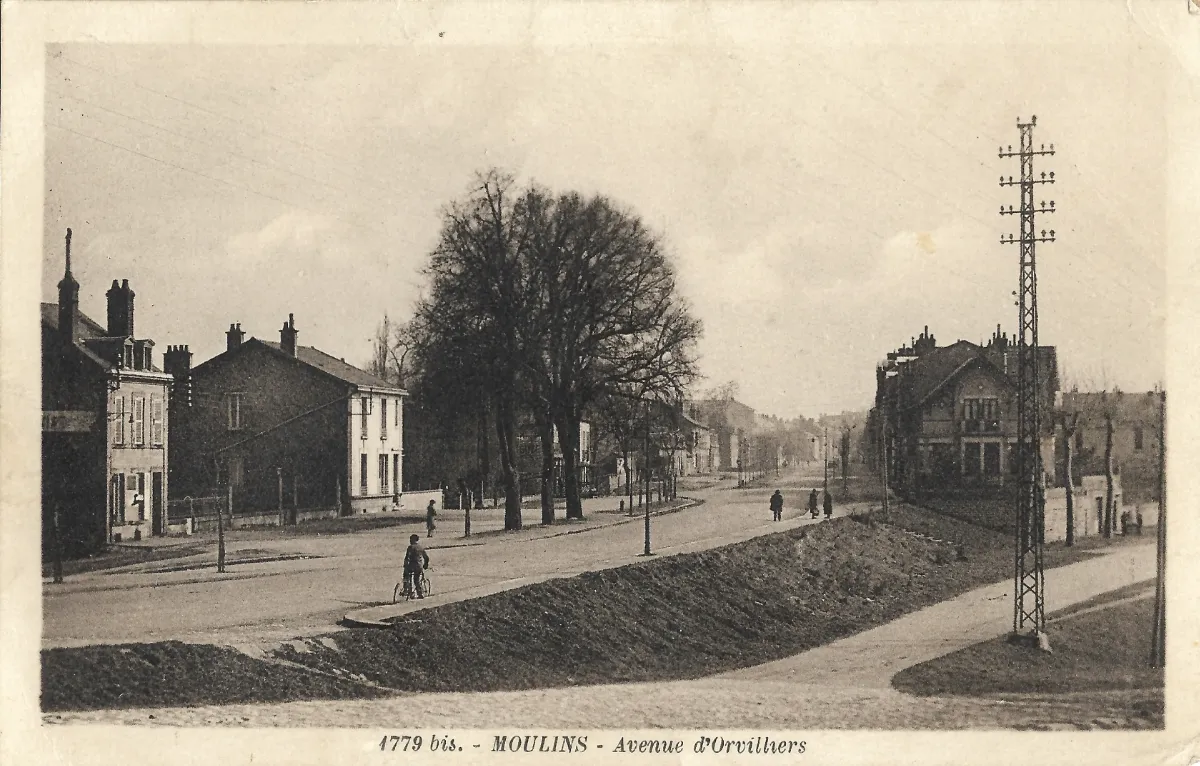
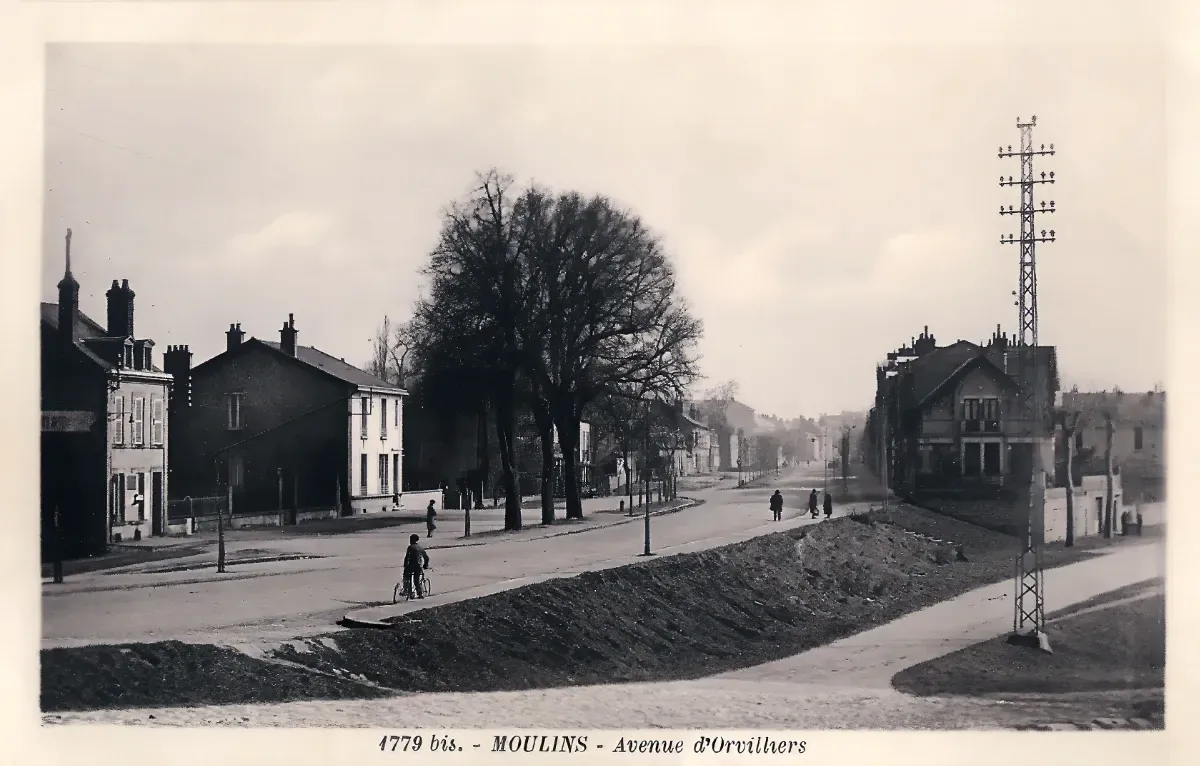
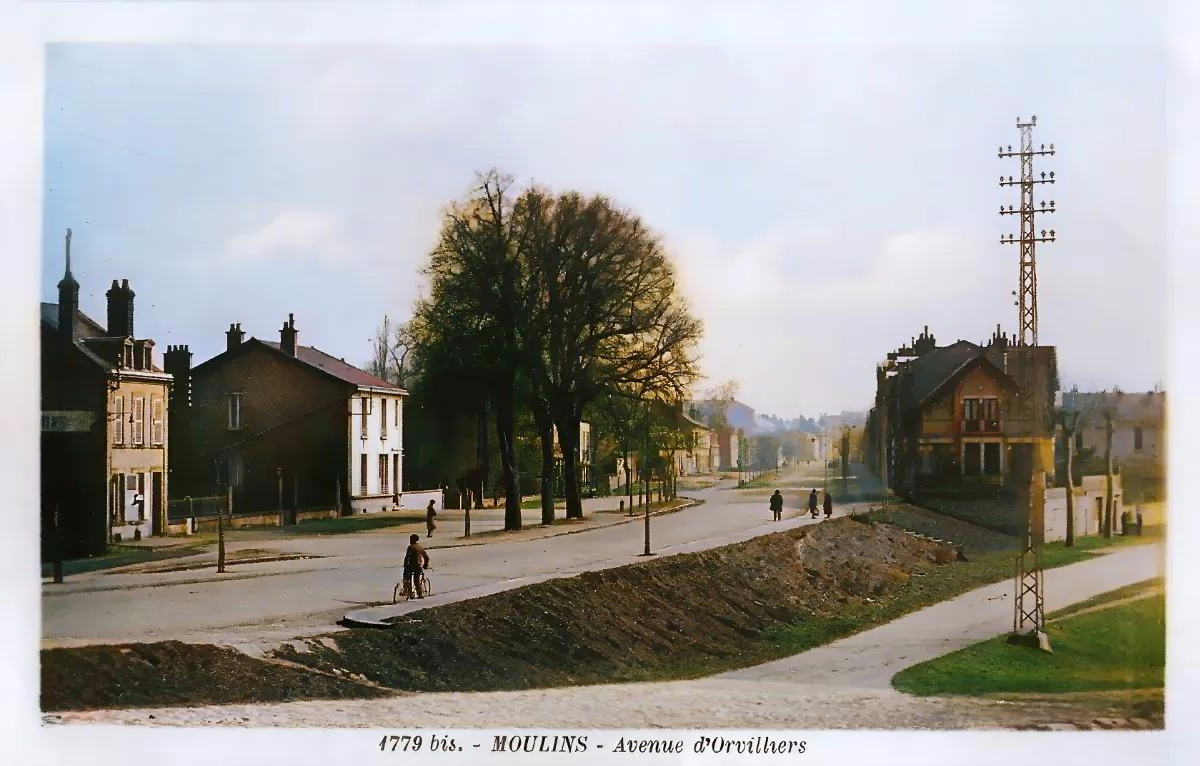
The Avenue d’Orvilliers in Moulins appears here as a broad residential thoroughfare in a relatively open district where the town was still developing beyond its older urban core. The printed caption at the bottom of the postcard clearly identifies the location as “MOULINS – Avenue d’Orvilliers”, preceded by the series number “1779 bis”.
Moulins, the prefecture of the Allier department and the historic capital of the Bourbonnais region, presents a very different appearance in this photograph from that of its better-known historic centre. The avenue has an airy, almost suburban character, with detached houses and small residential buildings lining both sides of the road. Several properties are separated from the street by small gardens, walls or fences.
The architecture is restrained and characteristic of the late 19th and early 20th centuries. Most buildings have one or two upper floors, with regularly arranged tall windows. Sloping roofs, numerous chimney stacks and occasional dormer windows reflect architectural forms commonly found in French provincial towns during this period.
One of the most striking features of the photograph is the amount of undeveloped or temporarily disturbed ground visible beside the avenue. A substantial earthwork dominates the foreground. It may relate to road construction, drainage or another form of public improvement, but its precise purpose cannot be established from the photograph alone. It is therefore best interpreted simply as evidence that development or public works were taking place when the photograph was made.
The roadway itself appears broad and remarkably quiet. A cyclist can be seen in the foreground and several pedestrians are scattered farther along the avenue. No motor vehicle can be identified with certainty. The limited traffic gives the scene a peaceful character and illustrates the relatively modest use of such urban roads before motorised transport became dominant.
Trees are an important part of the streetscape. A large mature tree near the centre of the image towers over the surrounding buildings, while other trees continue along the avenue. Their largely bare branches suggest that the photograph was probably taken during the colder months of the year.
The technical infrastructure is equally conspicuous. Several poles stand beside the road, while a tall lattice structure on the right carries numerous lines and insulators. Overhead cables cross the scene in several directions. They provide a visible reminder of the expansion of electrical, telephone and telegraph networks that was transforming French towns during this period.
The postcard consequently records more than a simple street view. It shows a district at a transitional stage, combining established residences, newly organised public space, mature vegetation and the increasingly visible infrastructure of a modern town.
Historical description
This postcard showing the Avenue d’Orvilliers in Moulins most probably dates from the first decades of the 20th century. A precise date cannot be established from the front of the card alone. However, the buildings, street furniture, extensive overhead wiring and apparently limited presence of motor traffic suggest a period roughly between the 1900s and the early 1920s.
The scene reflects an important stage in the development of many French towns: the expansion of residential districts beyond older historic centres. During the 19th and early 20th centuries, towns such as Moulins gradually extended along newly created or improved roads, where houses were constructed as urban populations and services expanded.
The avenue appears to belong to this type of transitional landscape. It is clearly already an organised urban street, yet development is not especially dense. Substantial houses stand alongside areas that remain relatively open. Such a pattern is characteristic of districts where building proceeded gradually along an established roadway rather than through the immediate creation of a continuous urban frontage.
The large area of disturbed earth in the foreground is particularly revealing. It indicates that public space was still being modified when the photograph was taken. The works may have concerned the roadway, pavements, drainage or another municipal installation. Without additional documentary evidence, however, their exact purpose remains uncertain.
The overhead networks provide another useful indication of the period. The lattice pole and the lines supported by numerous insulators belong to an urban environment increasingly shaped by electrification and telecommunications. During the early 20th century, electricity, telephone networks and improved public infrastructure became increasingly visible elements of everyday streetscapes.
Against this background of technological modernisation, everyday movement still appears remarkably simple. The cyclist in the foreground represents one of the most common forms of personal transport of the period. The scattered pedestrians and almost empty roadway create a striking contrast with the heavy motor traffic that would later characterise many urban avenues.
The buildings themselves also provide evidence of gradual urban expansion. Their conventional masonry construction, steep roofs and prominent chimney stacks belong to a domestic architectural tradition established during the 19th century and continuing into the early 20th century. Nothing in the photograph suggests a newly planned modernist district; instead, the avenue appears to have developed progressively as Moulins expanded.
The historical interest of this postcard therefore lies in its depiction of a town in transition. Avenue d’Orvilliers was already equipped with housing, trees, pedestrian areas and modern communications infrastructure, while major portions of its surroundings still retained an unfinished or developing appearance.
The photograph captures a moment when older patterns of everyday life coexisted with the technical innovations that would increasingly reshape French cities throughout the 20th century.