Moulins – The Girls’ Secondary School in the Early 20th Century
Geographic description
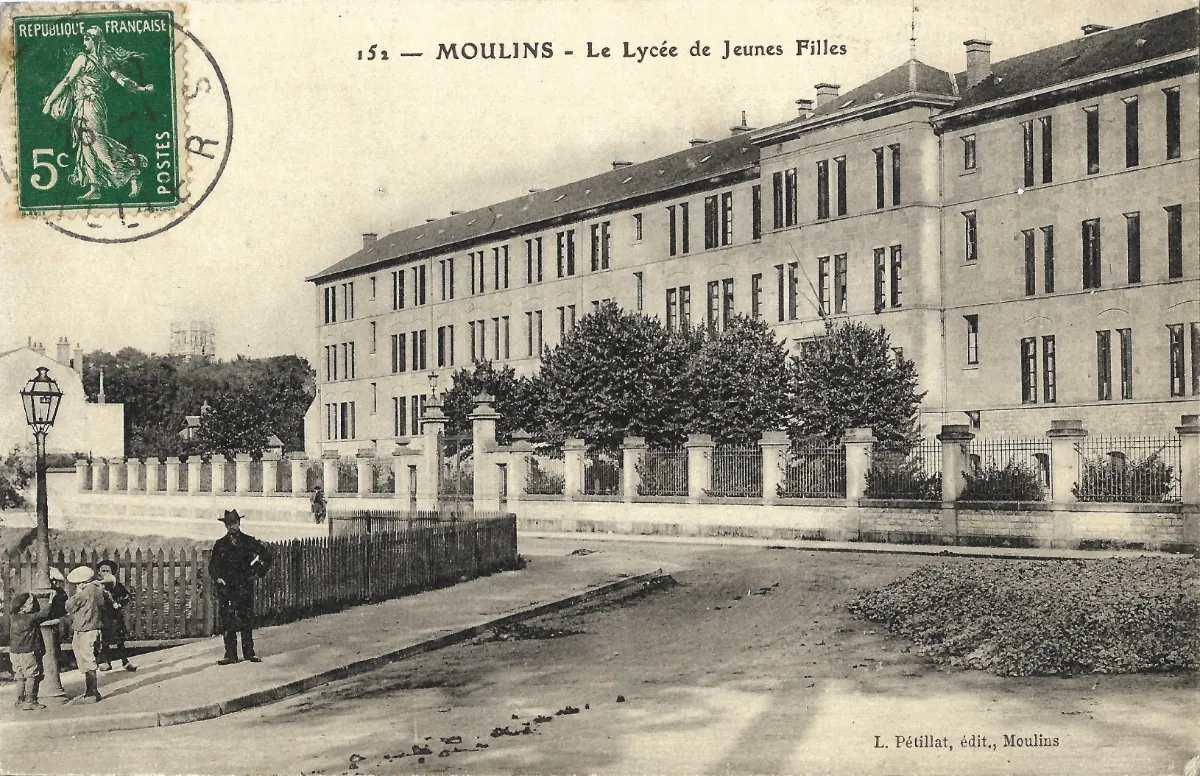
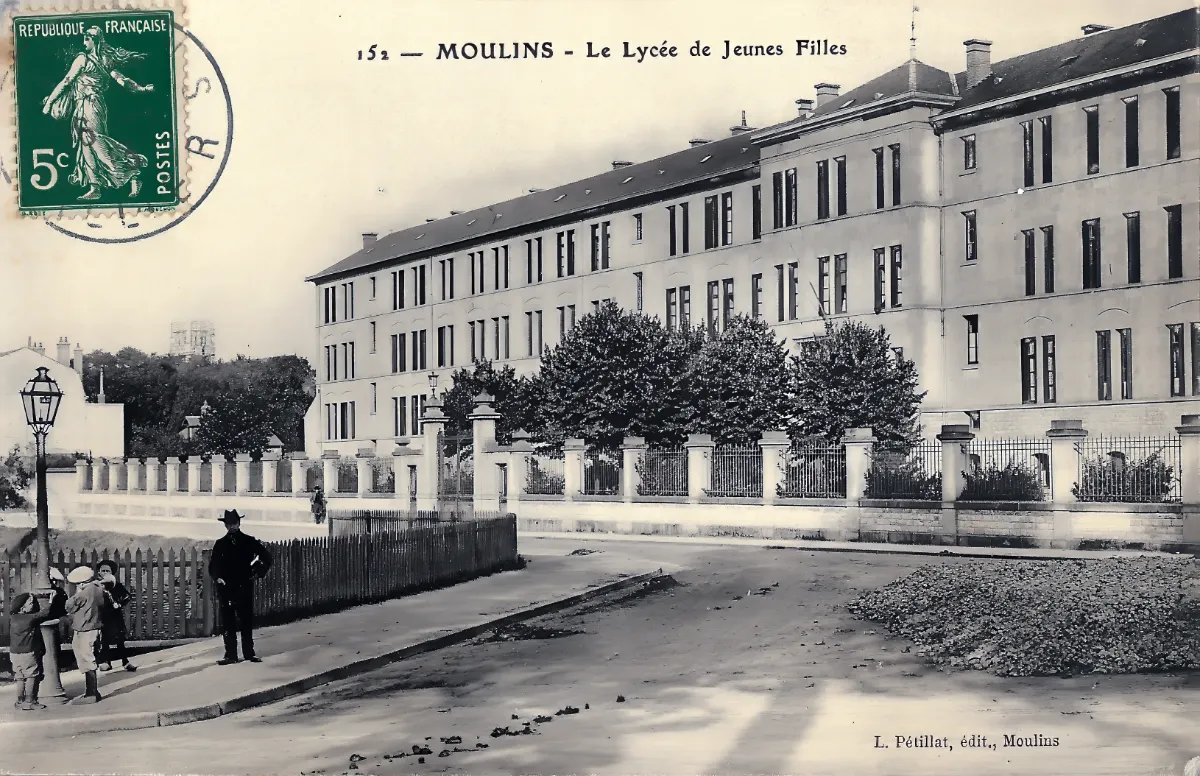
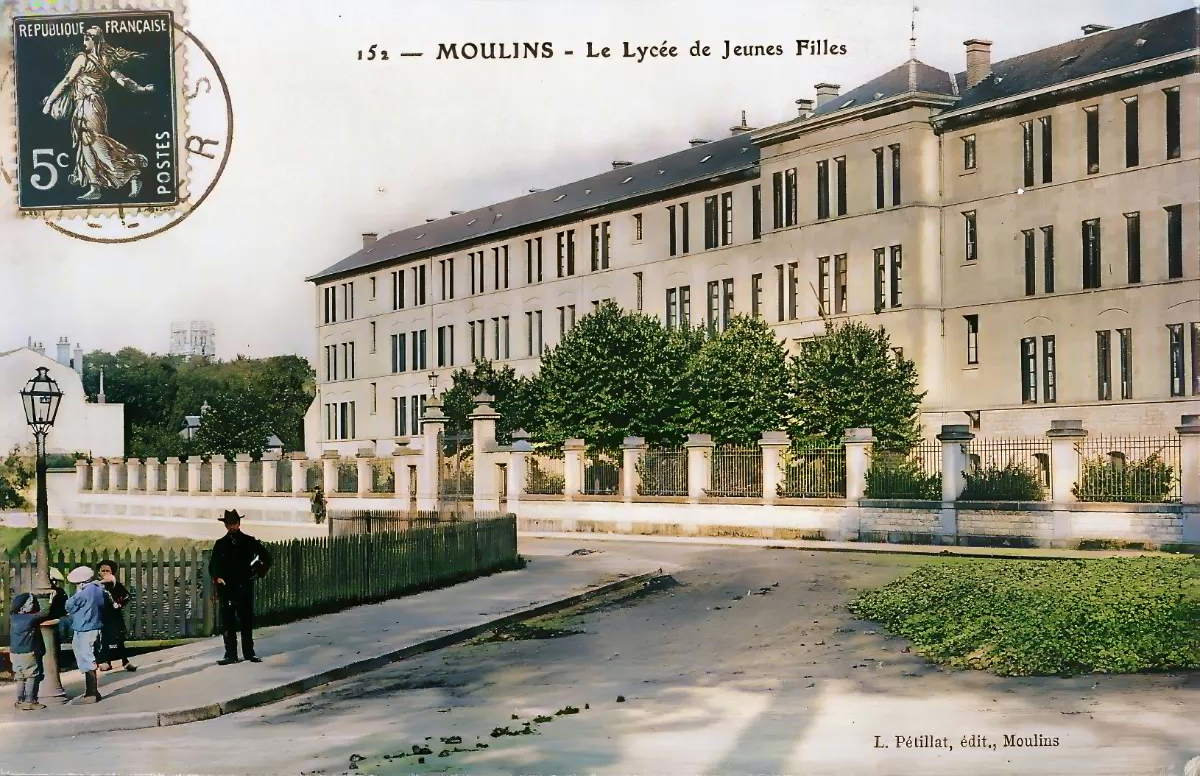
The Girls’ Secondary School in Moulins dominates this early postcard, occupying a large institutional building typical of French public architecture around the turn of the twentieth century. The printed caption identifies the subject clearly as “152 – Moulins – Le Lycée de Jeunes Filles.”
The school fills most of the right-hand side of the image. Its long façade extends across several storeys and is punctuated by numerous tall, regularly spaced windows. Decoration is restrained, with the impressive character of the building deriving mainly from its length, symmetry and carefully ordered elevations.
A slightly taller central section interrupts the otherwise continuous façade. Several connected wings or blocks appear to form the complete complex, reflecting the substantial amount of space required for classrooms and the other facilities of a secondary school.
Between the main building and the street is a planted area containing mature trees. A tall iron fence supported by masonry pillars separates the school grounds from the public roadway. This boundary gives the institution a formal appearance while creating a landscaped buffer between the building and the street.
The foreground is particularly revealing of the urban environment of Moulins at the time. The roadway appears relatively undeveloped when compared with a modern city street. Its uneven surface contrasts sharply with the ordered architecture of the school. On the right, piles of stones or other material may indicate roadworks or improvements taking place when the photograph was made, although their exact purpose cannot be determined from the image alone.
A traditional street lamp stands prominently on the left. Its design is characteristic of municipal street furniture associated with the period before electric lighting and modern street installations became universal.
Several people bring life to the scene. Children stand beside a low wooden fence in the foreground, while a man wearing dark clothing and a hat is positioned nearby. Another figure can be seen farther away beside the school enclosure. Their presence helps convey the scale of the building.
In the distance, beyond the lower houses and trees on the left, the upper portion of another substantial structure can be seen. The postcard does not provide enough detail to identify it confidently.
The scene therefore records more than the school itself. It preserves a section of Moulins at a moment when monumental public buildings stood beside streets that still retained a relatively simple and partly undeveloped appearance.
Historical description
The Girls’ Secondary School in Moulins belonged to an important phase in the development of public education in France. The Camille Sée law of 21 December 1880 established a national framework for public secondary education for girls. During the following decades, girls’ lycées and secondary schools appeared in many French towns and cities.
This represented a significant development under the Third Republic. Secondary education had previously been far more accessible to boys than to girls, and the creation of dedicated institutions marked an important expansion of educational opportunities for young women. Initially, however, the curriculum offered to girls remained different from that provided in boys’ lycées.
The scale of the Moulins building reflects the importance attached to the new educational institution. Its numerous windows, long façades and several connected sections suggest accommodation for a substantial number of pupils and school functions. As with many educational buildings from this period, the architecture emphasises order, daylight and a clear distinction between the school grounds and the surrounding city.
The tall fence visible across the front of the property reinforces this separation. Behind it, trees provide a landscaped area between the classrooms and the street. Their size suggests that the grounds had already been established for some time when the photograph was taken.
Several visual clues point towards an early twentieth-century date. The clothing of the people in the foreground, the absence of motor vehicles and the condition of the roadway are all compatible with this period.
The postage stamp provides another useful indication. A green 5-centime French Semeuse stamp has been attached to the upper left corner. This type belongs to the postal issues commonly used during the early decades of the twentieth century. The circular postmark extends across both the stamp and the postcard, but its date cannot be read reliably from the image.
Taking these elements together, the postcard can reasonably be placed in the early decades of the twentieth century, probably before or around the First World War. A more precise year cannot be established from the front of the card alone.
The lower-right corner carries the printed credit “L. Pétillat, édit., Moulins,” identifying a local publisher. The number “152” preceding the title shows that the postcard formed part of a numbered series, probably covering the streets, monuments and public institutions of Moulins.
The subject itself gives the card additional historical value. Rather than concentrating on a prestigious monument or picturesque tourist attraction, the photographer chose an institution devoted to female education. The postcard therefore documents both the appearance of Moulins and the broader transformation of French education during the Third Republic, when secondary schooling for girls became an increasingly visible part of urban and social life.