Blois — Rue Denis-Papin Seen from the Monumental Staircase
Geographic description
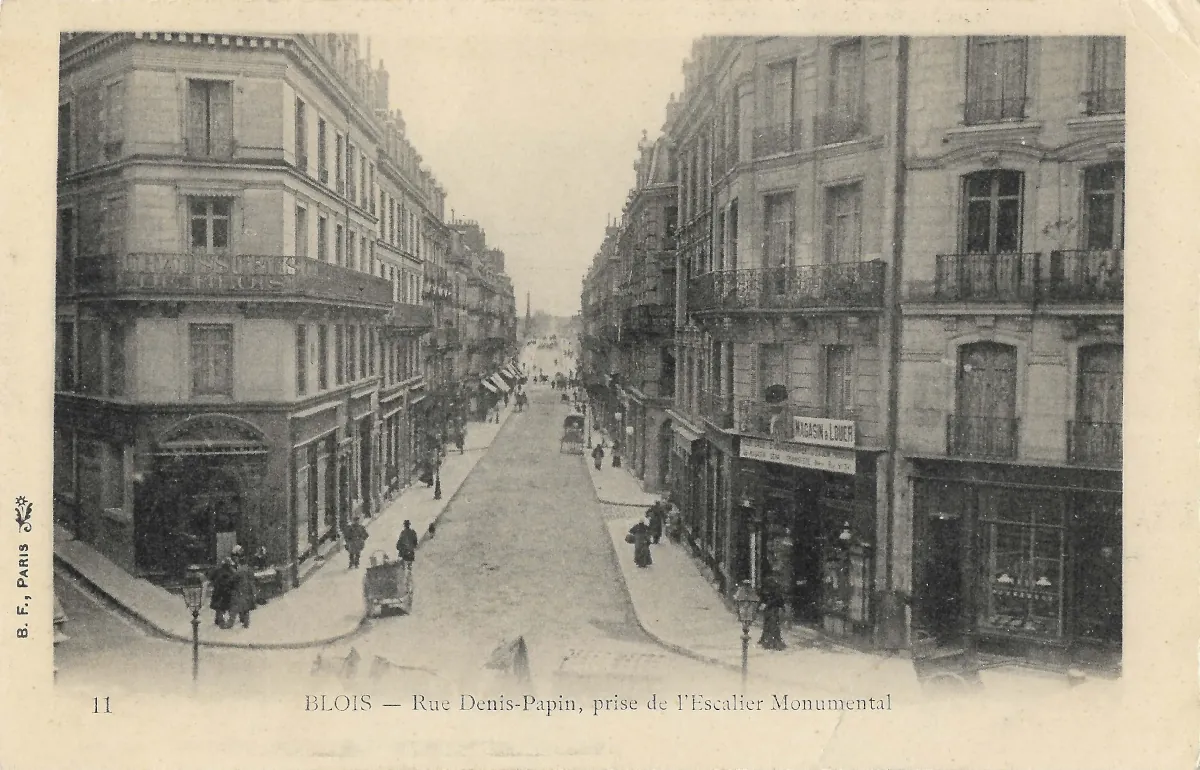
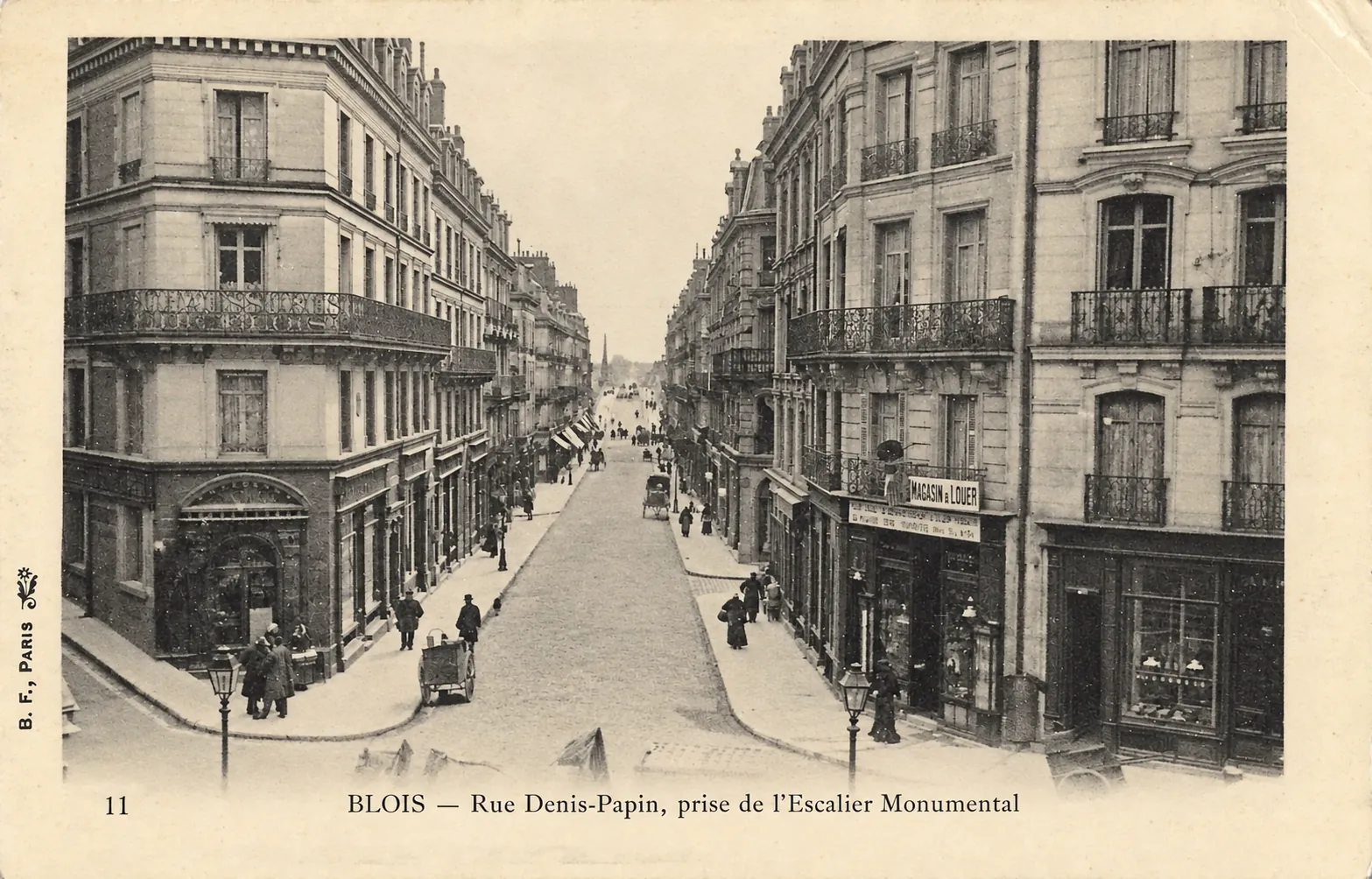
Rue Denis-Papin in Blois appears in this old postcard from an elevated viewpoint on the monumental staircase, with rows of buildings framing a long view down the street. The printed caption explicitly identifies both the location and the camera position: “BLOIS — Rue Denis-Papin, prise de l’Escalier Monumental”, meaning Rue Denis-Papin photographed from the monumental staircase. The identification is therefore supported directly by the postcard’s own inscription.
The street creates a strong central perspective between continuous lines of buildings. From the photographer’s raised position, the eye follows the roadway towards a brighter opening in the distance. Shopfronts, windows and balcony railings dominate the foreground, while pedestrians become progressively smaller further along the street. The distant background is too indistinct to identify individual structures or landscape features with confidence.
Two substantial corner buildings frame the scene. On the left, horizontal bands divide the façade, regularly spaced windows give it a measured rhythm, and a balcony extends around the corner. A commercial frontage occupies the ground floor. On the right, more elaborate window surrounds and long stretches of decorative balcony railings give the building a different character. Despite these variations, the repeated windows and uninterrupted building lines create a coherent streetscape.
Shops play a prominent part in the photograph. Large display windows open onto the pavements, and several projecting awnings can be seen further down the left-hand side. A sign above the shop on the right is visible, although the lettering cannot be read reliably enough to establish the business’s full name. The image nevertheless clearly shows a street combining commerce at ground level with upper floors probably used, at least partly, as residential accommodation.
Pedestrians occupy both sides of the street. Some appear to pause near the shopfronts, while others walk along the façades. Street lamps stand near the corners in the foreground, helping to define the junction at the foot of the viewpoint. Several vehicles or small carts are visible on the roadway, although their exact forms are not always clear enough for a firm identification.
The interest of the composition lies in the relationship between its elevated viewpoint and its everyday subject. Rather than presenting the staircase as a monument, the photograph uses it as a platform from which to observe shops, pedestrians and the arrangement of the surrounding streets.
Historical description
The postcard probably shows Rue Denis-Papin in the early twentieth century. An approximate date of around 1900–1914 is consistent with the clothing, the visible vehicle silhouettes and the overall presentation of the card. This remains a visual estimate, however: no printed year or postal information establishes a precise date for the photograph or this particular printing.
Several figures appear in long garments, while hats and dark clothing are visible among others. These details support the suggested period but cannot provide a narrow chronology. The people are too small for a dependable study of particular fashions. Similarly, the lack of an unmistakable motor car should not be treated as decisive evidence, since the photograph records only one moment in the street’s daily activity.
The commercial setting provides a more secure basis for interpretation. Display windows, awnings and pedestrians show a street closely connected with shopping and local movement. The pavements serve both as routes along the buildings and as places to stop outside businesses. The photograph consequently preserves evidence of everyday urban life as well as the architectural appearance of the street.
The camera position is an important part of that documentary value. By working from the monumental staircase, the photographer could look over nearby pedestrians and show the street’s layout in considerable depth. The staircase remains almost entirely outside the frame. Its role is practical and compositional: it makes the view possible without becoming the main subject.
The number 11 is printed in the lower-left margin. The vertical wording “B. F., PARIS”, together with a small decorative emblem, appears along the left edge. These are useful details of the postcard’s printed presentation, but they do not independently establish the publisher’s full identity or the date of this edition.
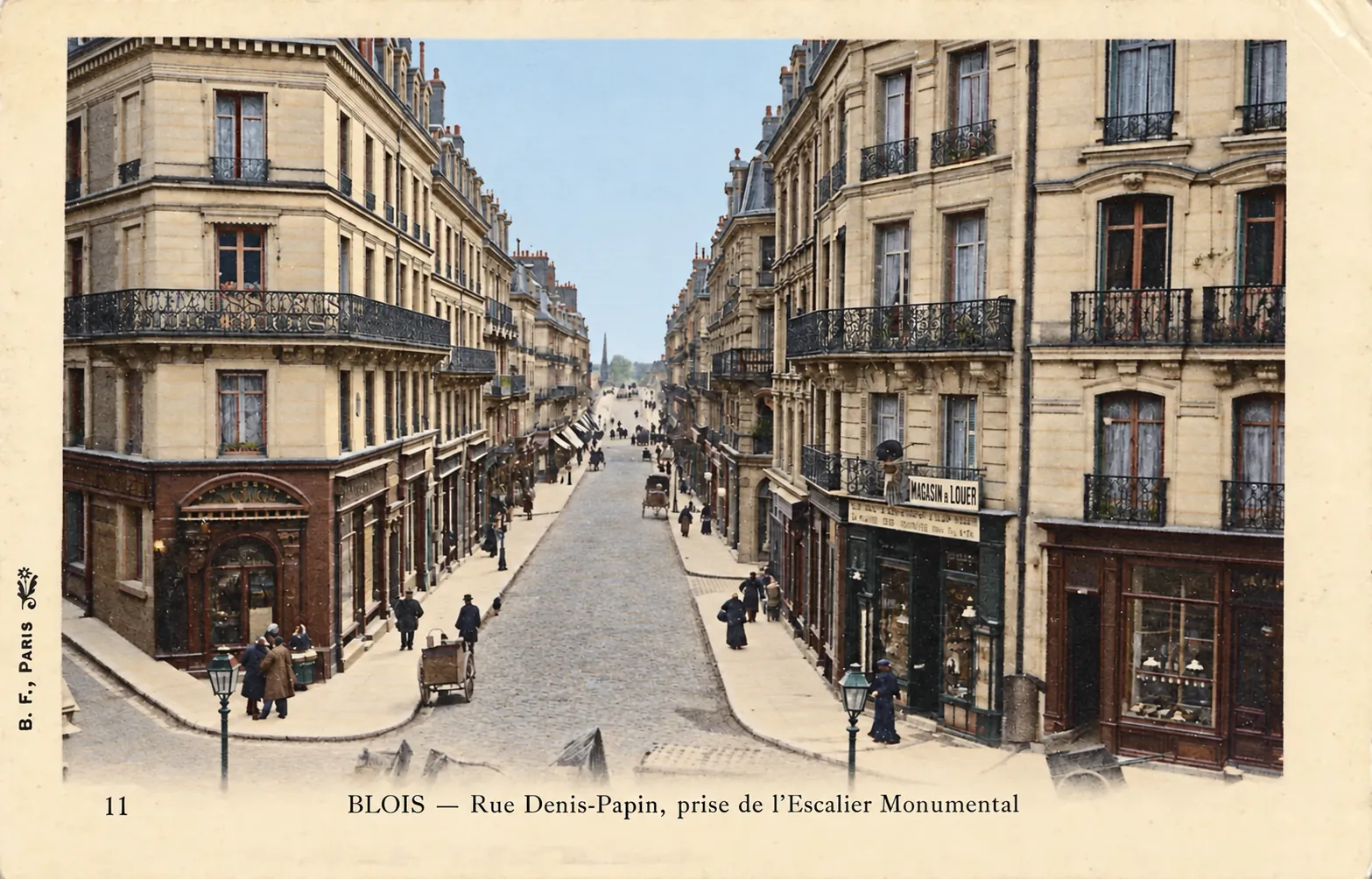
Finally, the cream-coloured paper and visible surface marks belong to the surviving object. They contribute to its present appearance but should not be read as evidence of the original colours of the buildings or street. The scene itself is reproduced in monochrome.