Blois – Royal Castle, Louis XII Wing and Main Gateway
Geographic description
The Louis XII wing of Blois Castle features one of the most remarkable historic gateways in the Loire Valley. Located in the heart of Blois, in the Loir-et-Cher department of central France, this monumental entrance forms part of the former royal residence overlooking the town.
Facing the Place du Château, the façade is an outstanding example of French Flamboyant Gothic architecture, a highly decorative style that flourished during the late fifteenth and early sixteenth centuries. It belongs to the wing commissioned by King Louis XII, who established Blois as one of the principal residences of the French monarchy.
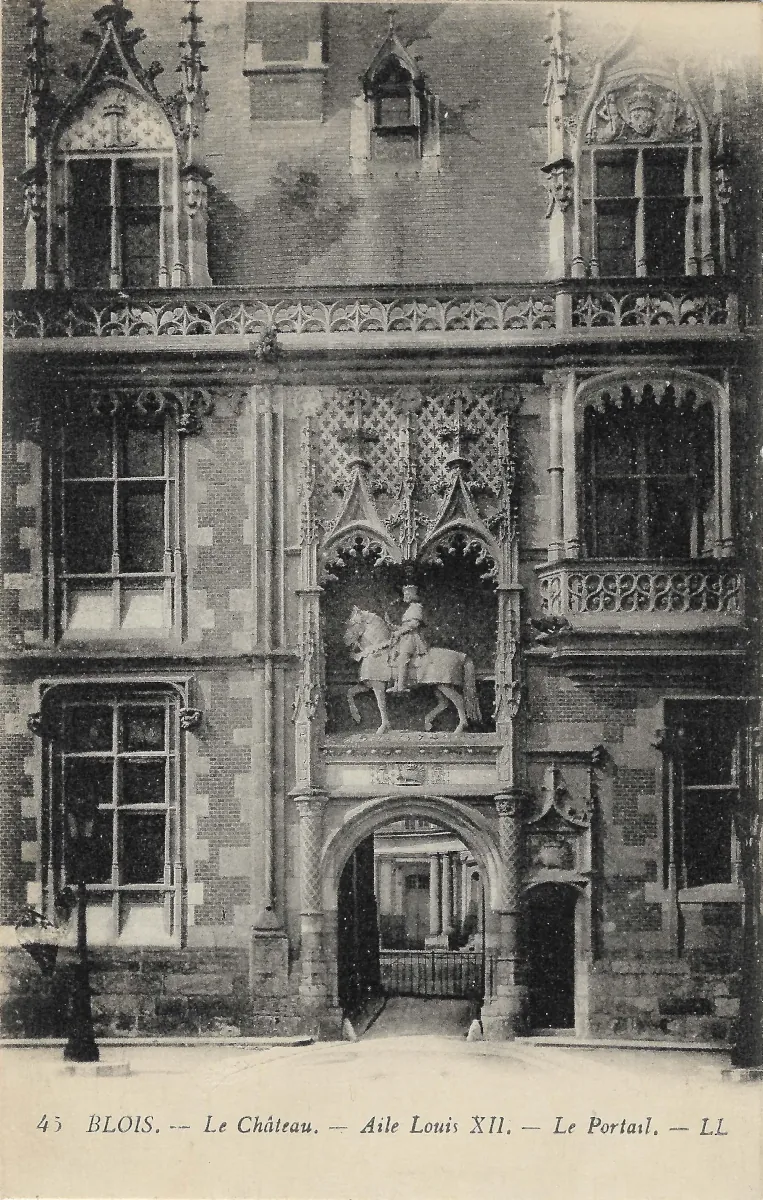
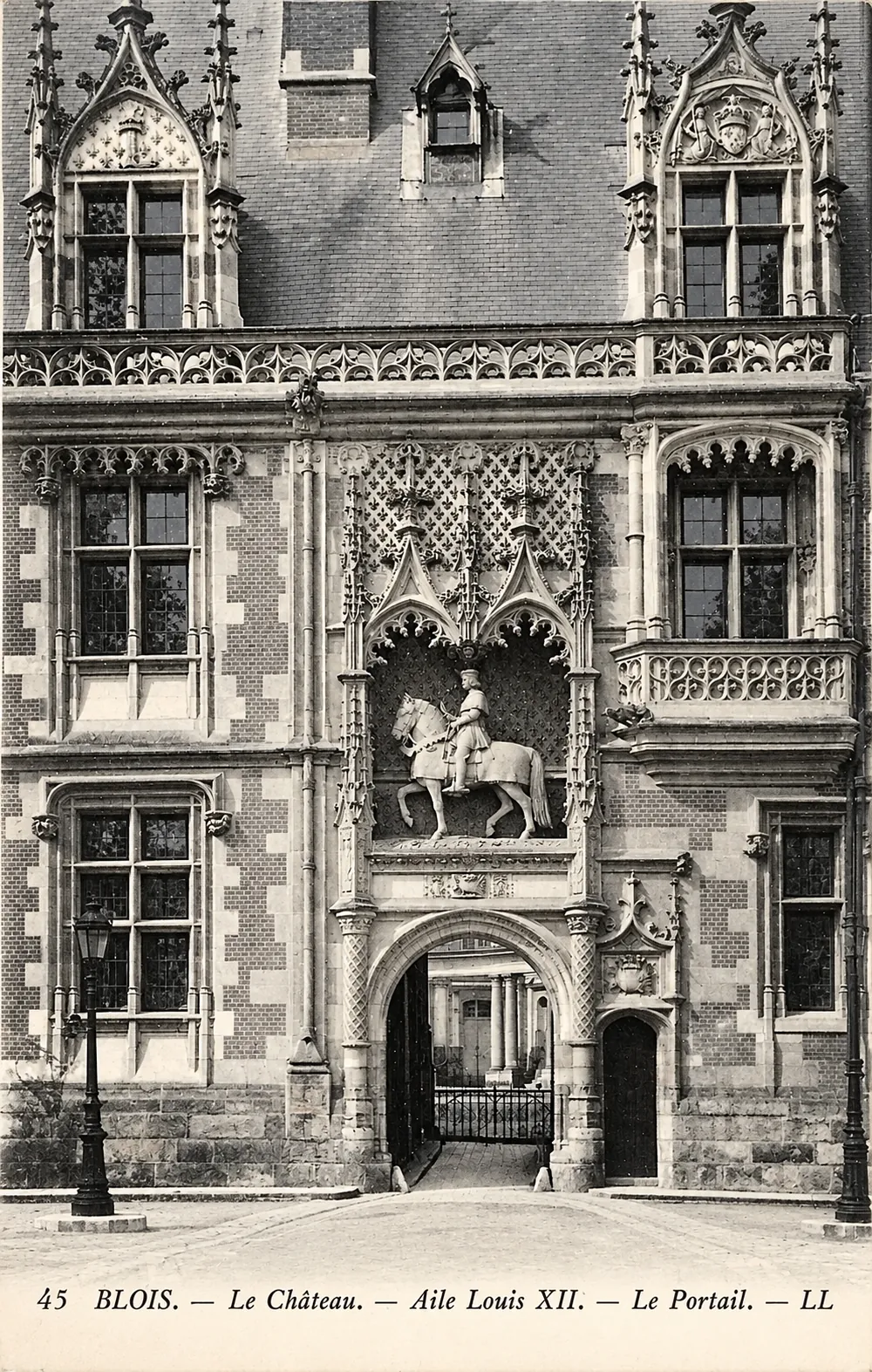
This vintage postcard provides a detailed frontal view of the main gateway, revealing the extraordinary craftsmanship of its sculpted stonework.
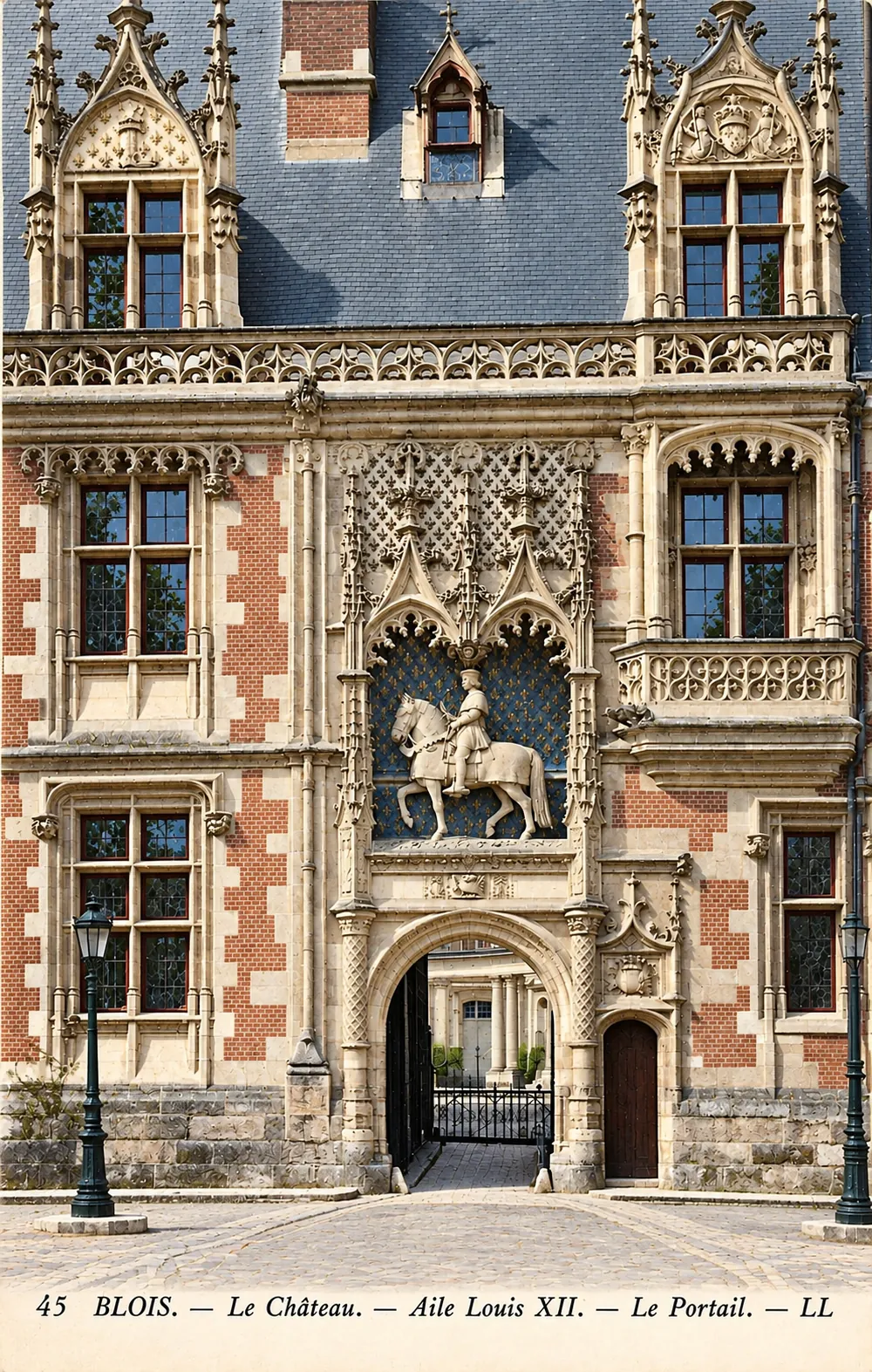
At the centre of the composition stands an elaborate architectural niche containing an equestrian statue of King Louis XII. The monarch is depicted on horseback, positioned directly above the large arched entrance leading into the castle’s inner courtyard.
The statue is framed by intricate Gothic ornamentation, including pointed arches, soaring pinnacles, delicate tracery and decorative elements typical of the Flamboyant Gothic tradition. These architectural features create an impressive ceremonial setting for the royal figure.
The façade combines red brick and pale limestone, materials whose contrasting colours give the Louis XII wing its distinctive appearance. Although the postcard is printed in black and white, the differences in texture and shading remain visible.
On either side of the entrance, tall mullioned windows illuminate the rooms within the castle. Several windows are crowned by ornate Gothic gables, while a continuous openwork stone balustrade extends horizontally across the upper façade.
The right-hand section features a recessed opening accompanied by a small stone balcony decorated with elaborate Gothic patterns. A narrower doorway, also visible to the right of the main entrance, forms part of the gateway’s architectural arrangement.
Through the central arch, an iron gate and portions of the buildings beyond the passage can be distinguished, offering a glimpse towards the interior courtyard.
The photograph concentrates almost entirely on the architecture. With no crowds or vehicles obscuring the view, the details of the stone carving, window frames and ornamental structures can be appreciated.
Blois Castle occupies a commanding position above the historic centre of Blois, on the right bank of the Loire River. Its elevated setting reflects the strategic and political importance of the site throughout French history.
Today, the Royal Château of Blois remains one of the Loire Valley’s major historic monuments, celebrated for the architectural diversity of its buildings and its close association with the kings and queens of France.
Historical description
The Louis XII wing of the Royal Château of Blois was constructed primarily between 1498 and 1503, during the opening years of the reign of King Louis XII, who ascended the French throne in 1498 following the death of Charles VIII.
This major building campaign transformed the medieval castle into a more comfortable and prestigious royal residence, designed to accommodate the needs of the French court.
Louis XII was born in Blois in 1462 and maintained a particularly strong connection with the castle. His marriage to Anne of Brittany in 1499 further reinforced the political importance of the royal court established there.
Architecturally, the Louis XII wing represents a transitional period in French history. Its design remains deeply rooted in the Flamboyant Gothic tradition while anticipating the artistic and architectural changes that would accompany the arrival of the Italian Renaissance in France.
The building combines richly decorated medieval forms with a growing emphasis on regularity, elegance and residential comfort. These characteristics reflect the changing expectations of royal architecture at the beginning of the sixteenth century.
The gateway illustrated on this postcard is among the most recognisable features of the Louis XII wing.
Above the main entrance, the equestrian representation of the king served as a powerful symbol of royal authority. Its prominent position ensured that the sovereign’s image dominated the ceremonial approach to the residence.
However, the statue visible today is not the original sculpture dating from the early sixteenth century. The original was destroyed during the French Revolution and subsequently replaced in the nineteenth century.
A new equestrian statue was installed in 1857 as part of the restoration of the castle. The sculpture depicted on this postcard therefore belongs to that nineteenth-century restoration, although it preserves the symbolic position of the earlier royal monument.
Following the reign of Louis XII, the castle underwent several major transformations.
King Francis I commissioned a new wing during the sixteenth century, incorporating architectural features inspired by the Italian Renaissance. Its celebrated monumental staircase became one of the most distinctive elements of the castle.
During the seventeenth century, Gaston, Duke of Orléans, initiated another ambitious building project, resulting in a Classical-style wing that was never fully completed according to its original plans.
The Château of Blois consequently brings together several important periods of French architectural history, from its medieval origins to the Gothic, Renaissance and Classical developments of later centuries.
During the nineteenth century, growing interest in France’s architectural heritage encouraged extensive conservation and restoration work. The architect Félix Duban played a central role in restoring the château and preserving its historic character.
The postcard bears the printed caption: “45 BLOIS. – Le Château. – Aile Louis XII. – Le Portail. – LL.”
The number 45 most likely identifies the card within a publisher’s numbered series. The initials “LL” appear at the end of the caption, although this inscription alone does not establish the publisher’s identity with complete certainty.
The monochrome photographic reproduction, decorative typography and conventional caption layout suggest that the postcard was probably published during the early twentieth century. An exact publication date cannot be determined from the front of the card alone.
Such postcards were widely circulated during a period when photography and the expanding tourist industry helped popularise France’s historic monuments.
By presenting a close architectural view rather than a general panorama of the castle, this image emphasises the craftsmanship and symbolic importance of the royal entrance.
It remains a valuable visual record of one of the most celebrated examples of late Gothic royal architecture in France, preserving the appearance of a façade whose essential features are still recognisable today.