Blois – Italian Renaissance Doorway at the Royal Château
Geographic description
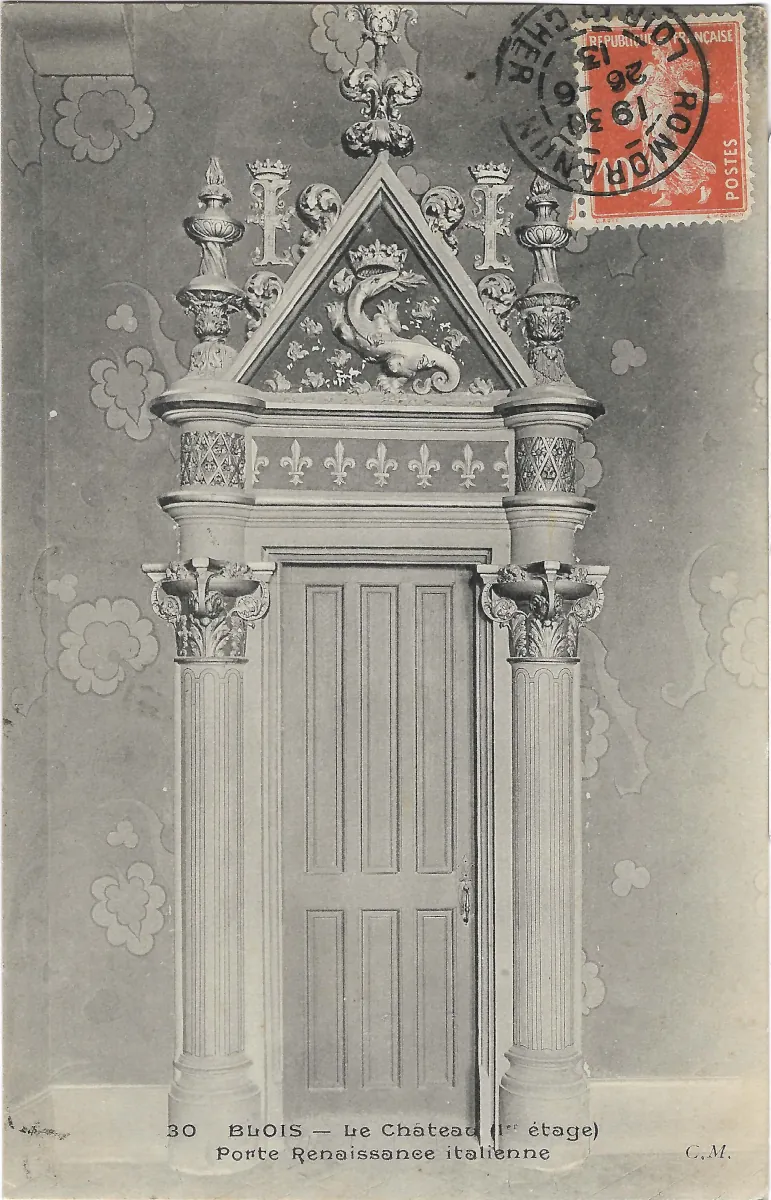
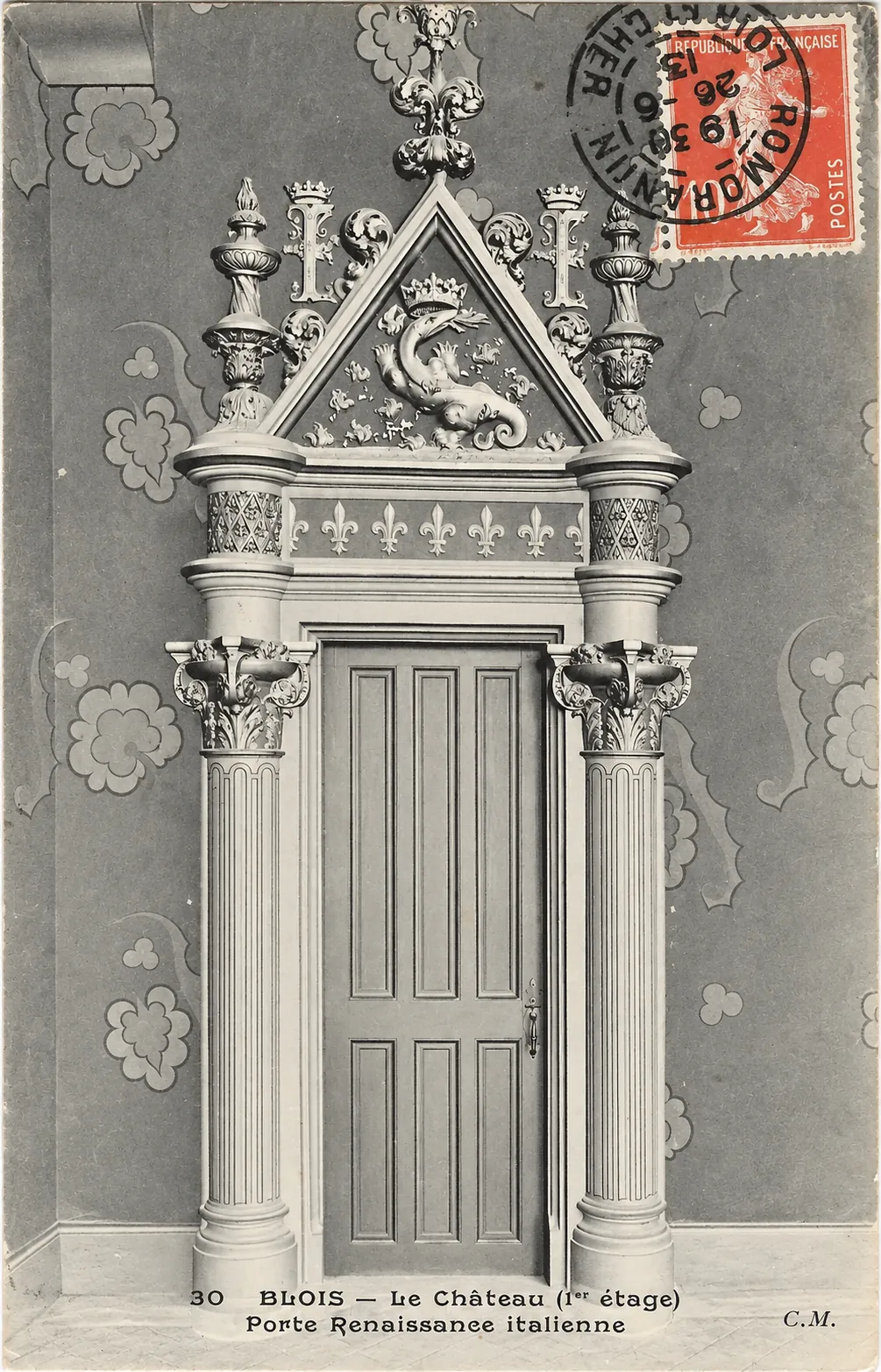
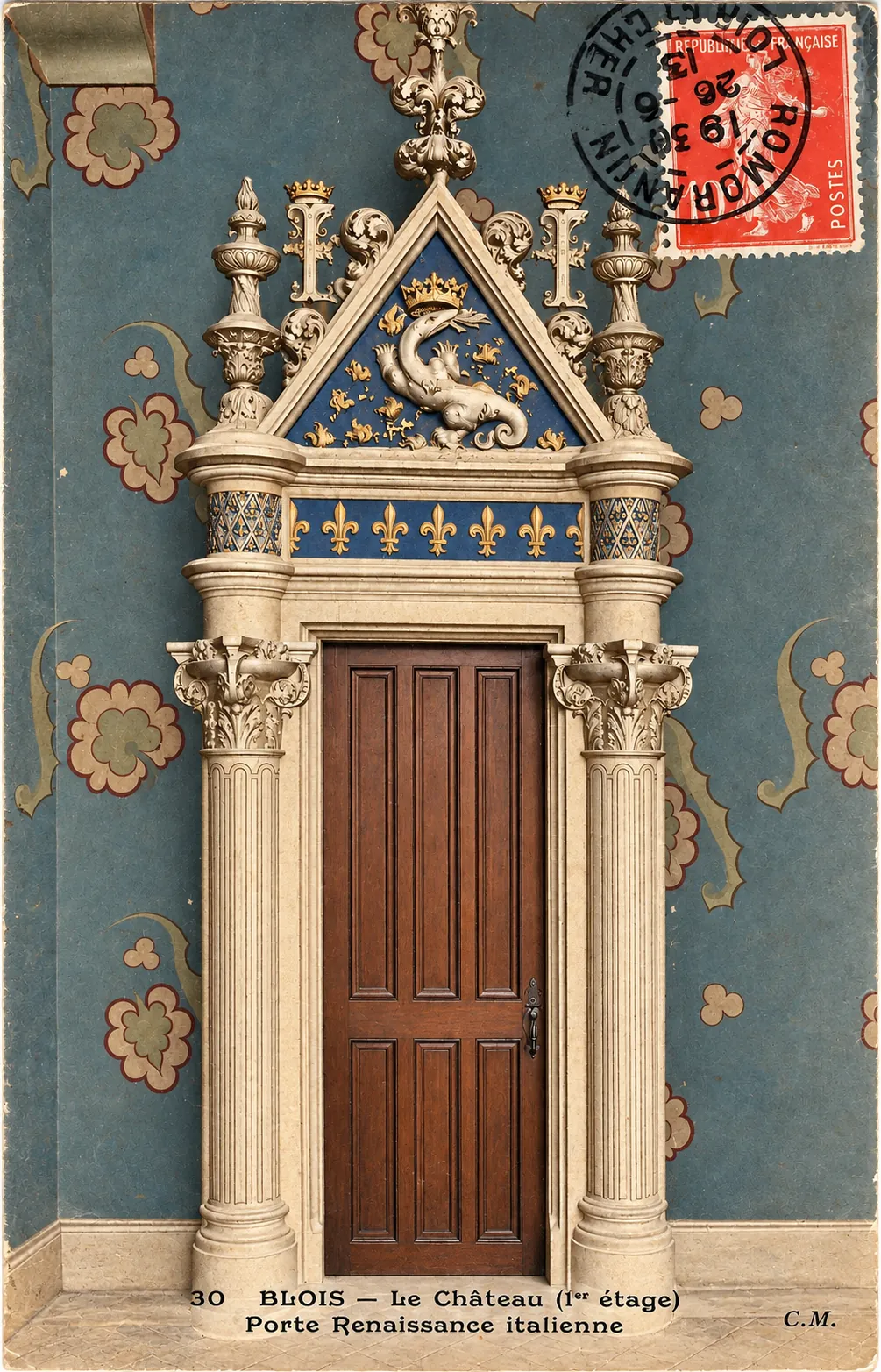
The Italian Renaissance doorway at Château de Blois is the central subject of this vintage postcard, which focuses on one of the richly decorated interiors of the former royal residence. The printed caption identifies the view as “Blois – Le Château (1er étage) – Porte Renaissance italienne,” placing the doorway on the first floor of the Château Royal de Blois in the Loir-et-Cher department of central France.
The photographer deliberately framed the doorway head-on, turning this architectural feature into a portrait of Renaissance decoration. Two tall fluted columns stand on either side of the wooden door. Their elaborate capitals are covered with vegetal ornament, while the structure above the doorway develops into a much richer composition of mouldings, smaller columns, carved decoration and a triangular pediment.
The royal symbolism is especially striking. A row of fleurs-de-lis runs across the horizontal frieze, while several large crowned letters “F” appear higher in the composition. At the centre of the triangular pediment is a crowned salamander surrounded by flame-like ornament.
These symbols closely connect the decoration with Francis I of France. The salamander was his best-known personal emblem and can still be seen throughout the Château de Blois. The crowned initial “F” provides another unmistakable reference to the king.
Architecturally, the doorway combines French royal imagery with decorative forms inspired by the Italian Renaissance. Classical columns, highly ornamental capitals and a carefully ordered architectural composition coexist with heraldic and dynastic symbols. This mixture is characteristic of the transformation of French architecture in the early sixteenth century, when Italian Renaissance ideas were increasingly adapted to French royal residences.
Behind the doorway, the wall is covered by a large repeating floral pattern, creating an exceptionally decorative interior setting. This appearance must also be considered in relation to the major nineteenth-century restoration of the château. Many of its interiors were restored, reconstructed or redecorated during that period, shaping the appearance subsequently encountered by visitors and photographed for postcards such as this one.
The postcard bears the number 80 at lower left. The initials C.M. appear at lower right and probably identify the publisher or photographic series, although the exact company cannot be securely determined from the front of the card alone.
Historical description
The doorway belongs to the artistic world of the French Renaissance and to the period in which Francis I transformed the Château de Blois into one of the most important royal residences of his reign. After becoming king in 1515, Francis commissioned a major new section of the château, now known as the Francis I wing. Its principal construction campaign took place during the first decades of the sixteenth century.
Italian Renaissance influence had become increasingly important at the French court following the Italian Wars. French rulers, nobles and artists encountered new architectural principles, decorative motifs and classical forms in Italy. These ideas were subsequently adapted rather than simply copied, producing a distinctive French Renaissance style.
The doorway shown on the postcard is an excellent expression of this process. Classical architectural forms are combined with the traditional fleur-de-lis of the French monarchy and the personal emblems of Francis I.
The crowned salamander dominating the pediment is particularly significant. Traditionally associated with the ability to survive fire, the salamander became Francis I’s personal emblem and was frequently represented among flames. Its presence turned architectural decoration into a statement of royal identity.
The repeated crowned letter “F” reinforces that message. Such imagery ensured that rooms within a royal residence did more than display fashionable decoration: they continually reminded visitors of the monarch for whom the building had been constructed or embellished.
The interior seen on this postcard also reflects a later chapter in the château’s history. During the nineteenth century, the building underwent extensive restoration, particularly under architect Félix Duban, whose work began in the 1840s. Architectural elements and interior decoration were restored or recreated as part of a broader effort to preserve the château and present its Renaissance character. The postcard therefore records not simply an untouched sixteenth-century interior, but an early twentieth-century view of a historic setting already shaped by nineteenth-century restoration.
A further chronological clue is provided by the postal cancellation visible at the upper right. The date appears to read 19 March 1926, demonstrating that this particular postcard was already in circulation by the mid-1920s.
The choice of an individual doorway rather than a general exterior view is also typical of historic postcard publishing. Publishers frequently produced numbered series devoted to major monuments, including close views of sculptures, staircases, fireplaces, façades and architectural details. The number 80 printed on this card suggests that it formed part of such a broader photographic collection.
Today, the image remains valuable both as a record of the presentation of the Château de Blois in the early twentieth century and as a detailed study of the royal imagery associated with Francis I and the development of the French Renaissance.