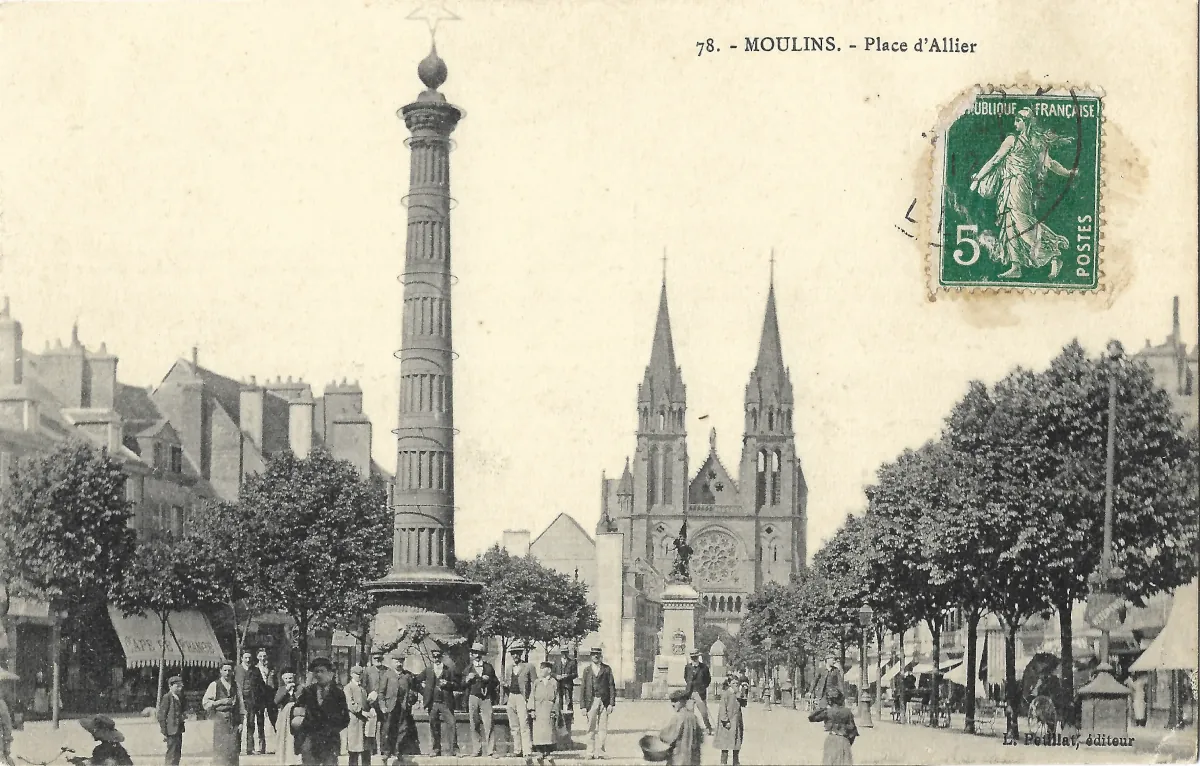
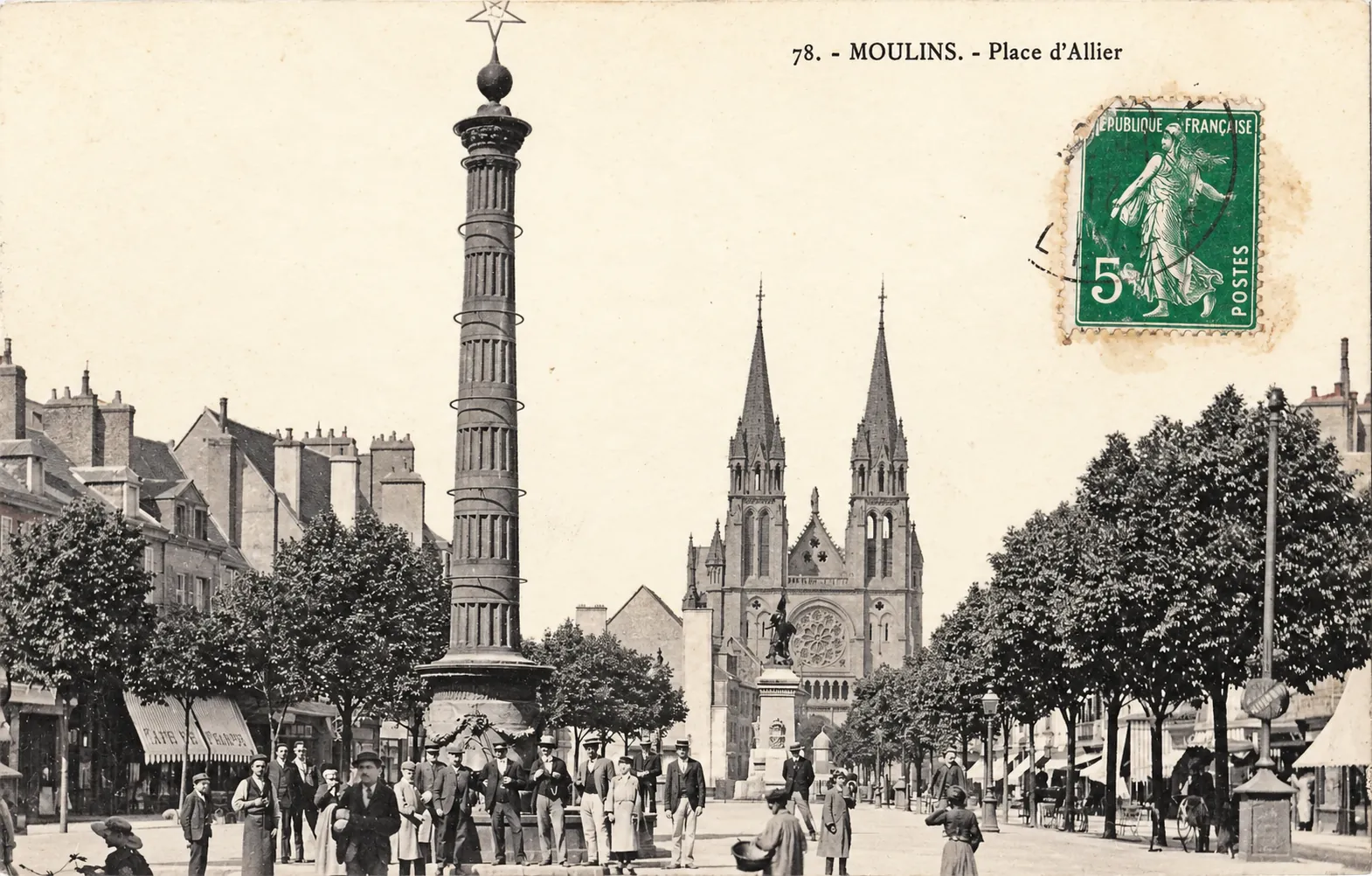
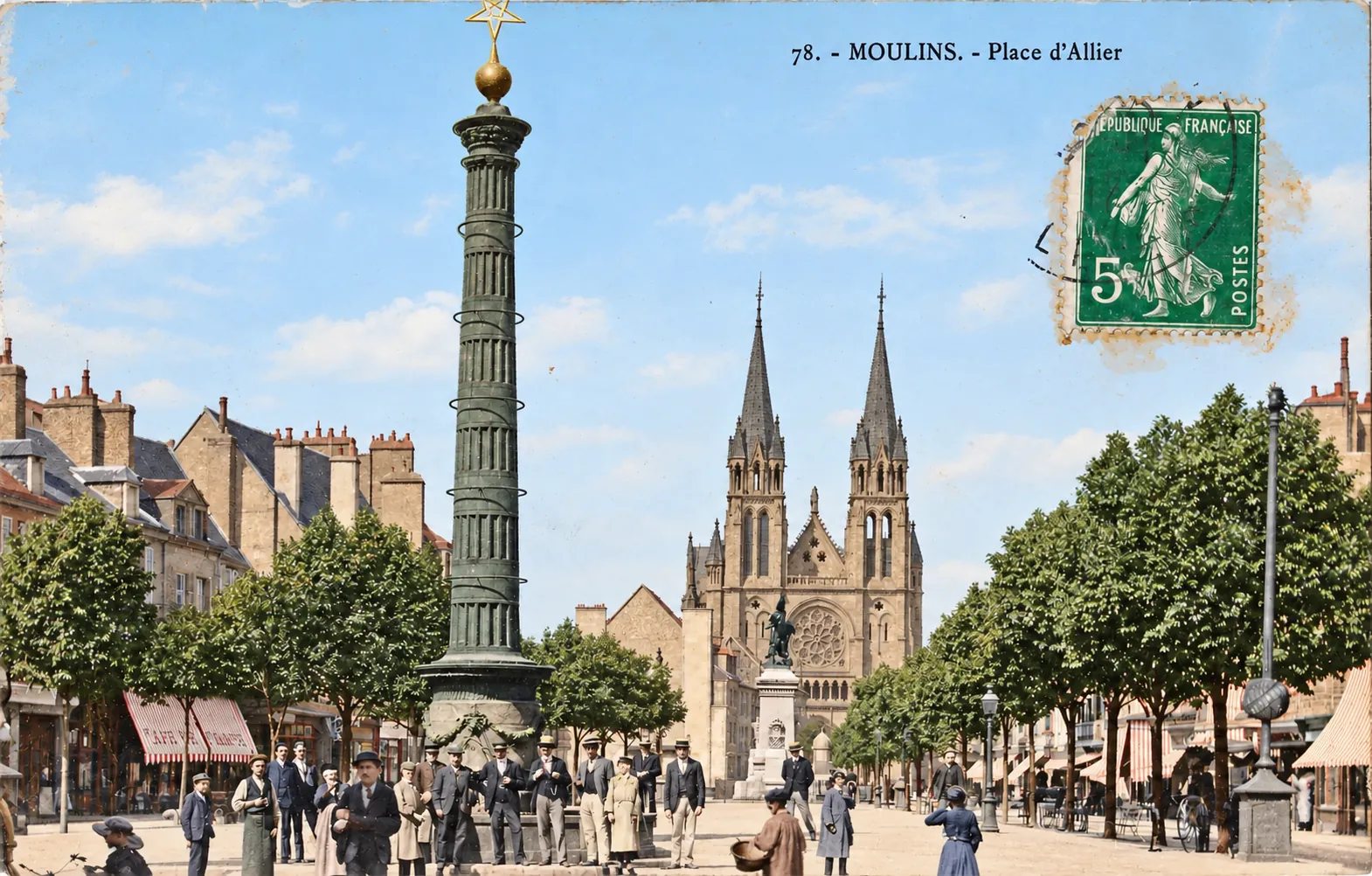
Moulins – Place d’Allier and the Sacred Heart Church c. 1910
Geographic description
Place d’Allier in Moulins is shown here in one of the most characteristic views of the town centre in the early twentieth century. The printed caption, “78. – MOULINS. – Place d’Allier,” identifies the location beyond reasonable doubt. The photographer is looking westward along the square towards the Church of the Sacred Heart, whose imposing Neo-Gothic façade and twin spires dominate the end of the perspective.
In the left foreground stands a tall stone column. This can be identified as the Saincy Fountain, one of the historic landmarks of Place d’Allier. Sources dealing with the heritage of Moulins record that the fountain originally stood on the town’s former Cours before being transferred to Place d’Allier in 1845. Its distinctive tall column, built from local Coulandon sandstone, remains associated with the square today.
The postcard nevertheless shows the monument in a setting very different from its modern surroundings. Its former base is clearly visible, with several people gathering close to it. The square and fountain were substantially redesigned during modern improvement works, and Place d’Allier is now largely pedestrianised.
Rows of urban buildings line both sides of the square. Many ground floors appear to contain shops, with large shopfronts and fabric awnings projecting above the pavement. Carefully pruned trees create two regular avenues along the edges of the open space, directing the eye towards the church at the far end.
The scene is particularly lively. A sizeable group of men has gathered beside the fountain, with several apparently looking directly towards the photographer. Jackets, trousers, hats and caps are typical of male urban dress during the period. Other pedestrians can be seen crossing the square or standing along its edges. On the right, furniture and awnings outside the buildings suggest active shops and probably cafés or similar establishments.
The historic importance of this commercial activity is supported by municipal planning documentation. During the nineteenth century Place d’Allier developed around the covered market and the Church of the Sacred Heart and became an increasingly important commercial centre, surrounded by shops, cafés and residential buildings.
At the western end of the square, the Church of the Sacred Heart of Moulins provides the postcard with its most striking architectural feature. Its large rose window, central portal and two slender towers crowned with spires are clearly recognisable. The church was built during the nineteenth century in the Neo-Gothic style and is regarded as one of the notable works of the architect Jean-Baptiste Lassus. Local heritage publications also describe it as the first church in France dedicated to the Sacred Heart.
The postcard therefore records far more than two monuments. It captures the structure of the old town centre itself: a broad commercial square, lined with trees and shops, organised around the Saincy Fountain and visually closed at its western end by the monumental façade of the Sacred Heart church.
Historical description
The exact date of this view of Place d’Allier in Moulins cannot be established from the photograph alone. Several clues nevertheless allow the postcard to be placed within a reasonably narrow period.
The strongest clue is the green 5-centime postage stamp attached in the upper-right corner of the picture. Its design appears to correspond to the green 5-centime Semeuse issue introduced in March 1907. The denomination was notably used for certain postcard postal rates. If this identification is correct, 1907 provides a reliable earliest possible date for the card’s postal use.
Unfortunately, only a fragment of the postmark survives and no year can be read with confidence. The stamp therefore cannot establish an exact mailing date. Postal archives also show that reduced 5-centime postcard rates remained in use for restricted messages, including the well-known five-word rate, so the denomination alone covers a period of several years.
Other visual evidence nevertheless points towards the late 1900s or early 1910s. The men’s clothing and headwear, the predominance of pedestrians and the absence of clearly identifiable motor cars are compatible with the years immediately preceding the First World War. A date of approximately 1910 is therefore a reasonable working estimate rather than a firmly established date.
By this period Place d’Allier had already become one of the principal centres of commercial life in Moulins. Its development during the nineteenth century had brought together a covered market, shops, cafés, housing and major public and religious buildings. This evolution helps explain the amount of activity captured by the photographer.
The Church of the Sacred Heart had also become a familiar part of the town skyline. Built during the nineteenth century, its Neo-Gothic design deliberately recalls the architecture of the great medieval churches of France. The twin spires seen so prominently on the postcard make the building a powerful visual terminus to the square.
The Saincy Fountain adds an even older layer to the scene. Originally created at the end of the eighteenth century, it was moved to Place d’Allier in 1845. The postcard therefore preserves an earlier arrangement of the monument long before the twenty-first-century redesign of the square.
At the lower-right edge of the postcard, the publisher’s imprint appears to read “L. Rouillat, éditeur.” The lettering itself is visible, but the publisher’s precise identity and period of activity could not be established securely enough from the sources consulted to use it as an independent dating criterion.
The number 78 printed before the caption probably belongs to the publisher’s series or catalogue. Without a surviving catalogue or other securely identified cards from the same numbered series, however, it cannot provide a precise date.
What makes this postcard especially valuable is its portrayal of everyday urban life. The men gathered around the fountain, pedestrians crossing the open space, shop awnings, tree-lined pavements and the monumental church in the distance combine to show Place d’Allier not simply as a collection of historic buildings, but as a busy social and commercial heart of Moulins during the golden age of the picture postcard.