Moulins – The Square and Hôtel de Paris in the Early 1900s
Geographic description
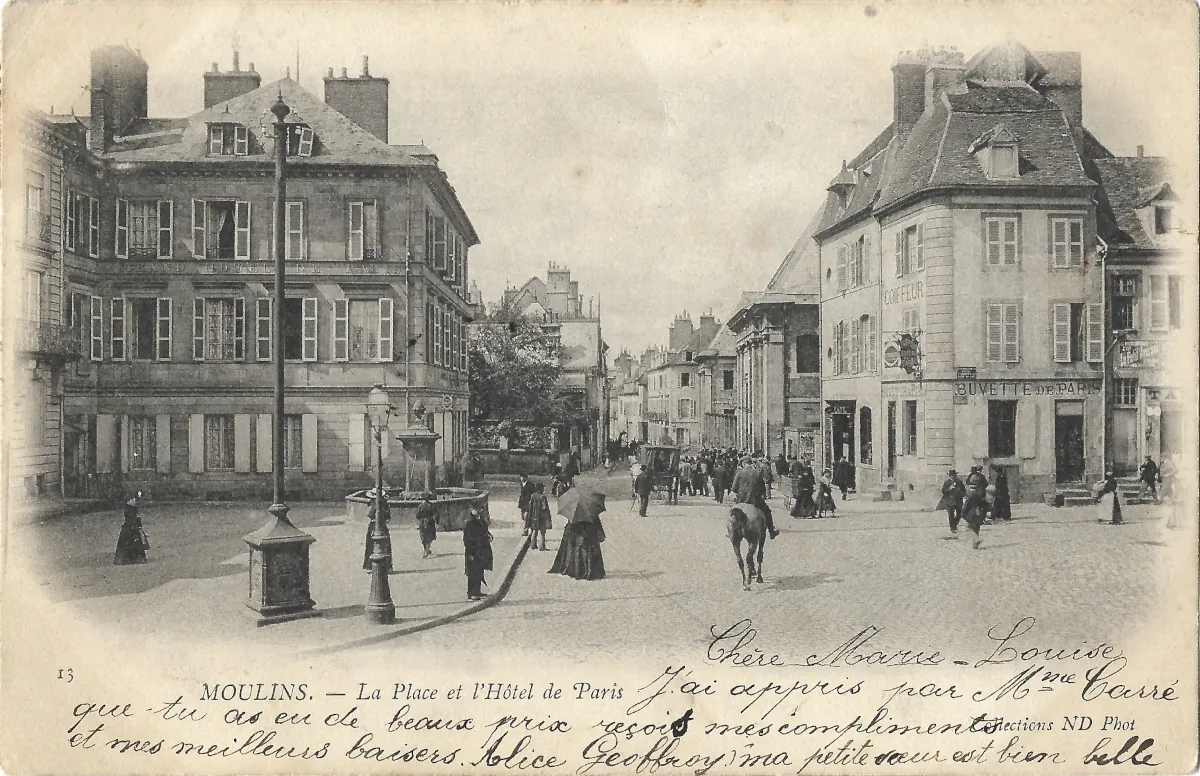
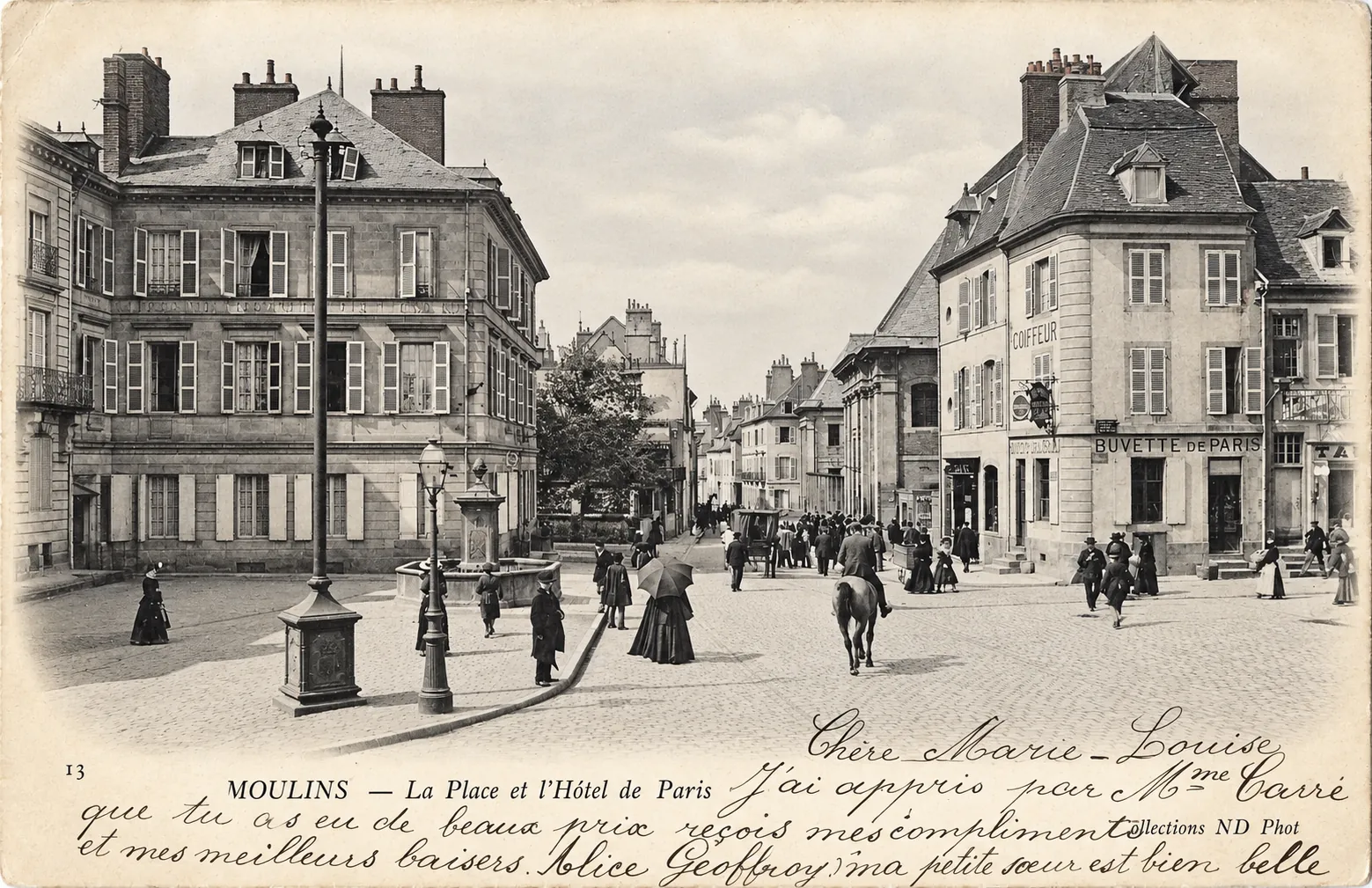
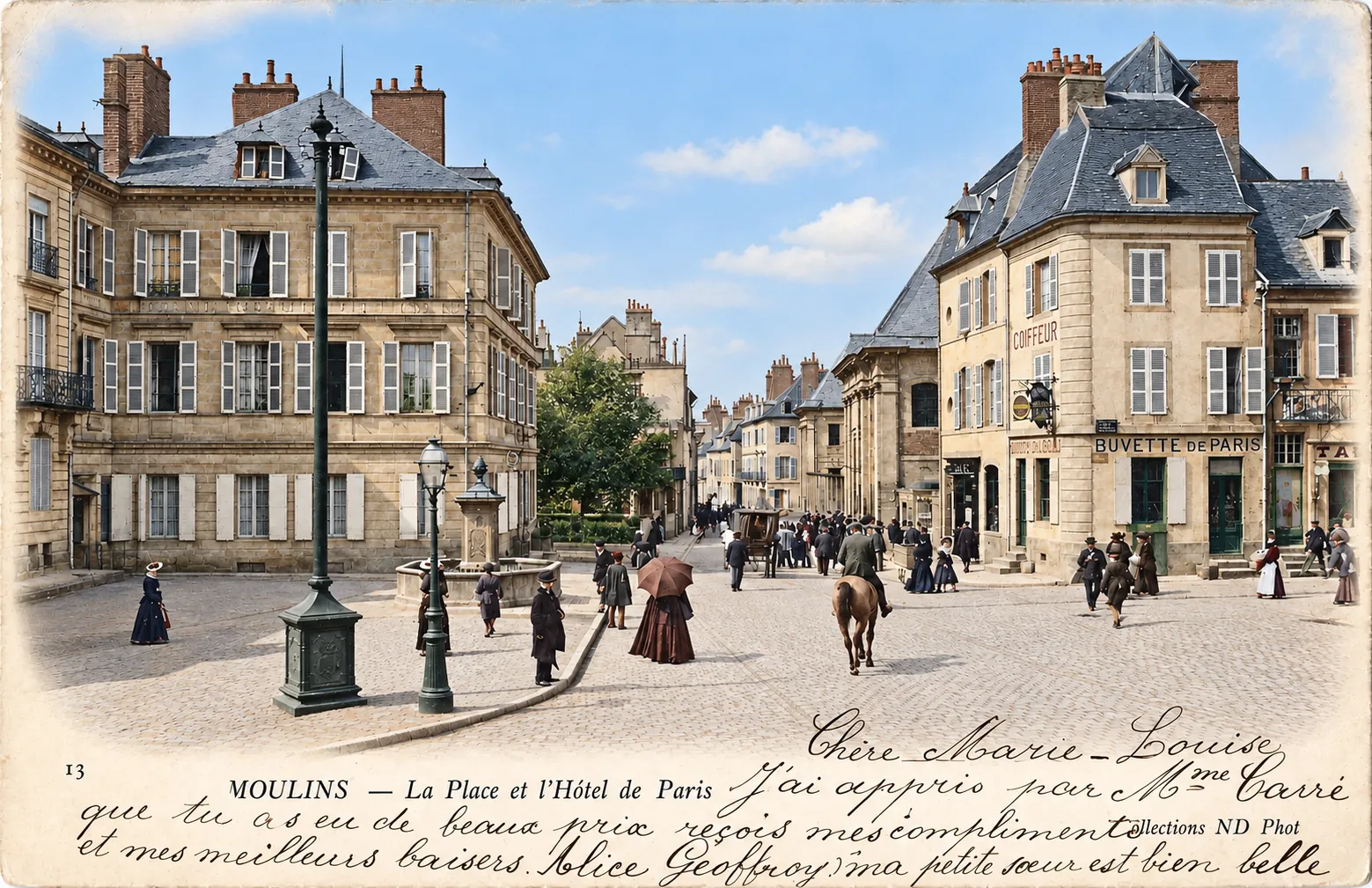
The Hôtel de Paris in Moulins dominates the left side of this old postcard showing a lively small square in the historic centre of the city. The scene is located along Rue de Paris, one of Moulins’ traditional main thoroughfares. Moulins is the prefecture of the Allier department and the historic capital of the Bourbonnais.
The hotel occupies a substantial three-storey corner building constructed in stone and topped by a slate roof with dormer windows. Its regular rows of shuttered windows, classical cornice and balanced proportions give it the appearance of a large nineteenth-century town residence. The building can still be identified today: the Hôtel de Paris remains in operation at 21 Rue de Paris and has retained much of its historic exterior appearance.
An ornamental fountain stands prominently in the foreground. Its polygonal basin and central stone feature form one of the principal landmarks in the photograph. A fountain still occupies this small open space near the hotel, providing an important visual link between the old postcard and present-day Moulins.
From the square, the street continues into the distance between tightly grouped buildings forming a continuous urban frontage. This perspective illustrates the dense character of the historic town centre. Rue de Paris was traditionally one of the principal routes leading northwards from Moulins. It also formed part of an important road corridor used by travellers moving between Paris and central France, which encouraged the development of inns and accommodation along the route.
The corner building on the right contains several clearly visible commercial signs. The word “COIFFEUR”, meaning hairdresser, can be read higher on the façade, while “BUVETTE DE PARIS” is prominently painted at street level. The combination of hotel, refreshment establishment and other small businesses demonstrates the commercial importance of this junction.
The square itself is remarkably animated. Women in long dresses cross the roadway, while groups of men gather near the shops. A mounted rider is moving away from the camera in the centre of the scene, and a horse-drawn vehicle can be seen farther along the street. No motor car can be clearly identified. The paved roadway, limited separation between pedestrian and traffic areas and the tall ornamental street lamps all contribute to the atmosphere of a French provincial town at the beginning of the twentieth century.
The comparison with modern Moulins is particularly revealing because several major landmarks have survived. The Hôtel de Paris still operates today as the Mercure Moulins Centre – Hôtel de Paris. Rue de Paris remains one of the historic streets of the city and contains numerous old town houses and heritage buildings. The fountain also provides a valuable point of continuity between the urban landscape shown on the postcard and the present-day street.
Historical description
This postcard was most probably produced during the first years of the twentieth century, approximately 1900-1905, although the exact date cannot be established from the front of the card alone.
Several visual clues support this approximate dating. Horse transport still dominates the scene: a mounted rider occupies the foreground and a horse-drawn carriage is visible farther along the street. The long skirts and dresses worn by the women are also characteristic of the Belle Époque. The design of the postcard, with a light area along the lower part of the picture used for handwritten correspondence, is another feature frequently encountered on cards produced during the early years of the postcard boom.
An especially useful clue is the printed wording “Collections ND Phot” visible at the lower right. This was a publishing mark associated with Neurdein Frères, a major Parisian photographic and postcard company operated by brothers Étienne and Antonin Neurdein. The company produced and distributed extensive series of views showing French towns, monuments and landscapes. Institutional collections identify “ND Phot” as one of the marks used by the Neurdein firm, and other postcards of Moulins issued by the same publisher are known from the opening years of the twentieth century.
The number 13 printed at the lower left indicates that this photograph formed part of a numbered series devoted to Moulins. Such series allowed visitors and local residents to select recognisable views of the city to send to relatives and friends.
The Hôtel de Paris was an obvious subject for such a postcard. The establishment occupies a residence built in 1834 and belongs to the tradition of substantial nineteenth-century hotels serving travellers arriving in French provincial towns. Its position on Rue de Paris was particularly significant.
For centuries, Rue de Paris had formed one of the principal approaches to Moulins. Historical accounts of the Faubourg de Paris describe an important road used by travellers and lined with inns and hostelries. The later Hôtel de Paris therefore continued a much older tradition of accommodation associated with this route.
By the beginning of the twentieth century, the hotel stood close to the historic centre while remaining directly connected to one of the city’s major traffic arteries. The activity visible in the photograph reflects this strategic location. Pedestrians, horse traffic and groups gathered around the neighbouring businesses make the square appear as a genuine place of movement and everyday social interaction.
The “Buvette de Paris” opposite the hotel further emphasises this role. Together with the neighbouring hairdresser, it shows how accommodation, refreshments and everyday services were concentrated around busy urban crossroads. Such commercial signs are valuable documentary details because they preserve businesses and activities that might otherwise have disappeared without trace.
The postcard is therefore more than a simple architectural view of the Hôtel de Paris. It records everyday life in Moulins at a transitional moment, when streets were still dominated by horses and pedestrians shortly before motor vehicles began to transform urban traffic. The continued presence of the hotel, fountain and part of the surrounding architecture makes this image an especially interesting record of more than a century of urban continuity.