Moulins – The Agriculture Fountain
Geographic description
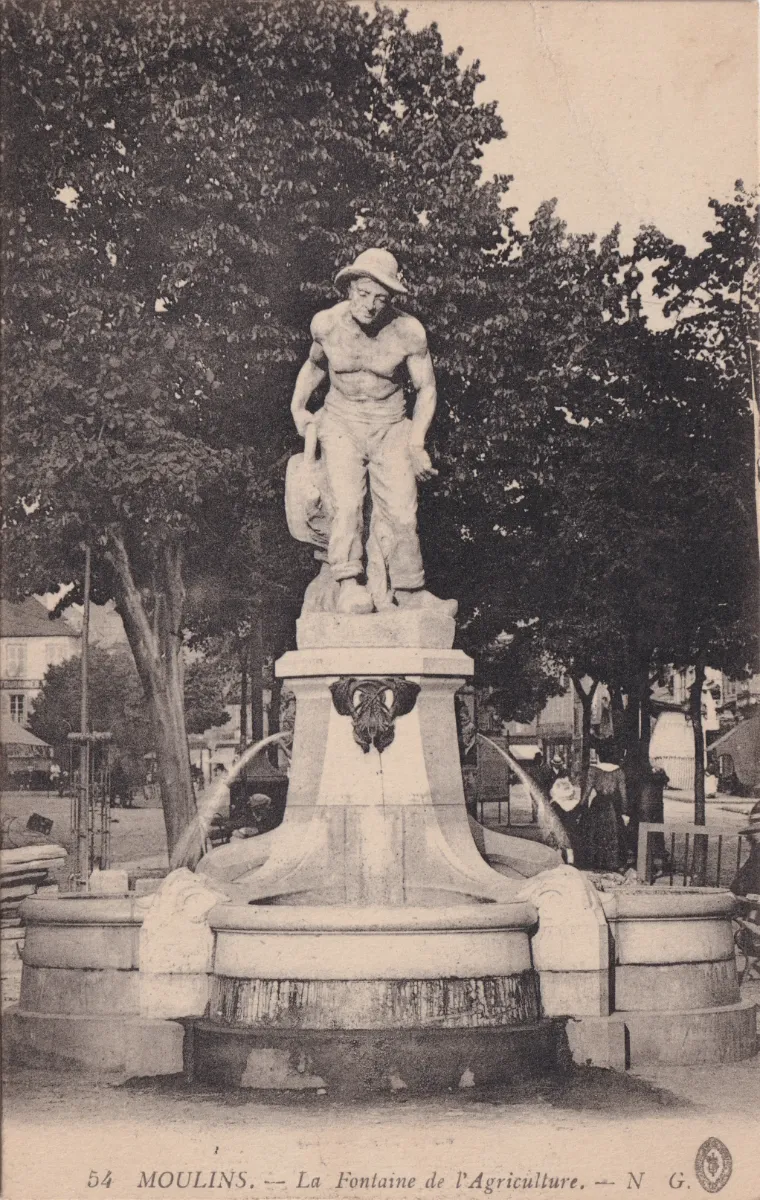
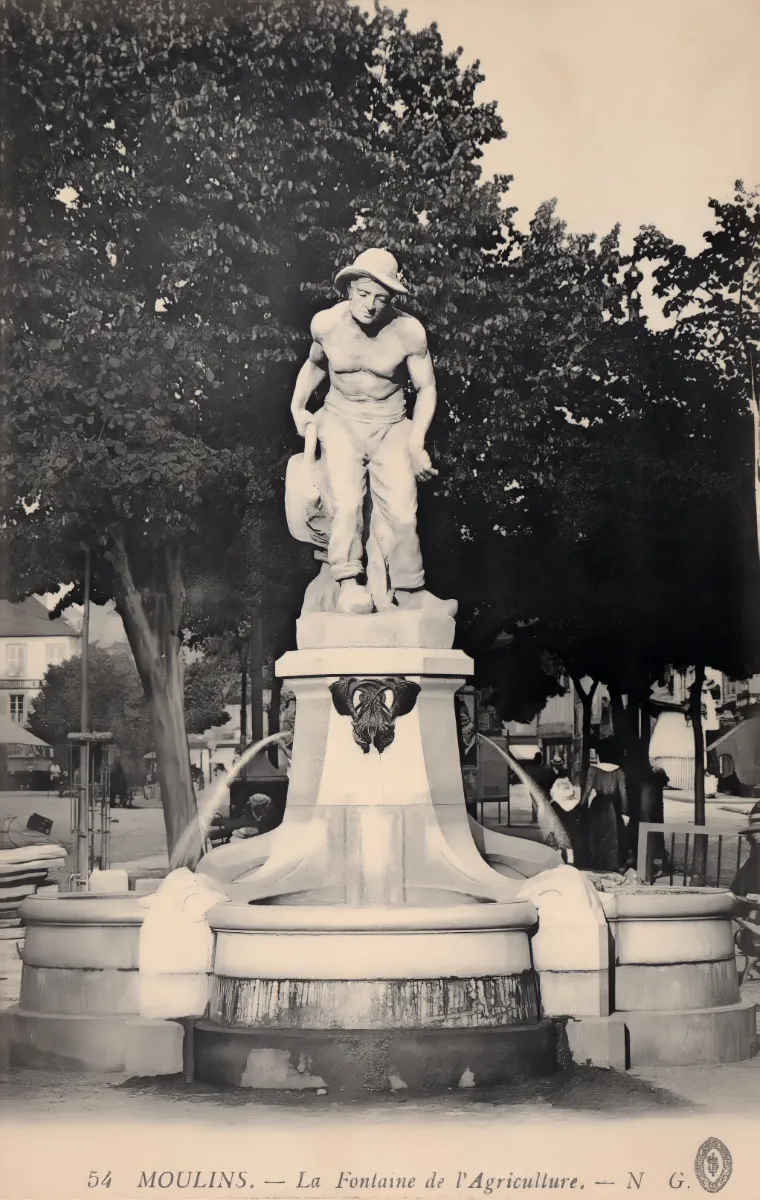
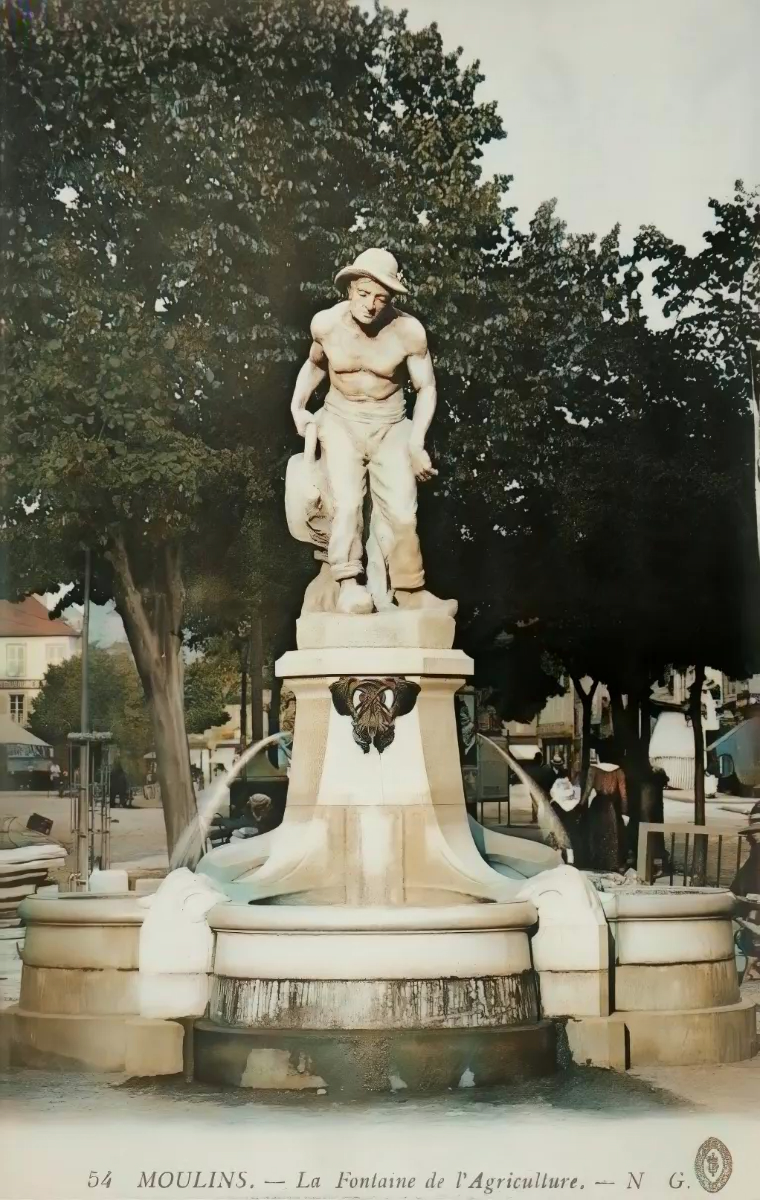
The Agriculture Fountain in Moulins is the central subject of this early twentieth-century postcard showing one of the city’s distinctive public monuments. The printed caption, “Moulins – La Fontaine de l’Agriculture,” provides a certain identification. At the time the photograph was taken, the fountain stood in Place d’Allier, its original location. It now stands in nearby Place de la Liberté in central Moulins. À nos Grands Hommes
The monument is photographed almost directly from the front, emphasizing its strong vertical composition. A working gardener dominates the fountain. Bare-chested, wearing a hat, work trousers and clogs, he bends slightly towards the ground while handling a watering vessel. His pose is deliberately ordinary rather than heroic. The sculptor chose to represent physical labour, patience and concentration instead of an idealized allegorical figure of agriculture.
The gardener is associated with the market gardeners of Moulins traditionally known as the “Saccarauds.” These growers cultivated land around the town and supplied its markets with fresh vegetables. The fountain therefore refers directly to an activity that once formed part of the everyday economic life of Moulins.
The statue stands on a substantial sculpted pedestal that also forms the central structure of the fountain. Water jets can clearly be seen flowing sideways into the surrounding basins. A metal animal-head ornament occupies the front of the pedestal. Documentary records describe the complete monument as having three basins and three bronze water outlets, together with a bronze relief of a sower on the rear. The combination of flowing water, the gardener and agricultural imagery creates a coherent celebration of cultivation and rural labour.
Large mature trees fill much of the background of the postcard. Their foliage visually isolates the pale monument from the surrounding buildings. Portions of façades and urban structures remain visible between the trunks and branches, showing that this was not a rural scene but a landscaped area within the town.
Place d’Allier was an important commercial and social space in central Moulins. The fountain remained there for more than a century. During the major redevelopment of the square in the early 2010s, it was removed, restored and finally transferred to nearby Place de la Liberté in 2013.
The postcard is therefore valuable not only as a portrait of a public monument but also as a record of its former urban setting. The fountain itself survives, but the relationship between the monument, its trees, the surrounding buildings and the old Place d’Allier belongs to an earlier stage in the history of Moulins.
Historical description
The Agriculture Fountain was created by Moulins-born sculptor Pierre Fournier des Corats and was inaugurated on 5 September 1908. Its construction followed the execution of a 7,000-franc bequest from Louis Bignon, whose name is recorded in an inscription on the rear of the pedestal. Heritage documentation identifies the work as an Art Nouveau fountain combining marble sculpture with bronze decorative elements.
The choice of an agricultural subject was closely connected with Louis Bignon’s own career. Originally from the Allier department, Bignon achieved considerable success in the Paris restaurant trade before investing heavily in agriculture. From the mid-nineteenth century onward, he acquired several hundred hectares of farmland at Theneuille and sought to modernize the estates. His projects included improved farm buildings, drainage, modern agricultural techniques and better living conditions for tenant farmers. He was also active in agricultural organizations. The fountain funded through his legacy therefore commemorated a field in which he had been personally involved for decades.
Fournier des Corats avoided the grand heroic language often associated with nineteenth-century public monuments. His gardener is shown bent over his work, absorbed in the everyday task of watering. Contemporary and later descriptions associate the figure with the old Bourbonnais gardener and with the Moulins market gardeners known as the Saccarauds.
The date of the monument provides an important chronological clue for the postcard. The photograph cannot have been taken before 1908. The monochrome printing, typography and general presentation are consistent with postcard production during the early decades of the twentieth century. A date in the years following the fountain’s inauguration, probably during the 1910s, is plausible, although the front of the card does not provide enough evidence for a precise year.
The number 54 precedes the printed caption, while the initials N.G. appear at the lower right. These probably identify an edition or postcard series. The initials alone, however, are insufficient to establish the publisher’s complete identity with confidence, so a more precise attribution would remain hypothetical.
The fountain survived the many transformations of central Moulins. During the redevelopment of Place d’Allier, it was removed and subsequently restored. In 2013 it was installed in Place de la Liberté. The postcard therefore records both a monument that still exists and an urban setting that has disappeared, making it a useful document for understanding the changing appearance of central Moulins.