Moulins – The Post Office on Avenue Nationale
Geographic description
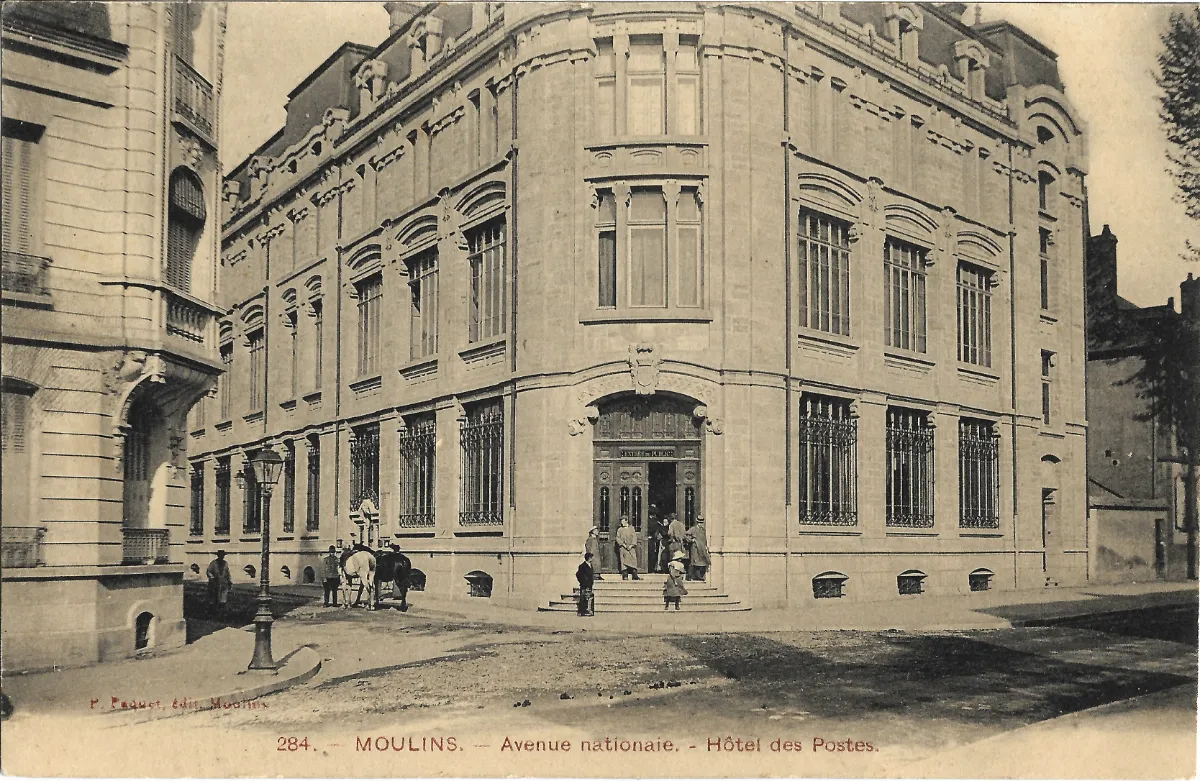
The Moulins Post Office, photographed from Avenue Nationale, dominates this old postcard numbered 284. The printed caption, “Moulins. – Avenue nationale. – Hôtel des Postes,” clearly identifies both the town and the purpose of the building. Moulins, the prefecture of the Allier department, is one of the historic urban centres of the former Bourbonnais province in central France.
The Post Office is a substantial public building occupying a prominent street corner. The photographer deliberately chose an oblique viewpoint, allowing both façades to be seen and emphasizing the building’s considerable size. Its slightly rounded corner follows the shape of the street junction while creating a particularly imposing architectural composition.
The ground floor has a solid appearance, with tall windows protected by elaborate metal grilles. The main entrance occupies the corner section and is reached by a short flight of steps. Sculptural decoration around the doorway and an inscription above it emphasize the public character of the building and make the entrance the visual centre of the composition.
The upper floor contains large vertical windows designed to provide ample natural light. Considerable attention was given to the exterior decoration: shallow arches, carved surrounds, horizontal bands and projecting cornices give the façades a degree of refinement well beyond purely functional architecture. Dormer windows punctuate the roofline, adding to the characteristic appearance of a prestigious French public building from around the turn of the twentieth century.
Part of another monumental building can be seen on the left-hand side of the postcard. Its stone façade and large arched openings create an imposing architectural setting beside the Post Office. The portion visible in the photograph is too limited, however, to identify this neighbouring building solely from the image with complete certainty.
The surrounding streetscape remains relatively open. The road surface appears only lightly developed by modern standards, and no motor cars can be seen. A tall street lamp in the foreground provides an interesting example of period street furniture. Near the side façade, several horses and what appears to be a horse-drawn vehicle illustrate the continuing importance of animal transport in urban life.
Several people have gathered around the entrance. Some may have paused specifically for the photographer, a common feature of early postcard photography. Their clothing, long garments and hats contribute to the period atmosphere. The scene therefore records more than the architecture itself: it shows the Post Office functioning as an important and frequently visited public place within the town.
Historical description
This postcard records the Moulins Post Office during the early twentieth century, when postal, telegraph and subsequently telephone services were becoming increasingly important to everyday urban life.
Several visual features support an early twentieth-century date. The architectural treatment belongs to the transition between the late nineteenth century and the years around 1900, when major public buildings were often given monumental façades combining practical requirements with elaborate decoration. A central post office was intended not merely to provide working space but also to represent the authority, efficiency and modernity of the public administration.
The street scene offers further chronological clues. Horses remain clearly present, while motor vehicles appear to be absent. The clothing worn by the people gathered near the entrance is also consistent with the opening decades of the twentieth century. These details provide a useful approximate context, although they are not sufficient to assign an exact year to the photograph.
Post offices were among the essential public institutions of this period. Letters remained the principal form of long-distance personal and commercial communication, while telegraph services made it possible to transmit urgent information much more quickly. The gradual development of telephone networks further increased the importance of buildings that housed communications services.
The architecture also reflects the broader modernization of French provincial towns during the period commonly associated with the Belle Époque. Municipal and national authorities were constructing or enlarging specialized public buildings to accommodate expanding services. Post offices belonged to the same changing urban landscape as railway stations, schools, administrative offices, banks and department stores.
The group of people standing on the entrance steps gives the postcard considerable documentary value. Rather than presenting an entirely empty architectural view, the photographer captured a small moment of everyday life. The people may include postal employees, customers or simply passers-by who stopped for the photograph; the image itself does not allow their roles to be determined with certainty.
The horses standing beside the building are equally significant. They illustrate a period when horse-drawn transport still formed an ordinary part of city traffic and could also be closely associated with the movement of mail and goods. The contrast between this traditional means of transport and the imposing modern communications building is one of the most evocative aspects of the scene.
The number 284 printed in the caption probably identifies the postcard within a publisher’s numbered series devoted to Moulins or the surrounding area. A small printed indication also appears near the lower left corner, but it is not sufficiently legible in this copy to identify the publisher or photographer reliably.
As a whole, the postcard provides a valuable record of Moulins at the beginning of the twentieth century. It documents not only a major public building on Avenue Nationale but also the street layout, period lighting, horse-drawn transport and everyday activity surrounding an institution that stood at the centre of contemporary communications.