Moulins – General View from the Saint-Gilles Tower
Geographic description
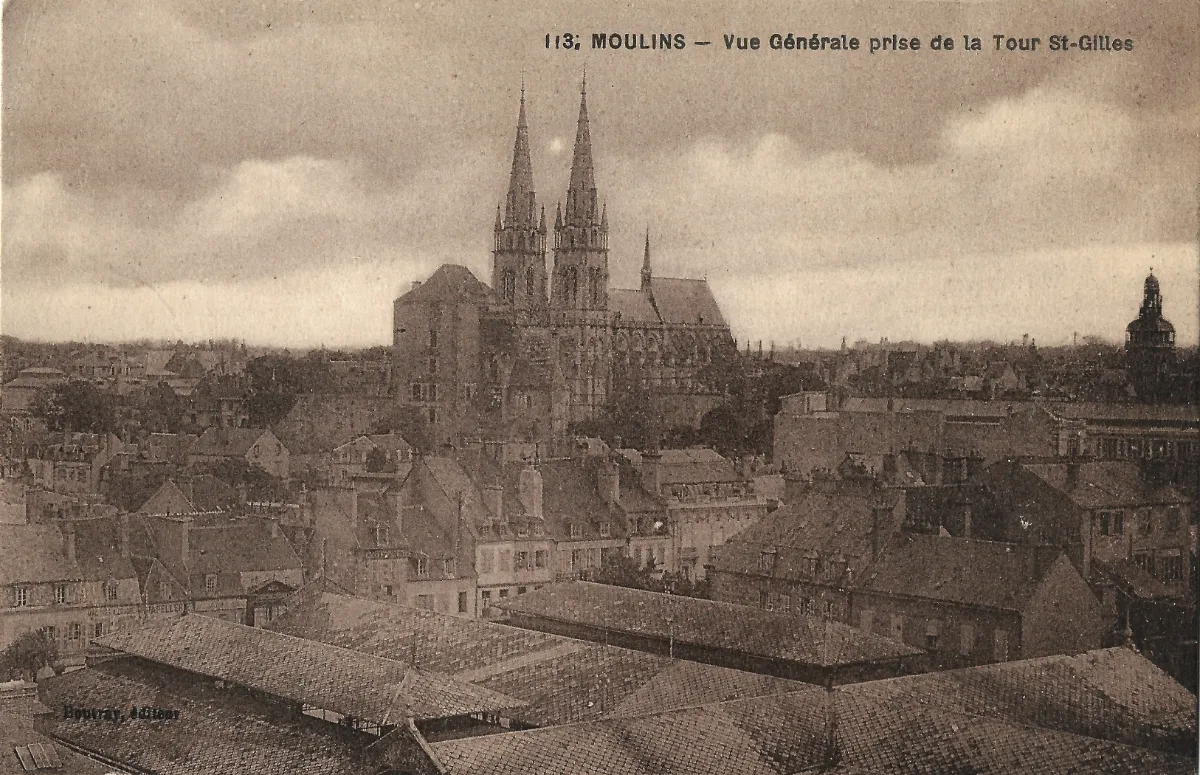
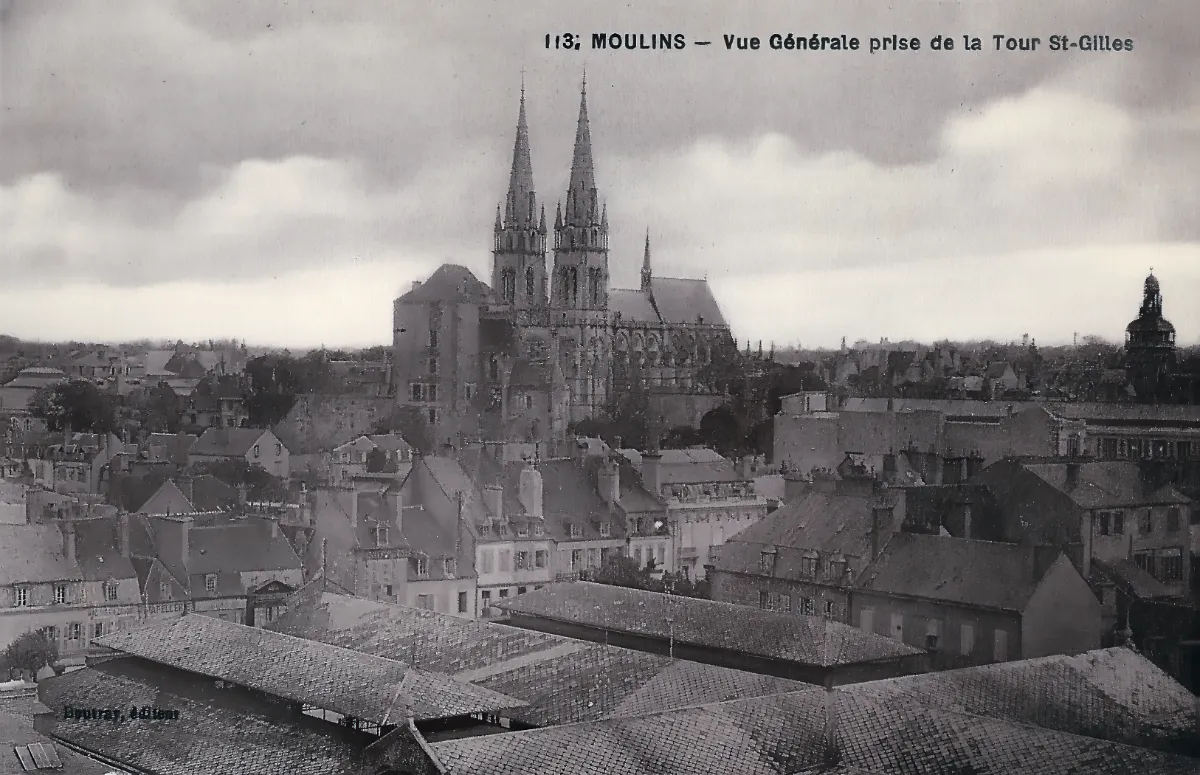
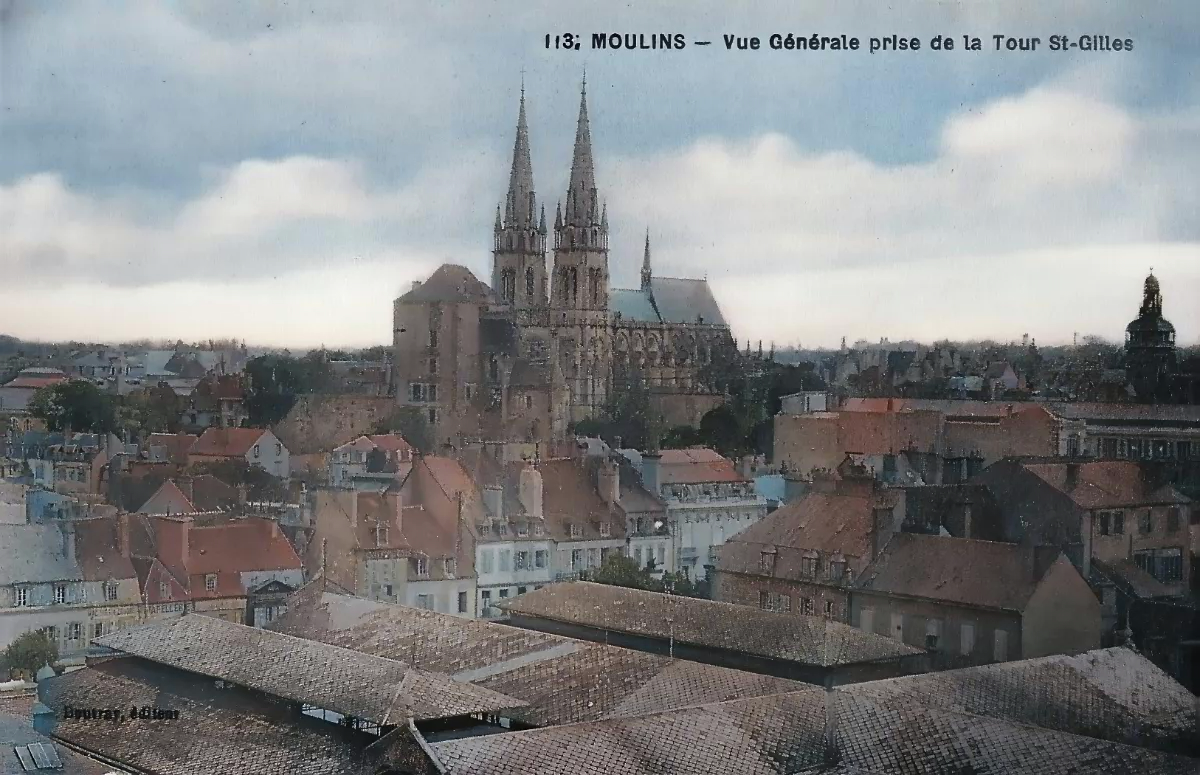
This general view of Moulins from the Saint-Gilles Tower provides a remarkable panorama of the historic centre of the Allier prefecture, dominated by the major religious buildings that still shape the city’s skyline. The elevated viewpoint reveals a particularly dense urban fabric, with rows of roofs, courtyards and closely packed buildings surrounding the historic core.
At the centre stands Moulins Cathedral, Notre-Dame, immediately recognizable by its two tall symmetrical spires. The building has a complex architectural history. Its choir incorporates the former collegiate church begun in the late fifteenth century, while the nave and western section with its two towers resulted from a major nineteenth-century enlargement. According to the City of Moulins, this extension notably combines pale Chauvigny limestone with dark volcanic stone from Volvic, producing one of the building’s characteristic contrasts.
To the right, another monumental silhouette rises above the distant rooftops: the Sacré-Cœur church, also dating from the nineteenth century. The combination of these religious landmarks is a distinctive feature of the Moulins skyline. A French Ministry of Culture heritage record describing another general view of the city specifically mentions the spires of both Sacré-Cœur and Notre-Dame Cathedral.
The foreground is very different from this monumental architecture. It consists largely of the roofs of the old town: tiled coverings, chimneys, party walls and buildings of varying heights form a compact urban landscape. The streets themselves are almost completely hidden by the photographer’s elevated position. The scene therefore provides a particularly striking impression of the density of historic Moulins before the large-scale transformations associated with twentieth-century urban development.
The printed caption, “113. MOULINS – Vue Générale prise de la Tour St-Gilles,” directly identifies the observation point. This elevated position explains both the unusual angle from which the cathedral is seen and the considerable depth of the panorama. Rather than isolating a single monument, the photograph places the city’s principal landmarks within the ordinary fabric of houses and rooftops, giving the postcard considerable documentary value for the study of Moulins’ historic urban landscape.
Historical description
This general view of Moulins from the Saint-Gilles Tower most probably dates from the early decades of the twentieth century. Without a postal date or other chronological information for this particular copy, a more precise date would be speculative. Its monochrome printing, numbered caption and choice of an elevated urban panorama are nevertheless consistent with postcards widely produced during this period.
By the time the photograph was taken, the monumental skyline shown here had largely acquired the form created during the nineteenth century. The former collegiate church of Notre-Dame became the cathedral following the effective establishment of the Diocese of Moulins in 1823. The older church was subsequently enlarged on a considerable scale, with the nineteenth-century campaign adding the nave and the two great towers that dominate the centre of this postcard.
Behind this relatively recent monumental appearance lies a much older history. The origins of the cathedral are connected with the ducal chapel of the Bourbon dynasty, which became a collegiate church in the fourteenth century. A new building campaign begun in 1468 produced the eastern section of the present cathedral. This medieval heritage recalls the importance of Moulins as the capital of the Bourbon duchy and as a significant political and artistic centre during the late Middle Ages and early Renaissance.
The panorama therefore offers a visual summary of several centuries of urban development. The neo-Gothic spires of Notre-Dame and other nineteenth-century religious architecture rise above a much lower and older fabric of houses that developed gradually around the historic centre. This difference in scale accounts for the cathedral’s powerful presence in the photograph: its towers visibly dominate the dense mass of surrounding rooftops.
The postcard is also valuable because of its viewpoint. During the great period of postcard production in the early twentieth century, photographers frequently used towers, bell towers and other elevated structures to obtain panoramic views that could not be experienced from street level. From the Saint-Gilles Tower, the photographer was able to record not only Moulins’ principal monuments but also the overall density and arrangement of the historic town.
The image consequently preserves a view of Moulins in which church towers, spires and other monumental structures remained the principal visual landmarks of the urban landscape. Beyond its function as a picturesque souvenir, this postcard provides a valuable record of the historic centre and of the way nineteenth-century monumental architecture had become integrated into the much older fabric of the city.