Moulins – Hôtel-de-Ville Square and the Jacquemart Tower
Geographic description
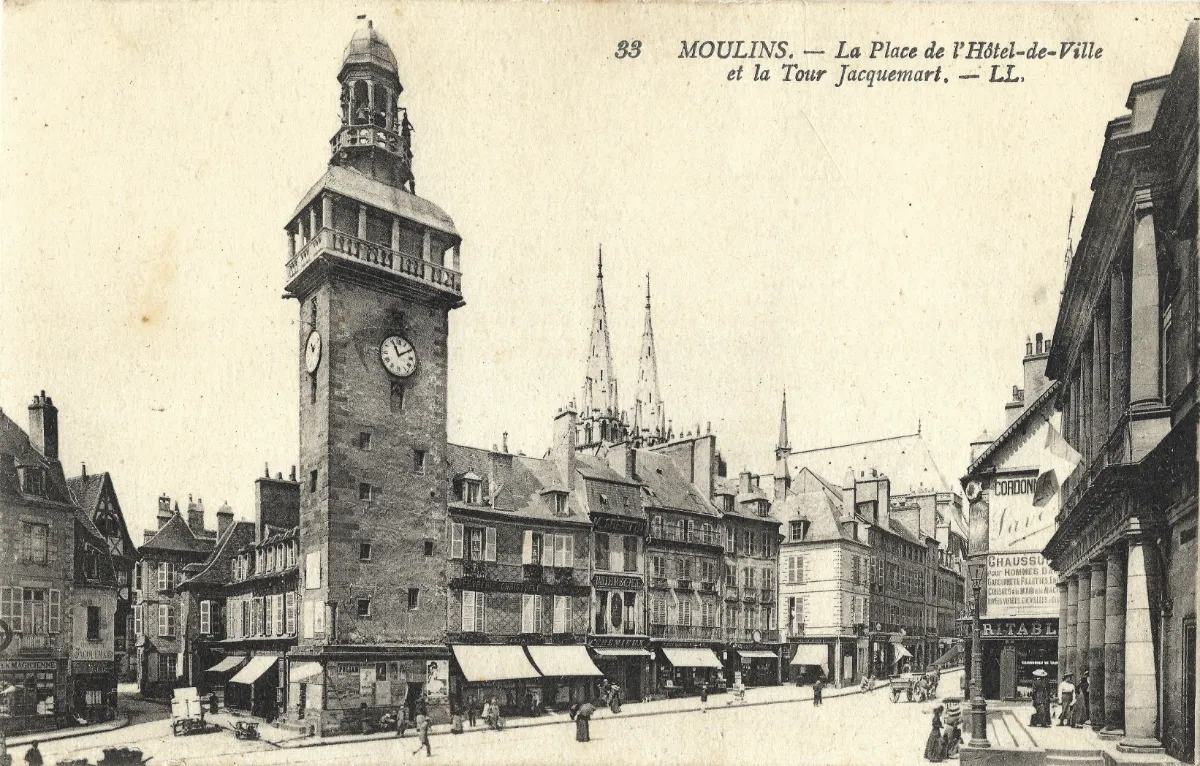
The Hôtel-de-Ville Square and Jacquemart Tower in Moulins form one of the most distinctive views of the historic centre of this town in France’s Allier department. The photograph was taken from the square, with the medieval clock tower dominating the left side of the scene. Its tall stone shaft rises well above the surrounding houses and shops, making it an unmistakable landmark in the urban landscape.
The Jacquemart consists of a largely unadorned rectangular stone tower pierced by small openings and fitted with clock faces. Its upper section is considerably more elaborate, with a balustraded gallery, a steep roof and an open lantern containing the striking mechanism and its mechanical figures. The tower still stands on Place de l’Hôtel-de-Ville and remains one of the best-known landmarks of central Moulins.
Part of the monumental Town Hall can be seen along the right-hand edge of the postcard. Its sandstone columns and Neoclassical architecture provide a striking contrast with the medieval character of the clock tower. Heritage information published by the City of Moulins records that the Town Hall was designed in the early nineteenth century by departmental architect François Agnéty, with its columned façade facing the historic square.
Between these two civic landmarks stretches a dense row of narrow multi-storey buildings. Their ground floors are occupied by shops, many protected by projecting awnings. Commercial signs are visible throughout the scene, including a footwear business on the right. The postcard therefore records not only an architectural setting but also one of the commercial centres of everyday life in Moulins.
Traffic appears light. Pedestrians cross the open roadway and gather near the shopfronts, while no heavy flow of motor vehicles is visible. A few distant vehicles or carriages can be distinguished, although their exact type cannot be established confidently from the photograph. The square consequently retains the atmosphere of an urban space in which pedestrians and local commerce remain predominant.
Several church spires rise above the rooftops in the background. The prominent pair of slender spires behind the buildings most probably belongs to the Neo-Gothic Church of the Sacred Heart, whose façade is framed by two matching towers. Together with the Jacquemart, these spires create a layered skyline of civic and religious landmarks characteristic of historic Moulins.
Historical description
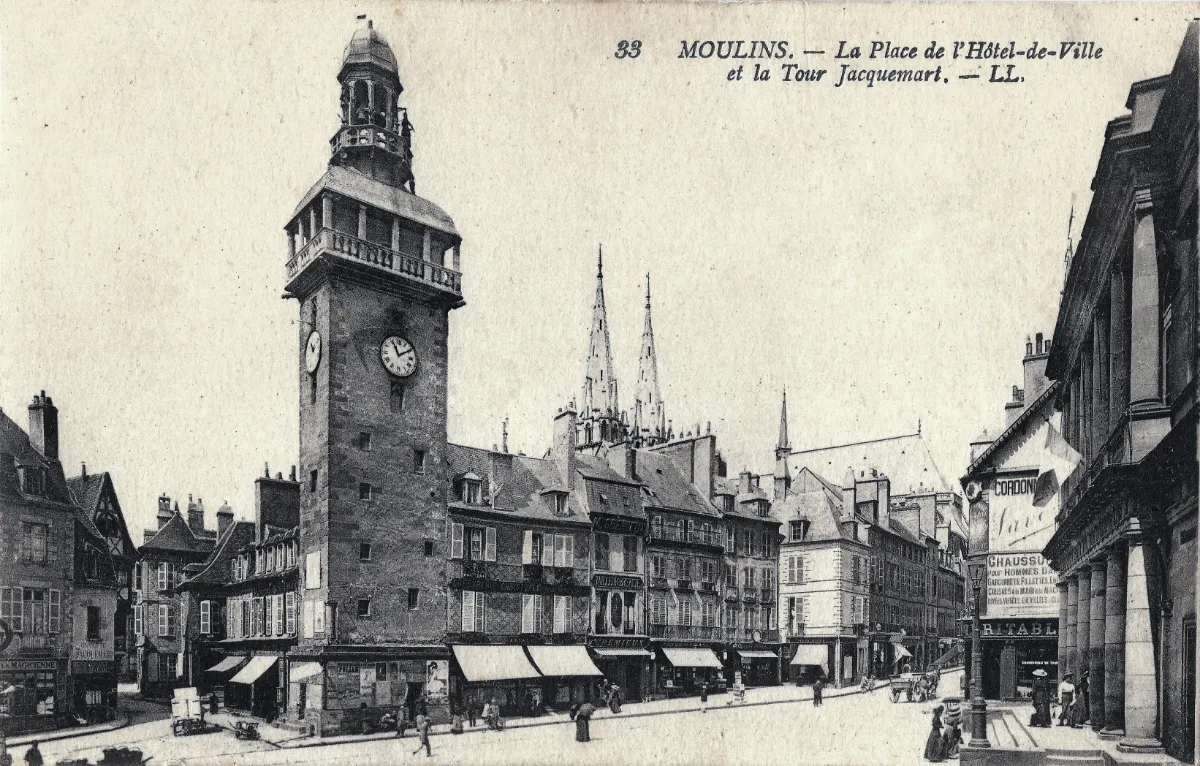
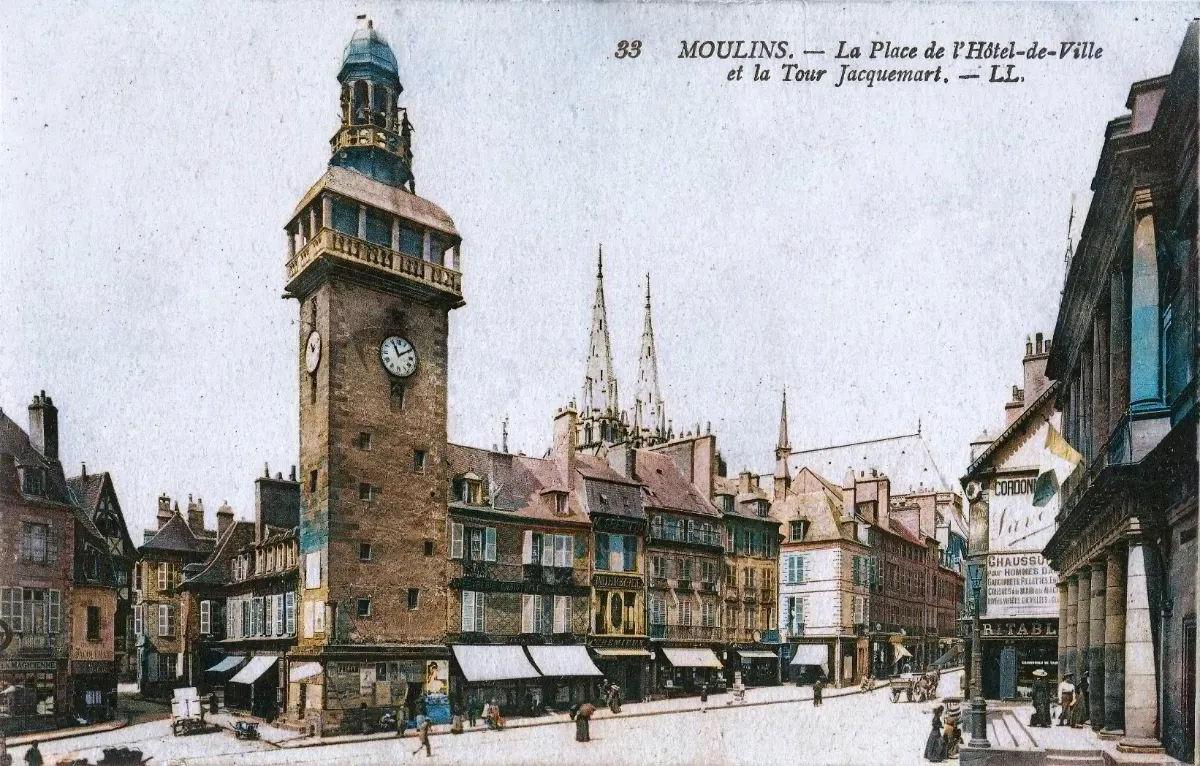
The postcard is captioned “Moulins – La Place de l’Hôtel-de-Ville et la Tour Jacquemart” and bears the series number 33 together with the initials “LL.” An identical photographic composition has been catalogued in online postcard collections, with one record associated with the year 1927. That date is useful supporting evidence, but it is not sufficient to establish the precise photographic or printing date of this particular copy.
The visual evidence is nevertheless consistent with the first decades of the twentieth century. Shop awnings and façades, pedestrians’ clothing, the limited presence of motor traffic and the general photographic presentation all suggest an approximate date in the 1910s or 1920s. No exact year can safely be established from the front of the postcard alone.
The Jacquemart itself is several centuries older. Official heritage records reflect the monument’s complex construction history: the French Ministry of Culture’s Mérimée database records a building campaign dated 1408, while heritage material published by the City of Moulins places completion of the medieval belfry in the mid-fifteenth century. The tower can therefore be securely regarded as a fifteenth-century civic monument linked with the development of municipal authority in medieval Moulins.
Following a major fire in the seventeenth century, the upper part of the tower was remodelled into the form broadly recognisable on the postcard. Its famous mechanical family consists of four figures that strike the hours. The French Ministry of Culture’s Palissy database dates this group to 1667.
The photograph is particularly valuable because it predates another major event in the building’s history. In 1946, fire again severely damaged the upper part of the Jacquemart. Municipal heritage documentation records that a public subscription was subsequently organised to rebuild both the tower and its clock mechanism to their previous appearance. The postcard therefore preserves a view of the pre-1946 Jacquemart, even though the later reconstruction was deliberately designed to reproduce the earlier silhouette.
Beyond its architectural significance, the postcard offers a vivid record of everyday urban life. The Jacquemart, the nineteenth-century Town Hall, traditional houses, shop awnings and pedestrians all occupy the same compact space. The result is a particularly informative portrait of central Moulins at a time when its medieval and nineteenth-century heritage still formed the backdrop to a busy commercial district.