Moulins – Rue d’Allier and the Saincy Fountain
Geographic description
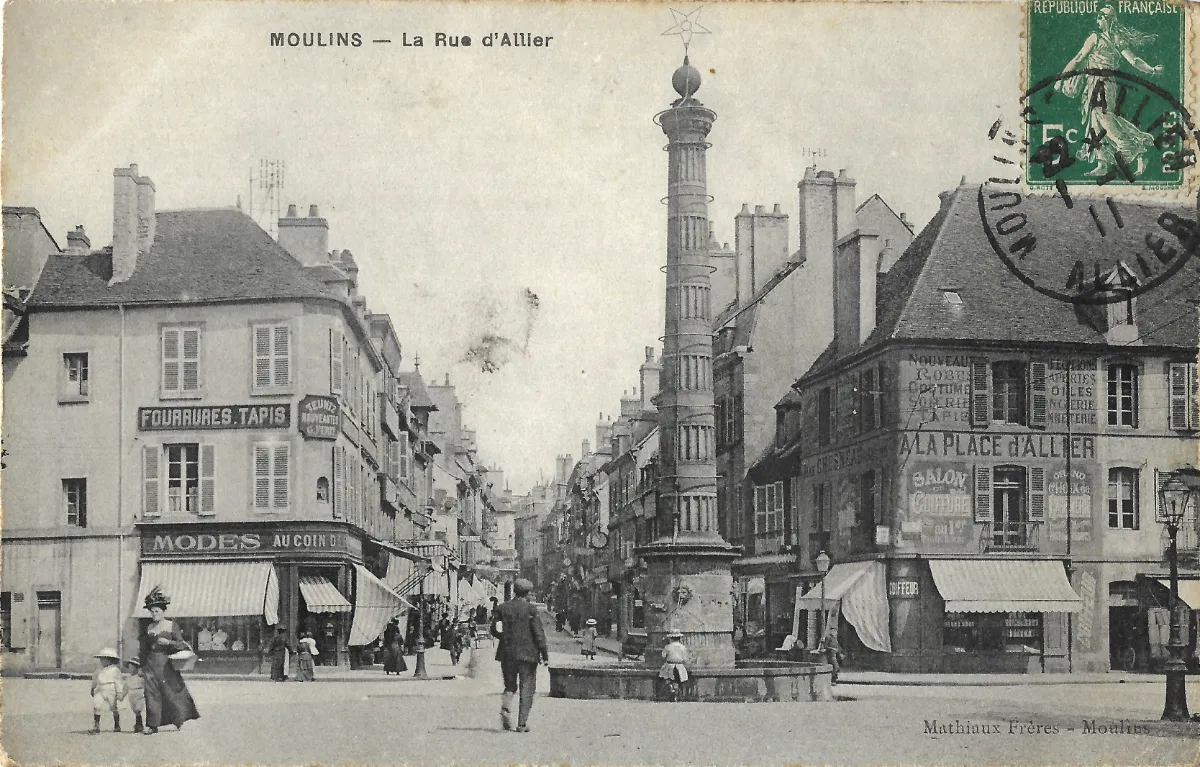
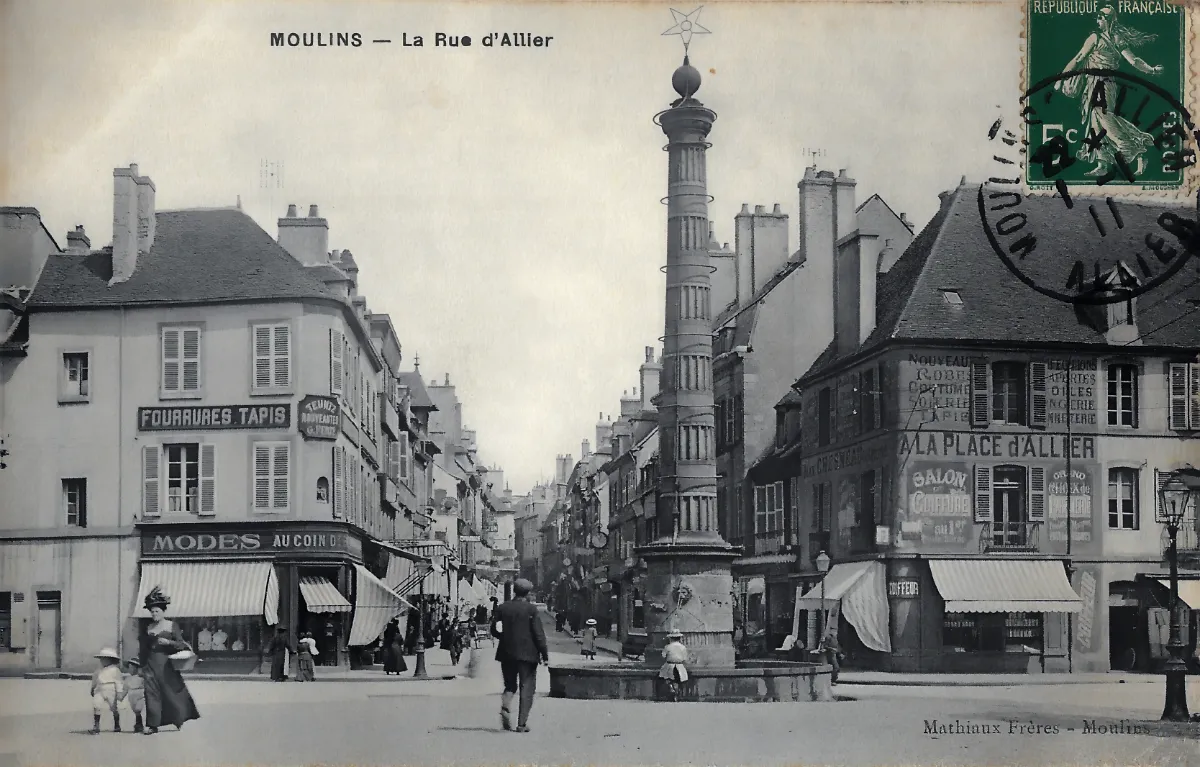
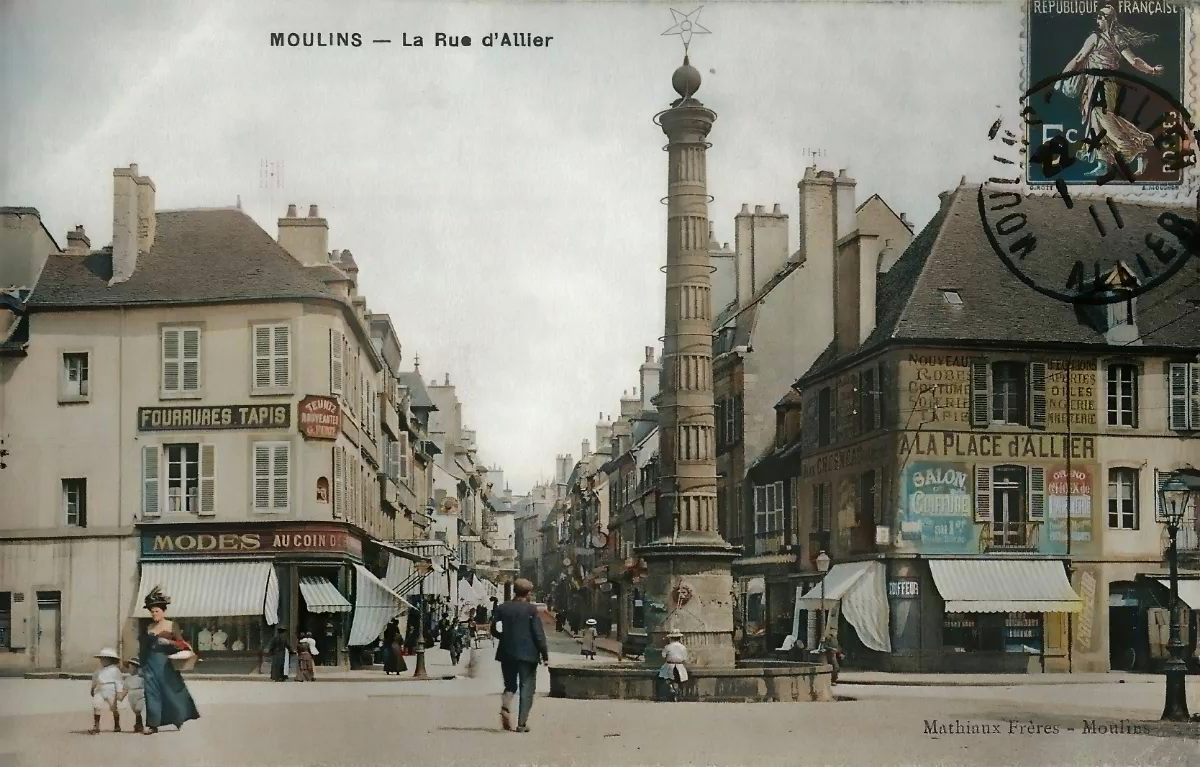
Rue d’Allier in Moulins is seen here from Place d’Allier, with the imposing Saincy Fountain dominating the foreground and the commercial street stretching away behind it. The tightly framed perspective, lined with shops and multi-storey buildings, belongs to the historic centre of Moulins, capital of the Allier department in central France. Rue d’Allier still connects Place d’Allier with the older streets around the clock tower and town hall, while the municipality describes Place d’Allier as one of the central spaces in the heart of the city.
The most prominent landmark is the Fontaine de Saincy, or Saincy Fountain. Municipal heritage documentation explains that Pierre de Saincy, Treasurer of France, had a private mansion built on the nearby promenades in 1775, with a monumental column fountain standing in front of it. The fountain has occupied Place d’Allier since 1848, making it considerably older than the postcard itself.
In the photograph, the fountain consists of a tall column rising from a circular basin surrounded by a low stone edge. Its strongly vertical silhouette divides the composition and provides an architectural transition between the open space of the square and the narrower shopping street beyond. The upper section is crowned by a metal feature visible against the pale sky.
Both sides of the street are covered with commercial signs. On the left, the words “FOURRURES, TAPIS” can be read clearly above one establishment, while a large “MODES” sign appears at street level. Striped awnings shade several shop windows. Across the street, the corner building is covered with painted advertisements, including the clearly legible words “LA PLACE D’ALLIER”. Other lettering survives only partially and cannot be transcribed confidently from the photograph.
These shopfronts show that this part of Moulins was already a busy retail district. Most of the buildings rise two or three storeys beneath steep slate roofs, combining older residential architecture with increasingly prominent ground-floor commercial premises. Rue d’Allier also retains several historically significant buildings, including the former Hôtel d’Orvilliers at number 57 and the former Hôtel des Feydeau at number 61, both evidence of the street’s long-standing importance within the urban fabric of Moulins.
Human activity contributes strongly to the character of the scene. Women in long dresses and elaborate hats, men in dark suits, children and other pedestrians occupy both the pavements and roadway. No motor car is clearly visible in the immediate foreground, leaving the street with an appearance still largely shaped by pedestrian movement. The awnings, shop displays and groups of people make this distinctly a commercial street rather than simply a transport route.
The area has changed significantly through later redevelopment and the transformation of retail activity. Place d’Allier nevertheless remains one of the key public spaces in central Moulins, and the Saincy Fountain survives as an important landmark. Its continued presence makes it possible to identify the viewpoint of this early postcard with considerable precision.
Historical description
The postcard most probably dates from the early 20th century, with several clues narrowing the likely period.
The most useful chronological evidence is the postage stamp attached to the upper right-hand corner of the picture. It is a green French 5-centime Semeuse camée stamp. This denomination and design entered general circulation in March 1907 and remained on sale until 1921. The card therefore cannot have been posted before 1907. Part of the circular cancellation is visible across both stamp and photograph, but the surviving figures are insufficient to establish a complete postal date with confidence.
A second clue appears at the lower edge of the postcard: “Mathiaux Frères – Moulins.” Mathiaux Frères were associated with the Nouvelles Galeries business in Moulins and issued numerous picture postcards of the town and surrounding communities. Surviving examples bearing their name are known to have circulated in 1907 and 1908.
A 1912 commercial record places the Mathiaux brothers’ firm at 8 and 10 Rue d’Allier, where it operated a bazaar and novelty business under the Nouvelles Galeries name. That business was transferred to the Société française de Magasins modernes in 1912. This does not provide an absolute terminal date for the postcard—existing stock could have remained in circulation—but it makes an issue date before or around that transition particularly plausible. Combined with the 1907 stamp, the evidence points toward an approximate period of 1907 to the early 1910s.
The people visible in the street are also consistent with the years before the First World War. Long skirts, large women’s hats and formal dark clothing for men are typical of the period. The apparent lack of motor traffic is compatible with an early-20th-century commercial street, although it cannot be used as precise dating evidence on its own.
The photograph therefore belongs naturally within the wider setting of Belle Époque Moulins. Local heritage material describes the years from roughly 1880 to 1914 as a period of architectural and commercial development in the city, with major landmarks and places of leisure such as the Grand Café, Maison Mantin and the Nouvelles Galeries reflecting this new urban vitality.
The Saincy Fountain provides a striking contrast to that commercial modernity. Already established on Place d’Allier for several decades, it represents an older phase of urban improvement, while the shops surrounding it belong to a newer world of department stores, advertising, large display windows and mass-produced illustrated postcards.
This combination gives the image much of its documentary value. It records not only the physical appearance of Rue d’Allier but also a transitional moment in the history of Moulins, when an older urban landmark stood at the centre of an increasingly modern shopping district. On the available evidence, circa 1907-1912 is a reasonable working date for the postcard, while the exact year remains uncertain.