Blois Courthouse — A Historic Postcard and Its Poster-Covered Wall
Geographic description
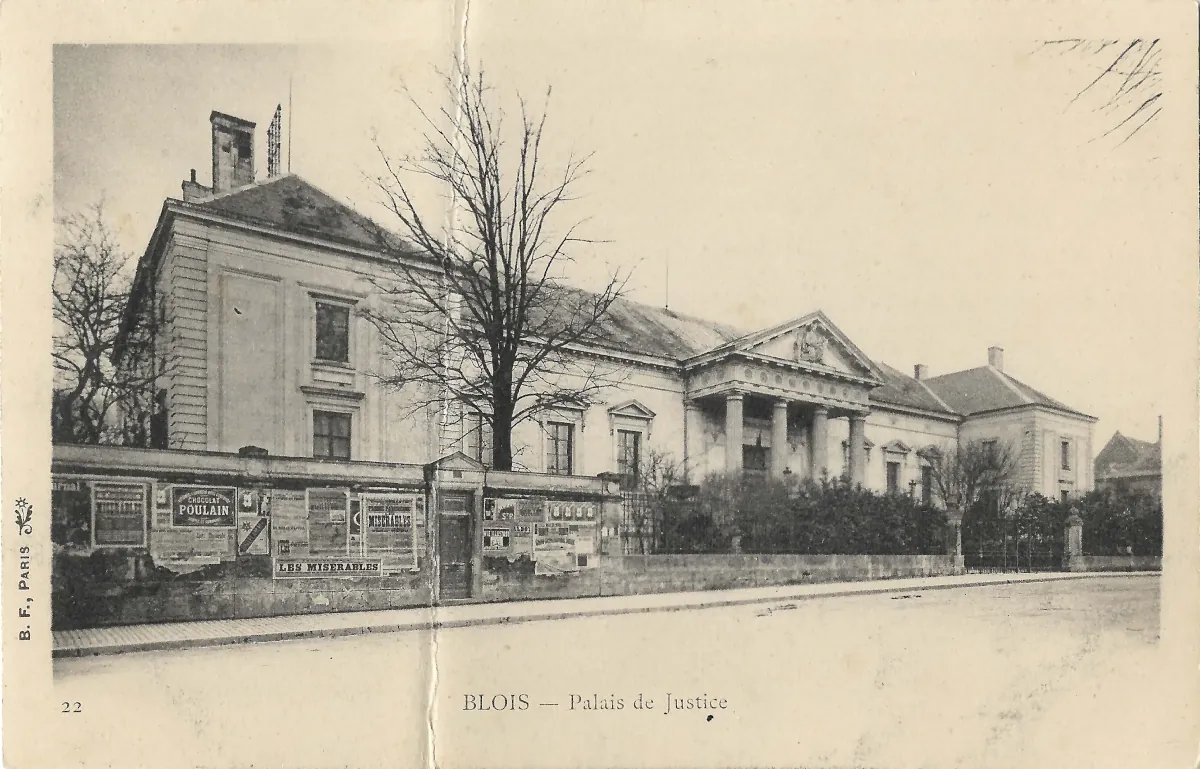
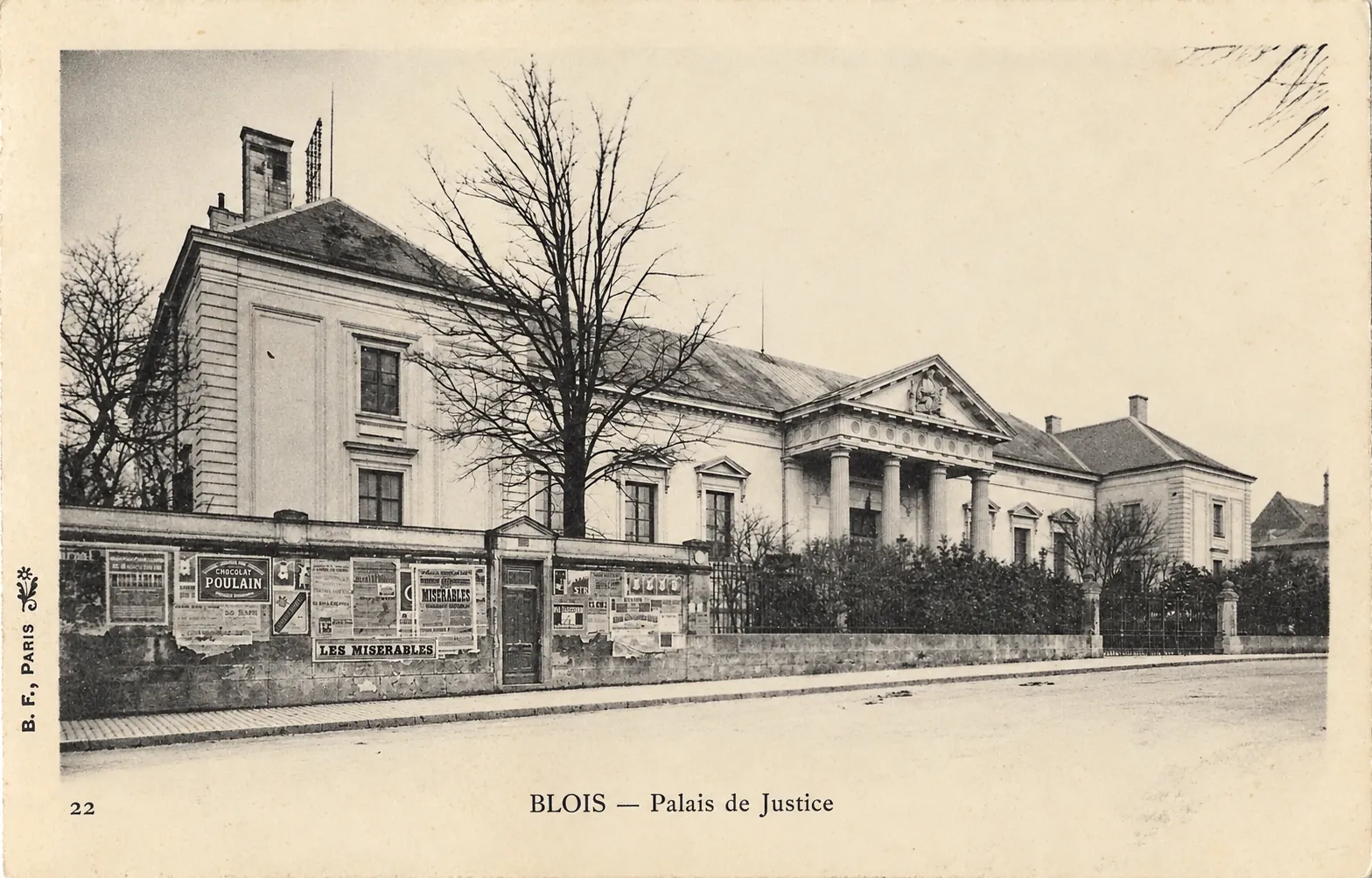
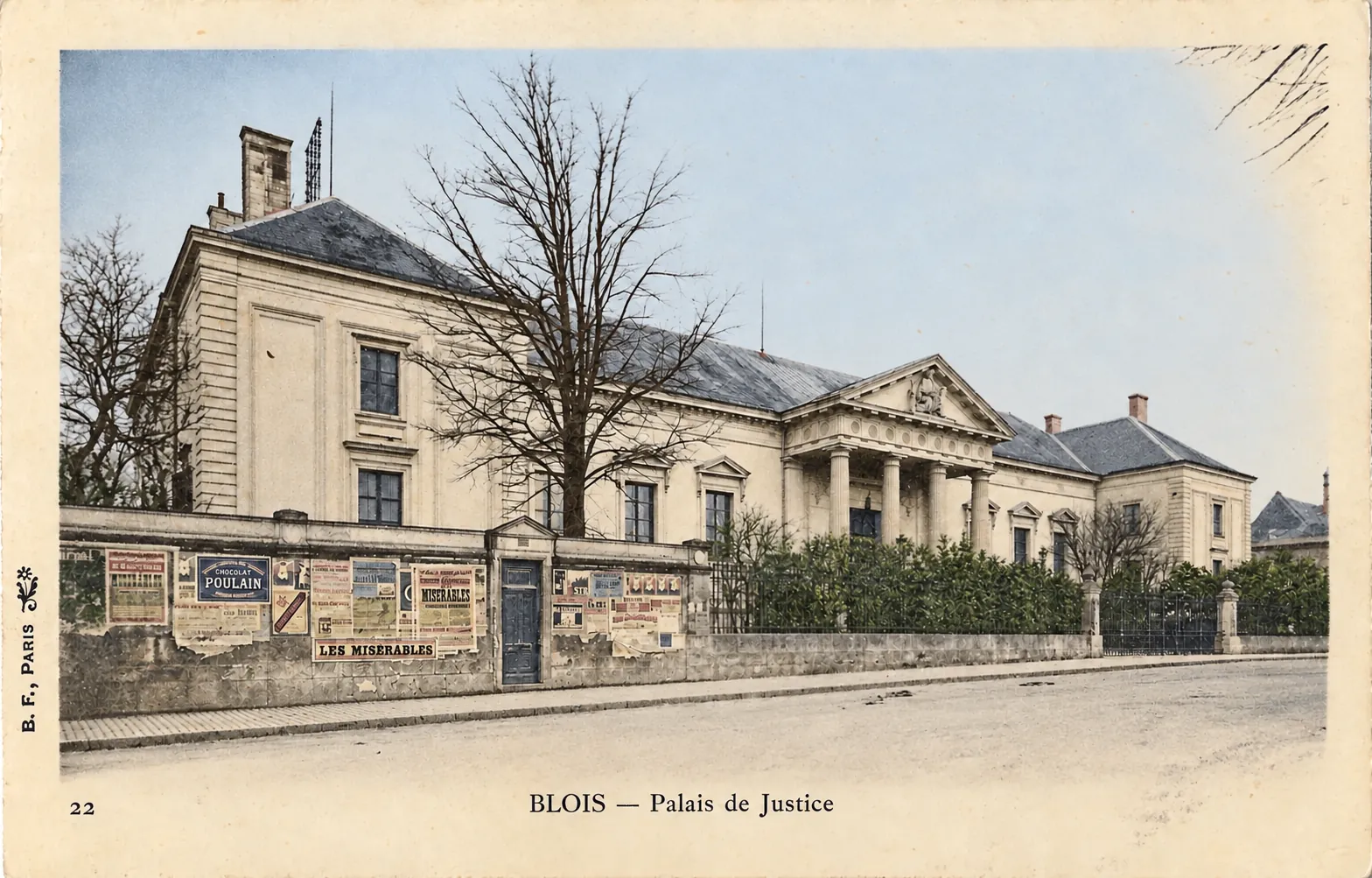
Blois courthouse is shown on this historic postcard in an angled view encompassing its principal façade, end pavilions and street boundary. The printed caption, “BLOIS — Palais de Justice”, explicitly identifies the building in Blois, in the French department of Loir-et-Cher. The photograph concentrates on the courthouse and its immediate surroundings: an open roadway, a pavement, leafless trees and a wall covered with posters.
The building consists of an elongated central range distinguished by a columned portico and a triangular pediment. This classically inspired entrance provides the main architectural focus. Sculptural decoration is visible within the pediment, although the image does not show enough detail to identify its subject securely. Below it, a frieze of repeated ornamental motifs emphasises the horizontal line of the entablature.
Windows punctuate the façade on either side of the entrance. Some have small triangular pediments, echoing the larger feature above the portico. Hipped roofs crown the pavilions at both ends of the building. The nearer pavilion, on the left, reveals the architectural detailing particularly clearly, including its horizontally banded corner masonry, window surrounds and prominent cornice.
The boundary between the courthouse grounds and the street changes across the photograph. On the left, a solid wall provides a broad surface for public notices and advertisements. A narrow doorway interrupts this wall beneath a small triangular masonry cap. Towards the centre and right, iron railings rise above a low boundary wall. Dense shrubs partly conceal the space in front of the entrance, and a gate can be distinguished on the right.
Trees are a conspicuous part of the setting. The largest stands in front of the left-hand section of the building, its bare branches extending across the façade and roof. The lack of foliage suggests that the photograph was taken during the colder months or in early spring, although it cannot establish a particular month.
No clearly identifiable vehicle occupies the foreground. The uncluttered roadway leaves the architecture and advertising wall especially prominent. The resulting composition places the formal courthouse beside the everyday visual culture of the street.
Historical description
The postcard’s monochrome appearance, its caption in the lower margin and the overall character of the scene suggest an early twentieth-century issue. An approximate range of 1900–1920 is plausible, but remains an estimate. No sufficiently legible year establishes when the photograph was taken or when this particular card was printed.
The number 22 appears in the lower-left corner. The left margin also carries the vertical inscription “B. F., PARIS”, together with a small decorative emblem. These are useful features for documenting the card’s publication, but the initials alone do not securely identify a particular individual or publishing business.
The posters provide some of the photograph’s most revealing details. An advertisement for Poulain chocolate is clearly recognisable, while the title “Les Misérables” appears on several notices. The smaller print is insufficiently legible to determine whether these advertised a theatrical performance, a film screening, a publication or another related offering. The title therefore cannot safely be used to date the scene through a specific adaptation.
These temporary notices give the image a value beyond its record of the courthouse. They show the boundary wall serving as a public advertising surface, bringing commercial promotion and cultural publicity into the same streetscape. Their varied sizes and close arrangement contrast with the ordered composition of the architecture behind them.
The courthouse’s columns, pediment and balanced volumes convey the formality of a judicial institution. The postcard thus records both an enduring civic building and the short-lived messages displayed along its perimeter. The posters are particularly valuable because such everyday material could easily disappear without leaving a comparable visual record.
The surviving copy also shows a pronounced vertical crease, surface wear and handwritten marks in the upper-right corner. These marks cannot be read confidently enough to extract a date or a meaningful inscription. They document the physical condition of the postcard rather than providing dependable evidence for its chronology.