Blois – Hotel d’Angleterre and Rue Denis-Papin
Geographic description
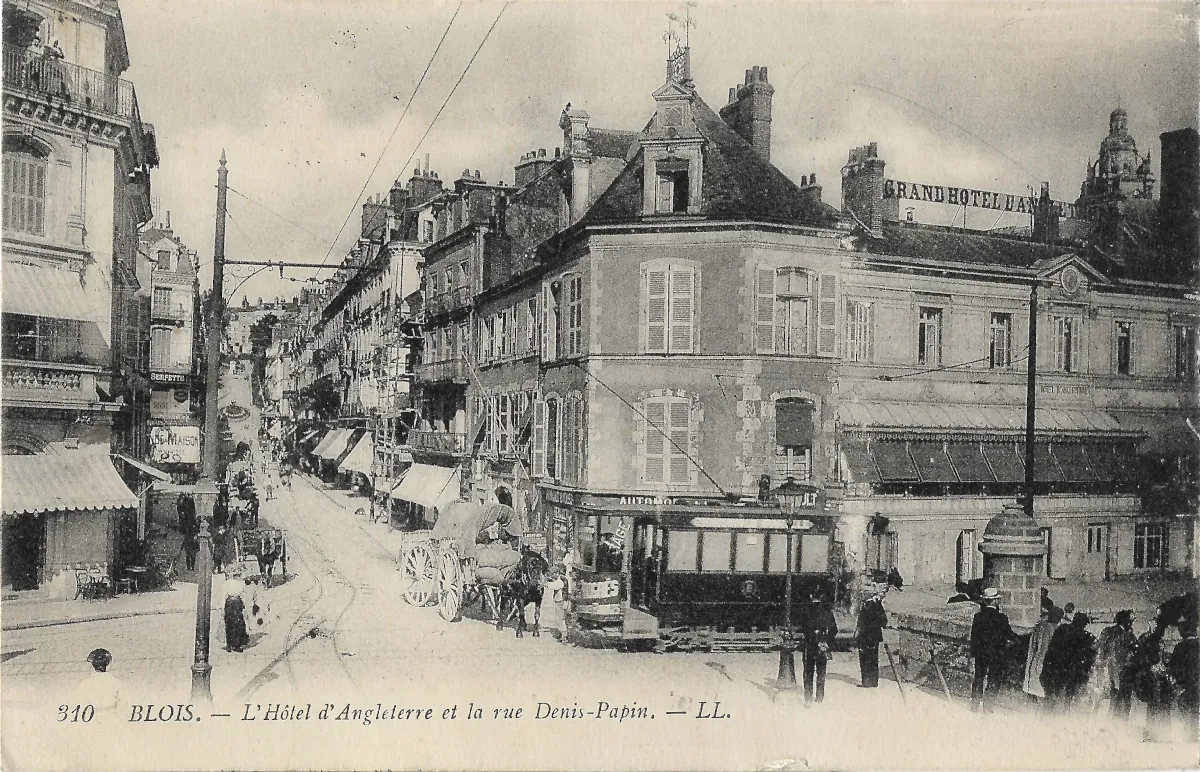
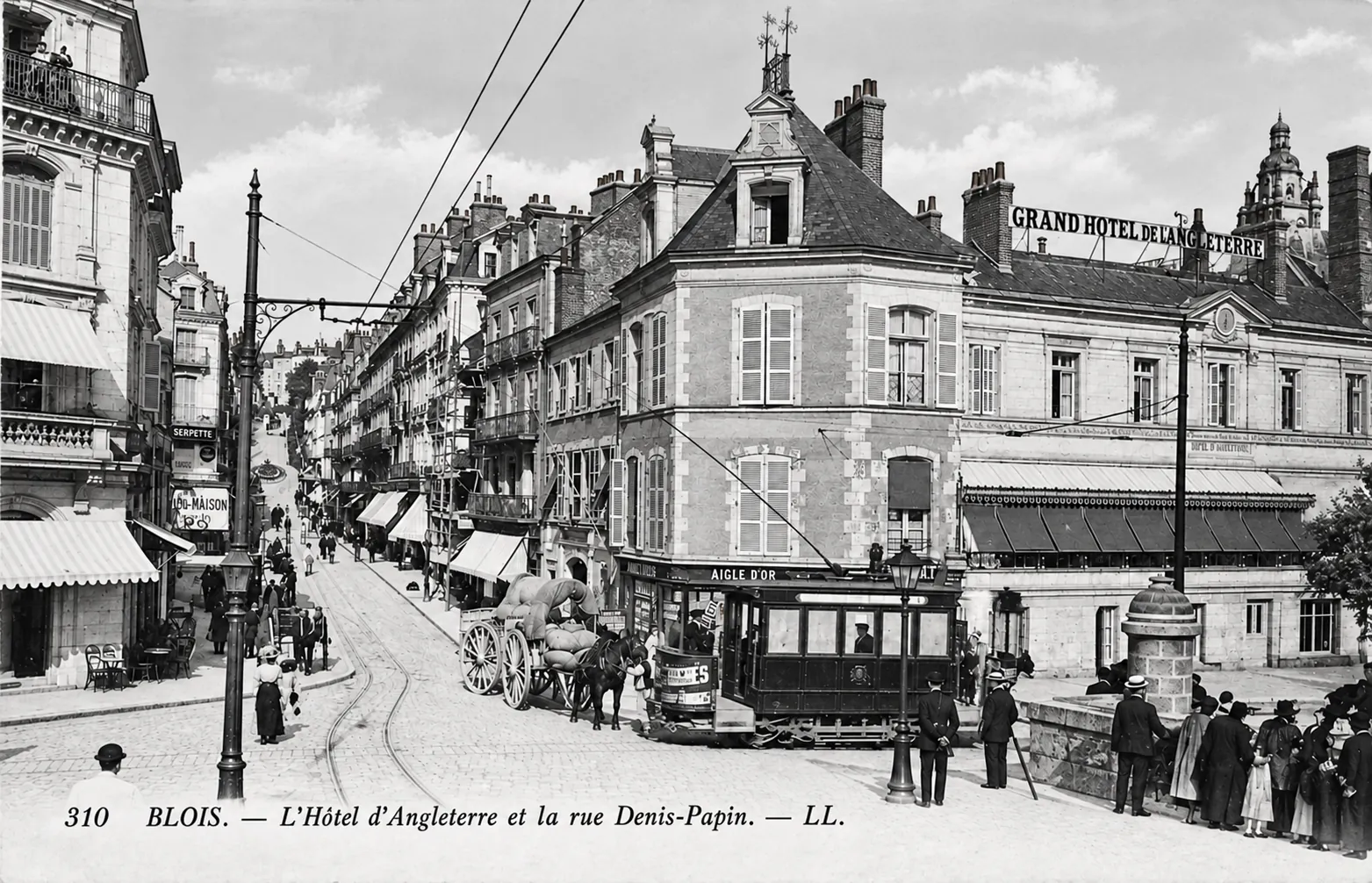
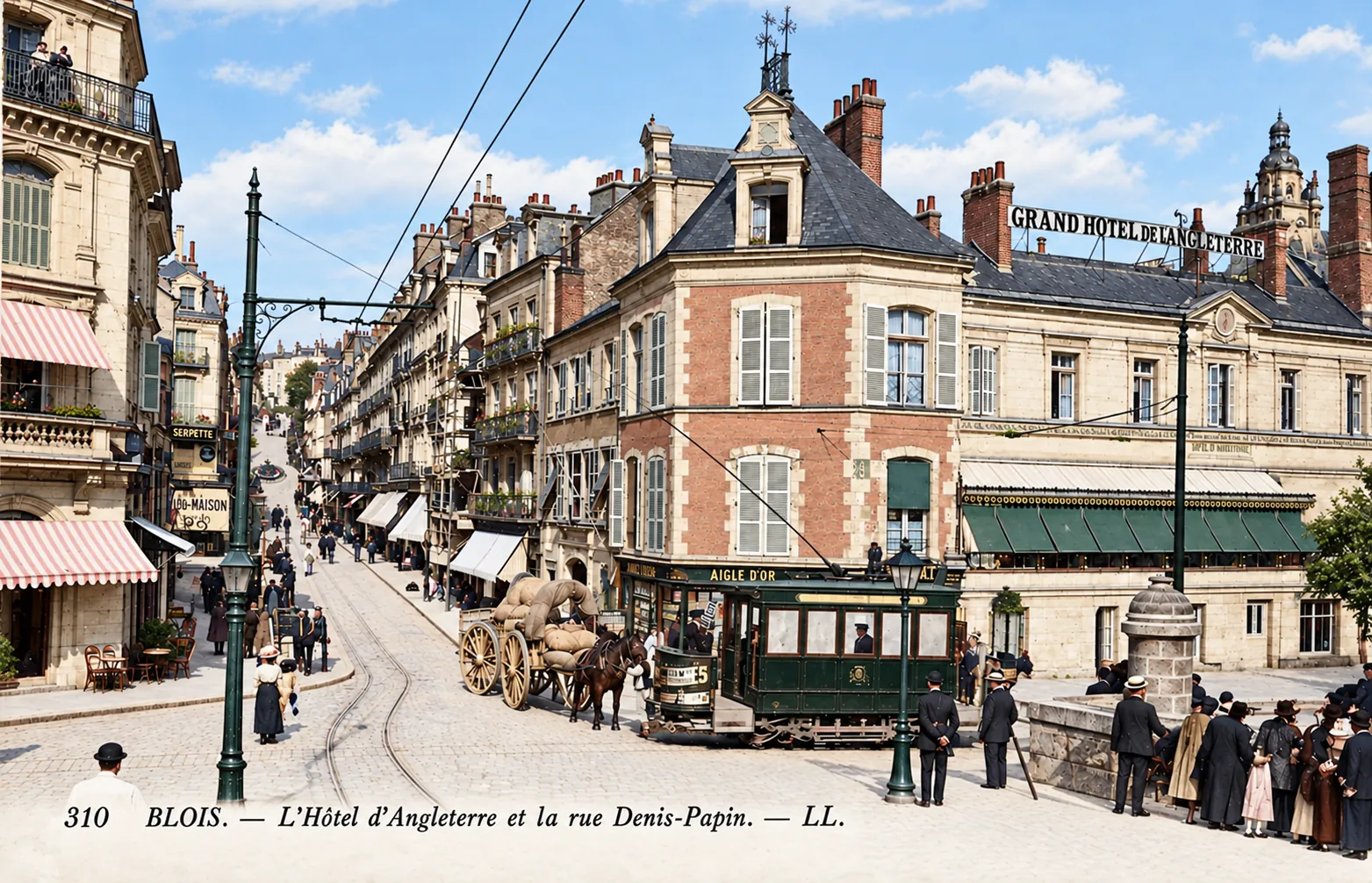
The Hotel d’Angleterre in Blois dominates this early postcard view of Rue Denis-Papin, one of the streets crossing the historic centre of the city. The hotel stands prominently on the right-hand side of the foreground, at the corner of the steep street rising towards the upper parts of Blois. Its name can be seen both on the building itself and on the large rooftop sign advertising the establishment as a grand hotel.
The photograph gives an excellent impression of the distinctive topography of Blois. Rue Denis-Papin climbs steadily away from the foreground between continuous rows of multi-storey buildings. This pronounced gradient reflects the geography of the city, which developed between the Loire valley and the higher ground overlooking the river.
The Hotel d’Angleterre is the principal architectural feature on the right. Its appearance is characteristic of nineteenth-century French urban architecture, with regularly arranged windows, external shutters, a steeply pitched roof, dormer windows and several large chimney stacks. A lower wing extends to the right, while what appears to be a covered terrace or glazed area occupies part of the ground floor. The huge rooftop lettering made the hotel highly visible to travellers approaching the junction.
Rue Denis-Papin itself is clearly a busy commercial street. Numerous shops occupy the ground floors of the buildings on both sides. Large fabric awnings project above the pavements, protecting shopfronts from sun and rain. Several commercial signs can also be distinguished, although many of the smaller inscriptions are not sufficiently clear to be identified with certainty.
Transport is one of the most informative elements of the photograph. Rails run through the roadway, while an electrically powered public transport vehicle stands immediately in front of the hotel. Overhead wires cross the scene and follow the street, providing further evidence of an electric traction system.
At the same time, traditional horse-drawn transport remains very much in use. A large carriage pulled by a horse can be seen beside the electric vehicle. The two forms of transport appearing together in virtually the same part of the street make the photograph an especially evocative record of technological change.
This coexistence illustrates a transitional period in French urban life. Electric transport systems were becoming symbols of modernity, but horses continued to play an essential role in both passenger and goods traffic. The transformation of city transport therefore took place gradually rather than abruptly.
Pedestrians add considerable life to the scene. Several people stand near the hotel and the junction, while others can be seen farther up the street. Their dark clothing and hats are consistent with fashions of the early twentieth century. The roadway itself remains an open shared space, used simultaneously by pedestrians, horse-drawn vehicles and public transport.
The postcard therefore records far more than an individual hotel. It captures an entire urban environment: a steep commercial street, densely built blocks, traditional architecture, electric infrastructure, horse traffic and the everyday movement of pedestrians. Together these elements provide a vivid impression of central Blois before the major upheavals and rebuilding campaigns of the twentieth century.
Historical description
The photograph was most probably taken during the early decades of the twentieth century, with the 1910s or early 1920s providing a plausible approximate period. An exact year cannot be established solely from the front of the postcard, but several visible features help narrow the dating.
The electric transport system is the strongest chronological clue. Rails are clearly embedded in the road, and overhead electrical lines run through the junction and along the street. The public transport vehicle standing beside the Hotel d’Angleterre also resembles the type of early electric cars introduced into many French towns and cities during this period.
Immediately beside this modern infrastructure, however, a horse-drawn carriage remains in everyday use. Horses were still essential for local passenger transport, deliveries and commercial traffic. Their coexistence with electric public transport is particularly characteristic of a transitional era when new technologies were spreading through French cities but had not yet displaced older forms of mobility.
Private motor cars are notably absent or at least not clearly identifiable in this view. Pedestrians move freely through the roadway, and there are none of the lane markings, traffic lights or extensive road signs associated with later twentieth-century urban traffic. The street therefore still functions according to patterns established during the nineteenth century.
Rue Denis-Papin already appears to have been an important commercial thoroughfare. Shopfronts, awnings and signs extend far up the slope, demonstrating the concentration of retail activity along the street. The Hotel d’Angleterre occupied an advantageous position at the busy junction and would have benefited from the movement of travellers through this part of Blois.
The words “Grand Hôtel d’Angleterre” displayed prominently above the roof suggest an establishment seeking to attract visitors from outside the city as well as local customers. Hotels of this type played an important role in towns connected to regional and national transport networks. Their guests could include tourists, travelling salesmen and other visitors staying in Blois on business or while exploring the Loire region.
Architecturally, the setting still belongs largely to the nineteenth century. Narrow façades, multi-storey buildings, slate roofs, dormer windows and numerous chimneys form a dense traditional townscape. Modern electrical equipment and public transport have therefore been introduced into a much older built environment.
The printed caption provides an unambiguous identification of the scene: “310 – Blois. – L’Hôtel d’Angleterre et la rue Denis-Papin. – LL.” The number 310 was presumably the reference assigned to the view within an illustrated postcard series. The initials “LL.” appear to identify the publisher or series, but the mark alone is insufficient to establish a more precise date without additional documentary evidence.
Blois would experience major changes during the decades that followed. Parts of the central city were seriously affected by wartime destruction during the Second World War, after which reconstruction and modern road planning altered sections of the urban landscape. Views such as this therefore have considerable documentary value because they preserve the appearance and atmosphere of streets before those transformations.
The postcard ultimately records a city at a turning point. Electric transport and modern commercial activity point towards the twentieth-century city, while horse-drawn traffic, nineteenth-century architecture and traditional street life still dominate much of the scene. The Hotel d’Angleterre and Rue Denis-Papin provide the setting for an unusually rich snapshot of that transition.