Blois Castle – The Porcupine Fireplace
Geographic description
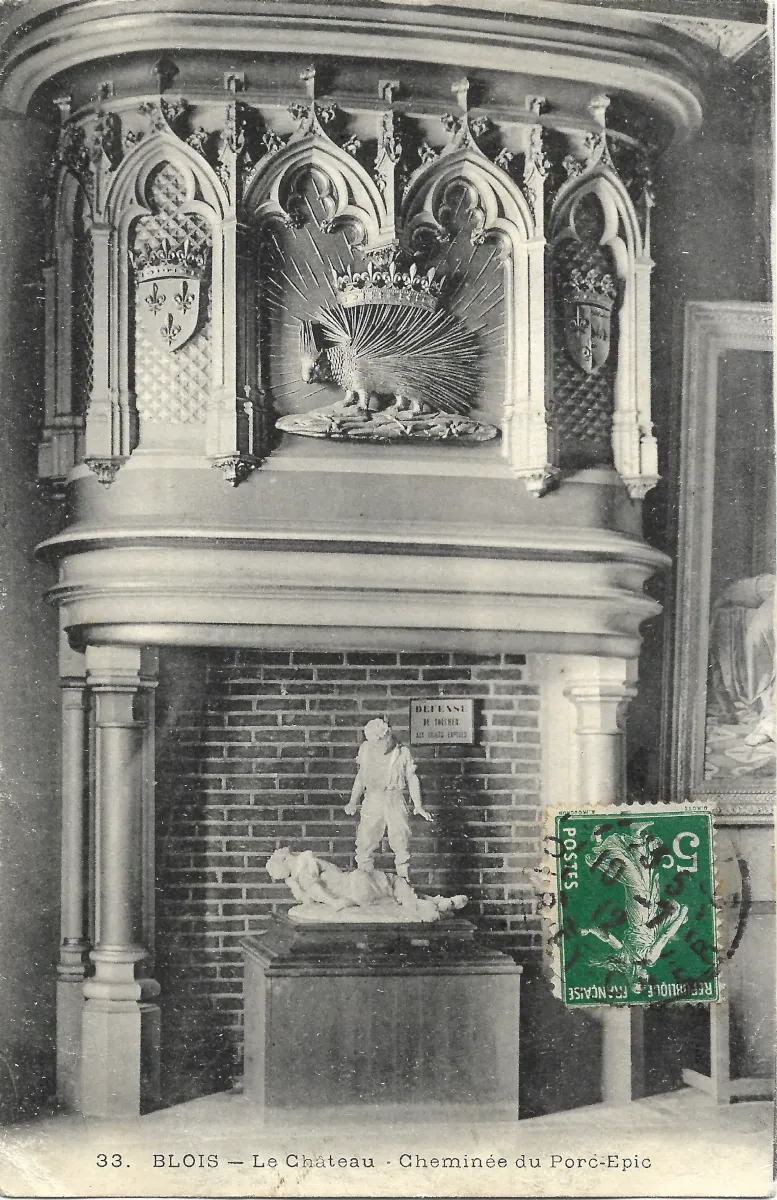
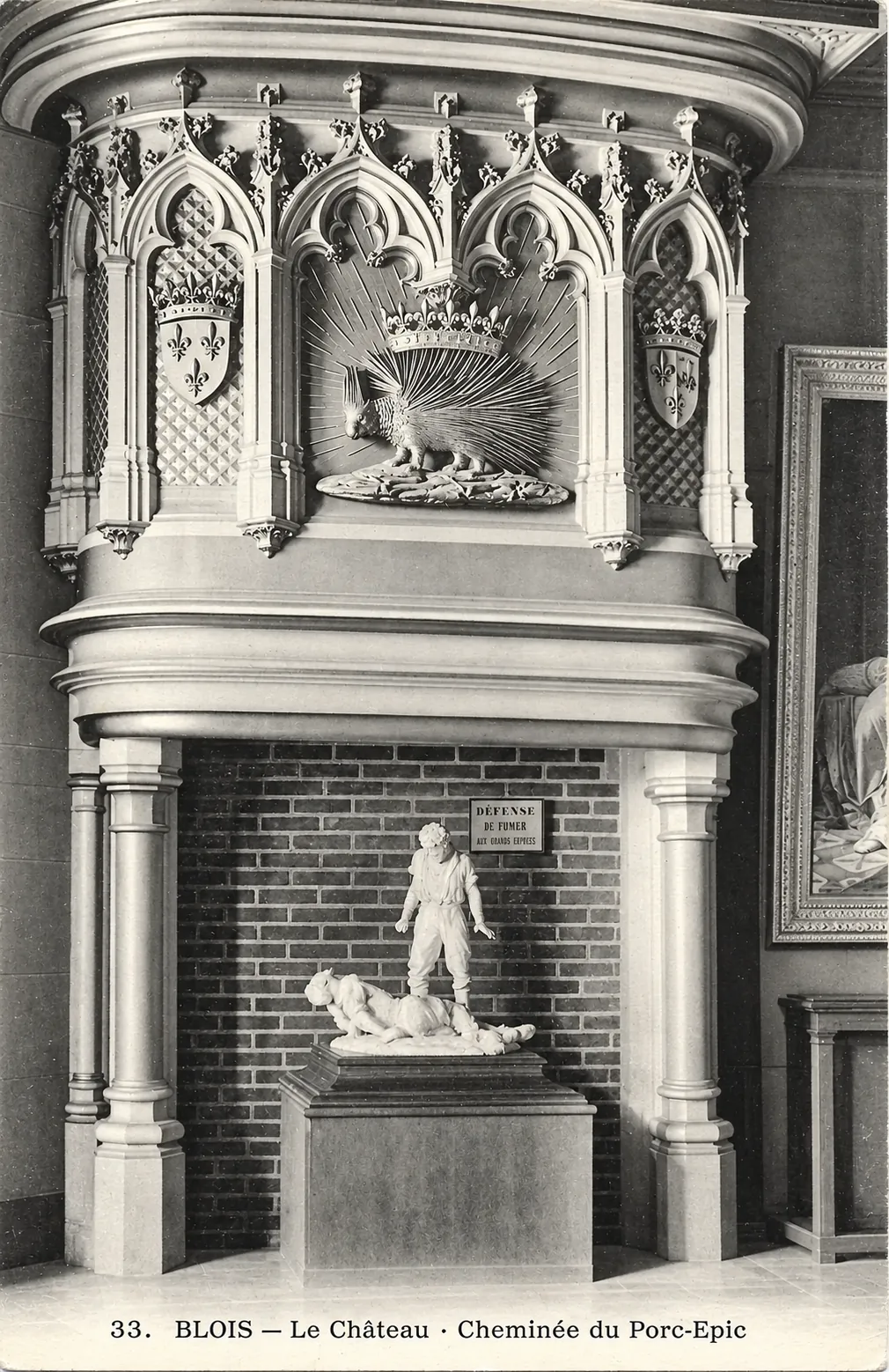
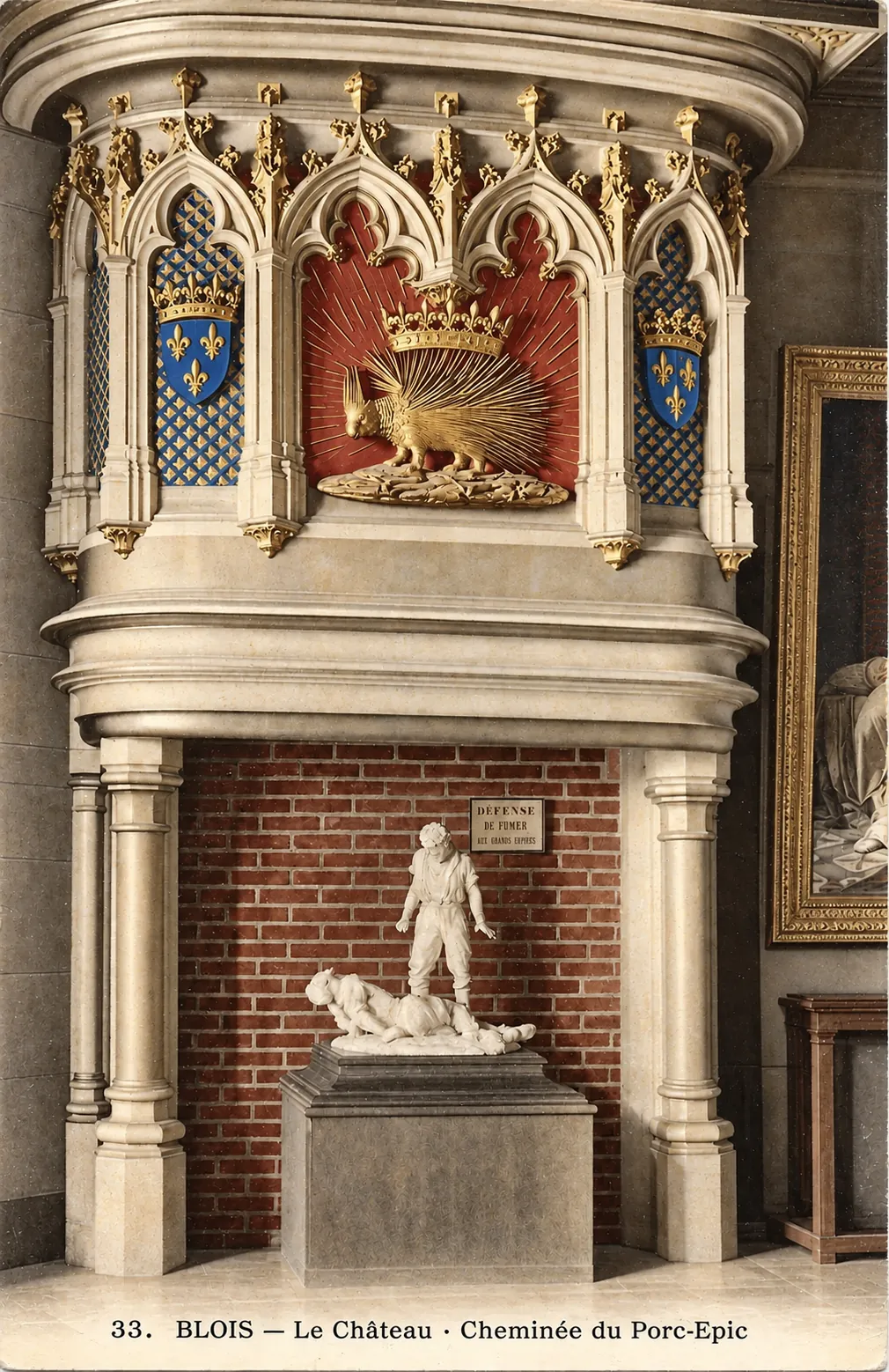
The Porcupine Fireplace at Blois Castle is located in the Louis XII wing of the royal château in Blois, in the Loir-et-Cher department of central France. This old postcard offers a close view of the monumental fireplace and its elaborate decoration, which brings together several symbols associated with King Louis XII and his wife, Anne of Brittany.
The upper section is framed by finely carved stonework in the Flamboyant Gothic tradition. Slender colonnettes divide the composition into pointed ornamental bays, while crockets, pinnacles and foliage create the intricate vertical effect characteristic of French architecture around the transition from the late Middle Ages to the Renaissance.
At the centre is a large crowned porcupine, shown in profile with its long quills radiating dramatically around its body. The porcupine was the personal emblem of Louis XII and appears repeatedly throughout the parts of Blois Castle associated with his reign. The crown above the animal clearly emphasizes its royal significance.
Heraldic decoration appears on either side. On the left, a crowned shield bearing fleurs-de-lis can be clearly distinguished. Decorations in the Louis XII wing frequently combine the king’s devices and monograms with those of Anne of Brittany. French heritage records specifically identify this fireplace as being decorated with the porcupine and with the monograms of Louis XII and Anne of Brittany.
Below the sculpted section is the large fireplace opening itself. Its dark brickwork forms a strong visual contrast with the pale stone surround. A small sculptural object or model stands in front of the brick background. A notice is also visible above it, although the lettering is too indistinct on this postcard to be transcribed reliably.
The photograph is tightly framed, leaving almost none of the surrounding room visible. Its purpose was therefore not to document the overall arrangement of the royal apartments but to isolate one particularly striking architectural feature. Such close studies of carvings, fireplaces, staircases and sculptures were common in postcard series devoted to major French monuments.
Blois Castle rises above the historic centre of Blois and the Loire Valley. One of its distinctive features is the juxtaposition of several major building campaigns, ranging from medieval structures to the Louis XII, François I and Gaston d’Orléans wings. The fireplace shown here belongs to the decorative world of the Louis XII wing, which reflects the transition between late Gothic architecture and the first French Renaissance.
Historical description
The Porcupine Fireplace is closely associated with the reign of Louis XII, king of France from 1498 to 1515. Blois became one of his principal royal residences, and substantial building work was undertaken there during his reign. The wing now bearing his name was created during a period when French architecture was gradually moving away from the late Gothic tradition and beginning to absorb Renaissance influences from Italy.
The porcupine was one of the most recognizable elements of Louis XII’s royal imagery. The device had already been associated with the House of Orléans before Louis became king, but during his reign it was used extensively on royal buildings, furnishings and decorative programs. At Blois, it often appears alongside symbols connected with Anne of Brittany, Louis XII’s queen and the sovereign duchess of Brittany. French national heritage collections preserve several early photographs identifying a fireplace in the Louis XII wing decorated with the crowned porcupine and other royal devices.
The postcard itself is, of course, much later than the fireplace. Its photographic style, vertical format and printed caption — “33. BLOIS – Le Château. Cheminée du Porc-Epic” — are typical of the great period of illustrated postcard production in the early twentieth century.
An additional dating clue is provided by the green 5-centime postage stamp attached to the picture side. It belongs to the French Semeuse series based on the design by Louis-Oscar Roty. The 5-centime green denomination of this type entered general circulation in March 1907 and was withdrawn in 1921. The postal use of this particular card can therefore reasonably be placed within that period, provided that the stamp belongs to the card’s original mailing.
The presence of the stamp on the illustrated side also reinforces the postcard’s character as a genuine piece of early twentieth-century postal history. At the time, illustrated postcards were produced and exchanged in enormous numbers. They were both a practical means of communication and a form of inexpensive visual souvenir. Historic monuments, and especially the châteaux of the Loire Valley, became particularly popular subjects.
Publishers did not restrict themselves to general views of monuments. They also produced close studies of interiors and architectural details that tourists were likely to recognize after a visit. The Porcupine Fireplace was particularly suitable for such treatment because its royal symbolism could be understood almost immediately. Rather than simply documenting an interior, the photographer turned one piece of decoration into a visual emblem of the reign of Louis XII.
An early photograph preserved by the Musée d’Orsay likewise records a fireplace at Blois Castle decorated with the emblems of Louis XII and Anne of Brittany, demonstrating that this type of architectural detail attracted photographers even before the great postcard boom.
The postcard therefore combines two different historical periods within a single object: the royal imagery of the late fifteenth and early sixteenth centuries and the mass tourism and postcard culture of the early twentieth century. The vivid green stamp, standing out against the otherwise monochrome photograph, adds a particularly striking postal dimension to the surviving card.