Union County Courthouse in Elizabeth, New Jersey
Geographic description
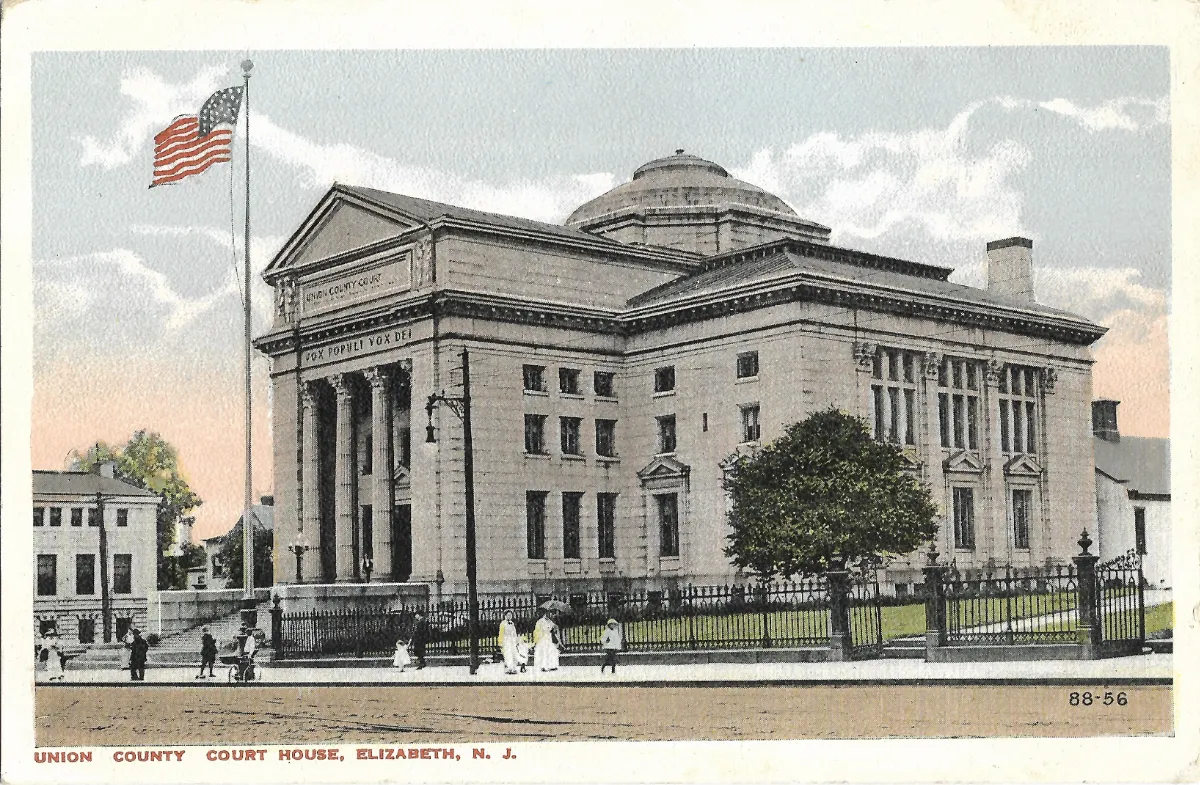
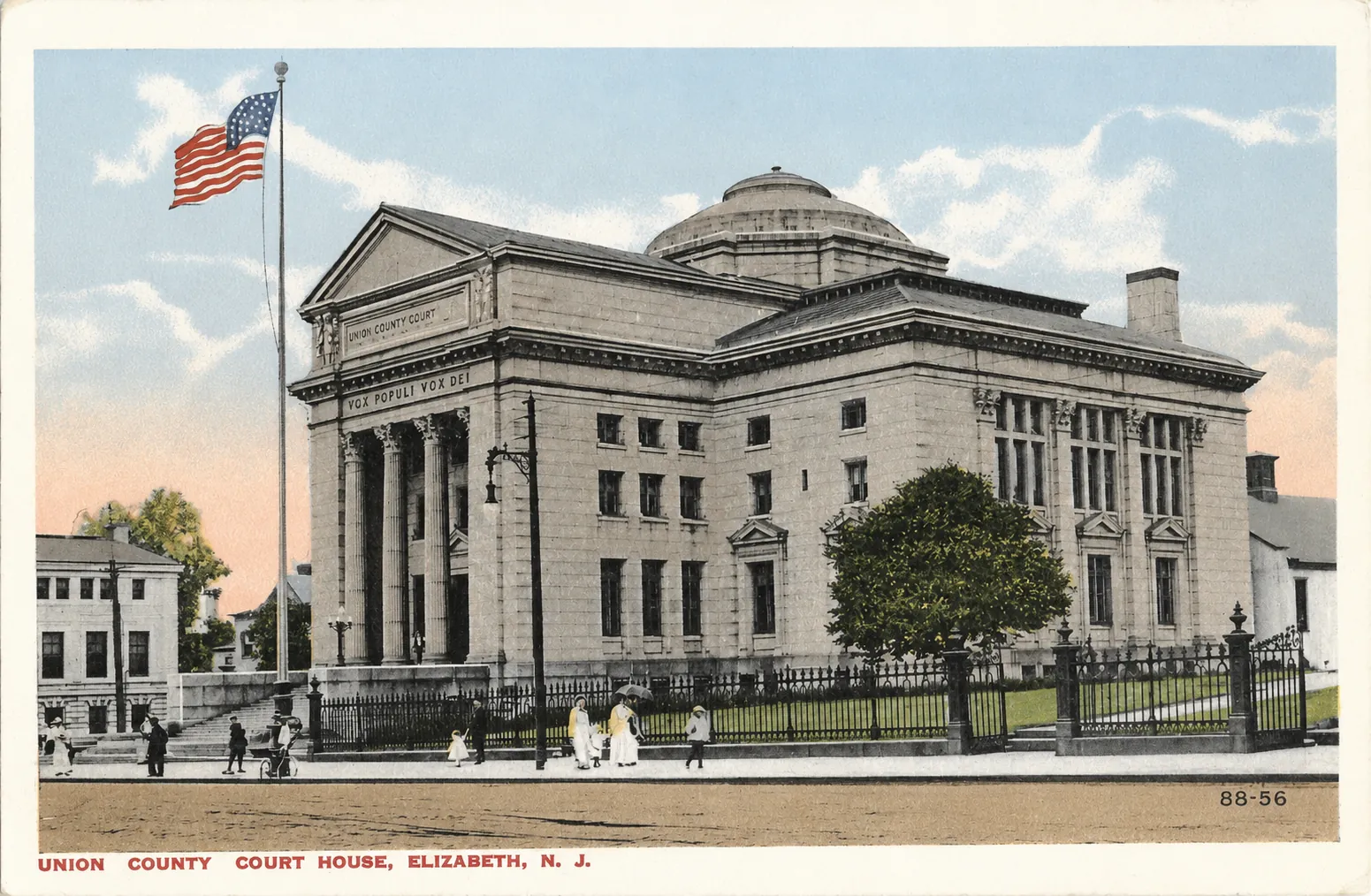
The Union County Courthouse in Elizabeth is the imposing civic building shown on this colorized vintage postcard from New Jersey. Its identity is certain because the printed caption along the lower edge reads “UNION COUNTY COURT HOUSE, ELIZABETH, N. J.” The courthouse stands in central Elizabeth at the historic Broad Street and Rahway Avenue site, where public and governmental buildings have occupied the area since the colonial period.
The postcard focuses on the earliest monumental section of the present courthouse complex. Its architecture reflects the Classical Revival style widely used for American government buildings during the early twentieth century. The principal façade is dominated by a monumental columned portico beneath a triangular pediment. Clearly visible above the columns is the Latin inscription “VOX POPULI VOX DEI,” meaning “The voice of the people is the voice of God.” The motto remained part of the historic courthouse façade and can still be documented in modern views of the building.
Behind the portico rises a broad, shallow dome. The New Jersey State Library describes the original 1905 courthouse section as a Neoclassical building with a large portico and a low central dome covering an interior rotunda. The side elevation visible on the postcard is organized into regular rows of rectangular windows, with restrained Classical ornament around several openings. The balanced proportions, symmetry and massive masonry construction give the courthouse the dignified appearance expected of an important county institution.
A tall iron fence surrounds a carefully maintained lawn, clearly separating the courthouse grounds from the public sidewalk. Several pedestrians can be seen outside the fence, including men, women and children. Their presence gives a useful sense of scale to the architecture. Some of the women appear to wear long skirts or dresses and hats, while the men are generally shown in dark clothing. Although these figures are consistent with the early twentieth century, they are too small to support an exact date on their own.
A large American flag flies prominently to the left of the courthouse. Its red, white and blue colors have been emphasized by the postcard’s colorization, making it one of the strongest visual elements in the composition. The street fills the foreground, where several parallel lines appear in the roadway. These may be streetcar rails. Such an interpretation would be historically plausible, since the Historical Society of Elizabeth records an internal street railway operating in the city from 1888. The postcard itself, however, does not allow the lines to be identified with complete certainty.
The surrounding buildings are considerably lower than the courthouse, allowing the civic structure to dominate the streetscape. This is particularly significant because later additions would greatly enlarge the judicial complex. The postcard therefore preserves an earlier stage in the urban development of central Elizabeth, when the original courthouse building remained the principal architectural landmark on the site.
Historical description
The courthouse shown on this postcard dates from a period of rapid civic development in Elizabeth. According to the official history of Union County, architects Ackerman and Ross designed a new county courthouse as the growing population and administration required larger facilities. A three-story building accommodating the principal county government offices and courts opened in 1905. The county identifies its architectural style as Classical Revival. The Historical Society of Elizabeth gives 1903 as the construction year, a difference that can reasonably reflect the distinction between the building process and its formal opening.
The location itself has a much longer civic history. Union County records indicate that a government or community building stood on the site as early as the seventeenth century. The Elizabethtown Meeting House is mentioned from 1668, and several later structures occupied the property. Some were destroyed during the Revolutionary era or by fire. After Union County separated from Essex County in 1857, expanding government functions gradually created the need for the larger purpose-built courthouse seen here.
The photograph used for this postcard must therefore have been taken after the construction of the new courthouse. More importantly, it shows none of the tall later structures that eventually changed the skyline of the complex. The New Jersey Judiciary states that a seven-story annex was added in 1925, followed by a 17-story tower in 1931. The 1931 tower is conspicuously absent from this view.
For that reason, together with the clothing of the pedestrians and the relatively open streetscape, the underlying photograph was probably taken sometime between 1905 and the 1920s. This remains an estimate rather than a firm date. The postcard itself could have been printed later, since publishers commonly continued using older photographs for subsequent editions.
Its printing technique also points toward the early postcard era. The scene appears to have originated as a monochrome photograph that was subsequently given printed or applied color. The pale blue sky, green grass, warm stonework and strongly colored American flag have the characteristic appearance of an artificially colorized photographic postcard rather than genuine color photography. The small reference “88-56” in the lower-right corner is probably a publisher’s series, negative or production number. Since no publisher’s name can be read on the front, assigning the card to a particular company would be speculative.
The postcard is especially interesting because it captures the courthouse before later construction overwhelmed the scale of the original Classical Revival structure. The monumental columns, low dome, iron fence, American flag and “Vox Populi Vox Dei” inscription combine to present an idealized image of civic authority and democratic government. The 1905 section has survived as part of the present courthouse complex, even though the 1925 annex and 1931 tower subsequently transformed its architectural setting.