Elizabeth, New Jersey – The Old Fort near Bridge Street
Geographic description
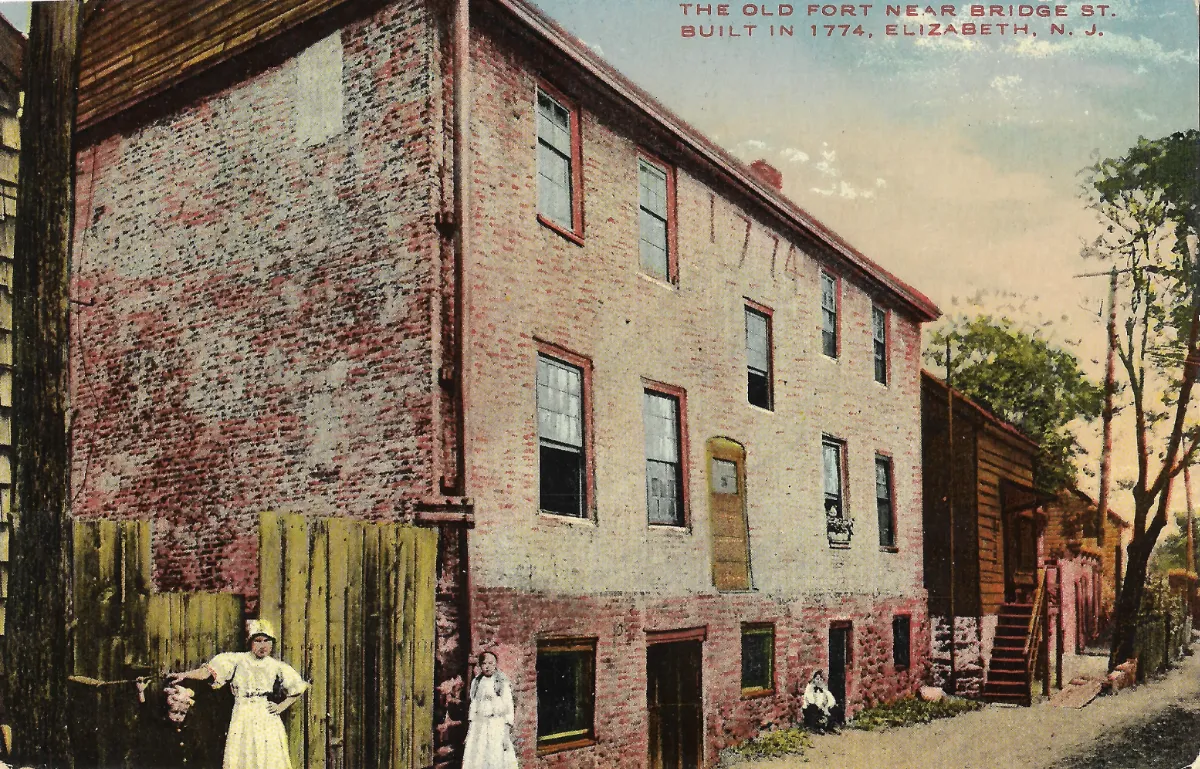
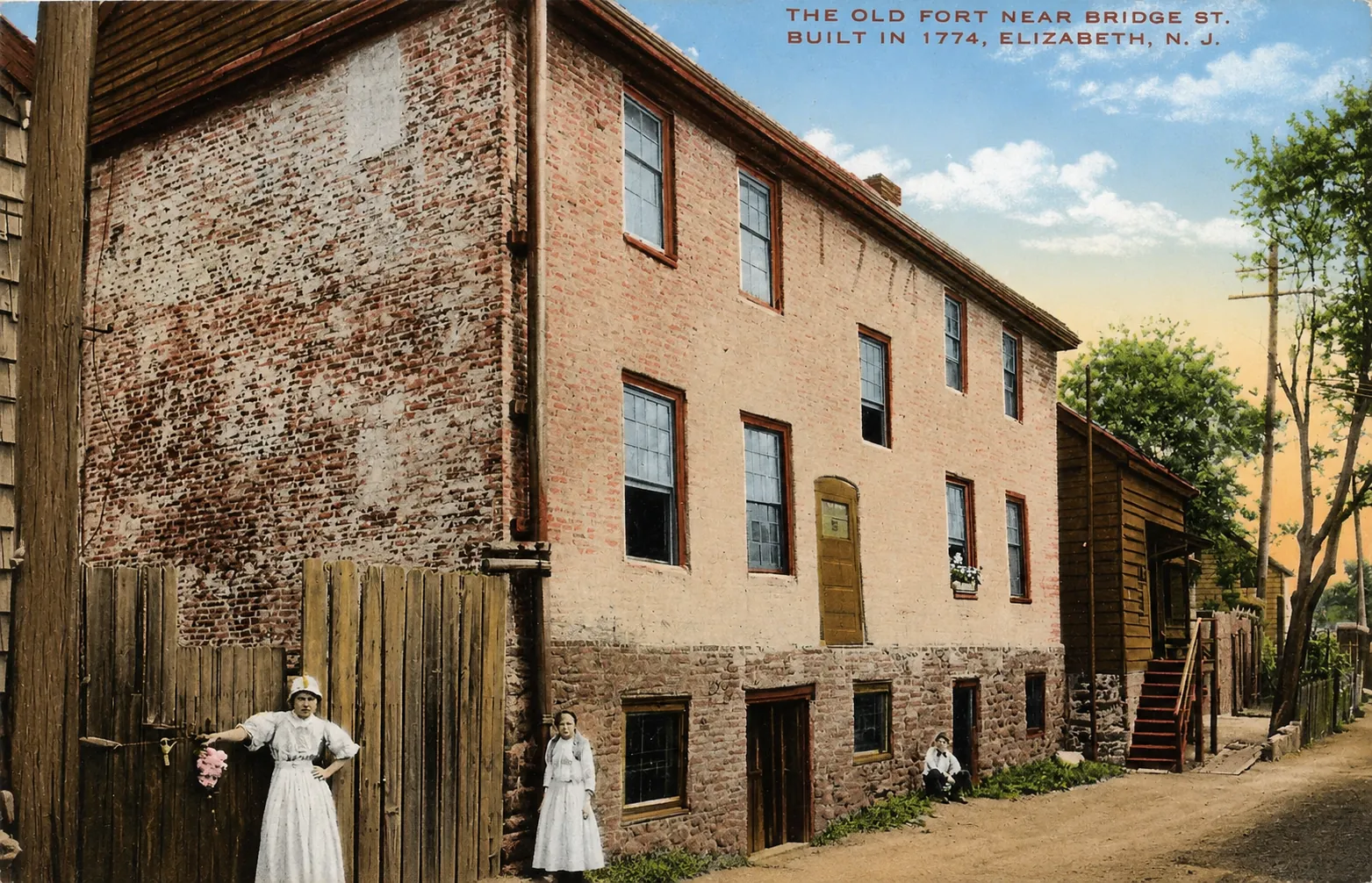
TThe Old Fort in Elizabeth NJ is shown on this vintage postcard as a substantial brick house standing near Bridge Street.The printed caption identifies it simply as being “near Bridge St.,” while historical documentation provides the more precise location of Thompson’s Lane near Bridge Street, within the older part of Elizabeth.
The long building dominates the center of the scene. Its architecture is plain and practical, with little exterior ornamentation. Much of the front elevation appears whitewashed or coated with a pale finish, although red brick remains clearly visible around the lower level and particularly on the large side wall at the left. That side wall has a noticeably uneven appearance, with patches and variations in the masonry suggesting that repairs or alterations may have taken place over the building’s long history. The photograph alone, however, does not allow individual construction phases to be identified with certainty.
The structure has several levels. Small openings are visible in the lower or basement portion, almost at ground level. Above them are the entrance and a series of tall rectangular windows, with another row of windows on the upper floor. The openings have simple surrounds, reinforcing the impression of an old utilitarian dwelling rather than an elaborately decorated mansion.
One of the most valuable features of the postcard is its depiction of the Old Fort as part of an inhabited neighborhood rather than as an isolated historic monument. A wooden structure stands immediately to the right of the brick house, reached by an exterior staircase. On the left, a tall board fence encloses what appears to be a yard. Wooden extensions, fences and modest surroundings contrast strongly with the monumental significance implied by the words “Old Fort.”
Several residents or passers-by give the scene a human scale. Two women stand near the fence and the front of the property, with another figure farther along the building and an additional person near the right edge of the view. Their long dresses are consistent with the early twentieth century, although clothing alone cannot provide a precise date. The colors should also be treated cautiously because this is a colorized printed postcard rather than a modern color photograph.
The lane beside the building appears narrow and relatively undeveloped. No automobiles, streetcars or conspicuous street furniture are visible, so transportation does not provide an additional dating clue. A large tree rises on the right, while the wooden outbuildings and enclosure create an almost semi-rural atmosphere despite the property’s location in the growing city of Elizabeth.
The name “Old Fort” itself deserves caution. The historical documentation consulted describes the structure specifically as a house. None of these sources establishes that it was originally constructed as a military fortification. The name therefore appears to have been a traditional local designation for the old building rather than reliable evidence of an original defensive function.
Historical description
The postcard carries the prominent caption “THE OLD FORT NEAR BRIDGE ST. BUILT IN 1774, ELIZABETH, N.J.” The printed date of 1774, however, is almost certainly the most historically significant error on the card.
The New Jersey Historical Society inventory of photographs and prints relating to Elizabeth lists the structure as “The Old Fort – built 1734.” Even more revealing is historical documentation preserved by the New Jersey State Library. It describes the Old Fort on Thompson’s Lane near Bridge Street and states that the date 1734 could be seen on the front of the house. The same account says that the building was probably constructed by Captain John Hunloke, who died in 1745. Significantly, the author also observed that the third digit of the date appeared to have been altered, causing it to look like 1774.
This provides a convincing explanation for the postcard caption. The publisher or an earlier source may simply have read the altered inscription as 1774 and reproduced that date as fact. Based on the historical evidence presently available, 1734 is the much better-supported date. Some caution remains necessary concerning the builder: the historical account itself says that Captain Hunloke “probably” built the house, so that attribution should not be treated as certain.
The same source records that Cortlandt Van Ansdol owned and occupied the property from 1785 to 1788, and that it later belonged to William Shute. These details reinforce the interpretation of the Old Fort as a long-lived domestic building that survived from the colonial period into the later development of Elizabeth.
If the 1734 date is correct, the house was already more than forty years old when the American Revolution reached Elizabethtown. The settlement itself had deep colonial roots. Elizabeth was formally established in 1664 and is described by the Historical Society of Elizabeth as the first permanent English community in New Jersey.
The town later found itself directly in the path of Revolutionary War events. In 1776, after being driven from Fort Lee, George Washington’s Continental forces marched through Elizabeth while British and Hessian troops pursued them. British forces occupied the town in December. This Revolutionary setting may help explain why an eighteenth-century building known locally as the Old Fort acquired particular historical importance, even though the sources consulted do not demonstrate that the house itself served as an actual fort.
The postcard was probably produced in the early twentieth century, perhaps around 1905-1915. Its colorized printing, typography and the clothing of the people in the foreground are compatible with that period. This remains an approximate dating rather than a documented year because no postal cancellation or publisher information from the reverse has been supplied.
The card is especially valuable because it records both a surviving piece of colonial Elizabeth and an example of how local history was presented to early twentieth-century postcard buyers. Its incorrect “Built in 1774” caption is itself historically informative: modern archival evidence strongly suggests that the building was actually associated with the year 1734, making this postcard a striking example of an error preserved and circulated through popular printed imagery.