Elizabeth, New Jersey – Soldiers and Sailors Monument, c. 1906-1907
Geographic description
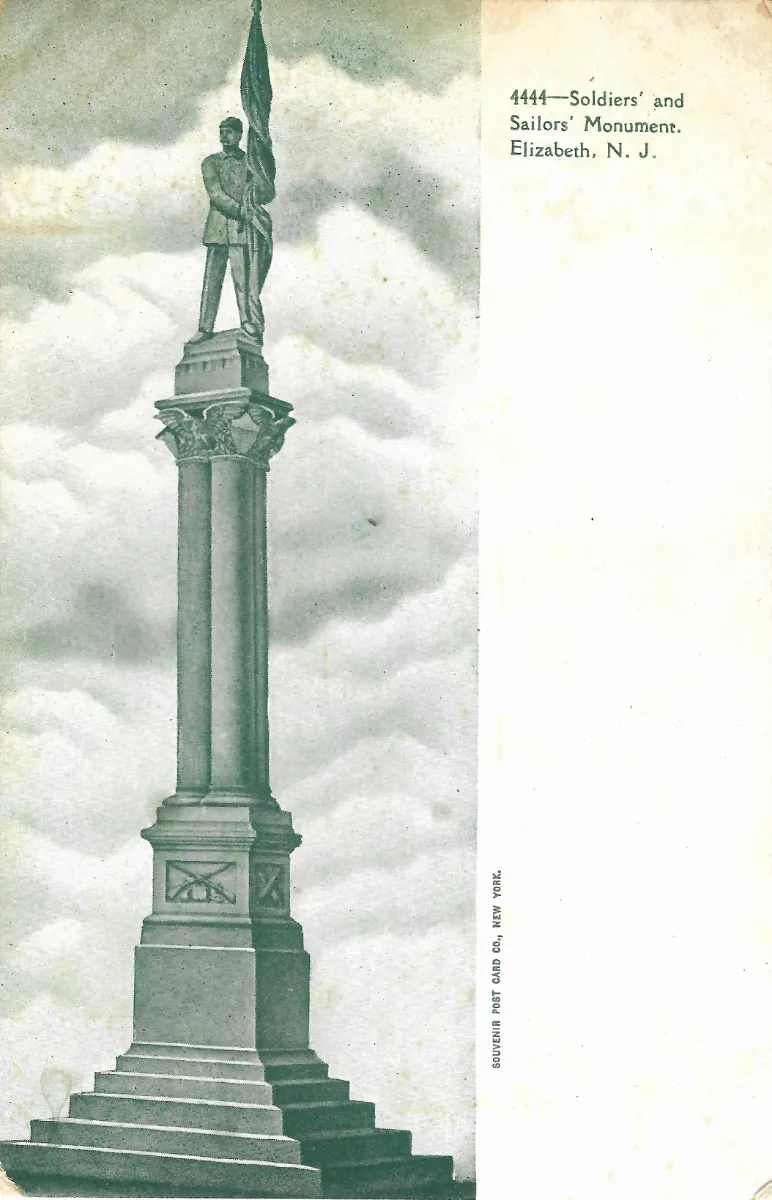
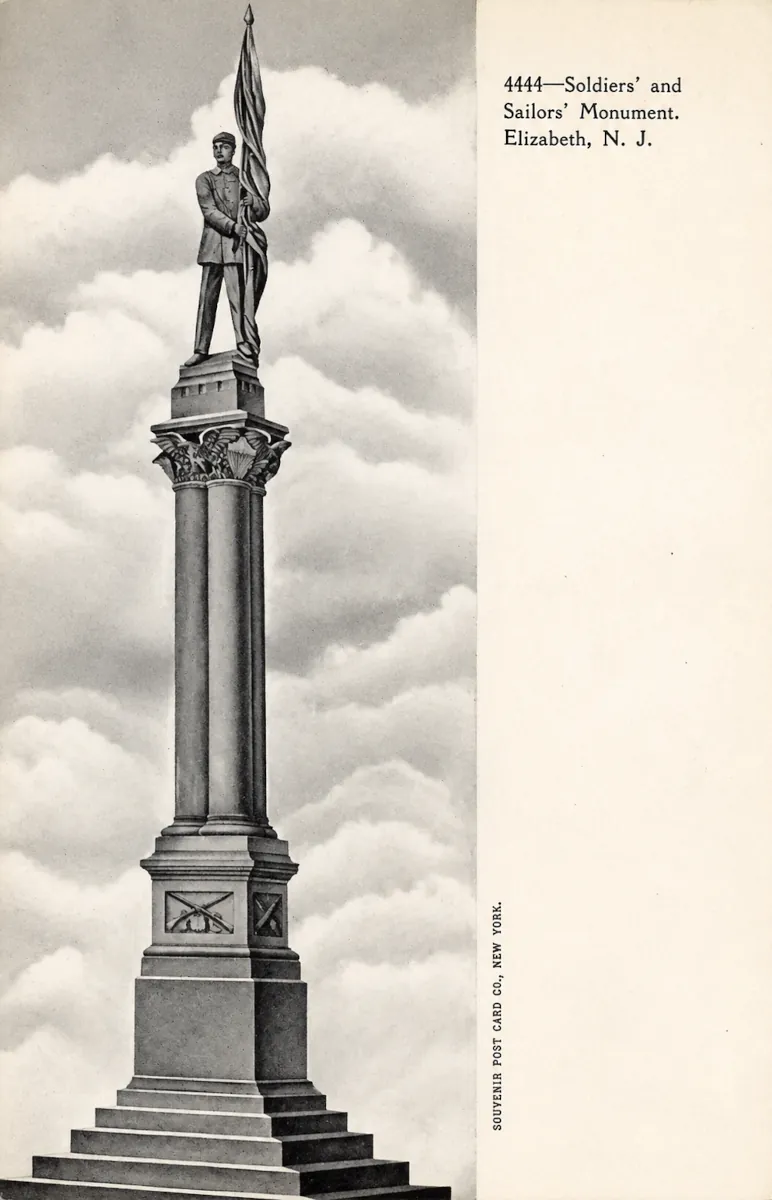
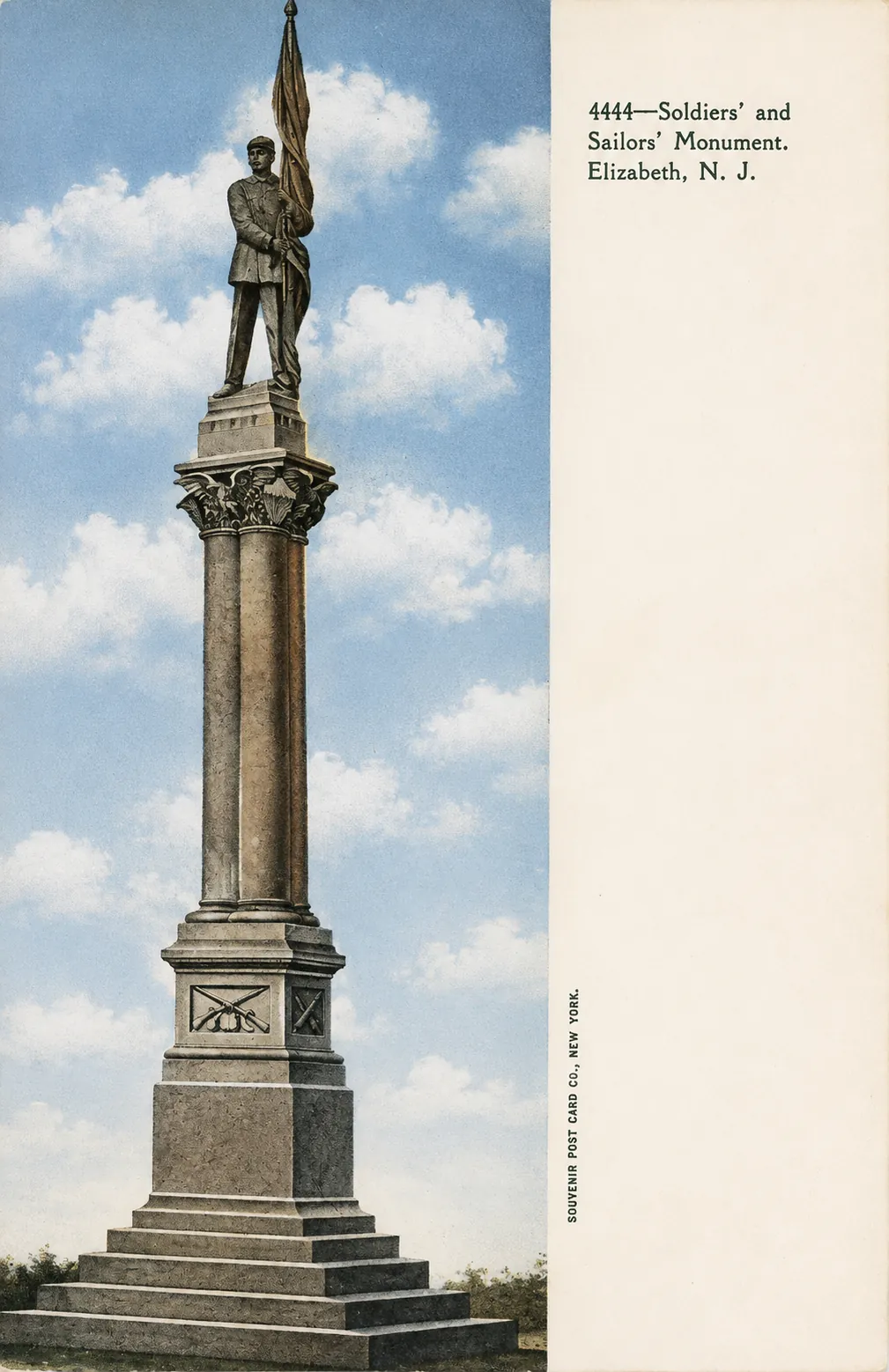
The Soldiers and Sailors Monument Elizabeth NJ dominates this early postcard view of one of Elizabeth’s major commemorative landmarks. The printed caption at upper right can be read clearly: “4444 — Soldiers’ and Sailors’ Monument. Elizabeth, N. J.” The number 4444 appears to be the publisher’s catalogue or series number for this particular view.
The photographer deliberately emphasizes the extraordinary height of the memorial. Rather than showing the surrounding streets and buildings, the postcard isolates the monument against a broad cloudy sky. A wide flight of stepped masonry supports a substantial pedestal, from which rises a tall architectural shaft composed of slender vertical columns or supports. Decorative capitals form the transition between the shaft and the statue above.
At the summit stands the figure of a Union soldier. He is shown upright in military uniform, holding the folds of a large American flag close to his body while his other hand reaches toward his sword. An early description of Elizabeth similarly portrayed the monument as a particularly imposing shaft crowned by a soldier grasping the Stars and Stripes and reaching for his sword.
The composition gives the postcard an intentionally monumental quality. The absence of pedestrians, vehicles and surrounding buildings means that it offers relatively little direct evidence about the nearby streetscape. Instead, the memorial itself becomes the sole subject, with the dramatic sky reinforcing its patriotic symbolism.
Historical geographical records help reconstruct the missing urban context. A New Jersey Geological Survey benchmark description places the Soldiers’ and Sailors’ Monument within a triangular space along North Broad Street, while Elizabeth’s current municipal code still identifies the Sailors and Soldiers Monument at the intersection of North Broad Street, Westminster Avenue and Magnolia Avenue. The monument therefore remains an established landmark within the city.
Another important clue is printed vertically near the lower edge of the white area: “Souvenir Post Card Co., New York.” The company was a prolific publisher of American city views during the early twentieth century. Museum and university collections contain examples by the same publisher dated to approximately 1905-1915, including cards produced around 1906 and examples printed in Germany, then a major centre for high-quality postcard printing.
The large blank panel occupying the right side of the front is also significant. It was intended to provide space for written correspondence while preserving a substantial photographic image, a format strongly associated with American postcards produced before divided backs became standard.
Historical description
The Soldiers and Sailors Monument in Elizabeth commemorates military service connected with the American Civil War of 1861-1865. It belongs to the large wave of civic Civil War memorials erected throughout Northern communities during the decades following the conflict, when towns and cities increasingly created permanent public monuments to the soldiers and sailors who had defended the Union.
The monument’s construction is securely documented in 1906. Its cornerstone was laid on May 30, 1906, during Decoration Day observances. A memorial address delivered by Congressman Charles N. Fowler for the cornerstone ceremony survives in a publication now represented in the Library of Congress and Internet Archive collections. Its title explicitly identifies the Soldiers’ and Sailors’ Monument at Elizabeth and the ceremony of May 30, 1906.
The completed monument was dedicated only a few weeks later. A Rutgers University Libraries bibliography records a speech by Frank Bergen as having been delivered at the dedication of the Soldiers’ and Sailors’ Monument in Elizabeth on July 4, 1906. Holding the ceremony on Independence Day gave the memorial an additional layer of national symbolism.
These dates provide an unusually useful basis for dating the postcard itself. The photograph cannot show the completed monument before the summer of 1906. At the same time, the postcard’s layout points toward the period immediately before the major American postal regulation change of 1907.
Until March 1, 1907, United States postal regulations generally reserved the back of privately produced postcards for the recipient’s address. Personal correspondence therefore had to be written on the picture side, and publishers commonly left an open area beside the illustration for that purpose. The Smithsonian identifies 1901-1907 as the American Undivided Back Era; the introduction of divided backs in 1907 allowed both correspondence and the address to appear on the reverse.
Because only the front of this particular postcard is available, its reverse cannot be classified with certainty. Older designs could also remain in circulation after the postal regulations changed. Nevertheless, the combination of the monument’s July 1906 dedication, the extensive writing space on the picture side and the known activity of the Souvenir Post Card Co. at that time strongly suggests a production date of approximately 1906-1907.
A separate surviving postcard of the Elizabeth Soldiers and Sailors Monument has also been catalogued with a 1907 date, providing useful comparative evidence, although it cannot prove that this specific card was issued in exactly the same year.
This makes the postcard especially valuable from a historical perspective. It appears to record the monument almost immediately after it became part of Elizabeth’s urban landscape. It therefore documents both the Civil War memorial culture of the early twentieth-century United States and the contemporary postcard industry that quickly transformed newly erected public monuments into widely circulated symbols of local and national identity.