Broad Street in Elizabeth: Trolleys and Shops Around 1907
Geographic description
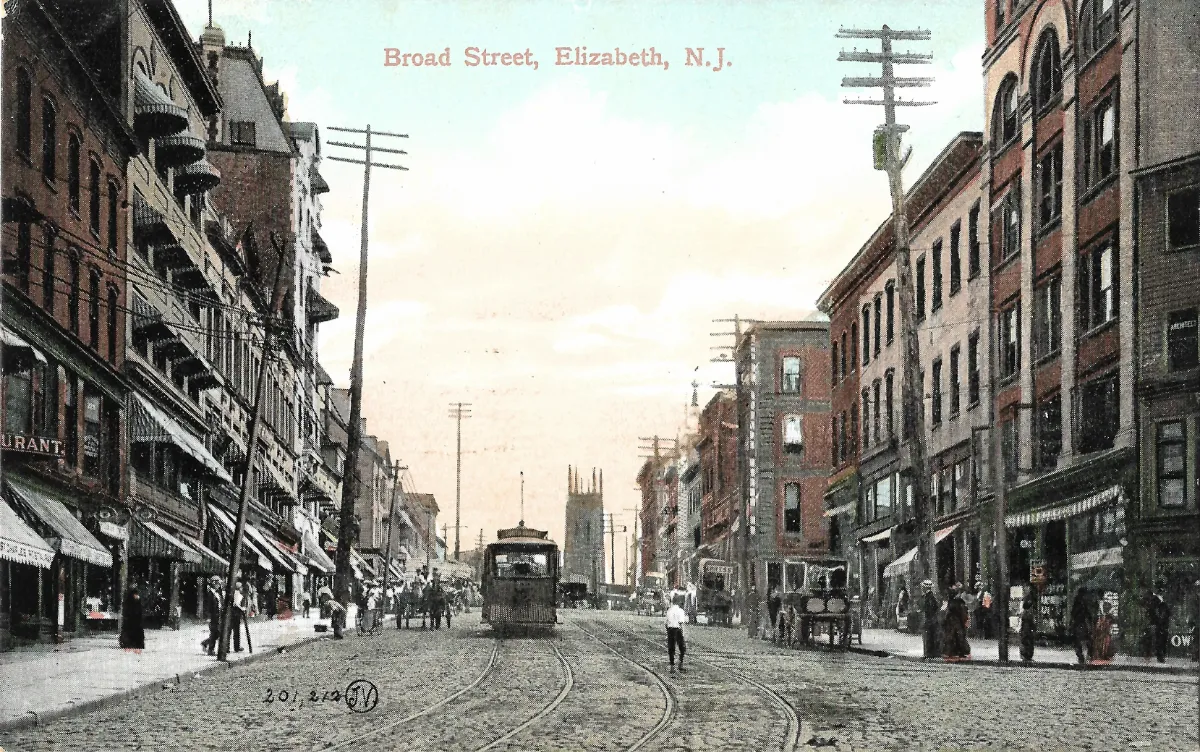
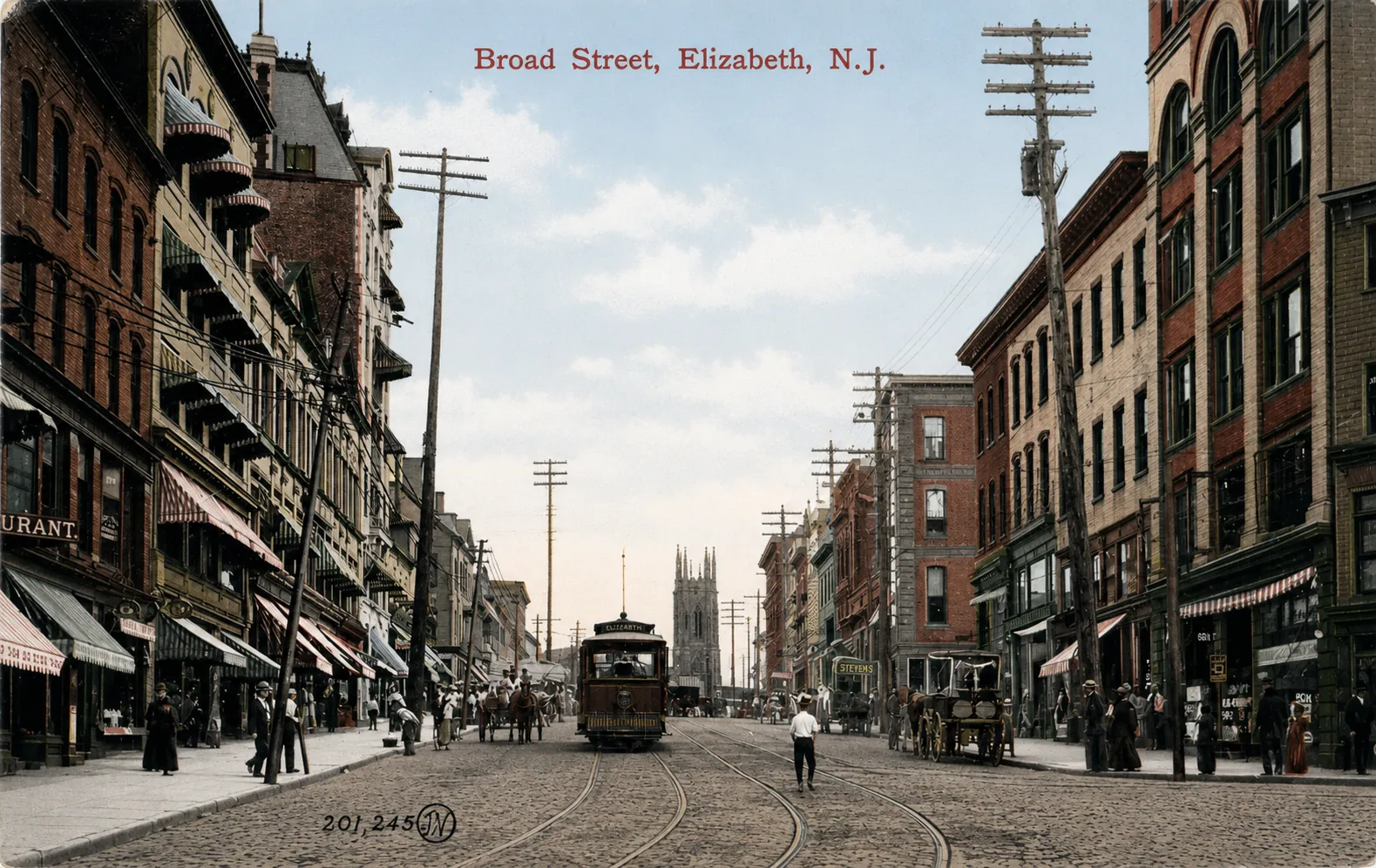
Broad Street in Elizabeth is shown here as a busy commercial thoroughfare in the heart of this New Jersey city. Its location is certain thanks to the printed caption, “Broad Street, Elizabeth, N.J.” The photographer is looking directly along the street, which is lined on both sides with closely packed multi-story buildings whose ground floors are largely occupied by shops and other businesses.
Several sets of rails are embedded in the roadway. An electric streetcar dominates the center of the scene, approaching the photographer as the tracks curve and converge in the foreground. Above them, numerous poles and wires create a dense network characteristic of the period. Some of these carried power for the streetcars, while others belonged to the telephone and telegraph infrastructure that was becoming increasingly common in American cities.
Street railway service was already firmly established on Broad Street by the late nineteenth century. A contemporary illustrated history of Elizabeth records that the Elizabeth Street Railway Company, incorporated and opened in 1888, operated a route beginning near Morris Avenue and running through Broad Street. The tracks visible in the postcard therefore formed part of a transport system that had already become an important component of the city’s urban life.
Both sidewalks are lined with storefronts and awnings, and the street is crowded with pedestrians. The upper floors display the architectural variety typical of American commercial districts around the turn of the twentieth century: brick façades, projecting bays, decorative cornices and large windows. On the left-hand side, external metal fire escapes are particularly conspicuous.
Transportation on the street provides one of the most revealing aspects of the image. The electrically powered trolley shares Broad Street with several horse-drawn vehicles. Horses, wagons and carriages can be identified in different parts of the scene, illustrating a period when new electrical transportation existed alongside older forms of urban mobility.
A tall Gothic Revival tower rises prominently in the distance. Its square proportions, crenellated summit and corner pinnacles correspond very closely to St. John’s Episcopal Church, which stands on Broad Street. An official architectural survey describes the church, constructed in 1859-1860, as having a four-story western tower with crenellations and large octagonal pinnacles at its corners—the same distinctive features visible in the postcard.
The church’s presence also fits the documented historic layout of the district. The Historical Society of Elizabeth explains that Broad Street gradually developed into the city’s principal area for commerce and professional activity and notes that First Presbyterian Church and St. John’s Episcopal Church historically framed this increasingly important business district.
The postcard therefore captures far more than an ordinary street scene. It records Broad Street functioning simultaneously as a retail center, pedestrian space and major public transportation corridor during one of the most dynamic periods in Elizabeth’s urban development.
Historical description
The scene was probably photographed during the first decade of the twentieth century, approximately around 1907-1910, although the front of the postcard alone does not provide enough evidence for an exact date. The electric trolley, continuing prominence of horse-drawn transportation, clothing, commercial architecture and style of the colorized postcard all support an early twentieth-century date.
Near the bottom of the image appears the printed reference “201,212”, accompanied by a small circular mark. It is clearly associated with the production or numbering of the postcard, but the front alone is insufficient to establish its precise meaning or to identify the publisher with certainty. An attribution should therefore not be made solely from this detail.
The bustling appearance of Broad Street reflects Elizabeth’s transformation during the nineteenth and early twentieth centuries. Railroad development had helped turn the community into an important industrial and transportation center. Manufacturing expanded considerably, and the city’s transport links connected its residents, factories and commercial districts with Newark and the wider metropolitan region.
Broad Street was one of the principal beneficiaries of this growth. The Historical Society of Elizabeth notes that Elizabeth Avenue—formerly Water Street—had served as the community’s main route during the colonial era. As railroads and industrialization reshaped the city during the nineteenth century, Broad Street increasingly became associated with commerce and the professions. The dense sequence of storefronts in the postcard is a direct visual expression of that development.
The streetcar in the center of the photograph was consequently an essential part of the commercial life of the district rather than merely a picturesque feature. Electric railways allowed people from surrounding neighborhoods and nearby communities to reach downtown Elizabeth more easily, increasing the importance of Broad Street as a shopping and business destination.
At the same time, the postcard preserves an urban landscape that predates the dominance of the automobile. Horses and electric streetcars still operate side by side. Pedestrians move close to the rails, and there are none of the lane markings, traffic lights or carefully separated traffic flows associated with later twentieth-century streets. The roadway is essentially a shared public space occupied simultaneously by streetcars, wagons, carriages and people.
Above this rapidly modernizing environment stands the much older St. John’s Episcopal Church. The congregation dates to 1706, while the present Gothic Revival building was constructed in 1859-1860. Its imposing tower became one of Broad Street’s most recognizable landmarks.
This view of Broad Street consequently documents a particularly interesting transitional moment in Elizabeth’s history. Electricity and mass transit are visibly reshaping everyday life, commercial buildings crowd the downtown corridor, yet horses remain a normal means of transport. The coexistence of these elements gives the postcard much of its historical interest and makes it an especially evocative record of an American city entering the modern age.