Chablis – Boulevard Jean-Jacques-Rousseau in 1903
Geographic description
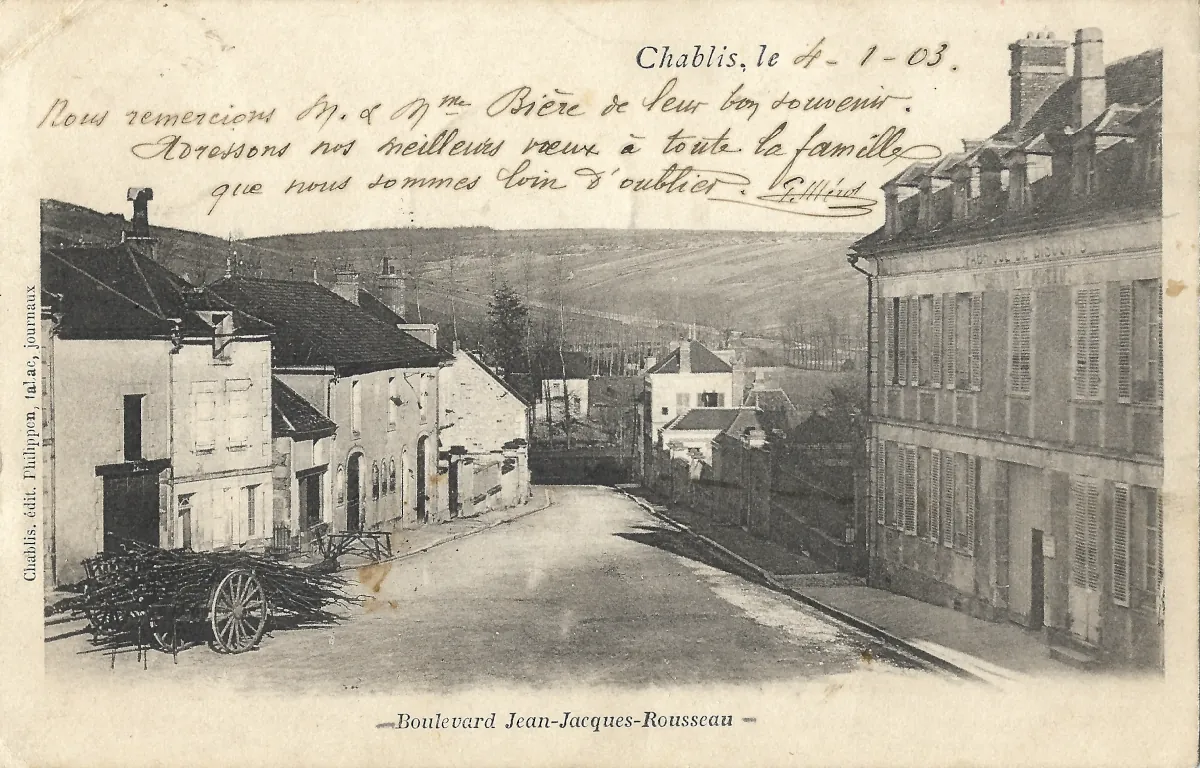
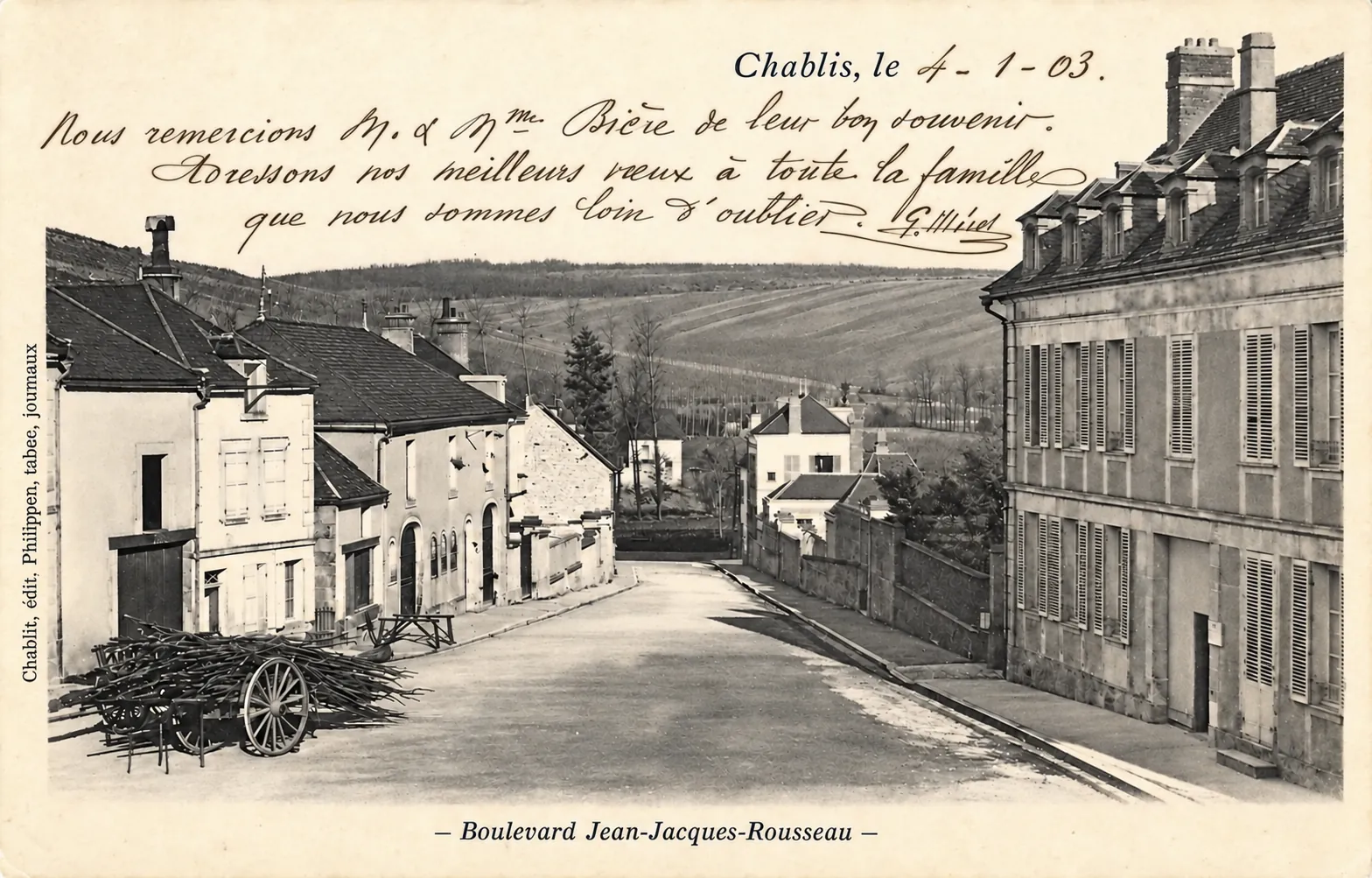
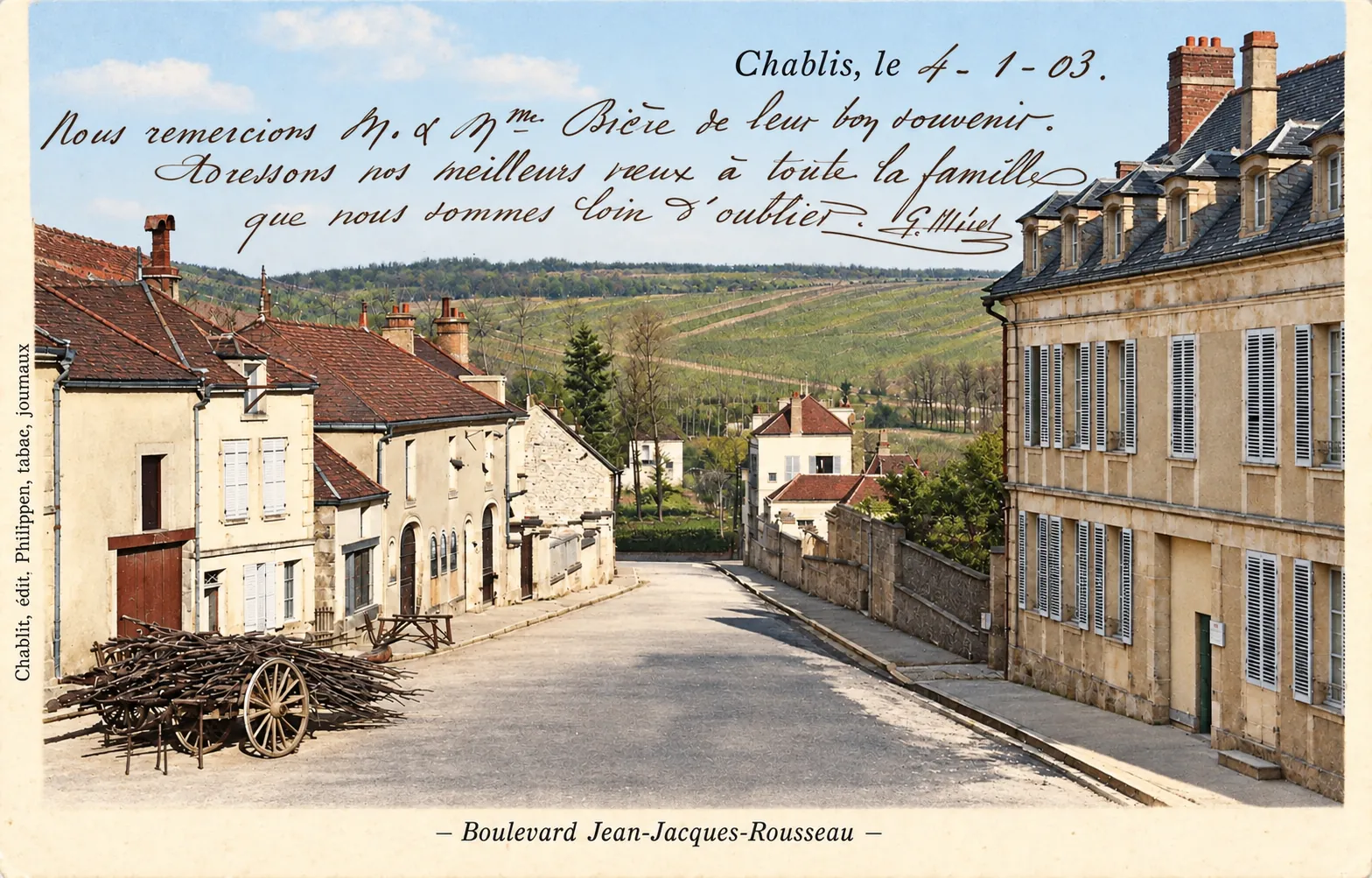
Boulevard Jean-Jacques-Rousseau in Chablis is shown on this vintage postcard at a time when the town still had the distinct appearance of a small wine-producing community at the beginning of the 20th century. Chablis lies in the Yonne department, now part of France’s Bourgogne-Franche-Comté region. The printed caption beneath the photograph clearly identifies the location as “Boulevard Jean-Jacques-Rousseau.”
The photographer looks along a fairly broad road that descends gently before curving in the middle distance. Its surface appears to be compacted earth or macadam, with no road markings, while a clearly defined pavement can be seen along the right-hand side. There are no motor cars and virtually no visible traffic, creating an unusually quiet streetscape.
A substantial two-storey building dominates the right side. Its long, regular façade contains numerous shuttered windows, while the roof above is punctuated by dormers and several tall chimneys. The postcard provides no reliable indication of the building’s original purpose, so it cannot safely be identified as a particular hotel, institution or private residence.
The left-hand side is more irregular. Several houses and outbuildings line the roadway, differing in height, frontage and architectural treatment. Their plain façades contrast with the larger building opposite. In the foreground, a large cartwheel stands beside or within a pile of branches or timber. This modest detail is particularly valuable because it reflects the practical everyday activities of a town that remained closely connected with the surrounding countryside.
The most distinctive feature lies beyond the houses. The street opens directly towards the hills surrounding Chablis, where regular lines on the slopes strongly evoke the cultivated vineyard landscape for which the district is famous. The photograph therefore illustrates the remarkably close relationship between the built town and its agricultural surroundings. The transition from houses to cultivated hills appears almost immediate.
The position of the boulevard itself is historically significant. Local research into the streets of Chablis explains that several boulevards were created on the open ground outside the former defensive ditches and walls surrounding the lower town. Boulevard Jean-Jacques-Rousseau was one of these roads. Its relatively open alignment is therefore connected with an earlier phase in the transformation of Chablis from a fortified town into a more accessible modern settlement.
The street no longer carries the name printed on the postcard. The former Boulevard Jean-Jacques-Rousseau was later renamed Boulevard de Ferrières. Local historical research records the change, while the municipality’s current address directory confirms that Boulevard de Ferrières remains part of the modern Chablis street network.
The postcard is consequently more than a general view of an old street. It preserves an obsolete street name and makes it possible to connect the early-20th-century landscape directly with present-day Chablis.
Historical description
This postcard can be dated unusually closely because of the handwritten inscription across its upper margin. The sender wrote “Chablis, le 4-1-03,” dating the use of this particular card to 4 January 1903. The photograph itself may of course have been taken somewhat earlier, but the card must already have been produced by that date.
Its design is characteristic of the very early years of illustrated postcards. The photograph occupies only part of the card, leaving a broad light-coloured area above it for correspondence. The handwritten message thanks the recipients for a souvenir and sends best wishes to the entire family, combining a personal piece of correspondence with a photographic record of Chablis.
Another important clue is printed vertically along the left edge: “Chablis, édit. Philippon, tabac, journaux.” The wording strongly suggests that Philippon was a local retailer who also published or distributed postcards, alongside tobacco and newspapers. Such combinations of activities were well suited to postcard sales, which were becoming an increasingly important form of everyday communication and tourism at the beginning of the century. A surviving postcard of Chablis railway station has also been catalogued with Philippon identified as its publisher, supporting the existence of this local postcard business, although the available evidence does not establish its exact period of operation.
The year 1903 is also highly significant in the history of the Chablis vineyards. During the closing decades of the 19th century, phylloxera and mildew had severely damaged the local wine industry. Official material published by the Chablis wine sector records the devastation caused by these diseases and the subsequent rebuilding of the vineyards, notably by grafting vines onto phylloxera-resistant rootstocks.
This historical background gives added importance to the cultivated hills visible beyond the boulevard. The postcard alone cannot establish which individual plots had been replanted or the exact condition of the vines shown. Nevertheless, the photograph was taken at a time when the Chablis vineyard was still recovering from one of the most serious agricultural crises in its modern history.
Other visual details reinforce the early date. There are no motor vehicles, the roadway remains comparatively simple, timber is stored beside the houses, and the architecture retains the appearance of a traditional provincial town. The scene therefore captures a period when urban life, small-scale commerce, agriculture and winegrowing still existed within a very compact geographical area.
Boulevard Jean-Jacques-Rousseau consequently provides an unusually rich historical record. It shows an old urban edge of Chablis before later street alterations, preserves the former name of today’s Boulevard de Ferrières, records the imprint of the local Philippon business and carries a handwritten date placing the postcard firmly at the beginning of 1903. At the same time, the vineyard-covered landscape behind the houses connects the everyday town directly with the activity that would ultimately make the name of Chablis famous far beyond the Yonne.