Chablis Around 1909 – Market Day in the Heart of Town
Geographic description
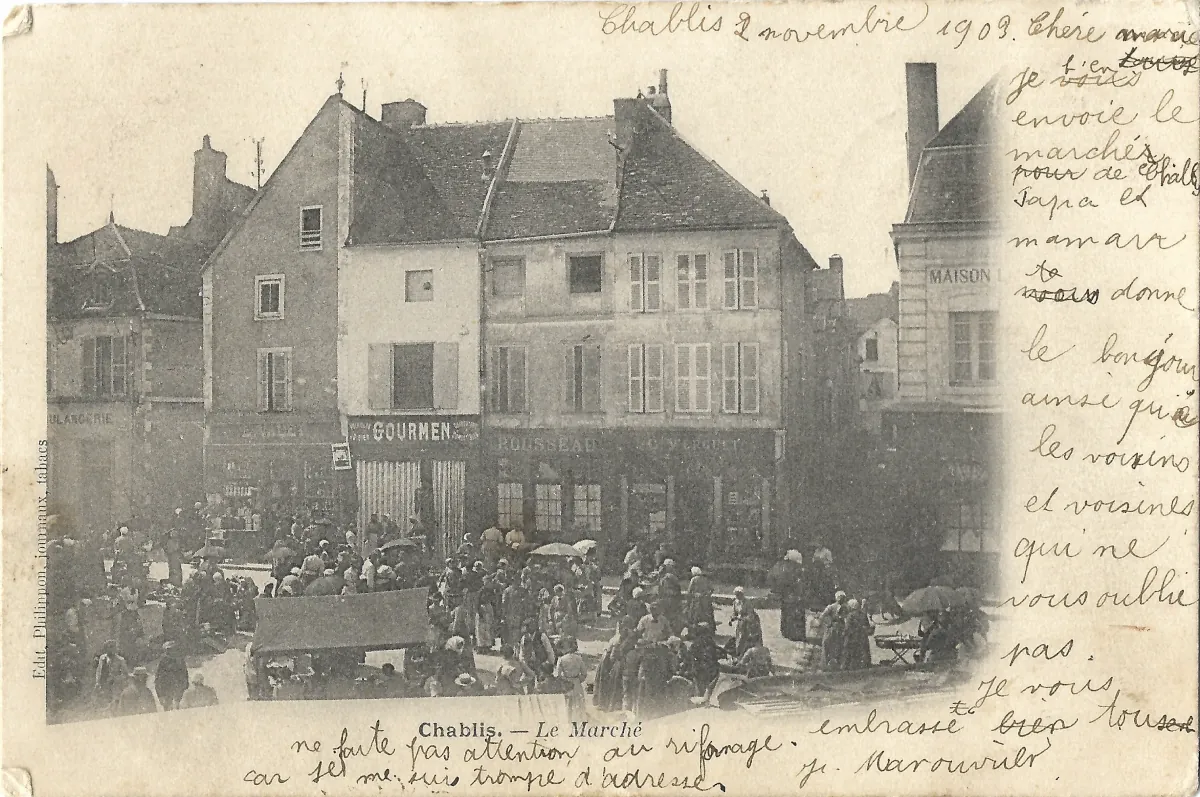
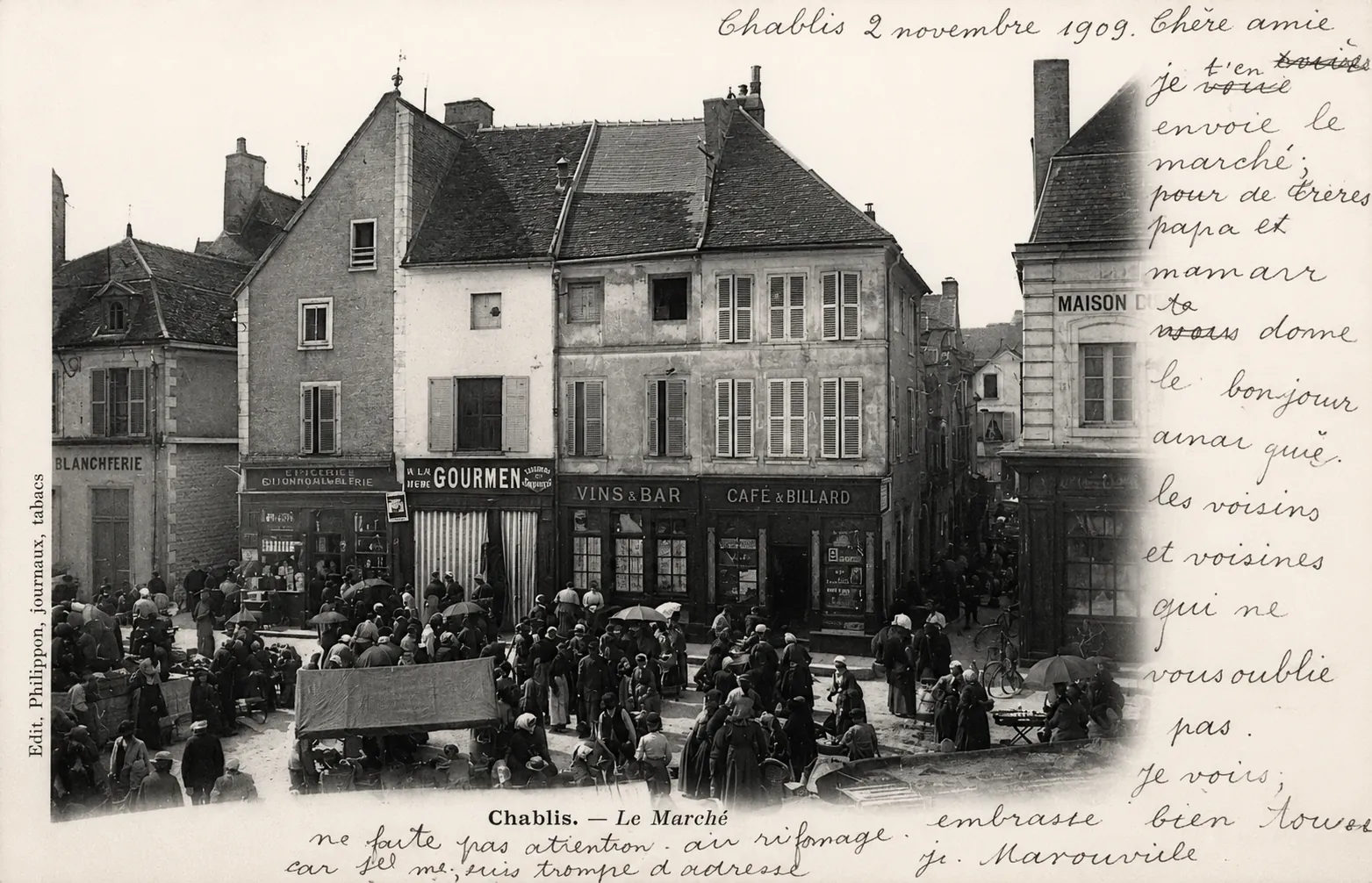
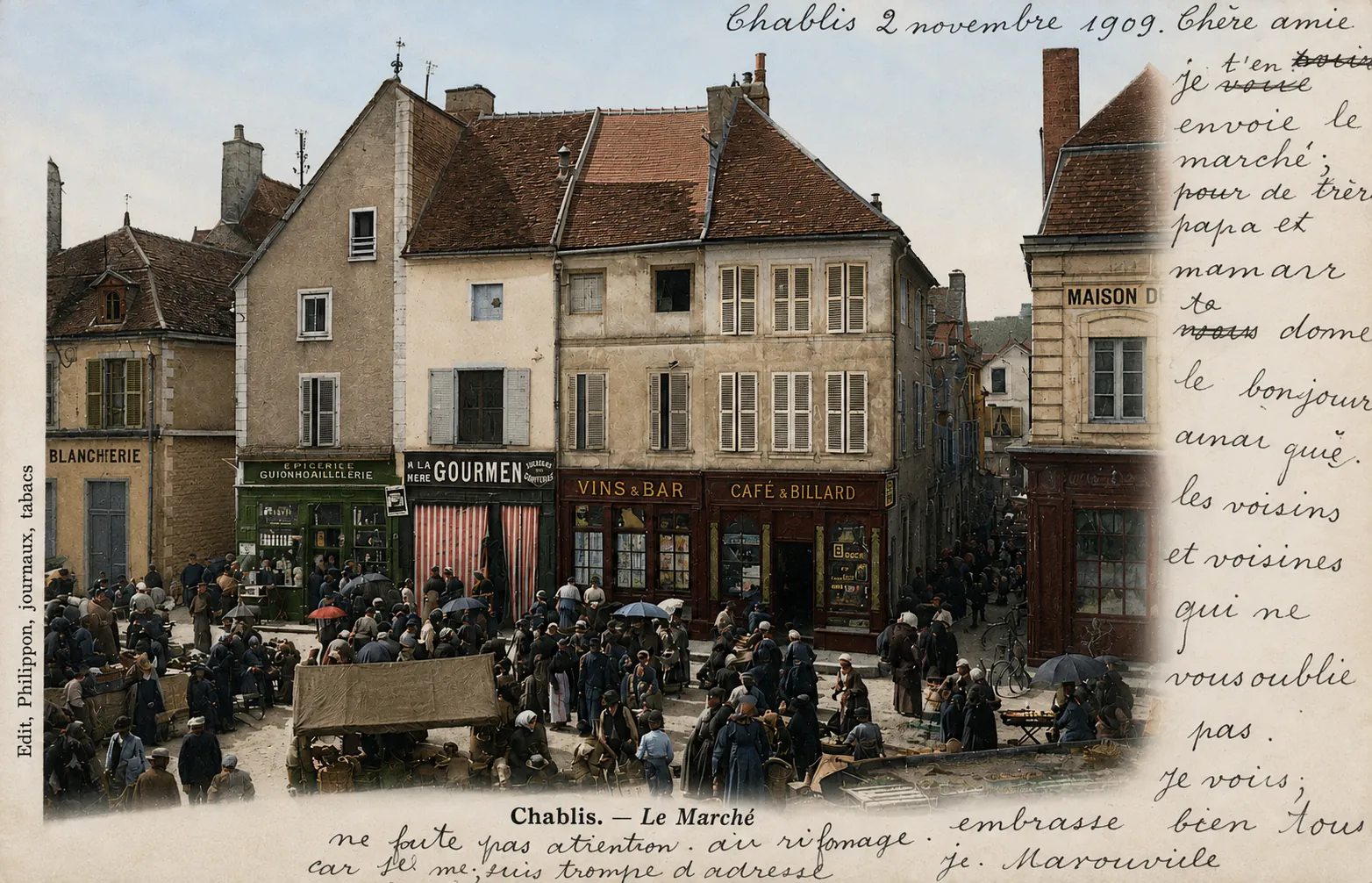
The old market in Chablis is shown here in an exceptionally lively early twentieth-century street scene in the Yonne department of Burgundy. The printed caption beneath the photograph, “Chablis. — Le Marché,” leaves no doubt about the subject. The precise present-day street, however, cannot be identified with certainty from this view alone.
The photograph was taken from a slightly elevated position and looks across an urban space almost completely occupied by the market. Buyers and traders crowd the foreground and gather immediately outside the neighbouring shops. Tables, baskets, wooden stalls and several large cart-like structures can be seen among them. These probably served to carry or display produce, although the photograph does not clearly show how they were moved, so they should not automatically be described as horse-drawn vehicles. A number of umbrellas can also be distinguished above the crowd.
The people themselves are one of the most valuable features of the postcard. Many women wear long, dark dresses or skirts and various forms of head covering, while men can be recognised by their hats and caps. Rather than presenting Chablis merely as a collection of picturesque buildings, the photographer captured a genuine moment of everyday activity. The image therefore provides evidence of how important the weekly market was as both a commercial and a social gathering.
The buildings form a continuous row around the market area. Most are two or three storeys high, with steep tiled roofs, narrow windows and traditional shutters. Their ground floors are occupied by shops, demonstrating the close relationship between permanent retail businesses and temporary market stalls.
The clearest shop sign reads “GOURMEN”, prominently displayed above a striped shopfront. Other lettering survives on surrounding façades, but much of it is too indistinct to transcribe reliably. On the right-hand side, part of a more imposing corner building can be seen, bearing the beginning of the word “MAISON…”, although the rest is obscured by the handwritten message on the postcard.
This mixture of shops, homes and open-air trading reflects Chablis’s long-standing role as a local commercial centre. A historical petition reproduced in the French Archives parlementaires describes Chablis in the late eighteenth century as a place where fairs and markets were held and where people from neighbouring villages came to purchase necessities and sell surplus produce. The postcard therefore records a commercial tradition that was already well established long before the photograph was taken.
That tradition continues today. The local tourist office states that the modern Chablis market takes place every Sunday morning along Rue Auxerroise and Rue du Maréchal-de-Lattre-de-Tassigny in the town centre. This continuity is significant, although it does not by itself prove that the exact buildings in the postcard stood on either of those streets. Establishing the precise viewpoint would require a detailed comparison with historical maps, cadastral plans or other photographs of the same shopfronts.
Historical description
The postcard can be dated unusually well because of a handwritten inscription across its upper edge: “Chablis 2 novembre 1909” — Chablis, 2 November 1909. This must be interpreted carefully. It dates the writer’s message and proves that the postcard was already in circulation by that date; it does not establish that the photograph itself was taken on 2 November 1909. The image must therefore date from 1909 or somewhat earlier.
Everything visible in the scene is consistent with an early twentieth-century date. The clothing, traditional shopfronts, architecture, wooden market equipment and lack of clearly visible motor cars all fit the closing years of the Belle Époque. The card consequently preserves an image of everyday Chablis only a few years before the First World War profoundly altered French society.
The left-hand margin provides another particularly useful clue. Printed vertically is the wording “Edit. Philippon, journaux, Chablis”, identifying Philippon as the local publisher or retailer associated with the card. Other surviving Chablis postcards are also attributed to an editor named Philippon, providing supporting evidence that this was a local postcard publisher or distributor. The available evidence does not reveal whether Philippon personally photographed the scenes or simply commissioned, published and sold the cards.
The GOURMEN shop sign is also intriguing. A local history organisation records a Lucien Gourmen, born in Chablis in 1913, who later developed the recipe associated with the well-known Chablis-style andouillette during the mid-twentieth century. Since this postcard was already in use in 1909, the shop shown here predates his birth by several years. The shared surname raises the possibility of an older Gourmen family business in the town. That connection, however, cannot currently be regarded as established: no source consulted directly links the shop in the photograph to Lucien Gourmen or proves what type of business it was.
The broader historical importance of the postcard lies in the activity it records. A market was more than a place to purchase food. It brought together townspeople, rural producers, travelling merchants and inhabitants of surrounding villages, turning the centre of Chablis into a regular meeting place. Historical evidence shows that fairs and markets had performed this function there since at least the late eighteenth century.
More than a century later, Chablis still holds a weekly market in its central streets, now promoted as one of the town’s characteristic Burgundian experiences. The postcard therefore documents a striking continuity in local life: while shopfronts, clothing and methods of transport have changed considerably, the market has remained one of the recurring occasions on which Chablis and its surrounding countryside come together.