Rue des Moulins and the Les Clos Ridge in 1907
Geographic description
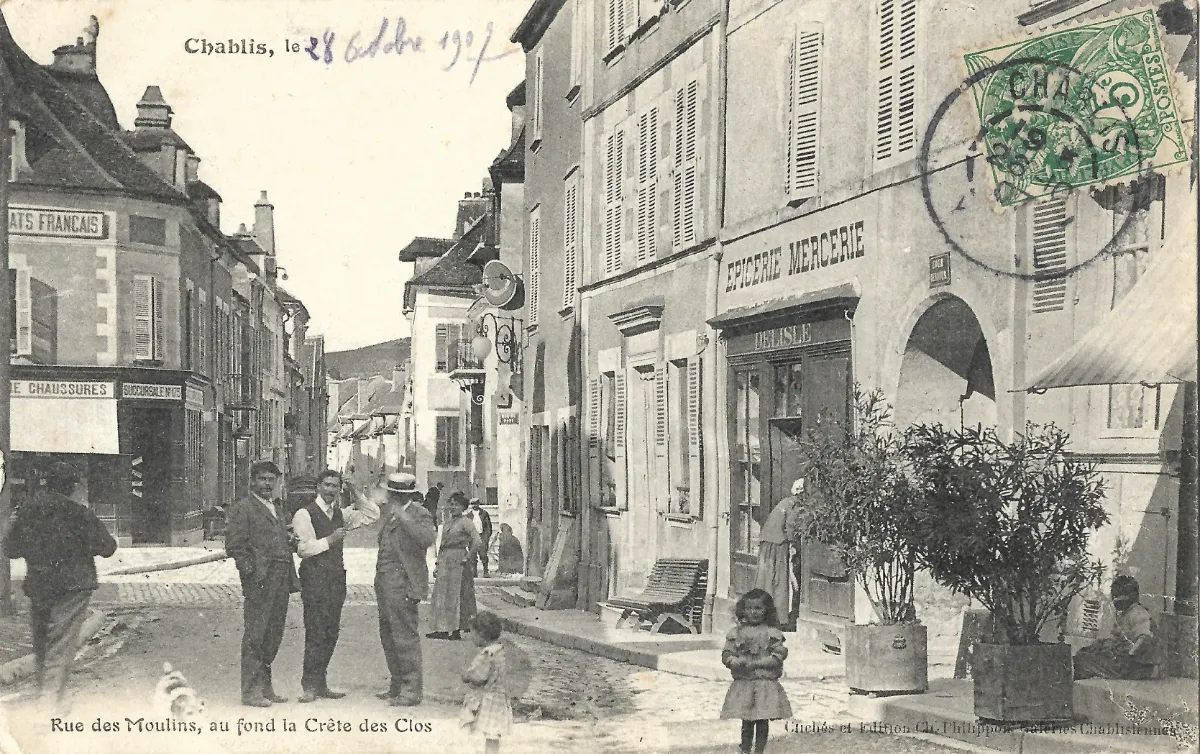
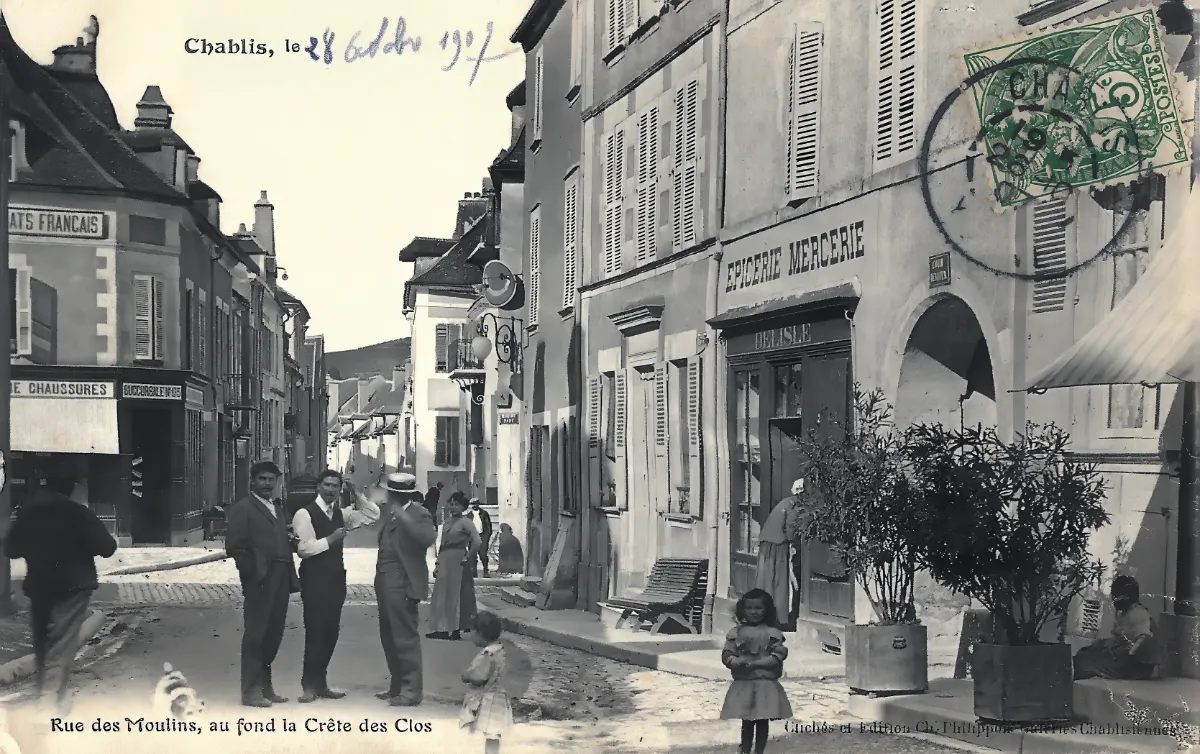
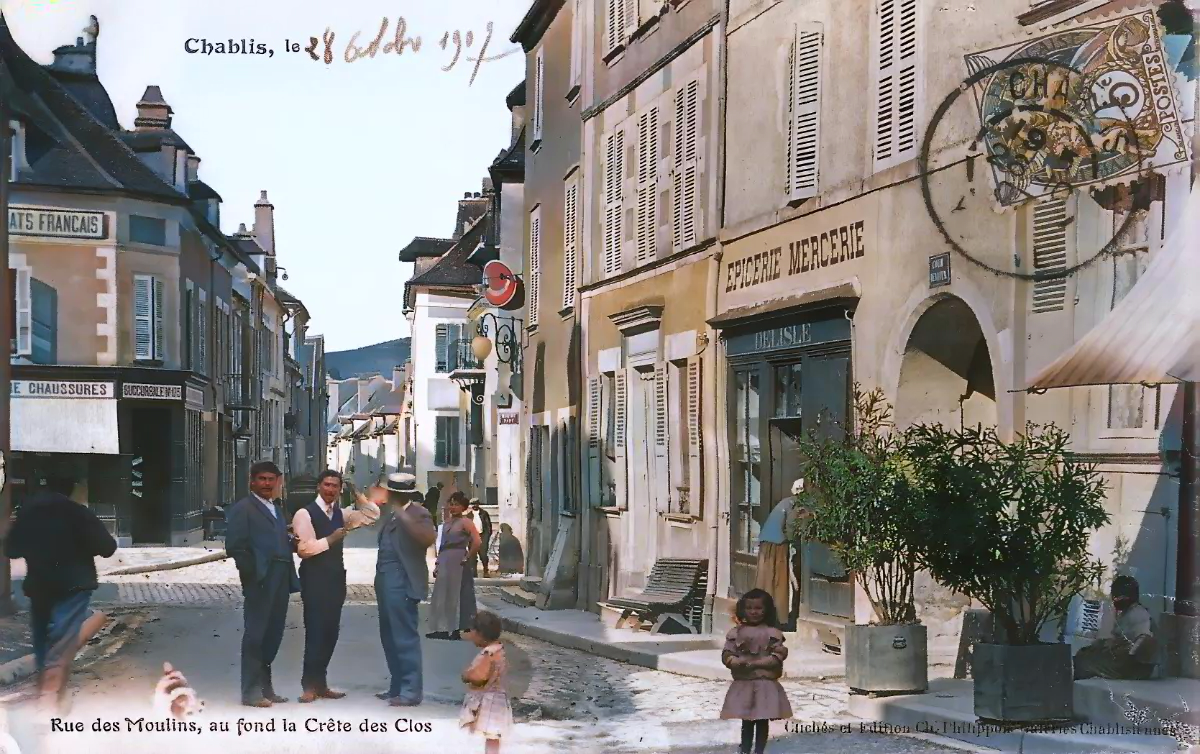
Rue des Moulins in Chablis is shown on this old postcard as a lively residential and shopping street, viewed towards the hillside closing the perspective in the distance. The printed caption is particularly informative: “Rue des Moulins, au fond la Crête des Clos” — Rue des Moulins, with the ridge of Les Clos in the background. It therefore provides a firm identification of the street as well as the name then used for the distant slope.
The street has the appearance of a small Burgundian town in the early twentieth century. Two- and three-storey houses stand directly along the roadway, creating an almost continuous frontage. Their architecture is restrained, with rendered walls and tall windows fitted with wooden shutters.
Several ground floors are occupied by shops, showing that Rue des Moulins was more than a residential street. On the right, the words “ÉPICERIE MERCERIE” can clearly be read above one shopfront. Such a business combined grocery goods with haberdashery and everyday textile accessories. The name on the shopfront appears to be Delisle, although the lettering is not clear enough for this reading to be considered completely certain.
Large potted shrubs stand outside the shop, while a bench has been placed against the wall. These small details help recreate the everyday atmosphere of the street and suggest a shopfront intended to be both practical and welcoming.
More commercial signs can be seen on the opposite side. The word “CHAUSSURES”, meaning shoes, is legible on one storefront. Another sign ends with the word “FRANÇAIS”, but the complete wording cannot safely be reconstructed from the photograph.
The roadway itself remains relatively simple. Narrow raised areas run along the buildings, while the central surface appears uneven and lacks the highly structured pavements and road markings associated with later urban development. No motor vehicle is visible. The street belongs primarily to pedestrians.
Men, women and children are scattered throughout the scene. Several people are looking directly towards the photographer, as though the taking of the picture had become a small neighbourhood event. The men wear shirts, waistcoats, hats or caps, while the women are dressed in long skirts or dresses. Children are particularly prominent, including a young girl standing in the foreground.
The distant hillside is identified by the postcard itself as the Crête des Clos. This almost certainly refers to the slope associated with Les Clos, today one of the seven named climats of Chablis Grand Cru. According to the official Chablis wine organisation, Les Clos covers nearly 26 hectares and extends from the bottom to the top of the hillside. The Chablis Grand Cru vineyards lie on the right bank of the Serein, northeast of the town.
Rue des Moulins still forms part of the urban layout of Chablis. A local historical study of the town’s street names also lists Rue des Moulins among the traditional names that reflect Chablis’s past.
Historical description
The postcard can be dated unusually closely because a handwritten note survives on the front. At the top, the inscription appears to read “Chablis, le 28 octobre 1907” — Chablis, 28 October 1907. The final year is sufficiently legible for 1907 to be considered highly probable.
The circular postal cancellation overlapping the green stamp is more difficult to decipher, although the visible elements appear compatible with the same period. The handwritten date is therefore the stronger piece of evidence. The photograph itself may, of course, have been taken somewhat earlier than the day on which the postcard was written and mailed.
Everything visible in the scene is consistent with an early-twentieth-century date: the clothing, traditional shopfronts, painted commercial lettering, shuttered houses, absence of cars and the photographic composition. The card therefore gives a convincing picture of Rue des Moulins in Chablis shortly before the First World War.
The commercial character of the street is especially valuable historically. The épicerie-mercerie represents the type of multi-purpose neighbourhood shop that served a wide range of everyday needs. A shoe business on the opposite side further illustrates the variety of small-scale trade found within the town.
The large number of residents is equally significant. Several adults appear to have stopped specifically to watch the photographer, while children stand close to the camera. At a time when street photography was still noticeable enough to attract attention in a small town, the photographer’s presence could easily become a minor public event.
The reference to the Crête des Clos gives the image an additional dimension. Les Clos is now one of the most famous vineyard sites in Chablis, covering the hillside within the modern Chablis Grand Cru appellation. However, the official Grand Cru appellation was not recognised until 1938, more than thirty years after this postcard was mailed.
The distinction is important historically. In 1907, “Les Clos” already belonged to the traditional geography of the Chablis vineyard, but it did not yet carry the legal AOC status familiar today. The official Chablis website notes that vines were already being cultivated on the site before 1267, demonstrating how deeply rooted the name is in local wine history.
The photographer therefore seems to have deliberately incorporated both town and vineyard into a single composition. The street leads the viewer’s eye directly towards a landscape already closely linked with Chablis’s identity.
A publisher’s line is also printed along the lower right-hand edge. The words “Cliché et Édition Ch. Philippe…” appear to be present, but the lettering is too faint and partially obscured to establish the full wording with confidence. Without another clearly identified example from the same series, a more precise attribution would be speculative.
This postcard is therefore much more than a simple street view. It records the daily life of Chablis around 1907: small independent shops, residents gathering in the roadway, children observing the camera and, beyond the houses, the vineyard slope of Les Clos. The image creates a direct visual connection between the town and the landscape that was already central to Chablis’s identity more than a century ago.