The Elks Home in Elizabeth, New Jersey, in the Early 1900s
Geographic description
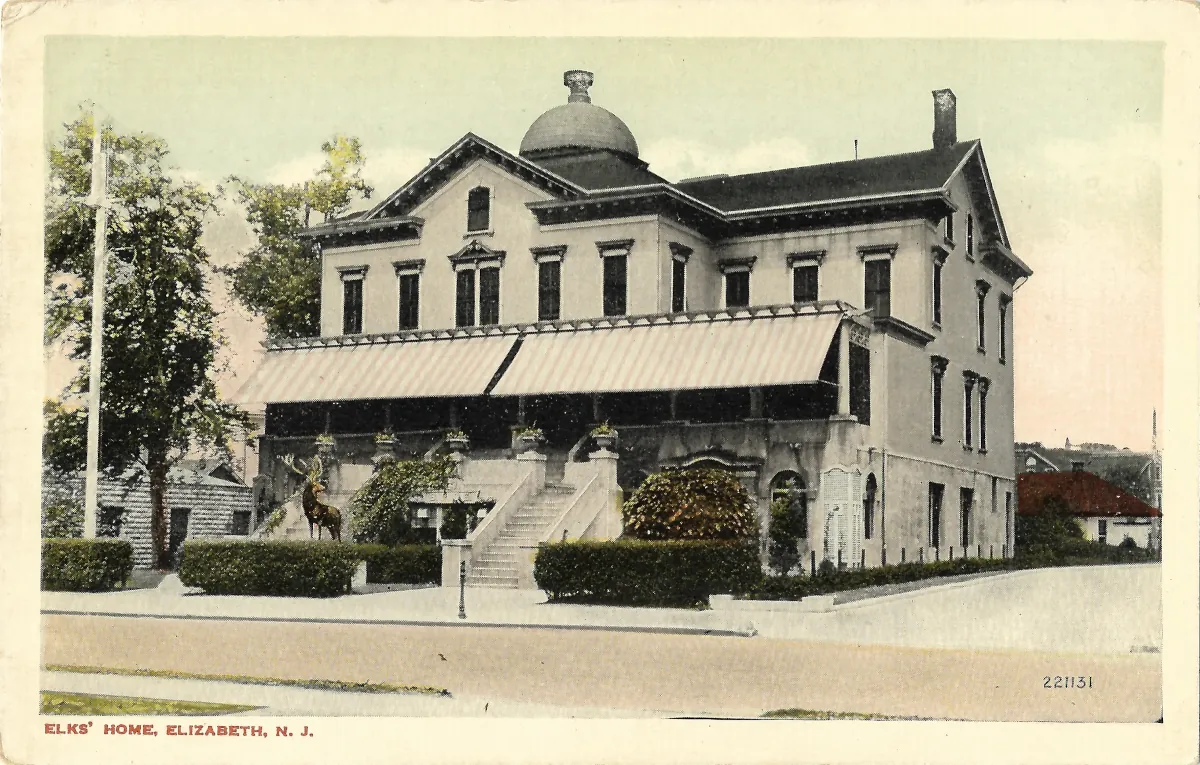
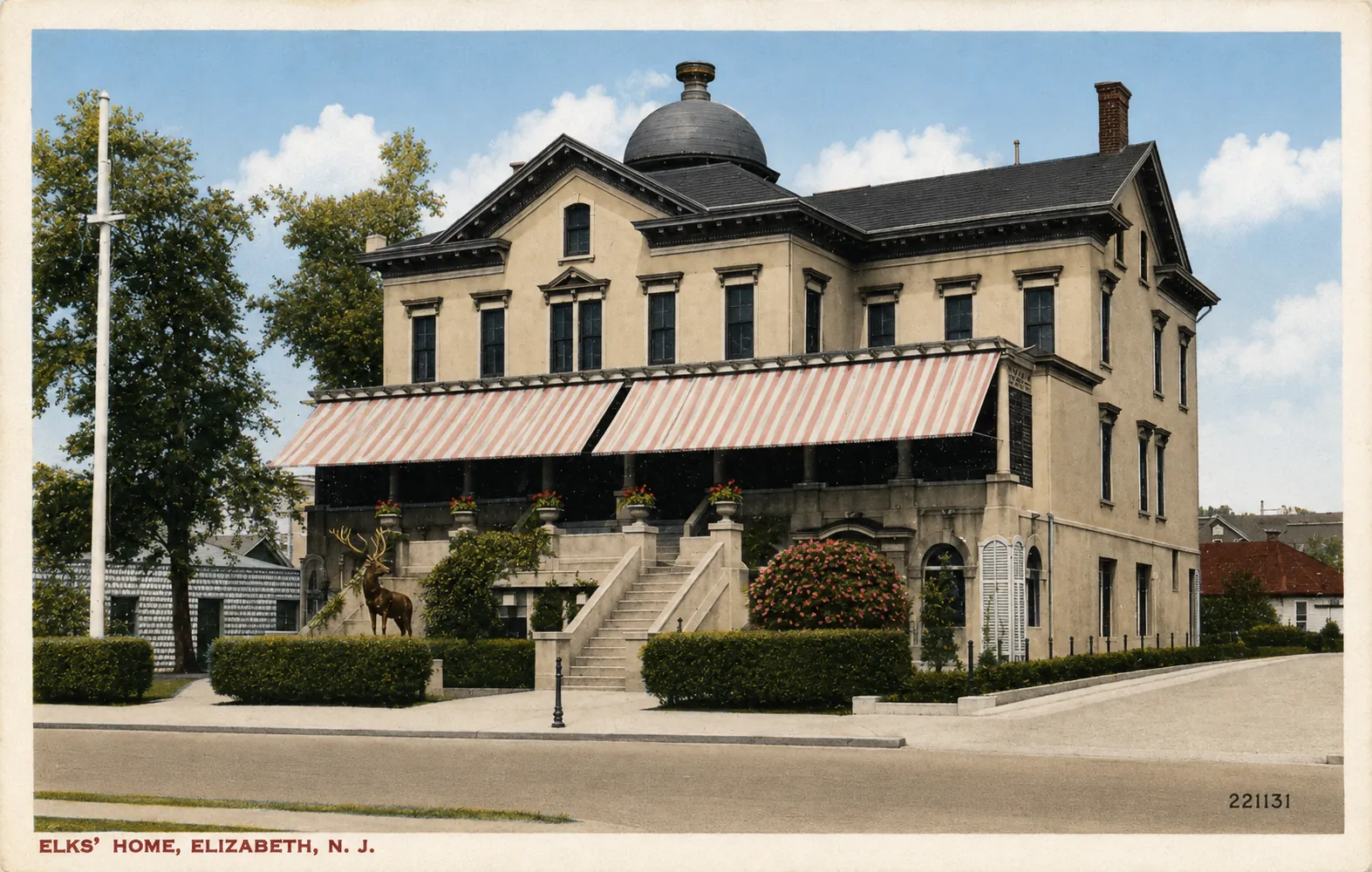
The Elks Home in Elizabeth, New Jersey, is the imposing building featured on this colorized early-twentieth-century postcard. Its printed caption, “ELKS’ HOME, ELIZABETH, N. J.,” provides a firm identification of both the city and the building’s original purpose as the headquarters of the local Benevolent and Protective Order of Elks lodge.
The structure occupies most of the image. It is a substantial multi-story building raised above street level on a high basement. Its most distinctive architectural feature is the rounded central cupola rising above the roof and terminating in a small lantern-like cap. Tall rectangular windows, pronounced cornices, triangular gables and ornamental window surrounds contribute to the appearance of a prosperous private institution. The architecture displays Italianate and Renaissance Revival influences typical of prestigious American residential and clubhouse architecture around the turn of the twentieth century, although no authoritative architectural classification of this particular building has been located.
Across the front is a long elevated veranda or terrace, almost completely sheltered beneath large striped awnings. The postcard colorist has given these awnings a pale reddish tint, contrasting with the light walls and green vegetation. Broad flights of steps connect the terrace with the pavement, while carefully clipped hedges and ornamental shrubs reinforce the impression of a formally maintained club property.
One of the most informative details stands to the left of the building: a statue of an elk, the animal adopted as the emblem of the Benevolent and Protective Order of Elks. This is more than decorative landscaping. A postcard held by the New Jersey State Library depicts the same building and the same statue in virtually the same position. That institutional collection identifies its subject as “The Elks Home”; its copy was postmarked in 1914 and was published by Line & Co. of Elizabeth.
No pedestrians, horse-drawn vehicles or automobiles appear in this particular view. The empty roadway gives the photographer an unobstructed perspective and makes the clubhouse itself the sole focus of the composition. A utility pole is visible on the left, while smaller buildings can be seen beyond the property.
The number 221131 printed near the lower-right corner is probably a printer’s or publisher’s production number. No reliable evidence has yet been found connecting it with a specific postcard publisher, so the publisher of this particular edition cannot be established from the front alone.
Official New Jersey records add an important geographical detail. Documents concerning Elizabeth Lodge No. 289 identify its premises as 17-21 Westfield Avenue, Elizabeth in the 1940s and 1950s. These records strongly suggest that this was the location of the historic clubhouse depicted on the postcard, although the street address itself does not appear on the card.
Historical description
A reasonable date for this postcard is circa 1908-1915, with the early 1910s being particularly plausible. The printing technique, colorized photographic appearance and general presentation all fit that period. More importantly, the New Jersey State Library’s postcard showing essentially the same Elks Home was already in circulation by 1914, as demonstrated by its postmark.
That does not establish 1914 as the date of the present card. No information from its reverse has been provided, so its precise production or mailing date remains undetermined.
The building served Elizabeth Lodge No. 289 of the Benevolent and Protective Order of Elks, commonly abbreviated B.P.O.E. The national organization had been formally established in New York City on February 16, 1868 and subsequently spread rapidly throughout the United States. Local lodges frequently called their headquarters an “Elks Home.” In this historical context, Home meant a lodge house or clubhouse rather than a residential care institution.
The Elizabeth lodge itself was already well established by the time this postcard was produced. A 1940 Elizabeth newspaper reported the celebration of the lodge’s 46th anniversary, placing its origins in 1894.
Its role also extended beyond private social gatherings. Historical material published by the Elks records significant community work by Elizabeth Lodge No. 289. In the 1920s it supported a Boys Club in Elizabeth and maintained a children’s property at Dunellen, where lodge members carried out improvements for the benefit of disadvantaged youngsters. Such activities illustrate how American fraternal organizations combined social membership, ceremonial traditions and charitable work during this period.
The elk statue featured prominently in the postcard therefore had considerable symbolic significance. Positioned near the street and clearly visible to passers-by, it effectively announced the identity of the institution. Together with the broad veranda, ornamental planting and substantial architecture, it also reflects the importance attached to lodge headquarters as visible markers of civic status.
The postcard is consequently more than an architectural record. It documents a form of urban social life that was particularly prominent in the United States in the late nineteenth and early twentieth centuries, when fraternal societies maintained elaborate clubhouses and occupied an important place in community affairs.
Lodge No. 289 continues today as the Elizabeth-Linden Lodge, although the New Jersey State Elks Association currently lists it in Linden rather than at its historic Elizabeth address.