Broad Street in Elizabeth, New Jersey, circa 1910
Geographic description
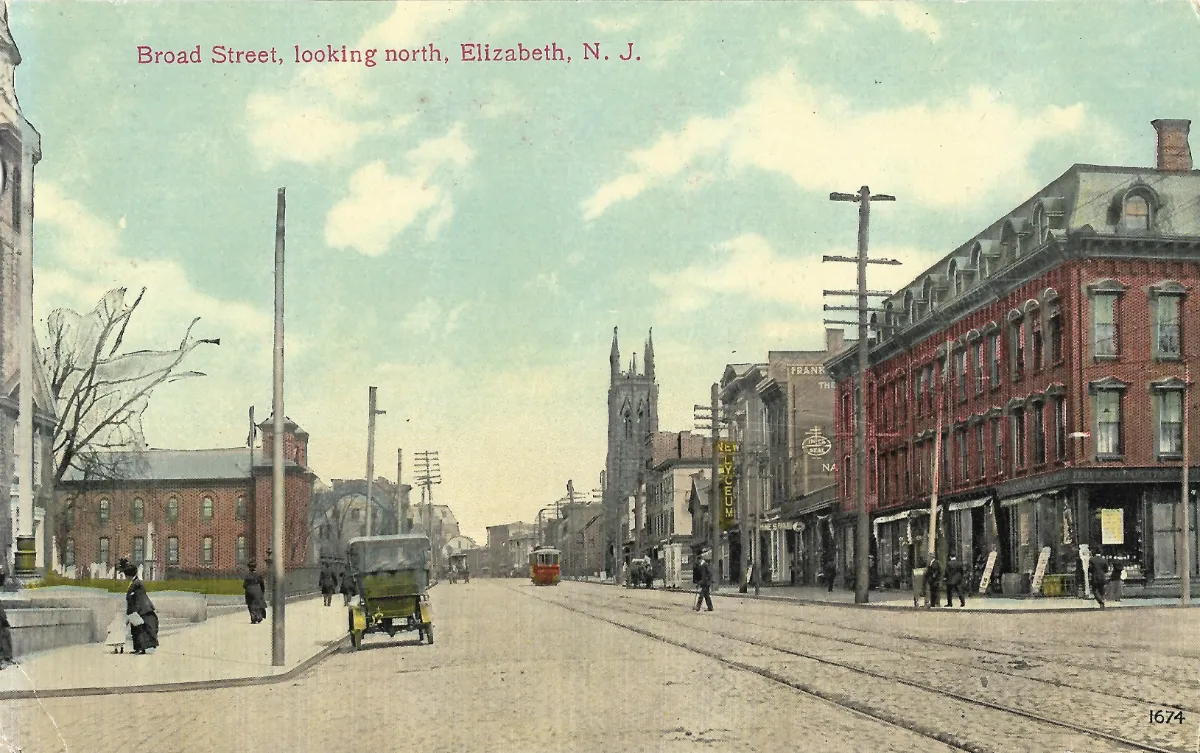
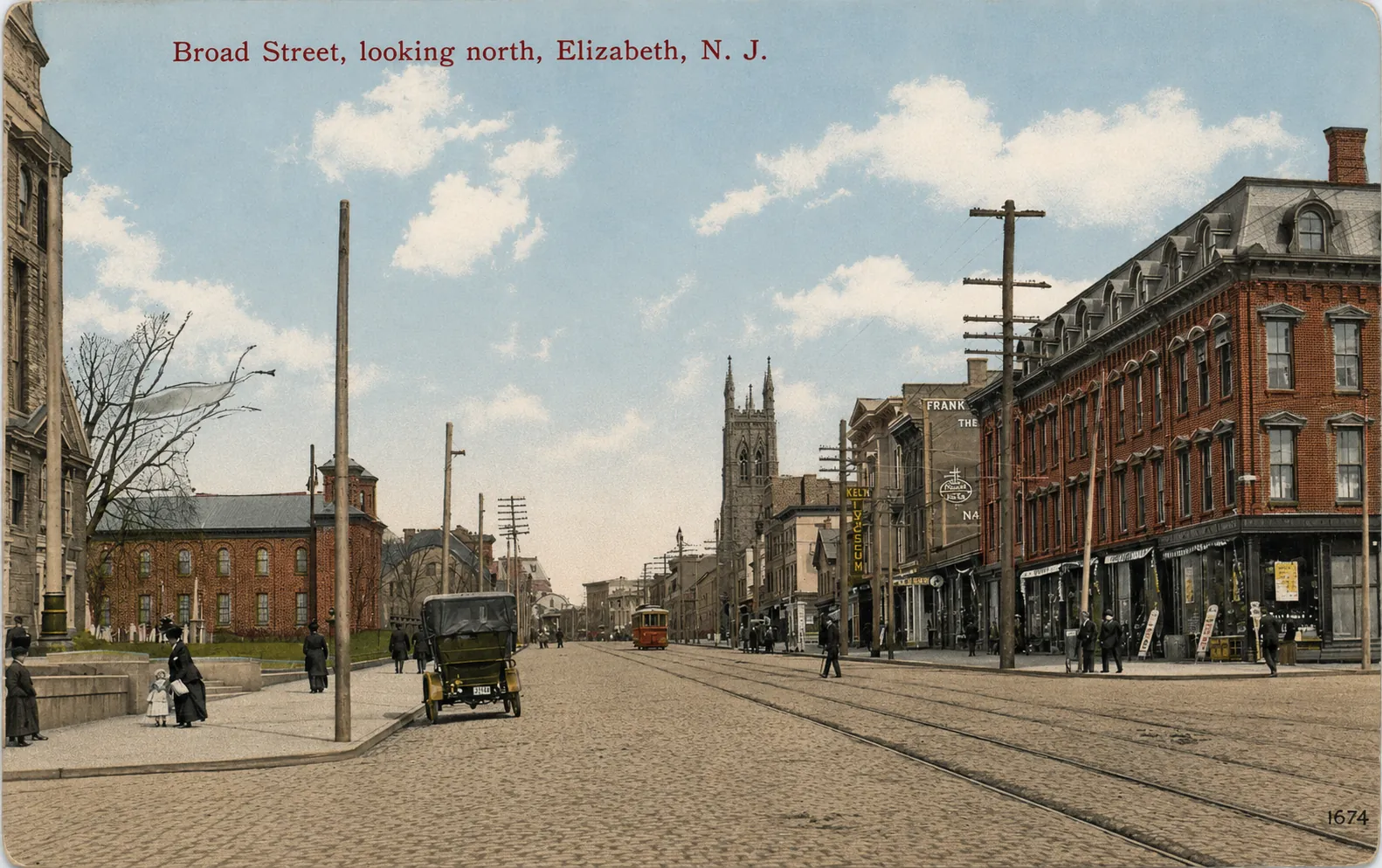
Broad Street in Elizabeth is shown here looking north, exactly as stated in the printed caption at the top of the postcard: “Broad Street, looking north, Elizabeth, N. J.” The scene is located in downtown Elizabeth, Union County, New Jersey. By the time this photograph was taken, Broad Street had developed into a substantial urban thoroughfare lined with multi-story buildings and crossed by an electric streetcar system.
Streetcar tracks dominate the broad roadway. In the distance, a trolley car, colored red in the printed postcard, travels along the street. Numerous utility poles are also visible, reflecting the expanding electrical, telephone and transportation infrastructure of the period. Together, these features give Broad Street the appearance of a rapidly modernizing American city center in the early twentieth century.
Near the left-hand curb, an early motor vehicle provides another particularly useful visual detail. Its tall body and narrow proportions are typical of the first generations of automobiles, before the more standardized designs of the 1920s. Cars are still relatively scarce in the scene. Pedestrians cross the broad roadway freely, illustrating a transitional period when streetcars, pedestrians and the emerging automobile were beginning to share the same urban space.
The right side of Broad Street is lined by a particularly attractive row of red-brick commercial buildings. Their ground floors contain shops opening directly onto the sidewalk, while their upper stories were probably intended for offices, commercial activities or residential use. Several signs can be seen, although they are not sufficiently legible to identify the individual businesses with confidence.
This commercial character is consistent with the documented development of the street. The Historical Society of Elizabeth explains that railroad expansion helped shift Broad Street toward commerce and professional activities during the nineteenth century. By the turn of the twentieth century, larger stores were appearing alongside traditional local shops, gradually establishing Broad Street as an important shopping center for Elizabeth and the surrounding region.
Two historic churches help locate the scene. On the left, the religious complex is very probably associated with the First Presbyterian Church, located at 42 Broad Street. Farther north, on the right-hand side of the street, the prominent Gothic tower can be identified with a high degree of confidence as St. John’s Episcopal Church. The Historical Society of Elizabeth describes these two churches as effectively framing the commercial section of Broad Street, which corresponds closely to the arrangement visible on the postcard.
The postcard itself is a colorized photographic view. The blue-green sky, red brickwork, vehicle colors and other tones were therefore probably applied during the printing process rather than recorded directly by the original photograph. The number 1674 appears in the lower-right corner and is most likely a publisher’s series or catalogue number. No publisher’s name can be reliably identified from the front of the card alone.
Historical description
This view of Broad Street in Elizabeth was most likely produced around 1910. The combination of electric streetcars, an early automobile, the commercial streetscape and the colorized postcard format all supports an early twentieth-century date. There is also a useful documentary clue: another example identified as “Broad Street looking north, Elizabeth, N.J.” is recorded with an October 22, 1911 postmark. A postmark does not establish the exact date when the photograph was taken or when this particular copy was printed, but it confirms that the view was already in circulation by 1911. A date in the late 1900s or around 1910 is therefore a reasonable estimate.
The postcard belongs to a period of remarkable expansion in Elizabeth. Between 1870 and 1900, the city’s population grew from fewer than 11,000 inhabitants to more than 52,000. Industrial development played a major part in that growth, particularly after the Singer Sewing Machine works opened in Elizabeth in 1872. Broad Street developed differently from the city’s heavily industrialized areas, becoming increasingly associated with commerce, banking, professional services and retail activity.
The First Presbyterian Church represents a much older layer of Elizabeth’s history. Its congregation dates from 1664 and is documented by the National Park Service as the oldest English-speaking congregation in New Jersey. An earlier church on the site was destroyed during the American Revolution in January 1780. Construction of its replacement began in 1783 and the building was completed in 1793. In 1851 it was enlarged and given Victorian Gothic alterations. A major fire in 1946 later destroyed the roof, interior and wooden upper portions of the tower. The 1947 restoration returned much of the building to an earlier architectural form, but the upper steeple was not reconstructed, explaining why the historic site seen by early twentieth-century visitors differs from its later appearance.
The prominent Gothic landmark farther along the street is almost certainly St. John’s Episcopal Church. The congregation has roots in the early eighteenth century, while the church was rebuilt in 1860 in its distinctive Gothic style. Its tall tower made it one of the most recognizable architectural landmarks along Broad Street and helps confirm the orientation of this postcard view.
Broad Street itself was becoming the commercial heart of the city during this period. According to the Historical Society of Elizabeth, nineteenth-century residences along the street increasingly gave way to shops with large ground-floor display windows and commercial premises above. Around the turn of the century, department stores began to appear, attracting shoppers from beyond Elizabeth itself. The street shown on the postcard was therefore not simply a transportation corridor: it was becoming one of the principal places where the city’s economic and social life was concentrated.
The image captures Elizabeth at a particularly revealing moment. Colonial and nineteenth-century landmarks remained prominent, yet the streetcar tracks, utility infrastructure, commercial storefronts and early automobile all announce a new urban age. It is precisely this coexistence of old and new that gives the postcard much of its historical interest. Broad Street around 1910 stood between the traditional nineteenth-century city and the increasingly automobile-oriented and vertically developed downtown that would emerge during the following decades.