Elks Home in Elizabeth, New Jersey: the Williamson House
Geographic description
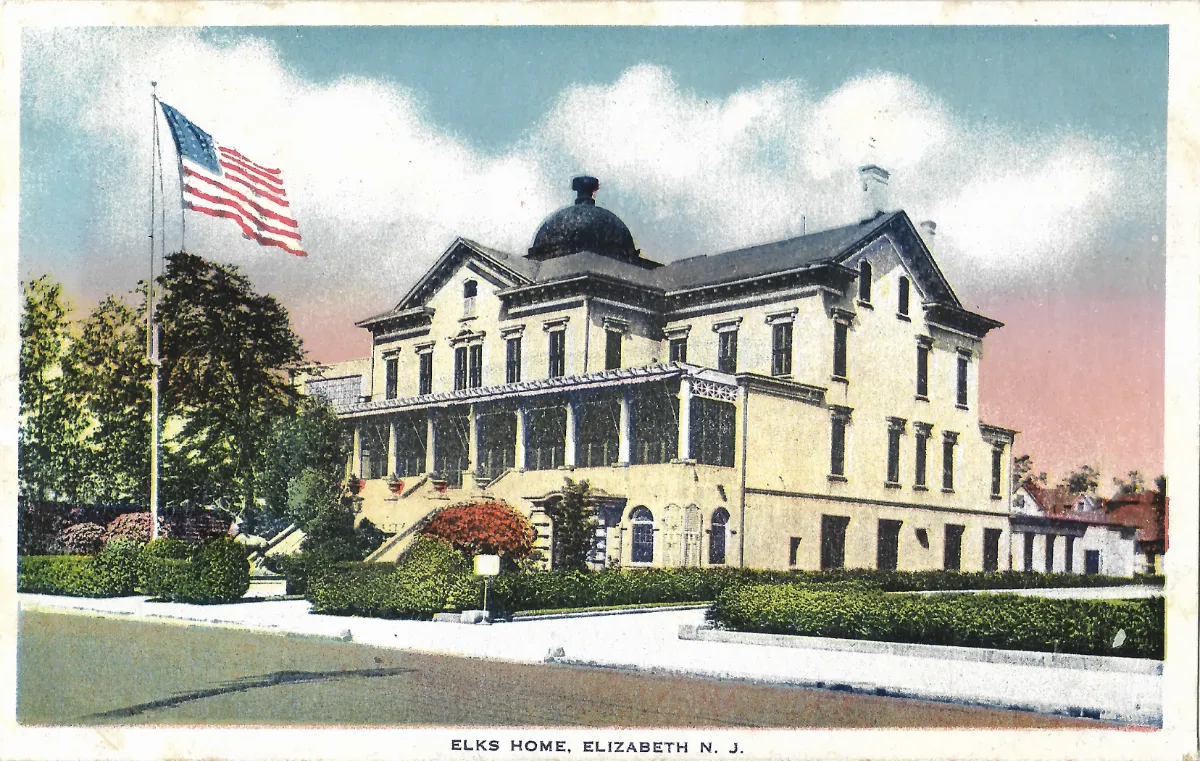
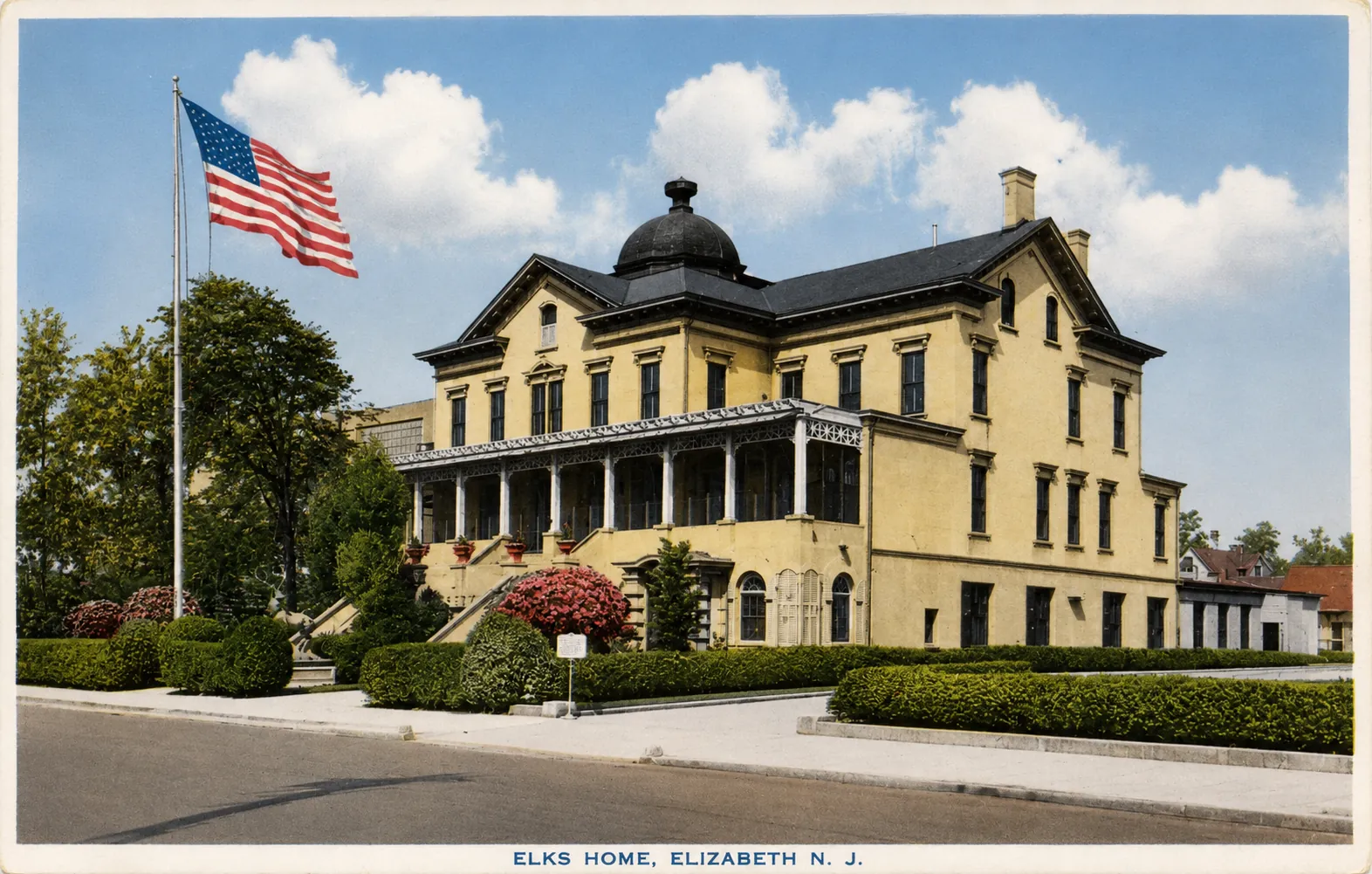
The Elks Home Elizabeth New Jersey postcard shows an imposing former residence adapted for use as a fraternal clubhouse in Elizabeth, Union County. The caption printed along the lower border, “ELKS HOME, ELIZABETH N. J.,” identifies the location beyond reasonable doubt.
The building dominates the scene. Two principal stories rise above a substantial lower level, while tall rectangular windows and large gabled sections give the structure a formal, symmetrical appearance. Most distinctive is the dark rounded cupola rising from the center of the roof. This feature, together with the broad veranda, makes the building readily identifiable in other surviving historic views.
Across the front is an extensive covered porch reached by several flights of steps. Decorative latticework runs along its upper edge. The veranda appears to have provided a generous social and recreational space, appropriate to the building’s later function as a club. These additions give the structure an institutional appearance quite different from what might be expected of an early nineteenth-century private residence.
The grounds are carefully landscaped. Trimmed hedges border the sidewalk, ornamental shrubs stand beside the entrance, and mature trees frame the left side of the property. A tall flagpole carrying the American flag is a conspicuous feature of the composition. Its prominence is consistent with the patriotic traditions of the Benevolent and Protective Order of Elks, which historically combined fellowship and charitable work with an explicitly patriotic identity.
No pedestrians, carriages, automobiles, or streetcars are visible. The photographer and postcard publisher clearly intended the building itself to be the subject. The empty roadway in the foreground and the carefully arranged landscaping give the view the quality of an architectural portrait.
Historical research adds an unusually rich story to the scene. A local history of Elizabeth identifies the building used by the Elks as the former Williamson House, constructed about 1808 by Isaac Halstead Williamson. Williamson later served as governor of New Jersey from 1817 until 1829, dates independently confirmed by the Rutgers Eagleton Center’s chronology of New Jersey governors. His son Benjamin Williamson subsequently altered and enlarged the residence.
According to the same historical account, the Williamson House originally stood at the northwest corner of North Broad Street and Westfield Avenue. It was later moved a short distance onto Westfield Avenue when its original site was required for a new United States Post Office, completed in 1911. The house was remodeled and became the Elks Club. The New Jersey Historical Society independently lists historic Elizabeth material describing the “Williamson House (now the Elks Club),” strengthening this identification.
Historical description
The postcard most likely dates from the early twentieth century, with the general appearance of the card and documentary comparisons pointing particularly toward the 1910s. Without a postmark or publisher information from the reverse of this particular card, however, an exact date cannot be established.
A valuable comparison is preserved by the New Jersey State Library. Its postcard collection contains another view of the same Elks Home in Elizabeth, recognizable by the central cupola, gabled roofline, window arrangement, and long veranda. That card was published by Line & Co. of Elizabeth and is recorded as having been postmarked in 1914. The photograph is not identical to this one, so the 1914 date cannot automatically be transferred to the present card, but it provides strong evidence that this appearance of the building was being reproduced on postcards during that period.
The building itself was already approximately a century old. The former Williamson residence had reportedly been erected around 1808, long before the rapid industrial and suburban expansion that transformed Elizabeth during the nineteenth century. Its association with Isaac Halstead Williamson gives it particular historical significance: Williamson served as New Jersey’s governor from 1817 to 1829.
Its conversion into an Elks clubhouse reflects a broader aspect of American urban and social history. During the late nineteenth and early twentieth centuries, fraternal organizations became prominent features of civic life, and substantial residences were sometimes acquired and modified to provide meeting rooms, dining facilities, auditoriums, and social spaces. In the photograph, the expansive veranda and multiple stairways are consistent with such a transition, although the precise date of each architectural alteration cannot be determined from the postcard alone.
The Benevolent and Protective Order of Elks originated in New York City in 1868 and subsequently expanded through a network of local lodges across the United States. Elizabeth’s organization was Lodge No. 289. The Elks Magazine records that Emil J. Hirtzel joined Elizabeth Lodge No. 289 in 1903, establishing that the lodge was already active in the city by the beginning of the century.
Later official New Jersey records give the lodge’s premises as 17-21 Westfield Avenue, both in the 1940s and again in the late 1950s. This fits the historical account that the former Williamson House was moved from the North Broad Street corner to a nearby site on Westfield Avenue.
The postcard therefore preserves several layers of Elizabeth’s history in a single image. What appears at first to be simply an early twentieth-century clubhouse was connected to one of the city’s older residences, to a nineteenth-century governor of New Jersey, to the redevelopment of the North Broad Street area around the new federal Post Office, and to the growth of American fraternal organizations. The soft blue and pink sky, green landscaping, red-white-and-blue flag, and pale façade were probably applied to enhance a photographic original, producing the attractive colorized appearance typical of many commercially issued postcards of the period.