Old City Hall in Elizabeth, New Jersey, circa 1910
Geographic description
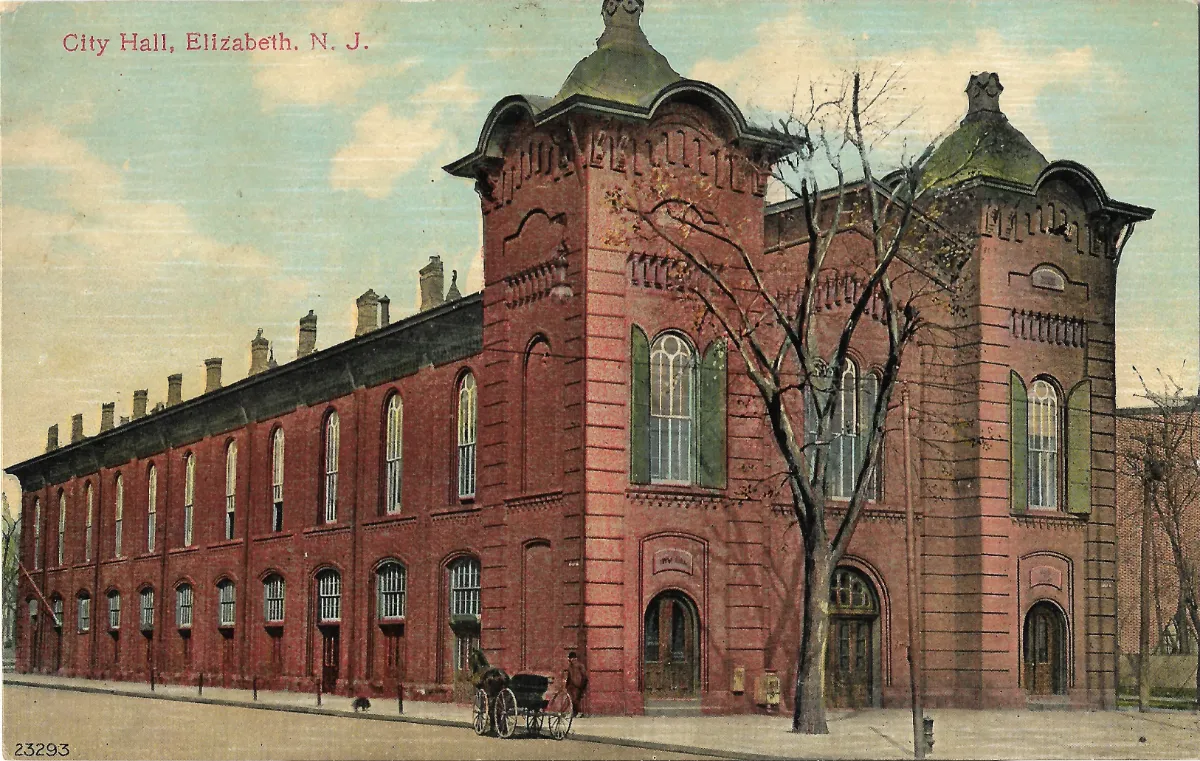
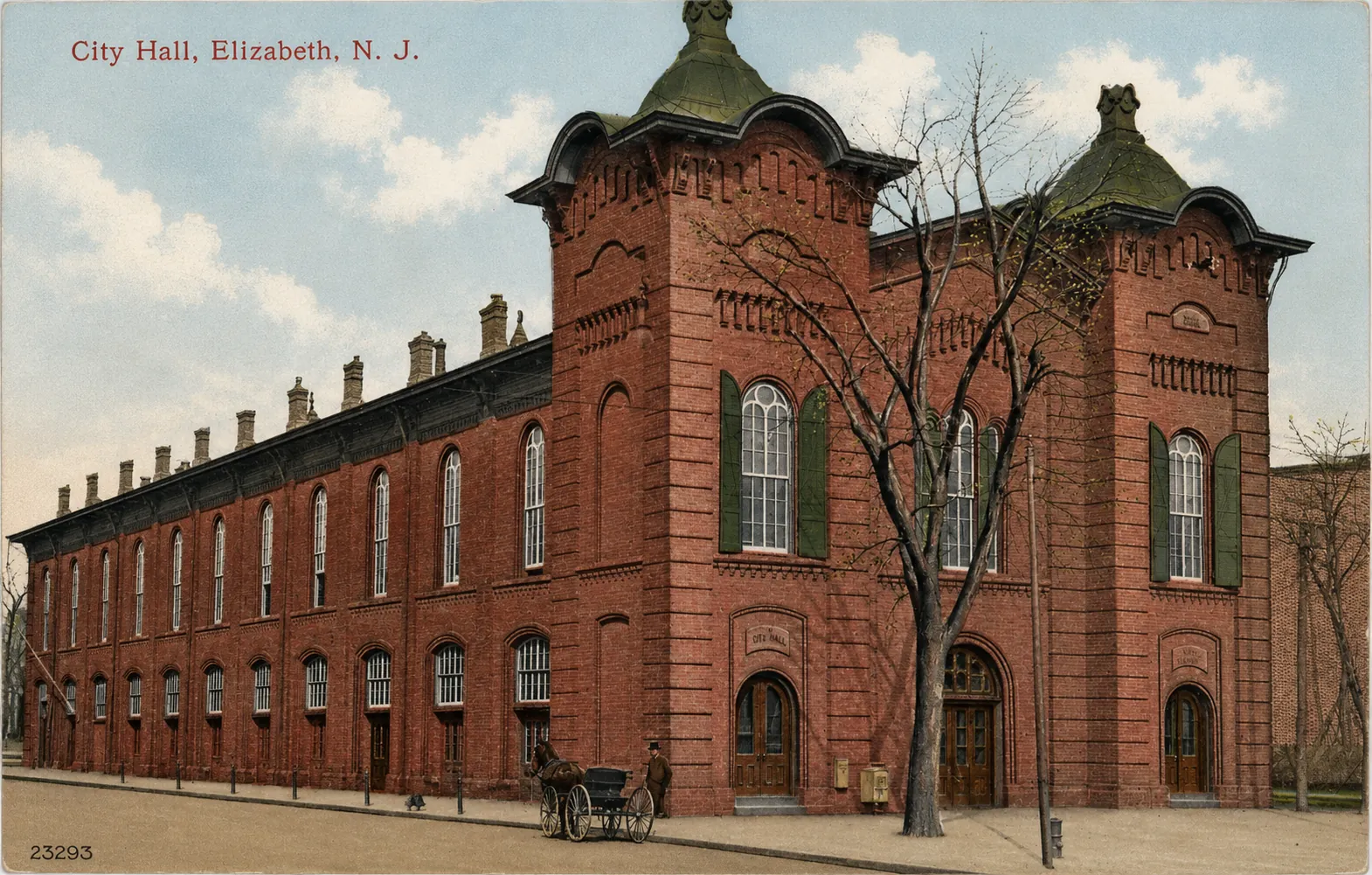
The Old City Hall in Elizabeth, New Jersey dominates this early-20th-century street scene from Elizabeth, the seat of Union County in northeastern New Jersey. The printed caption in the upper-left corner, “City Hall, Elizabeth, N. J.”, clearly identifies the subject. An additional clue appears at the lower left: postcard number 23293. Virginia Commonwealth University holds a postcard with exactly the same title and number in its James F. Stubbins collection and dates its publication to 1905–1912.
The structure shown here is not the present Elizabeth City Hall. Municipal historical records identify it as the Old City Hall and Police Headquarters, located on Elizabeth Avenue at Scott Park, and state that it was built in 1878.
Architecturally, the building is striking. Its long red-brick range extends across much of the image, with two principal stories articulated by regularly spaced narrow windows. The lower openings are smaller, and several appear to be barred, an especially interesting detail given the building’s documented use as police headquarters. Elizabeth’s municipal police history also records that the Police Court was established at City Hall in 1878.
The most imposing portion stands at the right-hand end of the building. Two massive square towers frame the principal entrance and rise above the long side wing. Their curved roof forms and decorative parapets give the façade a picturesque late-Victorian civic character. Tall round-headed windows, recessed brickwork and ornamental courses enliven what would otherwise be a very substantial and functional municipal structure.
Rather than relying on a single formal architectural style, the building appears to employ the eclectic vocabulary frequently used for American public architecture during the late nineteenth century. Its towers and arched openings suggest Romanesque influence, although the postcard alone does not justify assigning it to a more precise architectural school.
The foreground provides equally valuable evidence about the urban environment. A horse-drawn carriage stands beside the curb in front of City Hall. A few figures can be distinguished around it, while the roadway itself remains remarkably open. This was a transitional period in American transportation: motorcars were beginning to appear in cities, but horses, carriages and delivery wagons were still ordinary parts of everyday street life.
The leafless trees allow almost the entire façade to be seen. The broad sidewalk is clearly separated from the roadway, while slender poles punctuate the streetscape. There are no traffic signals, parked automobiles or dense modern street furniture. The result is a particularly clear view of an American civic center before automobile traffic transformed the scale and organization of downtown streets.
The postcard’s colors should not necessarily be interpreted as an exact photographic record. The strong brick red, pale blue sky and greenish roof details are typical of the color enhancement used on many commercially printed postcards of the period. The underlying image was probably photographic or photomechanically reproduced and then given a more attractive color treatment for the postcard market.
Historical description
The Old City Hall in Elizabeth, New Jersey belonged to a city undergoing extraordinary industrial and demographic expansion. Elizabeth had deep colonial roots, but the second half of the nineteenth century transformed it into a major manufacturing community within the New York metropolitan region.
The Historical Society of Elizabeth describes the growing importance of the Broad Street commercial district and the arrival of major industrial employers. The Singer Manufacturing Company, whose enormous sewing-machine works became one of the city’s defining industries, opened its Elizabeth operation in 1872. Between 1870 and 1900, Elizabeth’s population grew from fewer than 11,000 residents to more than 52,000.
The municipal building pictured on this postcard belonged directly to that era of expansion. An official history published by the Elizabeth Police Department identifies the Old City Hall and Police Headquarters on Elizabeth Avenue at Scott Park as having been built in 1878. The same historical record notes that the Police Court was established at City Hall that year, demonstrating that the building combined administrative, judicial and police functions.
The postcard itself can be dated more securely than would normally be possible from visual evidence alone. Virginia Commonwealth University has catalogued an example bearing the identical printed number 23293, identifying it as City Hall, Elizabeth, N.J. and assigning a publication period of 1905–1912. This documentary range is consistent with everything visible in the scene, particularly the horse-drawn vehicle and the appearance of the streetscape.
The image therefore preserves Elizabeth during the years just before the First World War, when the city was already a populous industrial center but still retained many features of nineteenth-century urban life. Horses remained part of ordinary transportation, civic buildings were closely integrated into mixed downtown districts, and the automobile had not yet reshaped every street.
The City Hall seen here would eventually be succeeded by a very different municipal building. According to the New Jersey State Library, the present Elizabeth City Hall was completed in 1926 and designed in the Beaux-Arts style then widely favored for important American civic buildings. Its monumental classical appearance represents a later phase of municipal architecture, very different from the red-brick towers and picturesque silhouette preserved on this postcard.
For local history, this view is therefore more than a simple architectural souvenir. It captures an earlier administrative center of Elizabeth at a precise moment in the city’s development. The combination of the imposing brick City Hall, nearly empty roadway and small horse-drawn carriage creates a visual record of a city poised between two eras: the industrial nineteenth century and the increasingly motorized, modern urban world of the twentieth.