Chablis Hospice on Place du Tilleul in 1904
Geographic description
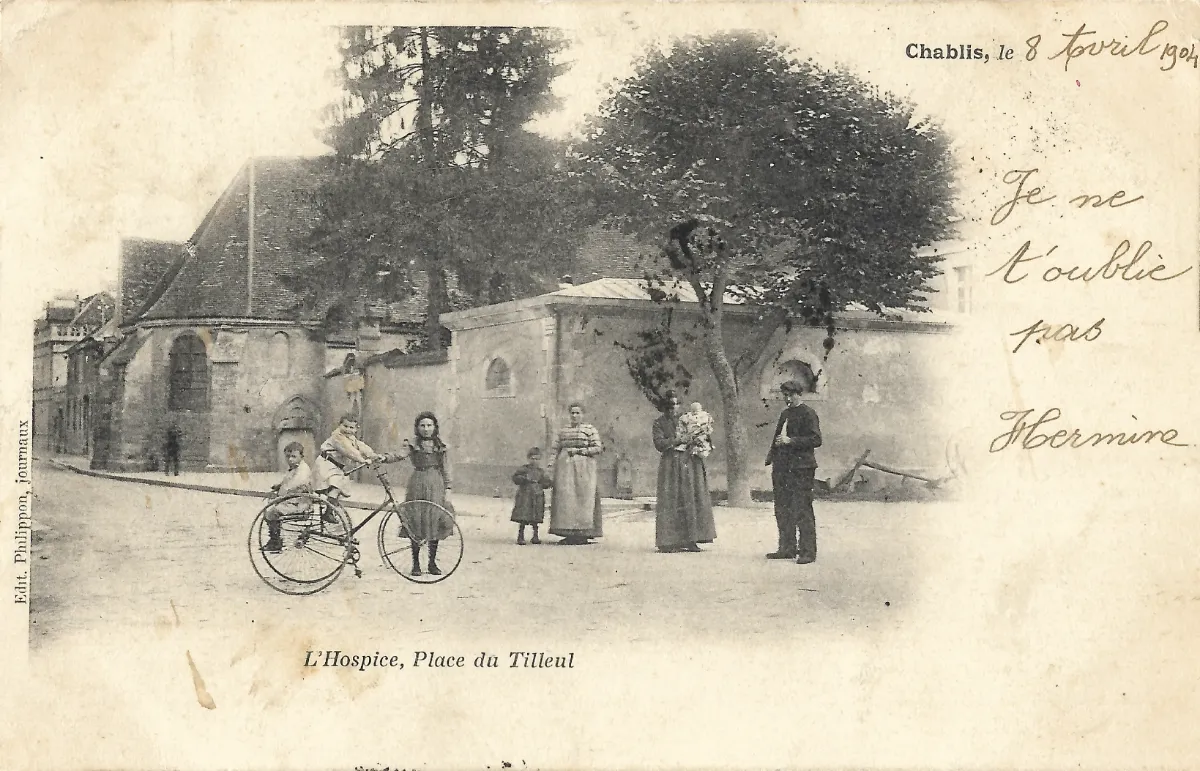
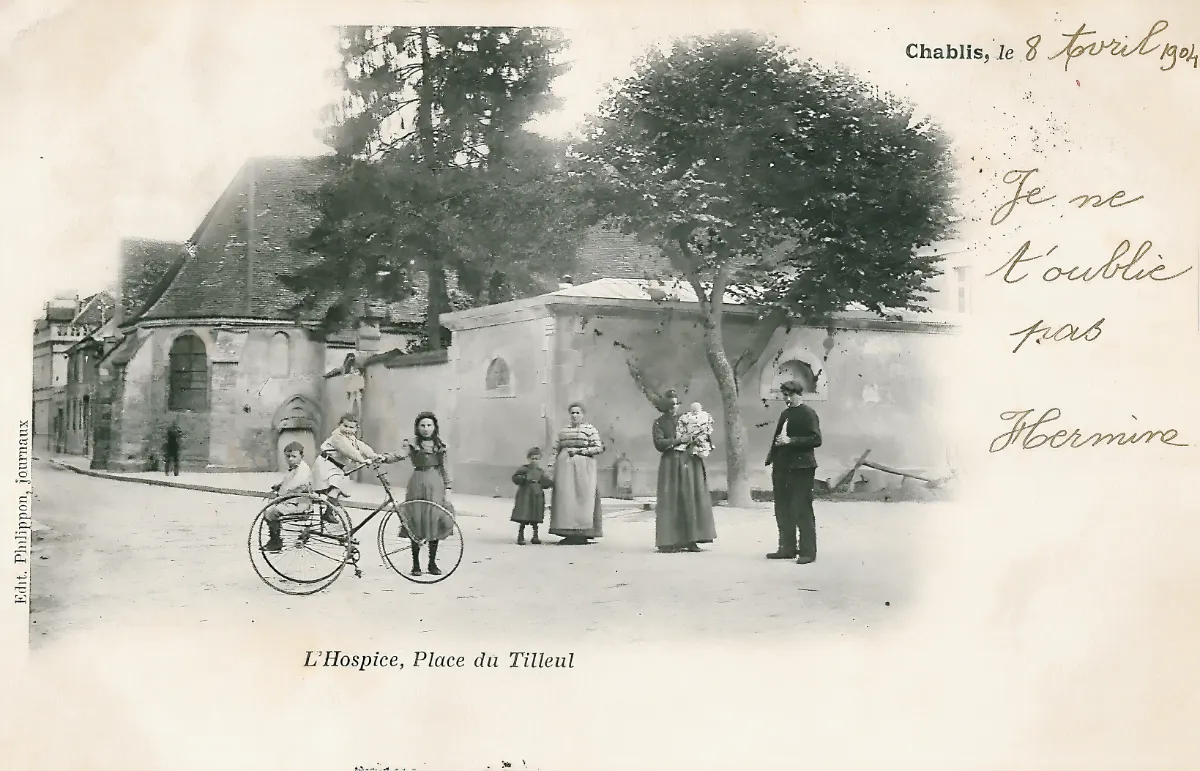
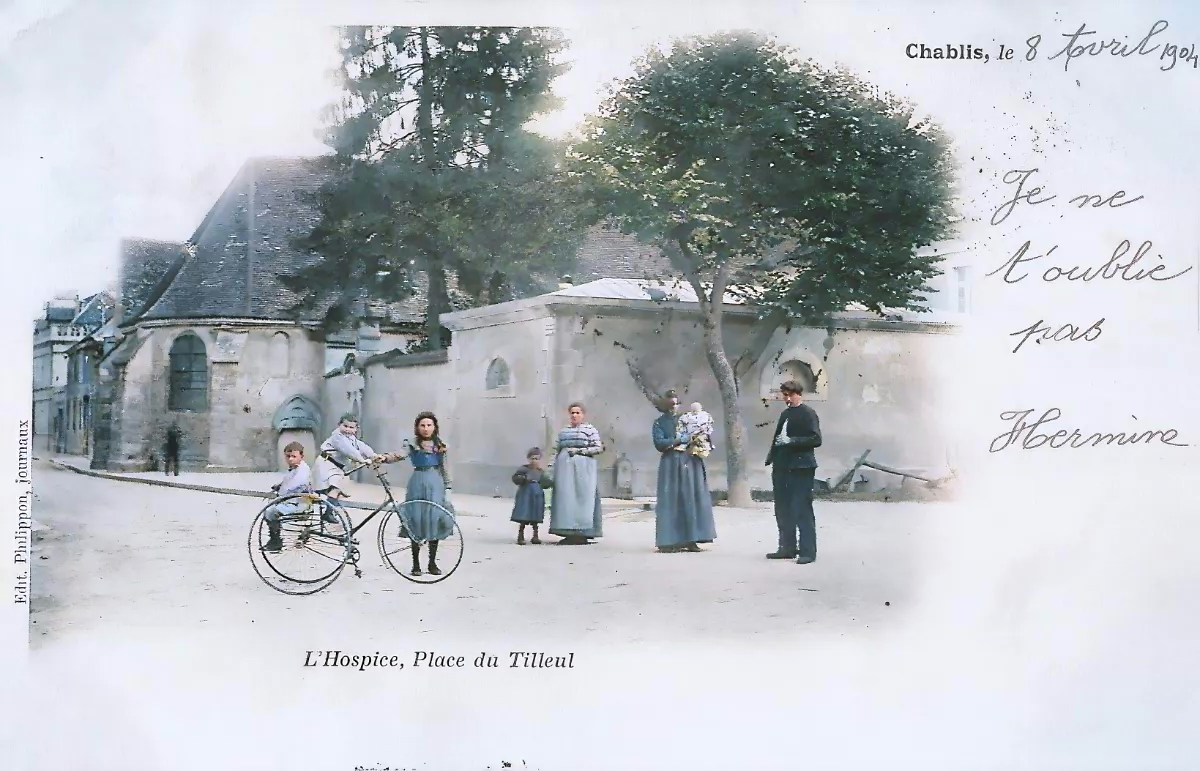
The Chablis Hospice is shown here from the former Place du Tilleul at the beginning of the twentieth century. The printed caption, “L’Hospice, Place du Tilleul,” identifies the subject precisely. The institution was the historic Hôtel-Dieu of Chablis, in the Yonne department of Burgundy. The French heritage inventory now records the surviving complex at 18 rue Jules Rathier, close to rue de l’Hôpital.
A large open space occupies the foreground of the postcard. Its surface appears to be bare earth or compacted stone rather than a modern paved roadway. There are no road markings, traffic signs or other contemporary street features, giving the square the appearance of a traditional provincial public space. Two substantial trees stand immediately outside the hospice and form an important part of the composition.
On the left, the photograph shows one of the older sections of the hospital complex. The rendered masonry walls, tiled roofs and a large round-headed window are particularly noticeable. The latter appears to belong to the hospice chapel, one of the historically significant parts of the site. According to local heritage information, the chapel once extended directly from the patients’ ward so that sick residents could attend Mass without leaving the hospital area.
A boundary wall separates part of the institution from the square, while additional buildings can be seen behind it. The official heritage inventory describes the complex as predominantly built of rendered rubble masonry and covered with flat tiles. Its irregular appearance reflects the fact that the Hôtel-Dieu was enlarged and altered during several different periods rather than being created as a single unified building.
The people gathered in front of the hospice make this postcard especially valuable. Several women and children, together with a man standing farther to the right, appear to have stopped for the photographer. A bicycle is prominently positioned in the foreground. Since photographic exposures of this period generally encouraged subjects to remain fairly still, at least some of the figures may have deliberately posed. The result is not merely an architectural record but also a small portrait of everyday life in provincial France.
The name of the square has changed since the postcard was produced. Research into the historical street names of Chablis indicates that Place du Tilleul — also known in earlier times as Place du Tillet and subsequently as Place de la Révolution — eventually became the present-day Place du Général Gras. The change is part of a wider pattern of renamed streets and squares within Chablis during the nineteenth and twentieth centuries.
Historical description
This Chablis Hospice postcard can be dated unusually closely because the sender wrote directly on the front: “Chablis, le 8 avril 1904” — Chablis, 8 April 1904. The inscription does not establish that the photograph itself was taken on that exact date. The photograph and printing could have been produced somewhat earlier. It does, however, demonstrate that this particular postcard design was already in circulation by April 1904.
The clothing, bicycle and overall visual style are consistent with this early twentieth-century date. Along the left-hand edge is the printed credit “Édit. Philippon, Tonnerre,” identifying the postcard publisher as being based in Tonnerre, another town in the Yonne department. The arrangement is typical of early picture postcards: large blank areas remain on the illustrated side for handwritten correspondence, while the reverse of postcards of this period was commonly reserved primarily for the recipient’s address.
The institution itself was already centuries old when this photograph was taken. According to the French General Heritage Inventory, the Chablis Hôtel-Dieu is first documented in 1367, when an administrator of the establishment appears in a lease. It probably depended on the Hospitallers of the Holy Spirit of Montpellier. Its chapel, dedicated to Saint John the Baptist, may have received support from Jean Bourrey, a minister of King Louis XI. The chapel vaults were rebuilt in 1632.
Major changes followed during the eighteenth and nineteenth centuries. Beginning in 1723, a new building was erected to separate male and female patients, who had previously shared the older ward. Further expansion began in 1853, including a laundry, bathroom and mortuary room. Another important phase took place in 1897, when a new men’s ward and sanitary facilities were added. This means that the hospice photographed in 1904 had undergone significant improvements only a few years before the postcard was written. The photograph alone does not, however, allow every visible section to be confidently assigned to a specific construction campaign.
The site continued to evolve during the twentieth century. Internal changes were undertaken from 1930, and the institution was enlarged again in 1957 after becoming a retirement home. The historic complex was later converted for use as a hotel and restaurant. Its chapel received official heritage protection when it was listed as a Monument historique on 6 January 1927.
The postcard therefore documents two histories at once. It records a charitable and medical institution whose origins extend back to medieval Chablis, while also preserving a remarkably human view of the town in 1904. The children, women, bicycle, mature trees and unmodernised public square place the historic hospice within the ordinary life of its neighbourhood. Rather than presenting the building as an isolated monument, the photographer captured it as part of a living town — one that was about to experience the extensive social, architectural and technological changes of the twentieth century.