Chablis – The Tacot du Serein Railway Station in 1904
Geographic description
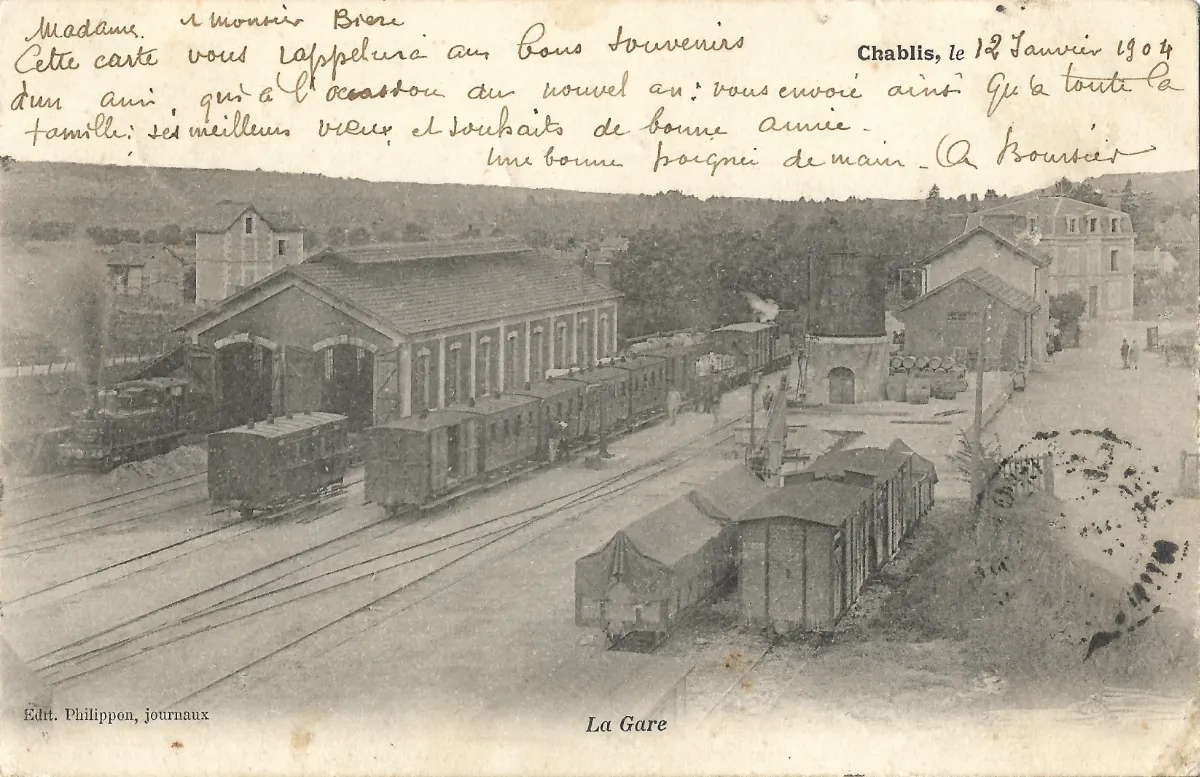
Chablis railway station in 1904 is shown on this postcard as a surprisingly extensive railway complex rather than a modest rural stop. The photographer stood at a slightly elevated position, providing a broad view of the tracks, rolling stock, workshops and ancillary buildings that formed the station area.
Several parallel tracks occupy much of the foreground. On the left stands the most imposing structure in the photograph: a long masonry building under a pitched roof, with a succession of tall openings along its side and larger openings at the end facing the tracks. Its architecture strongly suggests a technical railway function, most probably connected with the locomotive sheds or workshops. Historical documentation supports this interpretation, as Chablis was not simply a passenger station: the depot and workshops of the local railway were established there.
A considerable quantity of rolling stock can be seen throughout the site. Covered wagons and other railway vehicles stand beside the workshop building, while another group occupies a siding in the foreground. Their presence gives the scene an unmistakably industrial character. This was clearly a place where trains and freight wagons could be stored, handled and serviced, rather than merely a stopping point for passengers.
Near the middle of the picture, a faint plume of smoke or steam rises above the railway vehicles. It is consistent with steam-locomotive activity, although the locomotive itself is not sufficiently clear to allow any precise identification.
Another notable feature is the cylindrical structure near the centre-right of the photograph. Its position close to the tracks and technical buildings suggests that it was probably associated with the water supply required by steam locomotives. Historical descriptions of the Tacot du Serein confirm that Chablis was one of the stations equipped with a water tower.
The right-hand side of the railway complex contains several smaller buildings. Beside one of them is a conspicuous group of barrels or casks stacked in rows. The photograph itself does not reveal what they contained, so they cannot automatically be identified as wine barrels. Nevertheless, their presence is highly suggestive in Chablis. Historical accounts of the railway state that Chablis wine was among the goods transported on the line, together with timber and stone from local quarries. It is therefore reasonable to associate these casks with the local wine trade while retaining some caution about their precise contents.
Beyond the railway grounds, the surroundings remain relatively open. A handful of substantial houses appear on the right, while much of the background consists of undeveloped land and wooded or cultivated slopes. The station therefore seems to occupy a transitional area between the built-up town and the surrounding countryside.
At the bottom of the postcard, the printed caption simply reads “La Gare”. At lower left appears “Éditr. Philippon, journaux”, directly associating Philippon with the publication or distribution of the card. Other old postcards of Chablis attributed to Philippon are known, including another view of the station, although the available sources do not provide enough reliable biographical information to establish the publisher’s full identity or exact working dates.
Historical description
This postcard is unusually valuable for dating purposes because it contains a clearly legible handwritten date. In the upper-right corner, the sender wrote “Chablis, le 12 Janvier 1904” — Chablis, 12 January 1904. The postcard must therefore have been printed and available by that date, although the photograph itself may have been taken somewhat earlier.
The handwritten text consists largely of New Year wishes addressed to a family. This apparently ordinary message is an interesting reminder of the everyday role of postcards during the early twentieth century. They were inexpensive and convenient means of brief communication, not merely souvenirs or collectors’ items.
The correspondence has been written across the large blank area above the photograph. This layout is characteristic of early illustrated postcards, when space was deliberately left on the picture side for the sender’s message. Around 1904 postal-card design was changing, and the now-familiar divided back — one section for correspondence and another for the address — began to become standard. The Fondation La Poste notes that 1904 marked the period when postcards increasingly adopted this modern format.
The railway shown here belonged to the Tacot du Serein, a metre-gauge departmental railway serving the Serein valley. The line operated from 1887 until 1951. Chablis played an especially important role because the railway’s depot and workshops were located there. Consequently, when this postcard was written in January 1904, the railway had already been operating for about seventeen years and was a well-established part of the local transport system.
The photograph offers strong visual evidence of the importance of freight traffic. Numerous wagons occupy the sidings, and the size of the technical facilities is greater than would normally be expected at an ordinary rural passenger stop. Contemporary and later historical accounts state that the railway carried quarry stone, timber and Chablis wine. It therefore served as a practical economic link between the Serein valley and larger transport networks.
This function was particularly significant at the beginning of the twentieth century. Motorised road transport was still in its infancy, and a local railway could dramatically improve the movement of heavy or bulky goods. For wine producers, timber merchants and quarry operators, access to rail transport opened markets that would have been much more difficult and costly to reach by horse-drawn transport alone.
The large workshop building, sidings, wagons and water facilities visible on this postcard consequently represent more than railway architecture: together they form a small industrial complex serving the economic life of Chablis and the surrounding valley.
The Tacot du Serein finally ceased operating in 1951. A municipal historical account also states that the former depot and workshop site at Chablis later became the location of the local emergency-services centre. The railway landscape recorded by the postcard has therefore largely disappeared.
With its clearly dated correspondence and exceptionally broad view of the railway installations, Chablis railway station in 1904 provides a valuable visual record of an era when the Tacot du Serein was still an essential element of everyday life and local commerce.