Broad Street in Elizabeth: Woolworth, Goerke and the Rise of Downtown Shopping
Geographic description
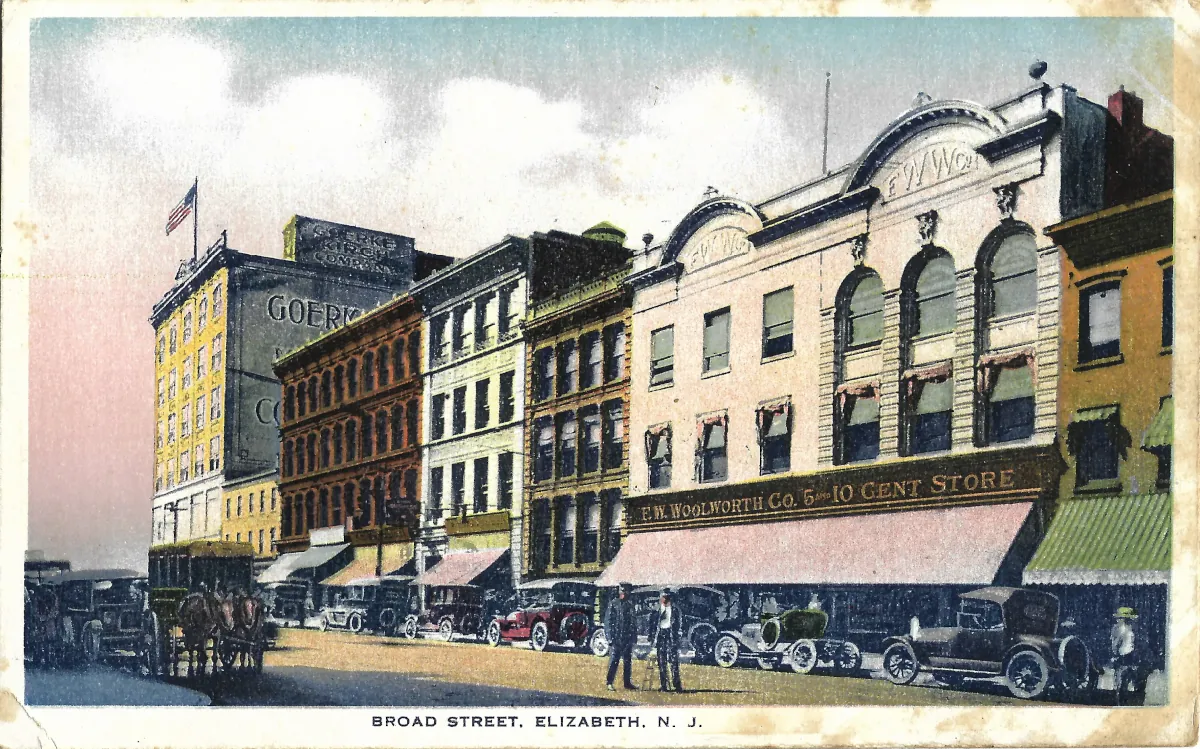
Broad Street in Elizabeth NJ appears on this vintage postcard as a busy commercial street lined with department stores, early automobiles and multi-story buildings.
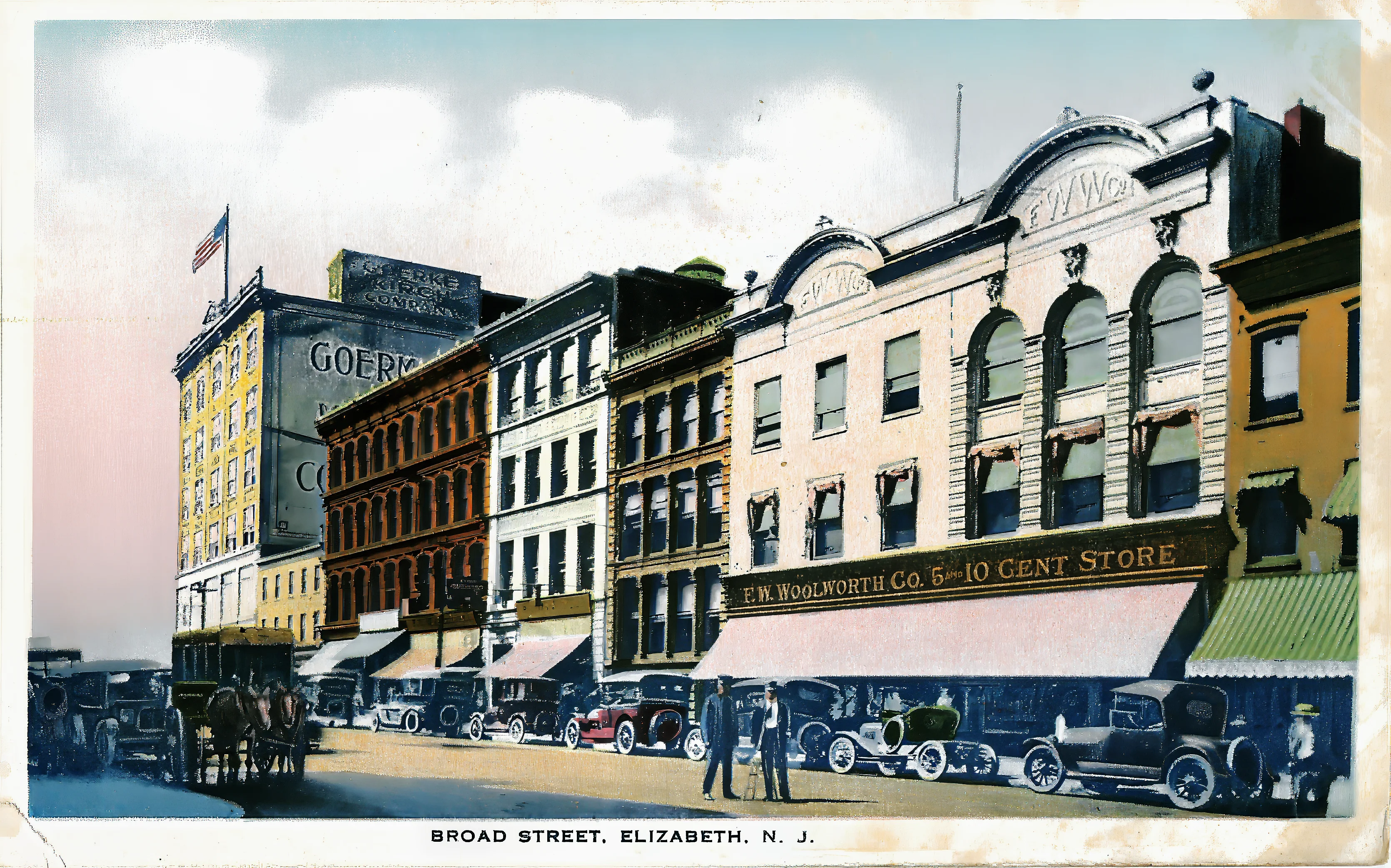
Broad Street in Elizabeth, NJ is shown on this vintage postcard as a dense and prosperous downtown shopping street lined with multi-story commercial buildings and prominent retail signs. The printed caption, “BROAD STREET, ELIZABETH, N. J.,” identifies the location with certainty. The scene is in the historic commercial heart of Elizabeth, a Union County city southwest of Newark and closely connected with the greater New York metropolitan area.
The most striking building stands on the right. Its light-colored façade is articulated by tall arched windows and decorative curved pediments. Across the storefront, the large inscription “F. W. WOOLWORTH CO. 5 and 10 CENT STORE” can clearly be read. This was one of the famous Woolworth “five-and-dime” stores, where inexpensive everyday merchandise played a major role in the growth of American mass retailing. Large fabric awnings extend across almost the entire storefront and would have protected its display windows from direct sunlight.
A historical study of Elizabeth describes the Woolworth five-and-ten-cent store on Broad Street as a long-standing local landmark. It also identifies the neighboring building as belonging to the Elizabethtown Gas Light Company and notes that Woolworth later moved farther along Broad Street, closer to Goerke’s department store. An earlier local publication records F. W. Woolworth & Co. at 138 Broad Street, providing a useful clue to the location of the store, although without information from the reverse of this particular postcard the precise address at the moment of the photograph cannot be established with complete certainty.
Moving left through the picture, the streetscape consists of a nearly continuous row of narrow commercial buildings. Red and dark brick façades alternate with lighter masonry fronts. Most rise three or four stories, creating the kind of compact urban commercial corridor commonly developed in American cities during the late nineteenth and early twentieth centuries.
Farther down the street, a much taller building carries the large Goerke name on its side wall. This is associated with the major Goerke department store at the corner of Broad and West Jersey streets. Local historical material identifies the long-established commercial site as 100 Broad Street and documents the importance of the Goerke store in Elizabeth’s downtown history.
The street also provides valuable evidence of changing transportation. A remarkable line of automobiles is parked beside the curb. They include open touring cars as well as enclosed vehicles with tall, squared-off passenger compartments. A few pedestrians can be seen in the roadway and on the sidewalk. Unlike earlier postcard views of Broad Street, no streetcar is visible in this particular image. The automobile has clearly become a major element of downtown life.
The postcard appears to have been colorized from a photographic original. Pink, green and reddish awnings and automobile bodies make the commercial scene visually attractive, but these colors should not necessarily be regarded as exact documentary evidence. Such color treatment was primarily intended to transform an ordinary street photograph into an appealing souvenir.
Historical description
The scene was probably photographed during the 1920s, perhaps during the first half of the decade. This remains an estimated date rather than a certainty because no postmark, publisher information or dated message from the reverse has been provided. Nevertheless, the automobiles, storefront design and documented history of the businesses visible in the image provide several useful chronological clues.
Goerke’s department store offers an important terminus for dating the view. The Historical Society of Elizabeth places the opening of the six-story Elizabeth department store around 1913, shortly before the First World War. Known historically as the Goerke-Kirch Company, it represented the emergence of large department stores in Elizabeth during the early twentieth century. The photograph therefore cannot predate the appearance of that building in the form shown here.
The automobiles suggest a somewhat later period. Their high bodies, narrow wheels, long engine compartments and mixture of open and enclosed designs are consistent with vehicles common from the late 1910s into the 1920s. Taken together, the evidence makes a date of approximately 1920-1925 quite plausible, although it should not be treated as an exact dating of the postcard.
This period coincided with the development of Broad Street into Elizabeth’s principal commercial center. During the late nineteenth century the city had experienced extraordinary industrial and demographic growth. The Historical Society of Elizabeth reports that the population increased from fewer than 11,000 residents in 1870 to more than 52,000 by 1900. Large industrial employers, especially the Singer Sewing Machine factory established in 1872, attracted workers to the city, while Broad Street increasingly became associated with shops, banks, offices and professional activity.
By the beginning of the twentieth century, traditional individual shops were being joined by larger department stores. These businesses could purchase goods in bulk, offer standardized prices and organize merchandise into specialized departments. Goerke became one of Elizabeth’s most important examples of this new retail model.
Woolworth represented another side of the same retail revolution. Instead of an elaborate department-store experience, its five-and-dime concept offered large quantities of inexpensive household goods, school supplies and other everyday items at standardized low prices. The presence of both Woolworth and Goerke in the same postcard therefore provides an unusually effective visual summary of changing American consumer culture.
The 1920s reinforced Broad Street’s importance. Historical Society research describes the decade as a period of postwar economic expansion in Elizabeth, when commercial development increasingly linked Elizabeth Avenue with the established shopping district along Broad Street.
Broad Street remained a major regional shopping destination for decades. Woolworth, Goerke, W. T. Grant and H. L. Green were joined by clothing stores, shoe shops, music businesses and several movie theaters. Local historical accounts describe a period when customers from throughout Union County came into downtown Elizabeth to shop.
The value of this postcard therefore extends beyond the individual buildings it records. It captures an American downtown at a decisive moment of change: large-scale retailing is firmly established, automobiles are becoming a dominant presence, and Broad Street is presenting itself as the modern commercial heart of a rapidly developed industrial city.