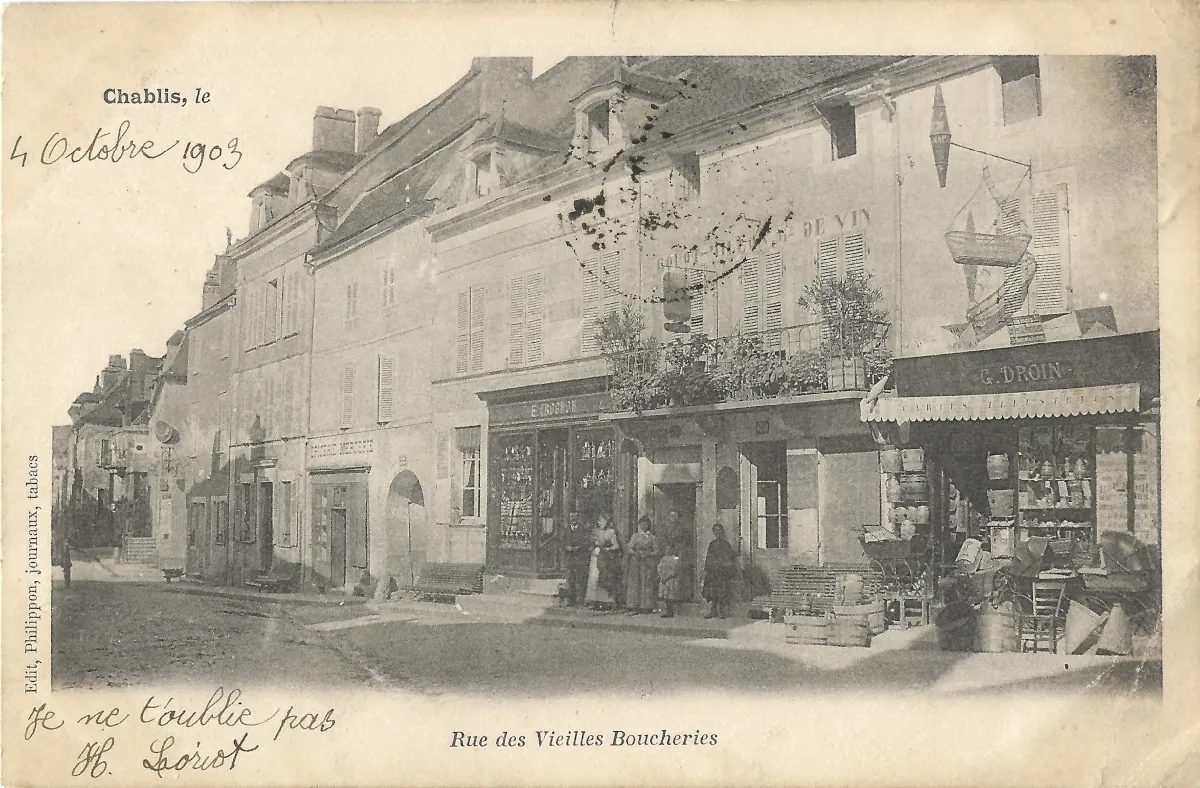
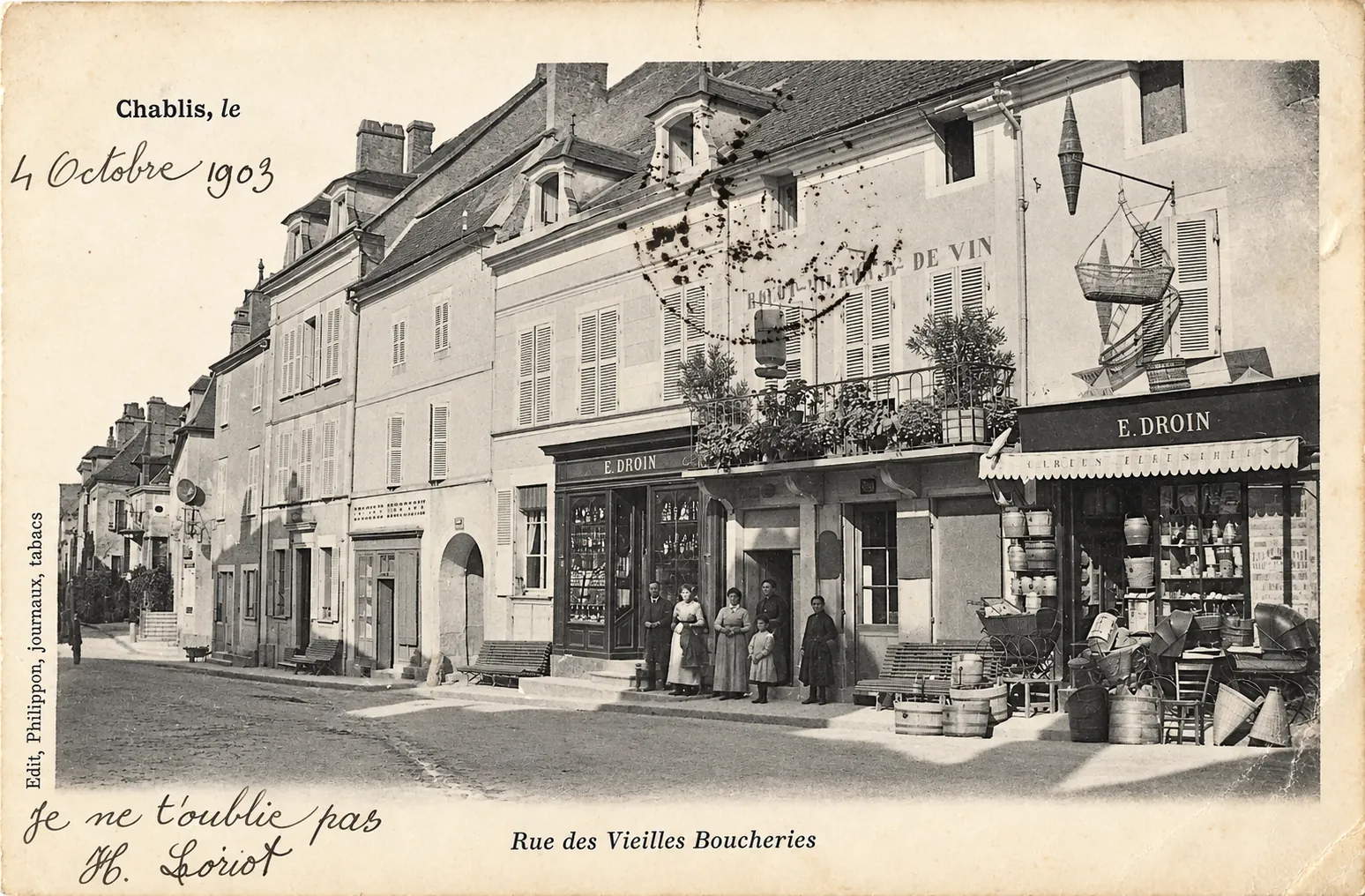
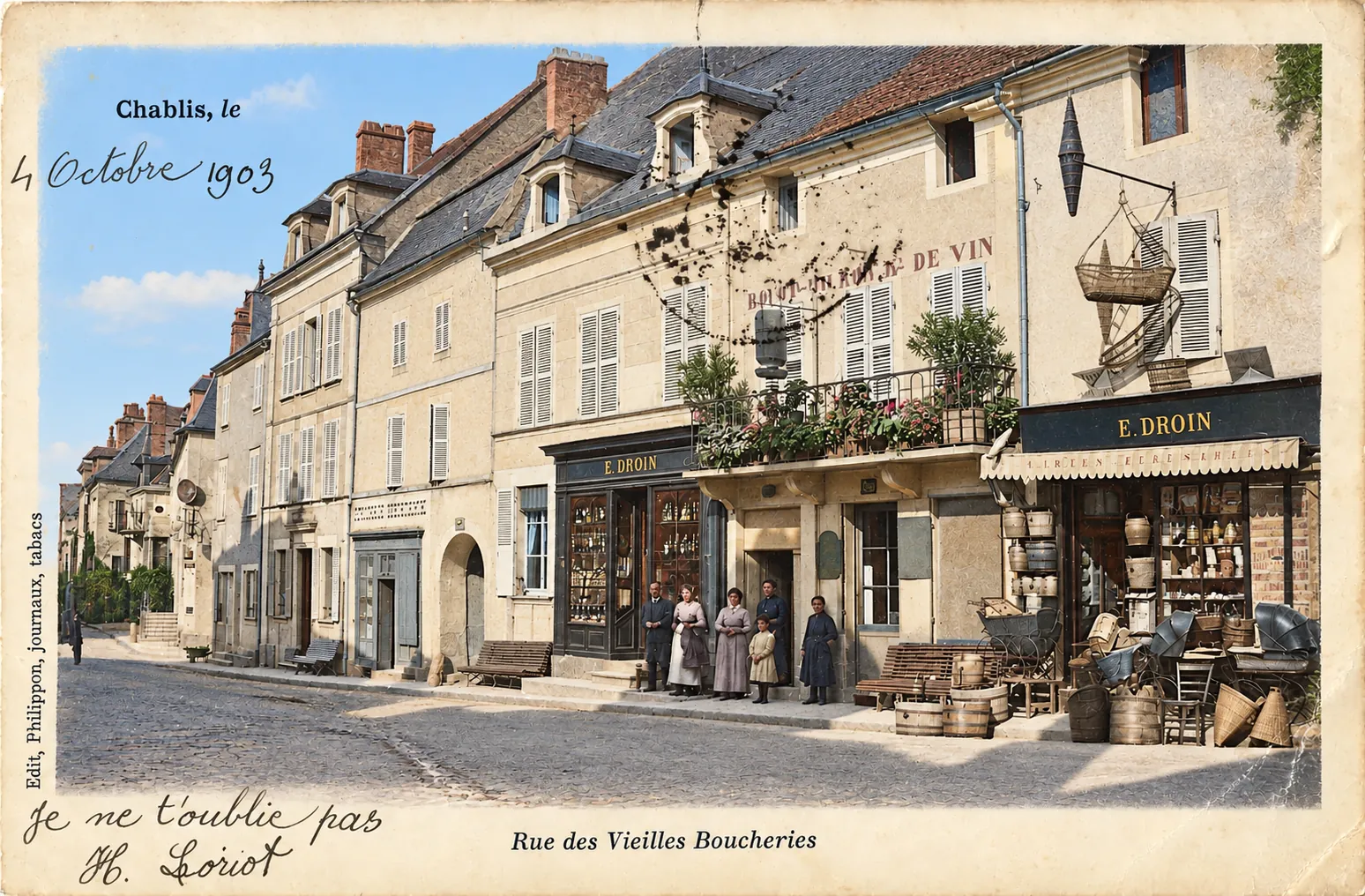
Chablis – Rue des Vieilles Boucheries in 1903
Geographic description
The Rue des Vieilles Boucheries in Chablis is shown here at the beginning of the twentieth century as a small commercial street in the historic centre of this town in the Yonne department of Burgundy. Chablis lies near Auxerre in the valley of the Serein River, at the heart of a landscape whose identity has been closely associated with vineyards and wine for centuries. The Chablis vineyards extend along both banks of the Serein.
The caption printed at the bottom of the postcard clearly identifies the location as “Rue des Vieilles Boucheries.” The street still bears this name today. Research into the history of Chablis street names shows that it was formerly known as the Rue des Bouchers, or Butchers’ Street, before becoming the Rue des Vieilles Boucheries. Its modern name therefore preserves the memory of one of the trades historically associated with this part of the town.
The photograph depicts a narrow street lined with adjoining houses built directly along the roadway. Most have an upper floor, with several roofs containing small dormer windows. The façades are simple and regular, with tall windows fitted with traditional wooden shutters. Steep roofs and numerous chimneys reinforce the appearance of an old Burgundian market town.
Several shops occupy the foreground. On the right, the name “G. DROIN” can be read clearly above a shop whose frontage opens directly onto the street. Baskets, crates, containers and other goods have been placed outside, almost turning the pavement into an extension of the shop itself. Above the building, the words “DE VIN” remain legible on the wall, although the preceding portion of the painted inscription has deteriorated too much to be read reliably.
A large projecting trade sign also hangs above the shop. Its exact significance cannot be determined from the photograph alone, but it would certainly have made the premises highly visible to people approaching along the street.
Next door is another shopfront apparently bearing the Droin name, although the lettering is less distinct. A small group of residents — mainly women and children — has gathered outside. Their presence gives the postcard considerable documentary value: rather than being a purely architectural photograph, it captures a small piece of everyday life in Chablis.
The potted shrubs along the balcony, half-open shutters, goods stacked against the façades and complete absence of motor traffic create the atmosphere of a compact provincial town in which commercial and domestic life shared the same narrow urban space.
Historical description
This postcard has an unusually useful dating clue. The sender has written “Chablis, le 4 Octobre 1903” in the upper left-hand corner. It therefore proves that the postcard was already in circulation by 4 October 1903. The inscription does not, however, prove that the photograph itself was taken on that exact date; the original photograph may have been produced somewhat earlier.
Along the left edge is another useful printed detail: “Édit. Philippon, journaux, tabacs.” This probably identifies Philippon as the local retailer or publisher responsible for issuing the card. Its monochrome printing, layout and documentary style are entirely consistent with French postcards produced during the first years of the twentieth century.
The G. Droin sign is particularly intriguing. The Droin surname has deep roots in Chablis and is closely connected with the history of local winegrowing. The history published by the present Jean-Paul & Benoît Droin estate records generations of winegrowers in Chablis, including Edme-Auguste Droin in the nineteenth century and Louis Droin, born in 1876. However, no sufficiently precise source found during this research establishes the identity of the G. Droin shown on the postcard. It would therefore be unsafe to claim that this shop belonged directly to the same branch of the family as the modern estate.
The date of 1903 is also significant in the wider history of Chablis wine. Local winegrowers had recently endured a particularly difficult period. The Droin estate’s historical records state that the entire 1902 harvest was destroyed by frost, while the Chablis vineyards had also been affected by phylloxera and mildew during the preceding decades. The postcard was therefore written during a period when the vineyards surrounding the town were undergoing major economic and agricultural change.
The modern regulatory system governing Chablis wine was still decades away. The Chablis Appellation d’Origine Contrôlée was officially established only in 1938. In 1903, Chablis wine already enjoyed a long-established reputation, but the legally protected appellation familiar today did not yet exist.
This postcard therefore offers more than a picturesque view of an old street. It documents the commercial heart of Chablis during the Belle Époque, showing local businesses, residents and shop displays at a time when everyday trade was conducted directly onto the street. The continued survival of the name Rue des Vieilles Boucheries adds another layer of historical continuity: although the old butchers who originally gave the street its name have disappeared, their presence remains embedded in the urban geography of modern Chablis.