Elizabeth – Singer Factory and Streetcars in the Early 1900s
Geographic description
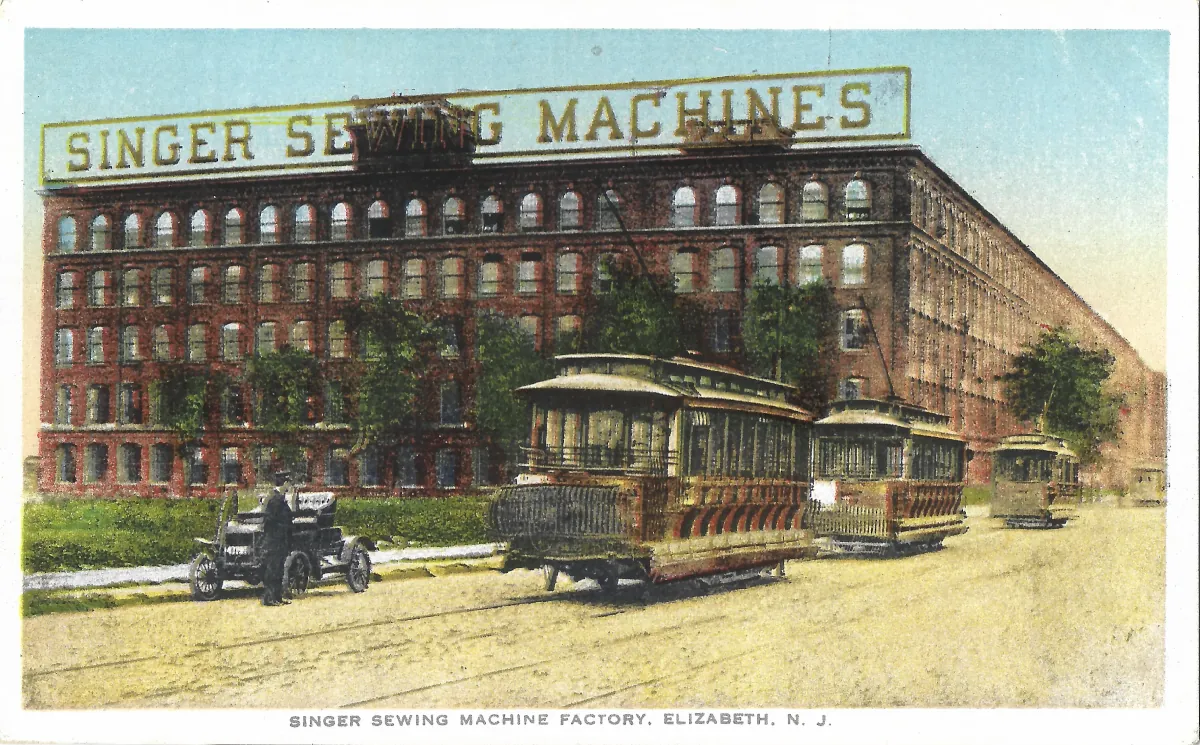
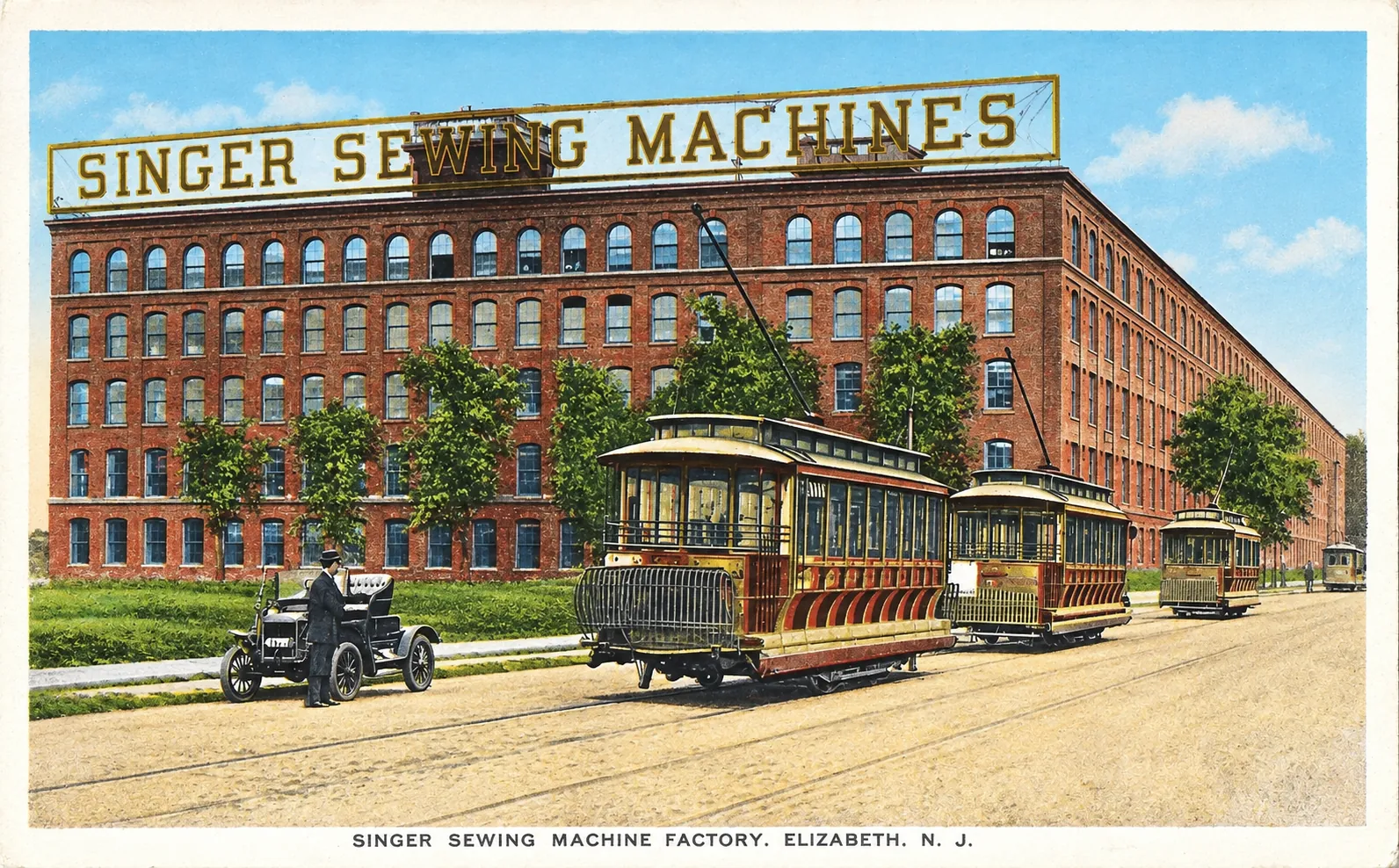
The Singer sewing machine factory Elizabeth NJ dominates this vintage postcard, its enormous brick façade forming the backdrop to a busy line of streetcars. The location is unmistakably identified by the printed caption, “Singer Sewing Machine Factory, Elizabeth, N. J.,” while the huge rooftop sign reading SINGER SEWING MACHINES turns the building itself into an advertisement for one of the world’s best-known sewing-machine manufacturers.
Elizabeth is a city in Union County, New Jersey, within the greater New York metropolitan area and immediately south of Newark. It remains the county seat of Union County. The eastern side of the city reaches Newark Bay and the Arthur Kill, the tidal waterway separating this part of New Jersey from Staten Island.
Singer’s industrial complex stood in Elizabethport, the city’s waterfront and industrial district. Historic American Engineering Record documentation places the Singer property at 321 First Street, bordering Newark Bay. The location had been deliberately selected for its excellent transportation connections: direct access to railroads, waterfront frontage and a navigable route leading toward New York Bay. Singer began acquiring land here in 1870.
The building shown on the postcard is very likely part of Singer’s famous “Great Factory,” the vast manufacturing complex developed between 1871 and 1873. Its architecture is unmistakably industrial: long red-brick walls, repetitive rows of tall arched windows and a façade extending far into the distance. Historic documentation describes the early Singer factory as a five-story red-brick structure featuring arched windows, brick pilasters and decorative brickwork. Enlargements carried out during the late nineteenth century eventually extended the building to roughly 1,500 feet, or about 457 metres, in length.
The postcard conveys this extraordinary scale particularly well. The early automobile at the left appears almost miniature beside the factory. Several electric streetcars occupy the foreground, running on rails embedded in the roadway. The nearest car has an enclosed passenger compartment with large windows and platforms at either end, while additional cars can be seen farther down the street. They provide an important visual clue to the transportation system serving this densely industrialized part of Elizabeth.
Motor traffic remains conspicuously light. Only one clearly visible early automobile stands beside the tracks. Its tall wheels and upright bodywork belong to the pioneering years of motor travel, when automobiles were beginning to share urban streets with electric streetcars rather than dominate them.
The postcard has also been colorized. The reddish factory walls, green foliage and streetcars, and pale blue sky were probably applied to an originally monochrome photographic image. Such treatment was common in early twentieth-century postcard production, meaning that the colors are best regarded as an artistic interpretation rather than precise documentary evidence.
Historical description
The history of the Singer sewing machine factory Elizabeth NJ is closely tied to the extraordinary nineteenth-century expansion of the sewing-machine industry. Isaac Merritt Singer developed his successful machine around 1850 and received a patent in 1851. The company subsequently became a dominant manufacturer, combining mechanical innovation with an exceptionally effective system of sales offices, demonstrations, customer instruction and installment purchasing.
By the late 1860s, Singer’s scattered New York manufacturing facilities could no longer efficiently meet demand. Management therefore decided to consolidate production in a single major factory with good transportation connections. The company purchased its first land beside Newark Bay in October 1870, construction began around 1871, and nearly two million dollars was invested in the new complex. According to the Historic American Engineering Record, on October 18, 1873, Singer transferred all of its United States manufacturing operations to Elizabeth. The new works became known as the “Great Factory.”
An official New Jersey heritage study states that when the Elizabeth factory opened in 1873, it was the largest manufacturing facility under one roof in the world. A New Jersey transportation history of Union County records that the Singer property eventually exceeded one hundred acres and employed as many as approximately 7,000 workers, making it by far the county’s largest industrial employer.
The postcard itself was almost certainly produced considerably later than the original factory. The electric streetcars, the early automobile, the colorized photographic presentation and the overall postcard style point toward the early twentieth century. A cautious estimate of approximately 1905–1915 is appropriate. No precise date or clearly identifiable publisher is visible on the front, however, so this should remain an approximate dating rather than a firm attribution.
That period coincided with Singer’s enormous international success. Historic American Engineering Record research indicates that by 1912 the company controlled roughly 60 percent of the American sewing-machine market and an even greater share of the global market. Elizabeth, together with Singer’s major works at Clydebank in Scotland, formed one of the principal manufacturing centers of this worldwide industrial organization.
The Elizabeth property continued to grow during the twentieth century. Documentary records identify buildings added in 1899, 1905, 1909, 1913 and 1918, including manufacturing shops, warehouses, offices, a foundry and a powerhouse. The result was not simply a factory building but a large, highly organized industrial campus with its own specialized infrastructure.
The streetcars in the foreground therefore represent more than picturesque period transportation. In a district dominated by large factories employing thousands of people, public transit formed an essential part of everyday urban life. The postcard deliberately combines the scale of the Singer works with modern transportation and the new presence of the automobile, presenting Elizabeth as a thriving industrial city at the beginning of the twentieth century.
Singer’s presence in Elizabeth eventually declined as the domestic sewing-machine market changed and international competition increased. Historic American Engineering Record documentation states that consumer sewing-machine operations in Elizabeth had closed by October 1980, while the remaining operations and property were being phased out or redeveloped during the early 1980s.