Elizabeth – Auto Truck No. 3 and Early Motorized Firefighting
Geographic description
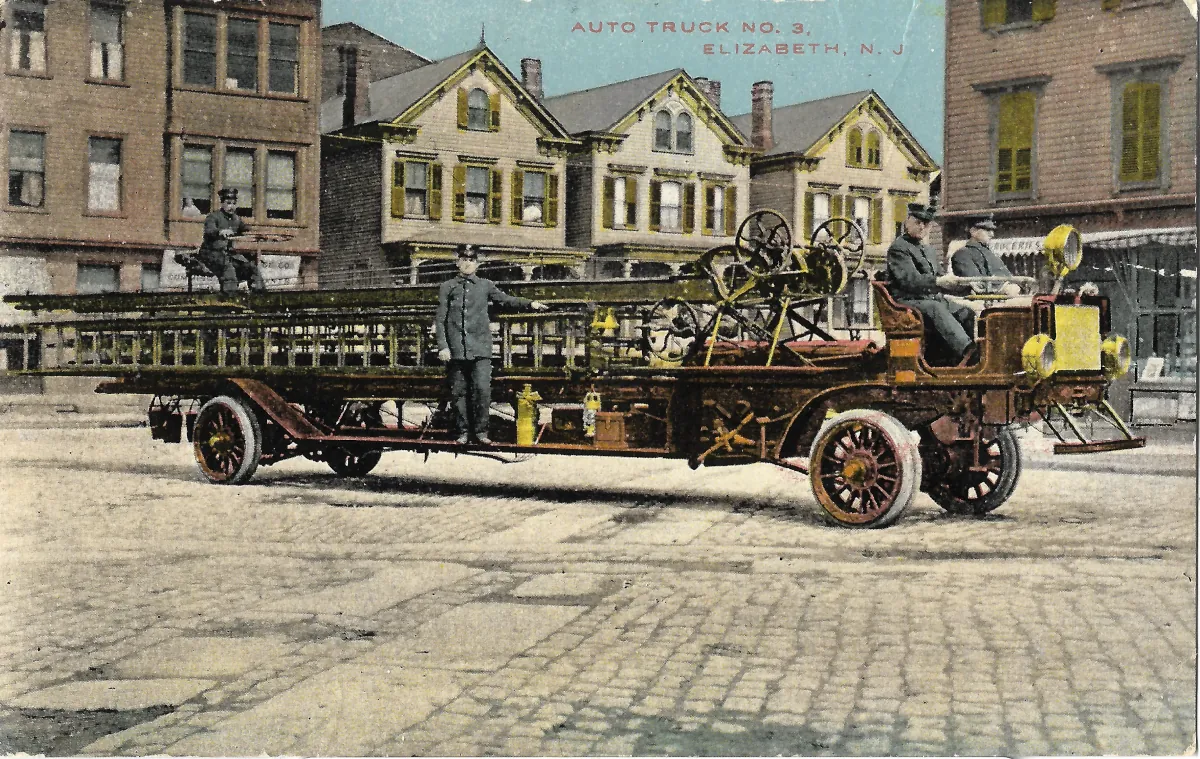
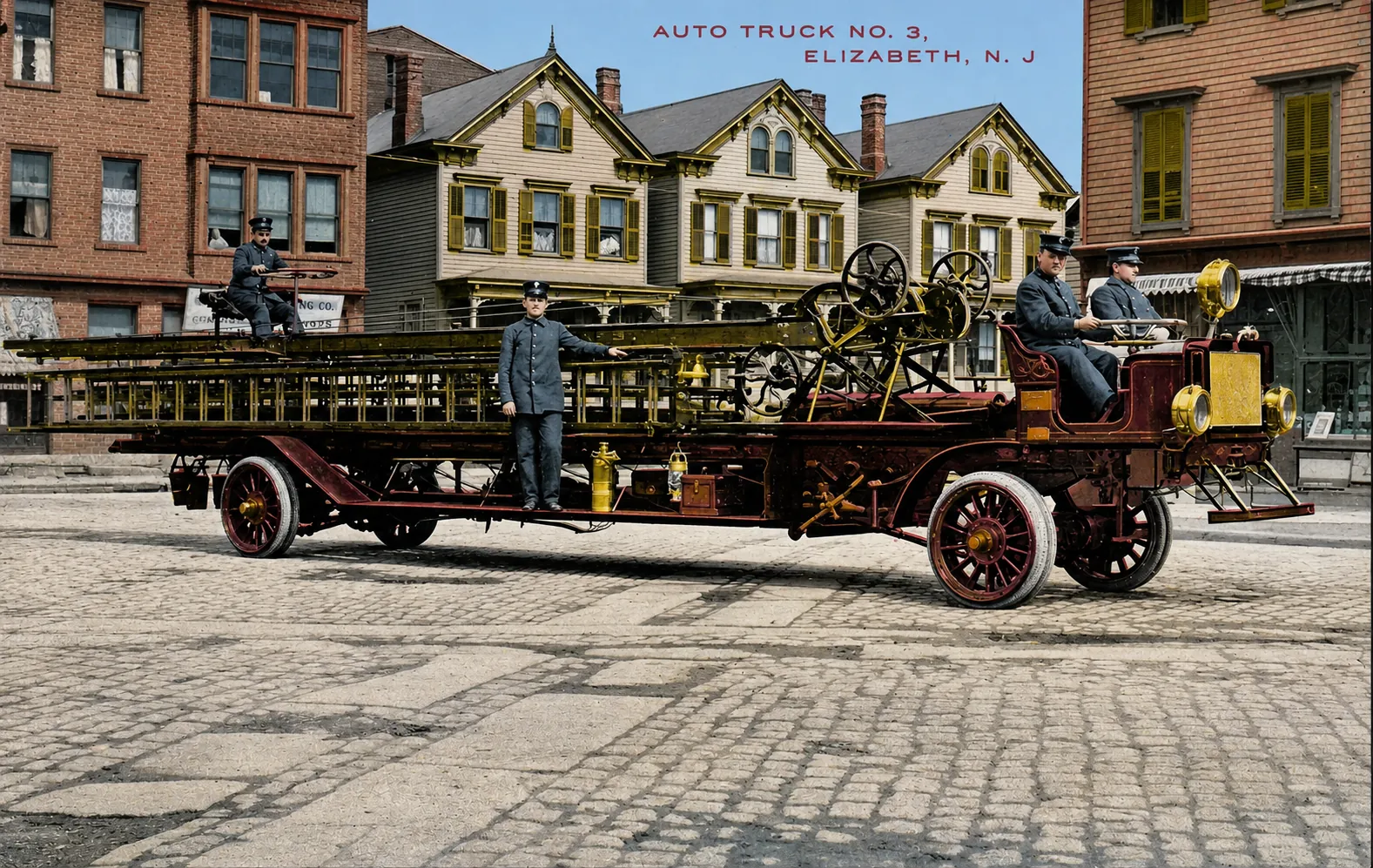
This Elizabeth fire truck is the central subject of a colorized postcard produced in Elizabeth, New Jersey. The caption printed across the top reads “AUTO TRUCK NO. 3 – ELIZABETH, N.J.,” securely identifying both the city and the designation given to the apparatus. Elizabeth lies in Union County in northeastern New Jersey, immediately southwest of Newark and close to Newark Bay, within an area that was already heavily urbanized and industrialized in the early twentieth century.
The vehicle is shown broadside on a wide paved street. Its unusual length immediately reveals its principal function: this is clearly a fire department ladder truck. Several long wooden ladders are carried horizontally along the sides and upper frame. Large hand wheels and mechanical gear can be seen near the center of the apparatus, apparently associated with raising, positioning or extending the main ladder. The exact manufacturer cannot be established solely from the postcard because no maker’s name or badge is legible enough to provide firm identification.
Four firefighters can be clearly distinguished. Two are seated at the front of the completely open driving compartment, another stands beside the apparatus near its center, and a fourth is positioned toward the rear above the ladder rack. Their dark uniforms and peaked caps reinforce the formal character of the photograph. Rather than depicting an emergency response, the scene appears to have been deliberately arranged to present the new apparatus and its crew.
The front of the truck is particularly revealing. A tall vertical radiator, large round lamps, spoked wheels and an exposed driving position belong to the pioneering period of heavy motor vehicles. Although mechanically powered, the apparatus still resembles the horse-drawn ladder wagons that preceded it. Ladders, tools, boxes and operating mechanisms remain almost completely exposed instead of being enclosed within the streamlined bodywork familiar on later fire engines.
The background provides a valuable glimpse of early twentieth-century Elizabeth. Closely spaced two- and three-story buildings line the street. Several are timber-framed houses with prominent gables and tall windows, while larger buildings occupy the edges of the photograph. The mixture suggests a dense urban neighborhood where residential buildings, small businesses and larger blocks stood in close proximity.
The precise street cannot be identified from the visible evidence. Nor is there enough information to claim that the photograph was taken directly outside the quarters of Truck No. 3. The reliable geographic identification should therefore remain Elizabeth, New Jersey, without assigning the scene to a specific address.
Historical description
The postcard most likely belongs to the early period of motorized American firefighting, probably during the first half of the 1910s. Several visual characteristics support such a dating: the open cab, large spoked wheels, prominent lamps, exposed mechanical controls and the combination of a motor chassis with equipment whose design still owes much to nineteenth-century horse-drawn ladder wagons.
The official history of the Elizabeth Fire Department provides useful context. During the nineteenth century, Elizabeth had only two truck companies, whose primary role was to carry ladders and related equipment. Lafayette Ladder No. 1 and the organization that developed into Truck No. 2 originally operated equipment drawn by firefighters and later by horses. Some of these early ladder wagons carried very long wooden ladders, including straight ladders approximately 60 feet in length.
Elizabeth then underwent a major organizational change. In 1901 the city approved the creation of a paid professional fire department, which officially began operating on January 1, 1902. The professional force expanded steadily in the following years and had reached 93 permanent firefighters by 1917, when the remaining call firefighters were eliminated.
Against this background, the wording “Auto Truck No. 3” is significant. The explicit use of “Auto” reflects a period when motor propulsion was still new enough to deserve emphasis. Replacing horses with an internal-combustion vehicle dramatically reduced response times and allowed firefighters to move heavy ladders and rescue equipment more rapidly through an expanding city.
The existence of Ladder 3 in Elizabeth is independently documented by 1916. Kean Fire Safety’s New Jersey firefighter memorial records Paul Zellmer as a member of the Elizabeth Fire Department’s Ladder 3 and gives his line-of-duty death as June 16, 1916. This provides firm evidence that a third ladder company was operating in Elizabeth by that year.
A secondary historical apparatus roster also lists two particularly early Elizabeth ladder vehicles: a 1908 Seagrave ladder and a 1912 American LaFrance 85-foot aerial. The latter is broadly compatible in period and function with the vehicle seen on this postcard. It would therefore be tempting to identify Auto Truck No. 3 as that 1912 American LaFrance apparatus. However, the available evidence does not directly connect that surviving inventory entry with the truck pictured here, and the postcard itself shows no legible manufacturer’s marking. The identification should therefore remain a plausible hypothesis rather than a confirmed fact.
A working date of approximately 1910-1916, most probably in the early 1910s, is consequently appropriate. The postcard was based on a monochrome photograph that was subsequently colorized, a very common publishing technique at the time. Yellow and gold highlights were added to lamps and fittings, reddish-brown tones to the chassis and wheels, blue to the sky and various colors to the buildings. These added colors enhance the visual appeal of the postcard but should not be treated as exact evidence of the apparatus’s original paint scheme.
The image is therefore more than a portrait of an impressive fire truck. It records a major technological transition in municipal firefighting, when horse-drawn equipment was rapidly giving way to purpose-built motor vehicles. The carefully posed crew and imposing length of Auto Truck No. 3 convey the pride attached to this new machinery and to the modernization of Elizabeth’s professional fire service.