St. James Methodist Episcopal Church in Elizabeth, New Jersey
Geographic description
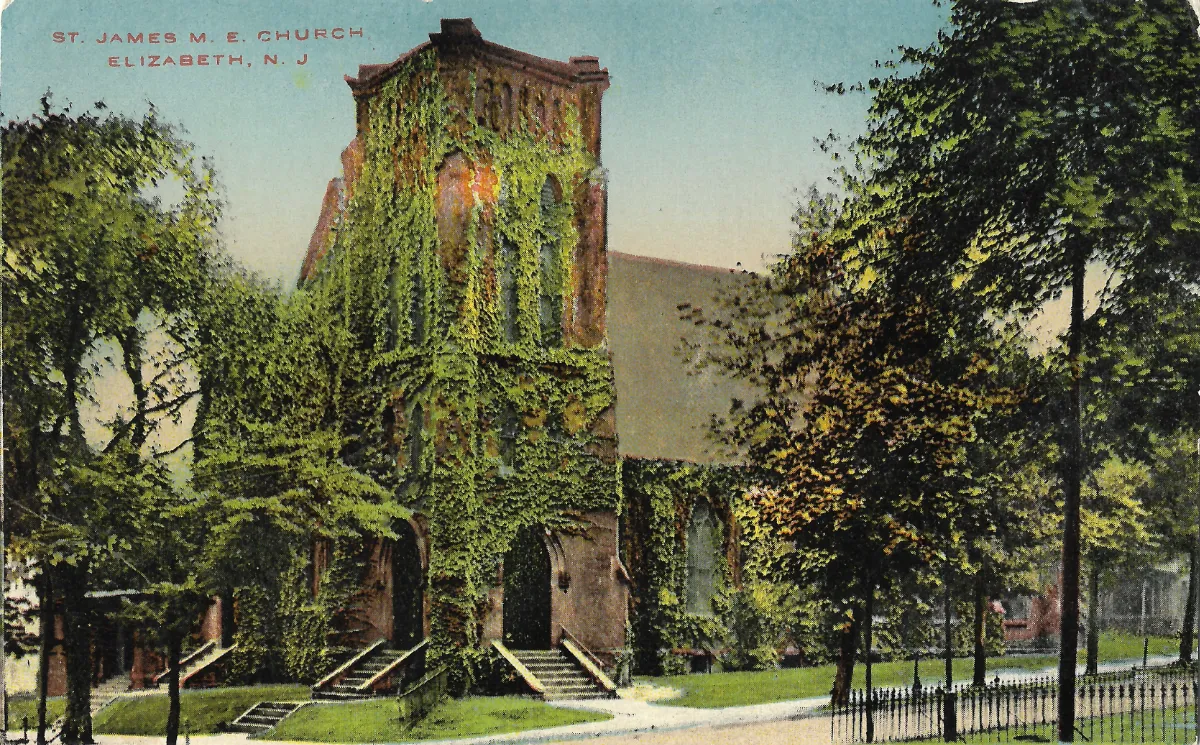
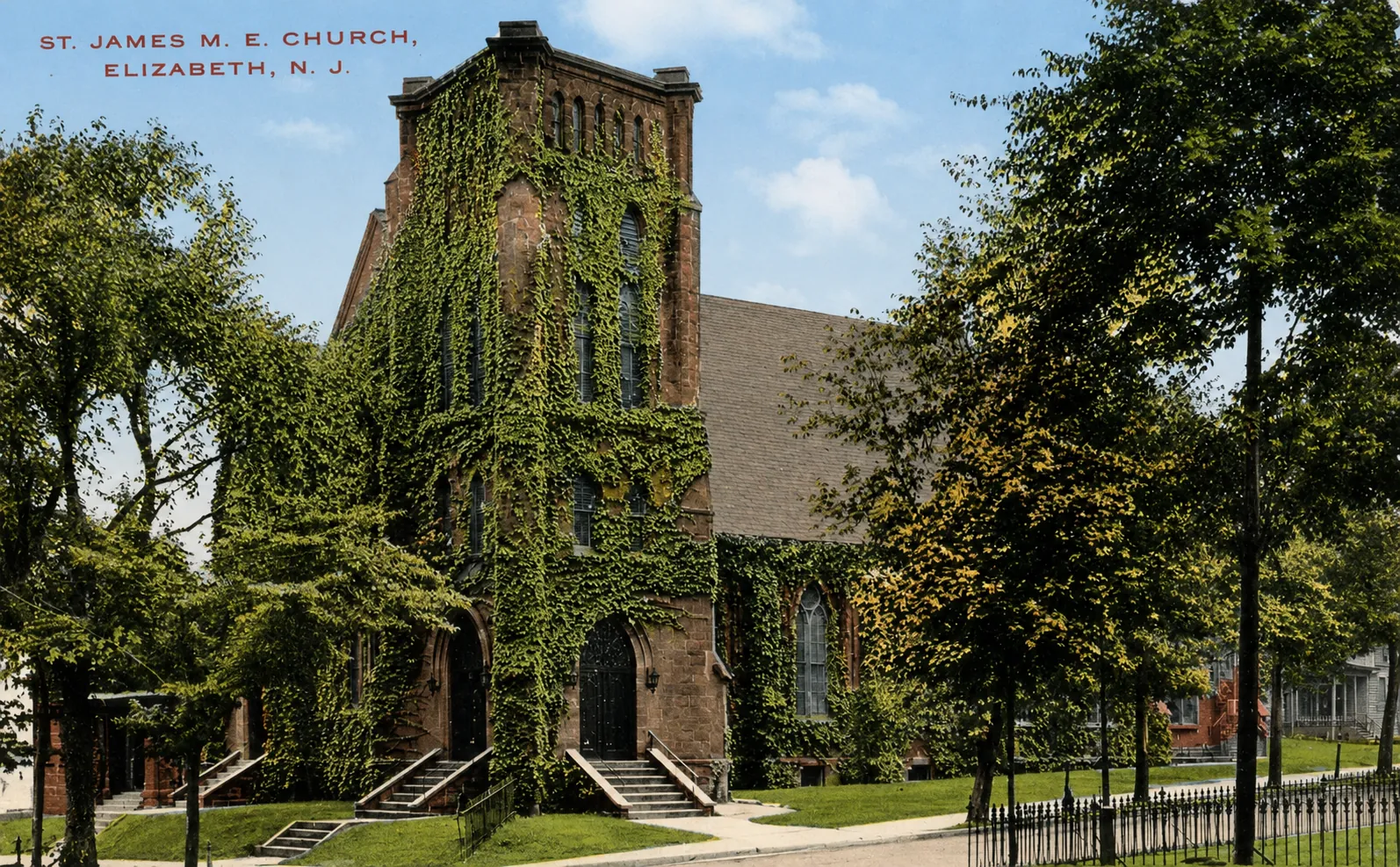
The St. James Methodist Episcopal Church Elizabeth NJ is the unmistakable subject of this vintage postcard. The printed caption in the upper left corner reads “ST. JAMES M. E. CHURCH. ELIZABETH, N. J.,” providing a firm identification of both the building and the city. Geographic records place the former Methodist church in central Elizabeth, near South Broad Street and Pearl Street.
The church dominates the scene, although much of its architecture is softened by mature trees and exceptionally dense climbing vegetation. The most prominent architectural feature is the large square brick tower at the front of the building. It rises well above the adjoining nave and ends in a relatively flat, substantial upper section rather than a tall spire. Arched openings, heavy brick masonry and the overall solidity of the composition give the church features commonly associated with nineteenth-century Romanesque Revival religious architecture. This is a stylistic observation rather than a documented attribution to a particular architect.
Perhaps the postcard’s most striking visual feature is the ivy or similar climbing plant covering much of the church. It surrounds the lower entrances, climbs almost the full height of the tower and partially obscures the brickwork. The vegetation had clearly been established for many years by the time the photograph was taken. Mature deciduous trees stand on both sides of the building, with their branches framing the church and partly concealing the nave on the right.
The front and side entrances are elevated well above sidewalk level. Several broad flights of steps lead to deeply recessed arched doorways. This raised arrangement suggests that usable lower-level spaces may have existed beneath the main worship floor, although the postcard itself does not allow their precise function to be determined.
A sidewalk crosses the foreground, while a low iron fence can be seen on the right. The landscaped grounds create an unusually quiet, almost park-like setting. No motor vehicles and very few, if any, pedestrians are visible. Their absence should not be used as a precise dating criterion, since photographers producing architectural postcards often deliberately waited for an unobstructed view of their subject.
The postcard appears to reproduce a photograph enhanced through color printing or hand-influenced colorization. The pale blue sky, rich green foliage and warm reddish-brown brickwork should therefore be understood partly as an artistic interpretation. Early color postcards frequently intensified natural colors in order to make architectural subjects more attractive to buyers.
Historical documentation helps clarify the exact urban setting. The property occupied by St. James had previously been known as the Broad Street Baptist Church property. A commemorative account published in 1906 also states that an earlier frame chapel stood behind the main church on Pearl Street. The church complex therefore occupied a site associated with both Broad Street and Pearl Street in the historic core of Elizabeth.
This location was within an established section of the city rather than a newly developing suburban district. The mature landscaping visible here reinforces that impression. By the time this image was produced, the church had become an established landmark whose ivy-covered tower and tree-filled grounds offered postcard publishers an especially picturesque architectural subject.
Historical description
The history of the St. James Methodist Episcopal Church Elizabeth NJ extends well beyond the congregation whose name appears on the postcard. The building itself originally belonged to another denomination, while the Methodist congregation that later occupied it resulted from the merger of two earlier Elizabeth churches.
Methodism had deep roots in Elizabeth. An 1897 history of Union County records Methodist activity in Elizabethtown during the 1780s, including preaching associated with the beginnings of an organized Methodist society around 1785. During the nineteenth century, the growing city consequently supported several Methodist congregations.
The immediate origins of St. James can be traced to two of them: Elizabeth Avenue Methodist Episcopal Church and St. Paul Methodist Episcopal Church. Representatives of the two societies met on October 23, 1876, to discuss combining their congregations and exchanging their existing properties for another church building. The negotiations ultimately produced the St. James Methodist Episcopal Church.
The building obtained by the new congregation was the former Broad Street Baptist Church. A 1906 St. James anniversary publication states that the cornerstone of that Baptist church had been laid in April 1868. The structure shown in this postcard therefore predates the St. James congregation by roughly nine years. This distinction is important: 1877 marks the beginning of St. James as a congregation on the site, not the construction date of the main church building.
St. James was formally organized on March 16, 1877, in an older frame chapel standing behind the church toward Pearl Street. The main building was formally opened for Methodist worship on April 15, 1877, with Bishop Gilbert Haven taking part in the service. The newly united church began with about 300 members.
By the beginning of the twentieth century, St. James had grown considerably. Its 1906 anniversary account reported 575 members. A chapel had been constructed in 1892, and a parsonage was acquired in 1904. The combined church and parsonage property was valued at $73,000 in that anniversary publication. Such figures indicate that St. James had become a substantial religious institution in Elizabeth rather than a small neighborhood mission.
The postcard was probably produced during this prosperous early twentieth-century phase. The front alone contains no publisher’s date, postal cancellation or other evidence capable of fixing an exact year. Its color treatment, printed caption and overall appearance are consistent with American postcards widely sold in the c. 1905-1915 period. That range should be regarded as an informed estimate rather than a firm date.
The exceptionally mature ivy is also compatible with a building dating from the late 1860s. By the first decade of the twentieth century the church had already stood for approximately forty years, giving climbing vegetation ample time to cover large sections of the masonry.
This postcard therefore documents several layers of Elizabeth’s religious history at once. It shows a church erected originally for a Baptist congregation in 1868, acquired by a newly united Methodist congregation in 1877, and photographed decades later when St. James had developed into a large and well-established urban church. The picturesque ivy-covered tower is visually memorable, but behind it lies a history of changing congregations, institutional consolidation and the long-standing presence of Methodism in Elizabeth.