Orléans – Rue de la République and the Joan of Arc Statue
Geographic description
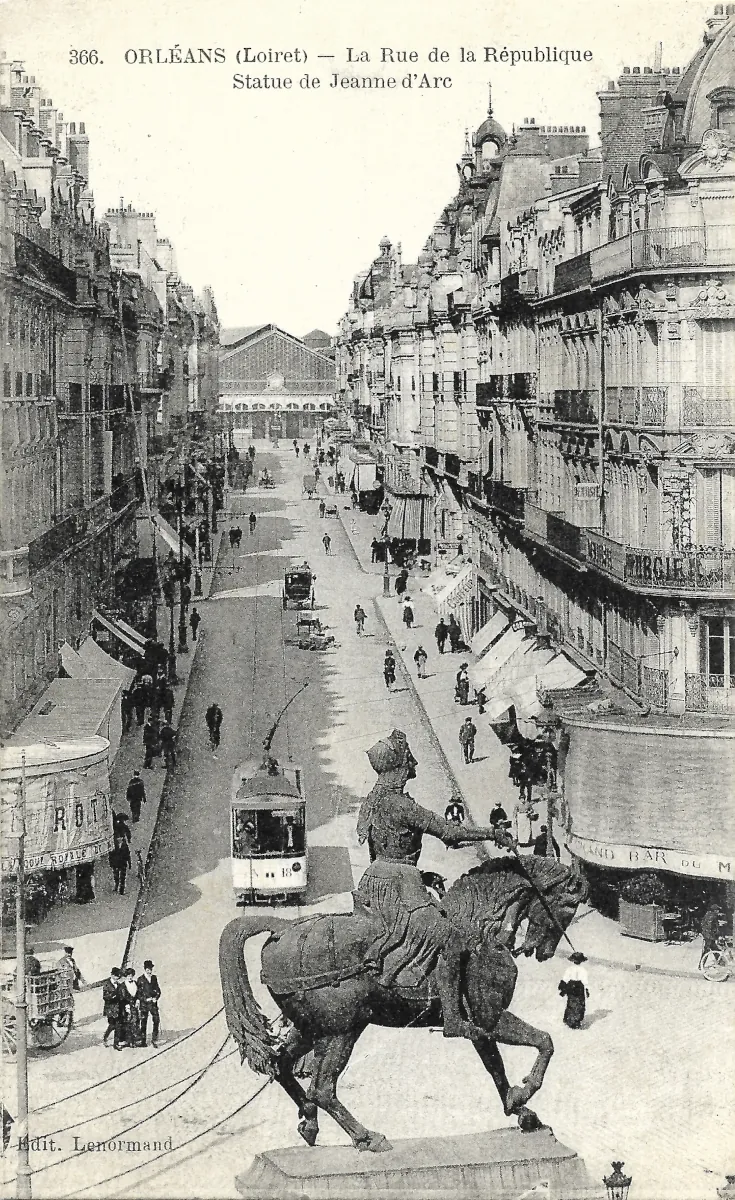
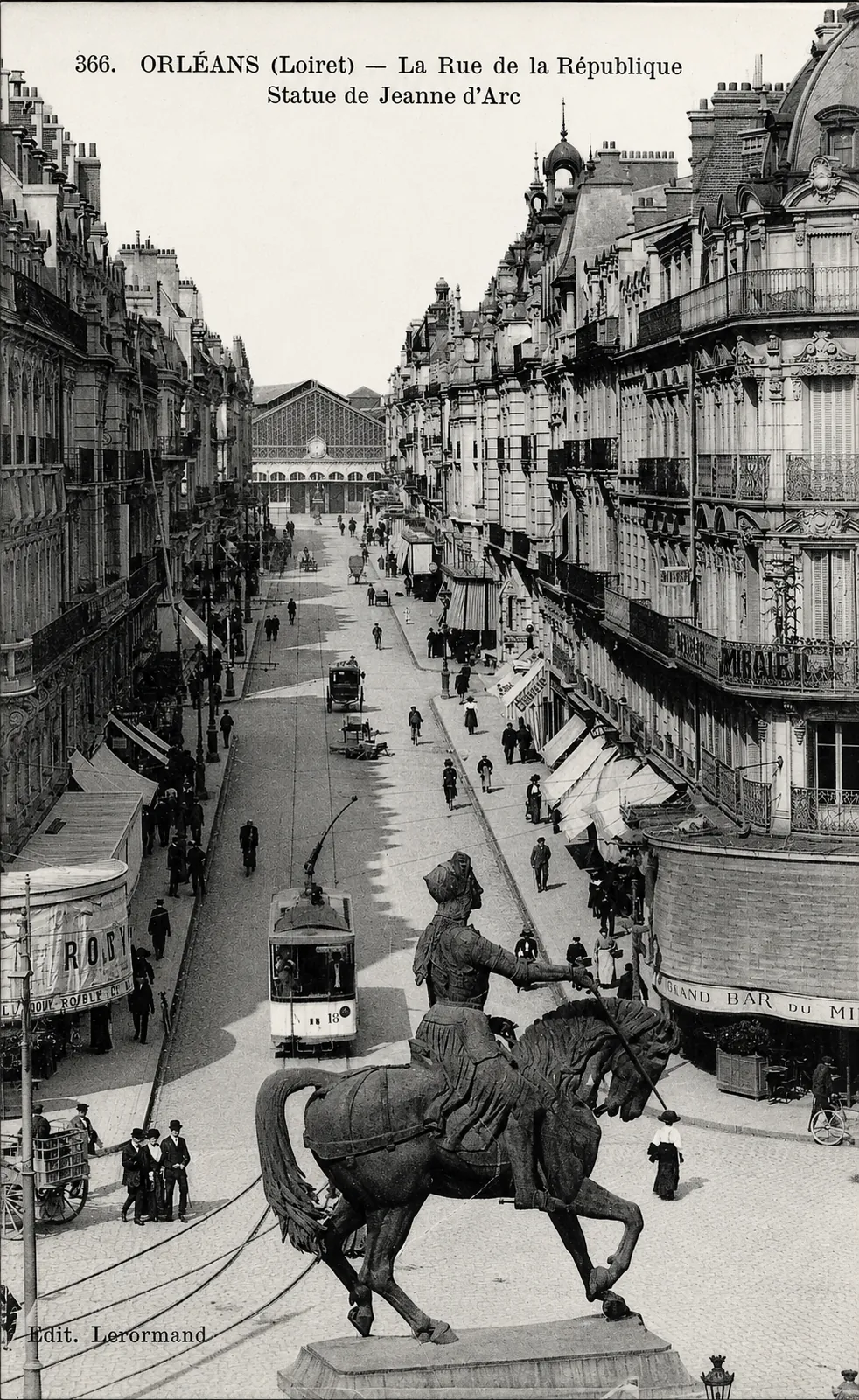
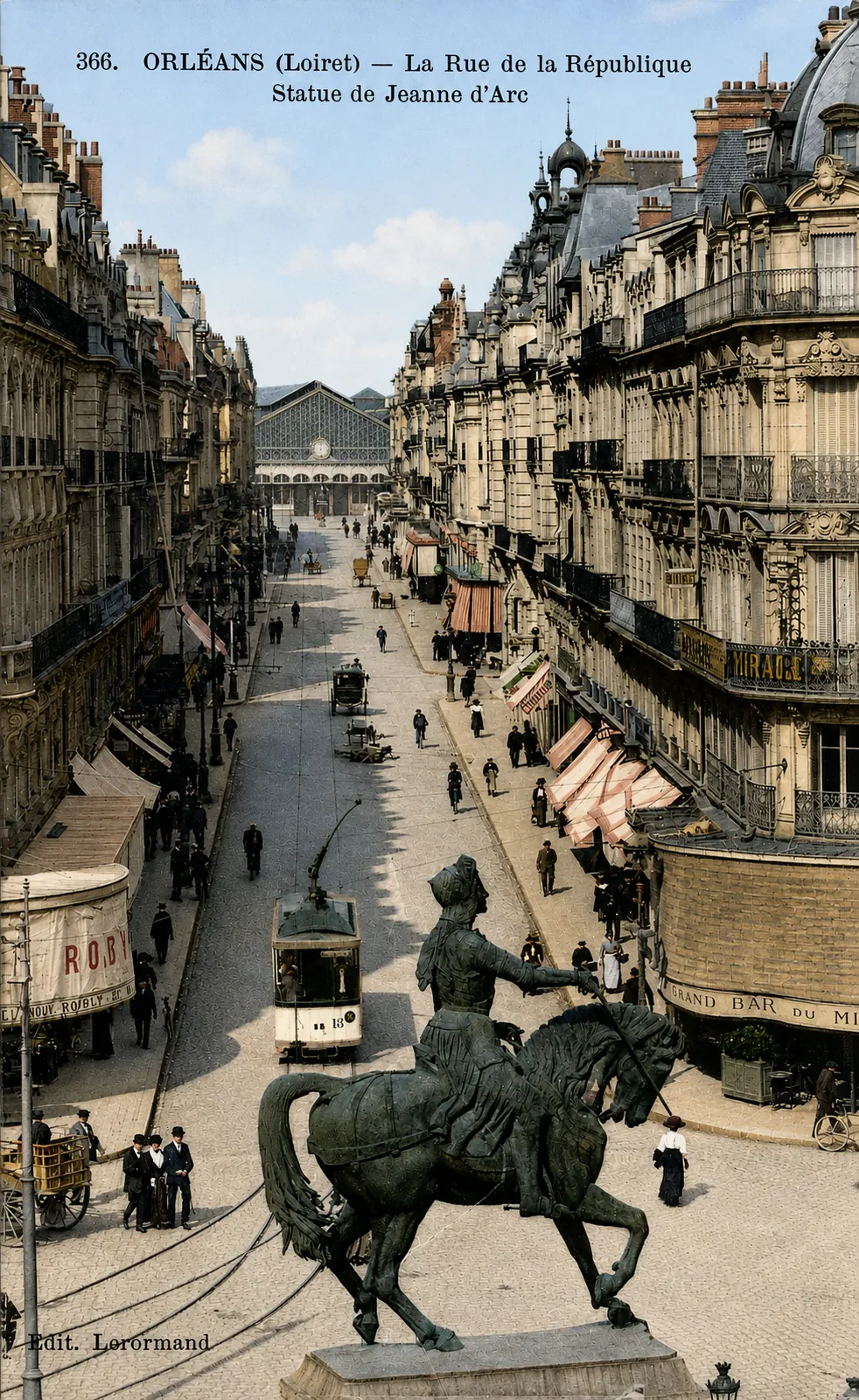
Rue de la République in Orléans is shown here in a striking view from Place du Martroi, with the equestrian statue of Joan of Arc dominating the foreground. The photograph was taken from an elevated position, almost exactly along the axis of the street, creating a long perspective towards the former Orléans railway station whose large glazed façade can be seen in the distance.
This alignment was deliberately planned. Rue de la République was created to provide a monumental connection between Place du Martroi, the historic and commercial centre of Orléans, and the railway station to the north. Heritage documents published by the City of Orléans state that the street was developed between 1894 and 1905 and is approximately 412 metres long and 17 metres wide. Its design follows the principles of Haussmann-inspired urban planning, including aligned façades, prominent corner buildings, continuous balconies and carefully decorated stone architecture.
The postcard illustrates these features particularly well. Tall buildings line both sides of the avenue, many displaying elaborate stonework, iron balconies, projecting cornices and steep roofs. On the right, an especially ornate corner building forms a dramatic entrance to the street. Numerous shop awnings project over the pavements, confirming the strong commercial character of the district, while a café or bar sign can be distinguished near the foreground.
Traffic provides another important element of the scene. Two tramcars can be seen travelling along the tracks, one of them clearly carrying the number 18. Pedestrians, cyclists and horse-drawn vehicles also share the street. Groups of people gather outside the shops, while others cross the roadway with a freedom that would be unusual on a modern city-centre thoroughfare. The scene records a transitional period in urban transport, when mechanised public transport was becoming established while bicycles and horse-drawn traffic remained part of everyday life.
The large glass-fronted structure closing the view can be identified as the former Orléans railway station. A larger station with an iron and cast-iron structure had replaced the original railway facilities in 1880. Around 1902, a new southern façade was created in the former gable so that the station would open directly onto the recently constructed Rue de la République. It is this façade that appears at the end of the street in the postcard. The building survived until 1965, when it was demolished and replaced by a modern station.
In the immediate foreground, Joan of Arc and her horse are seen largely from behind. Their dark silhouette gives depth to the photograph and emphasises the carefully constructed urban axis. From the viewer’s perspective, the monument seems to look straight along the new avenue towards the station, visually linking Place du Martroi with the expanding northern districts of Orléans.
Historical description
The postcard most probably depicts Orléans during the early twentieth century, perhaps between approximately 1905 and the outbreak of the First World War. This remains an estimated date rather than a certainty. The completed appearance of Rue de la République, the station façade created around 1902, the tram traffic, the clothing of pedestrians and the almost complete absence of motor cars all point towards the years immediately before 1914.
Rue de la République itself was still a relatively recent addition to Orléans. When the railway linking Paris and Orléans opened in 1843, the station stood beyond the traditional city centre and its main entrance did not face Place du Martroi. During the second half of the nineteenth century, however, railway development increasingly drew economic activity and urban expansion northwards. A direct and prestigious route between the station and the city centre therefore became desirable. After lengthy discussions concerning its route and the properties that would need to be acquired, Rue de la République was finally created during the 1890s and completed in the early years of the twentieth century.
The street became one of the major examples of late nineteenth-century urban redevelopment in Orléans. Its designers applied many of the principles associated with Haussmann’s transformation of Paris: a broad straight avenue, carefully aligned buildings, monumental corners and a strong visual axis. The new street was intended not merely as a practical route but also as an impressive entrance to the city for passengers arriving by train. The Joan of Arc monument on Place du Martroi consequently became a focal point at the southern end of the avenue.
The equestrian statue itself predates the street by several decades. Created by French sculptor Denis Foyatier, it was inaugurated on 8 May 1855 during Orléans’ traditional celebrations in honour of Joan of Arc. France’s national heritage database records that the bronze statue was cast in 1853, using metal that included nine cannons supplied by the Ministry of War. It was initially erected on a temporary pedestal before the monument reached its final form.
The postcard therefore brings together two contrasting aspects of Orléans’ identity. Joan of Arc represents the city’s medieval history and its enduring association with the events of 1429, while the railway station represents industrialisation, mobility and the rapid modernisation of French cities during the nineteenth century. Rue de la République physically and visually connects these two worlds.
The everyday details make the image especially valuable as a historical document. Tramcars run through a street filled with pedestrians and cyclists, horse-drawn vehicles remain in use, and shop awnings line the pavements beneath elaborate new apartment buildings. Rather than showing an empty architectural view, the photographer captured a busy commercial artery at work.
The postcard carries the collection number 366 at the upper left, while “Édit. Lenormand” is printed near the lower left corner. These markings identify the published series, although the front of the card alone does not provide sufficient evidence for an exact publication date. The probable early twentieth-century dating should therefore remain an informed estimate rather than a definitive year.