The Monument des Aydes and the Defence of 11 October 1870
Geographic description
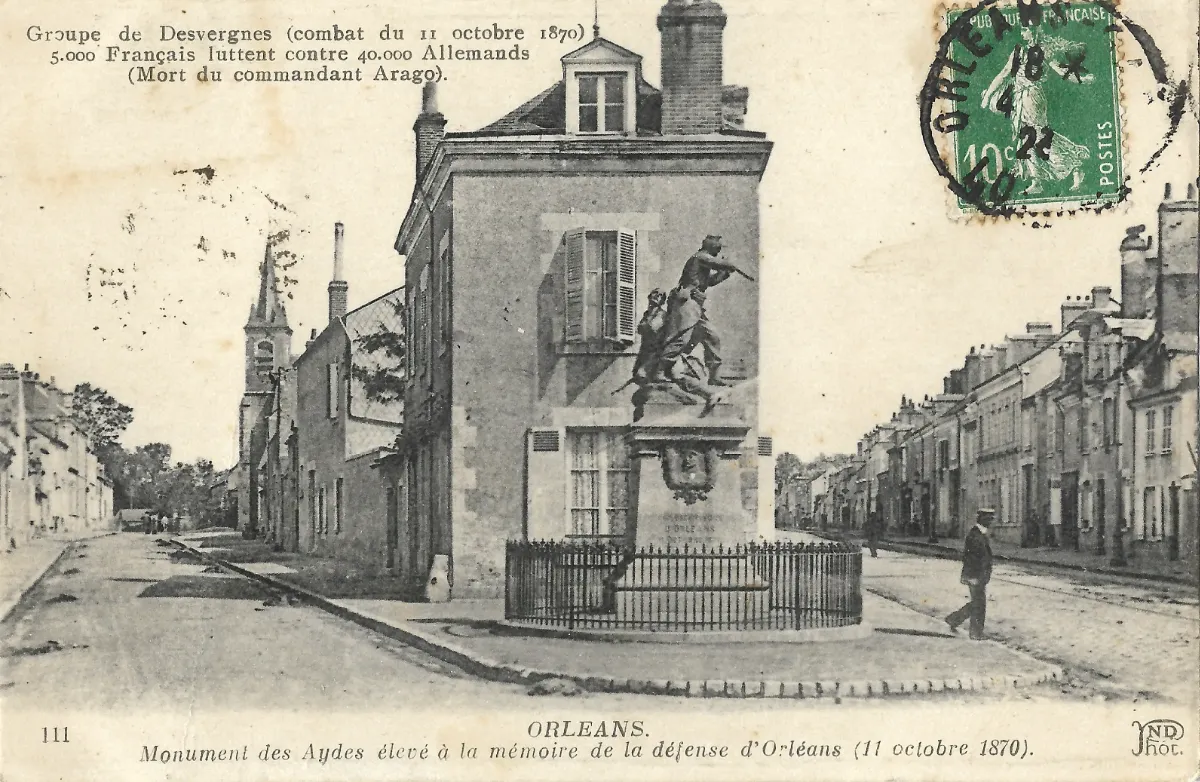
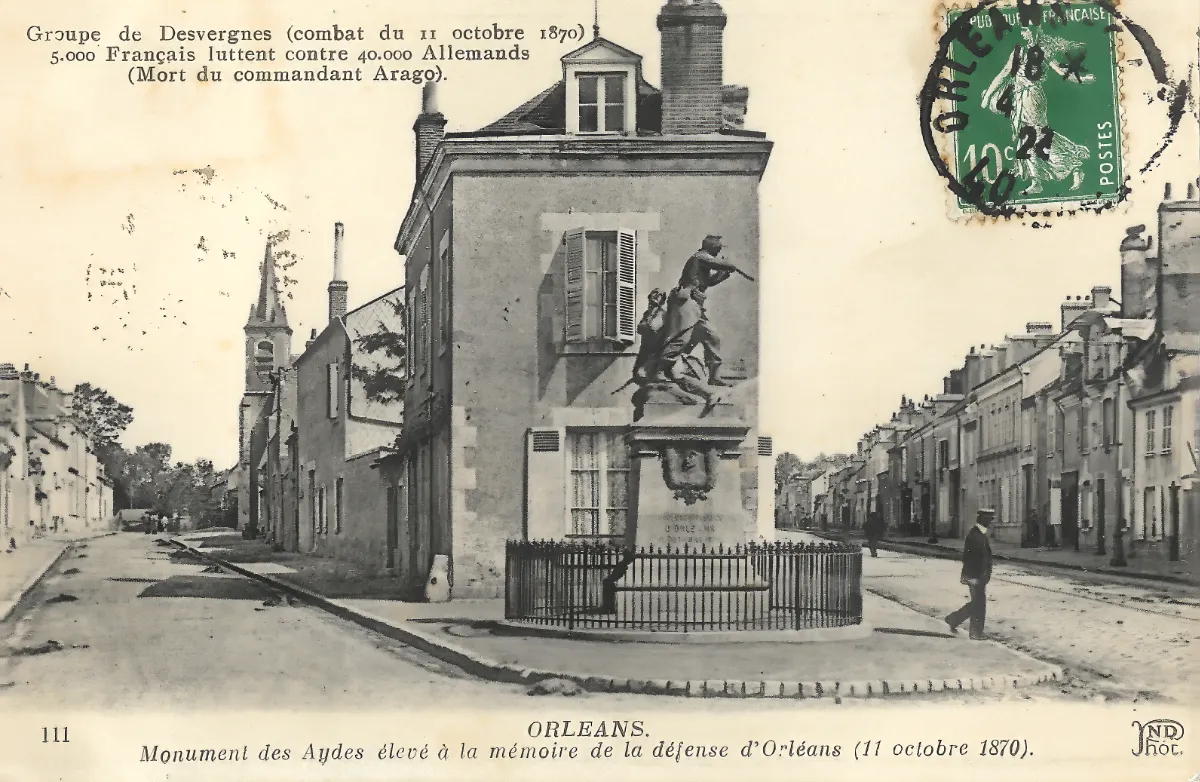
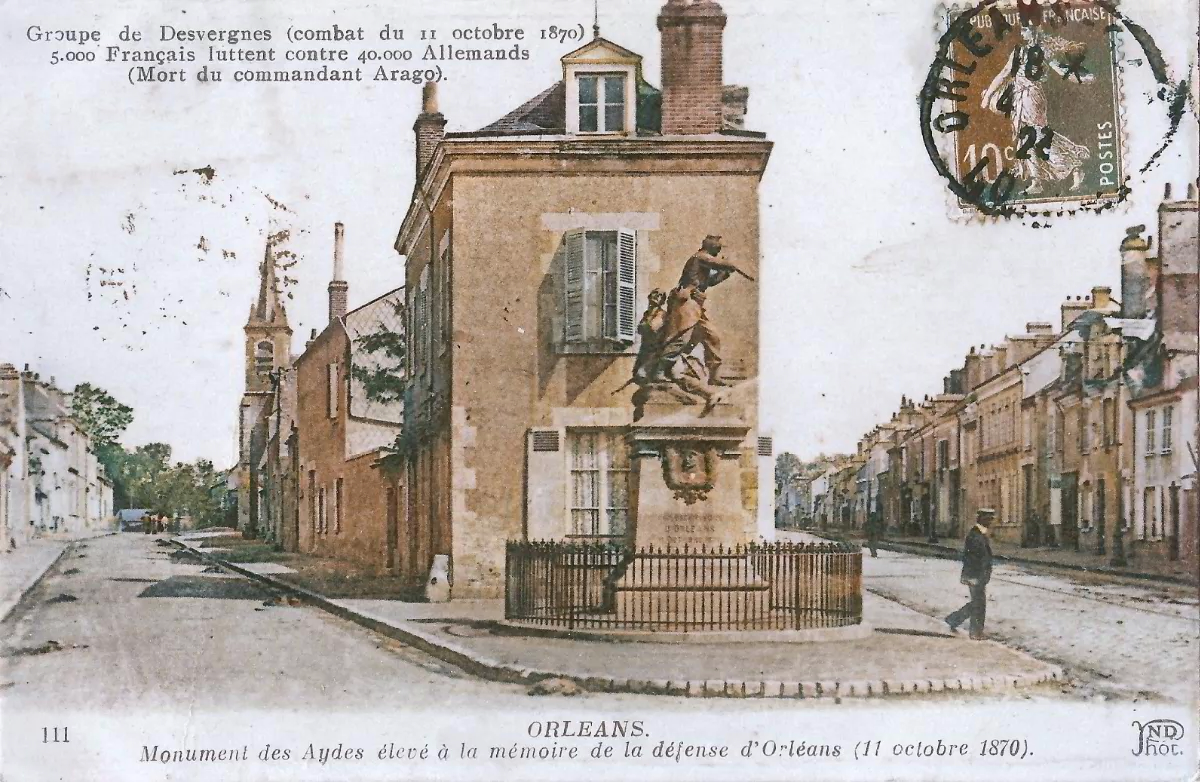
The Monument des Aydes in Orléans dominates the foreground of this vintage postcard, standing at a road junction in the Les Aydes district on the northern approach to the historic city. The printed caption at the bottom clearly identifies the subject as the monument erected in memory of the defence of Orléans on 11 October 1870.
The photograph provides a valuable view of this suburban district in the early twentieth century. The memorial occupies a small enclosed area surrounded by a metal railing and stands remarkably close to the neighbouring houses. One road continues into the distance on the right, lined almost continuously with modest terraced houses, while another branches away to the left. There is virtually no motor traffic, and the surroundings still have the appearance of a quiet outer suburb rather than a densely urbanised part of Orléans.
The Orléans Municipal Archives catalogue a comparable postcard as “Orléans – Place de la Bascule et Monument de la défense [Les Aydes]”. Their description places the memorial in the former Place de la Bascule area, near the Faubourg Bannier and the Rue des Trois-Croissants. The Musée d’Orsay heritage database gives its location as the corner of Rue du Faubourg-Bannier and the Route de Chartres. Together, these records locate the scene on what was historically one of the northern approaches to Orléans.
The streetscape itself is typical of a French suburban neighbourhood of the period. Along the right-hand side, narrow houses are built directly against the pavement and generally rise to one or two storeys. Their architecture is simple and regular, with rows of windows and numerous tall chimney stacks. Immediately behind the memorial stands a larger corner building, whose blank side wall creates a strong backdrop to the sculpture.
A small bell tower can also be seen farther to the left. Given its position and the documented presence of the Notre-Dame des Aydes chapel in the district, it may belong to that building. This identification remains probable rather than certain from the postcard alone. The Orléans archives preserve other postcards showing a commemorative stained-glass window in the chapel depicting the 1870 battle and the death of Commander Victor Arago.
Human activity is limited. A lone man crosses the road near the memorial, while only a few indistinct figures can be detected farther along the streets. This relative emptiness makes the postcard especially useful as an urban record: the photographer’s attention is clearly directed toward the memorial and its immediate setting rather than toward everyday street life.
Modern tourism sources in the Loiret now list the Monument des Aydes under Saran, immediately north of Orléans, and describe the fighting at Les Aydes as an episode that took place at the entrance to the city. This helps explain why an early twentieth-century postcard could naturally be captioned “ORLÉANS” even though the present-day administrative presentation of the site may refer to Saran.
Historical description
The memorial commemorates the fighting of 11 October 1870 during the Franco-Prussian War of 1870-1871. German forces were then advancing south towards Orléans after a succession of engagements north of the city. A chronology published by the Loiret Departmental Archives records that Orléans was occupied that day by the Bavarian Corps and the Prussian XXII Division. The Orléans archives further note that Bavarian troops entered the city at about 7 p.m. despite French resistance.
Les Aydes lay directly on this northern approach and became one of the places most closely associated with the defence of Orléans. The importance of the episode in local memory is demonstrated by the survival of an extensive 235-page manuscript account written by the parish curate, describing events in the Les Aydes district during October and November 1870.
The inscription printed across the top of the postcard is dramatic. It states that 5,000 French troops fought 40,000 Germans and refers to the death of Commander Arago. It also begins with the words “Groupe de Desvergnes.” This does not refer to a military formation commanded by a man named Desvergnes. It identifies the sculptural group created by Charles Desvergnes, whose authorship of the memorial is confirmed by the Musée d’Orsay documentation.
The troop figures printed on the postcard should not be treated as precise military statistics. They belong partly to the patriotic commemorative language surrounding the battle. A different postcard recorded by the Orléans Municipal Archives gives a figure of 6,000 French troops facing 45,000 Prussians and states that 300 French defenders lost their lives. Such variations are an important reminder that the postcard records the memory and interpretation of the battle as much as the event itself.
The Monument des Aydes was not erected immediately after the war. In 1897, the municipality of Saran and the departmental committee of the Souvenir français decided to establish a monument commemorating those who had fought in defence of Orléans. A public subscription and a competition followed. Charles Desvergnes’s memorial was inaugurated on 30 April 1899 in the Les Aydes district. The Orléans Municipal Archives still hold the 1899 booklet published for the inauguration of the monument to the defenders of Les Aydes and Orléans.
The memorial gives particular prominence to Commander Victor Arago, who was born in 1833 and died during the fighting on 11 October 1870. According to the Musée d’Orsay database, the pedestal carries the inscriptions “V. ARAGO 1833-1870” and “AUX DEFENSEURS D’ORLEANS / 11 OCTOBRE 1870”. The monument depicts Arago standing and wearing a military képi, while his likeness also appears in a medallion on the pedestal.
The postcard itself also contains clues about its production and use. At the lower right is the small “ND Phot.” mark, associated with the Neurdein photographic and postcard publishing company, one of the major French producers of illustrated postcards during this period.
A green 10-centime French stamp has been placed on the picture side. Part of its postmark remains visible, and the final two digits appear to read “23”. Although the complete cancellation cannot be read with sufficient certainty, the card was therefore probably mailed in 1923. This should be regarded as the date of use of this particular copy, not necessarily the date when the photograph was taken or when the postcard was first printed.
The postcard is therefore valuable on several levels. It records the appearance of the northern outskirts of Orléans in the early twentieth century, documents a major local memorial created in 1899, and illustrates the way the traumatic events of 1870 remained embedded in local memory more than fifty years after the battle.