Lyon – Panorama of the City and Fourvière from the Metallic Tower
Geographic description
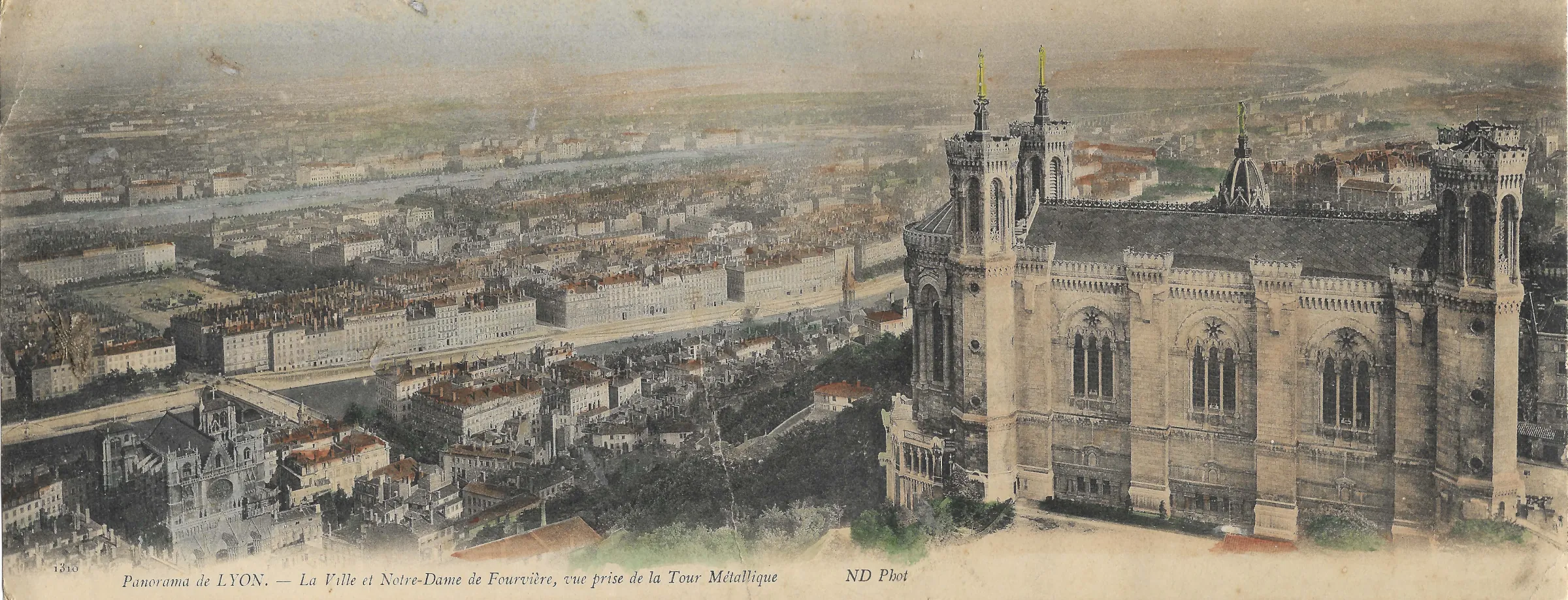
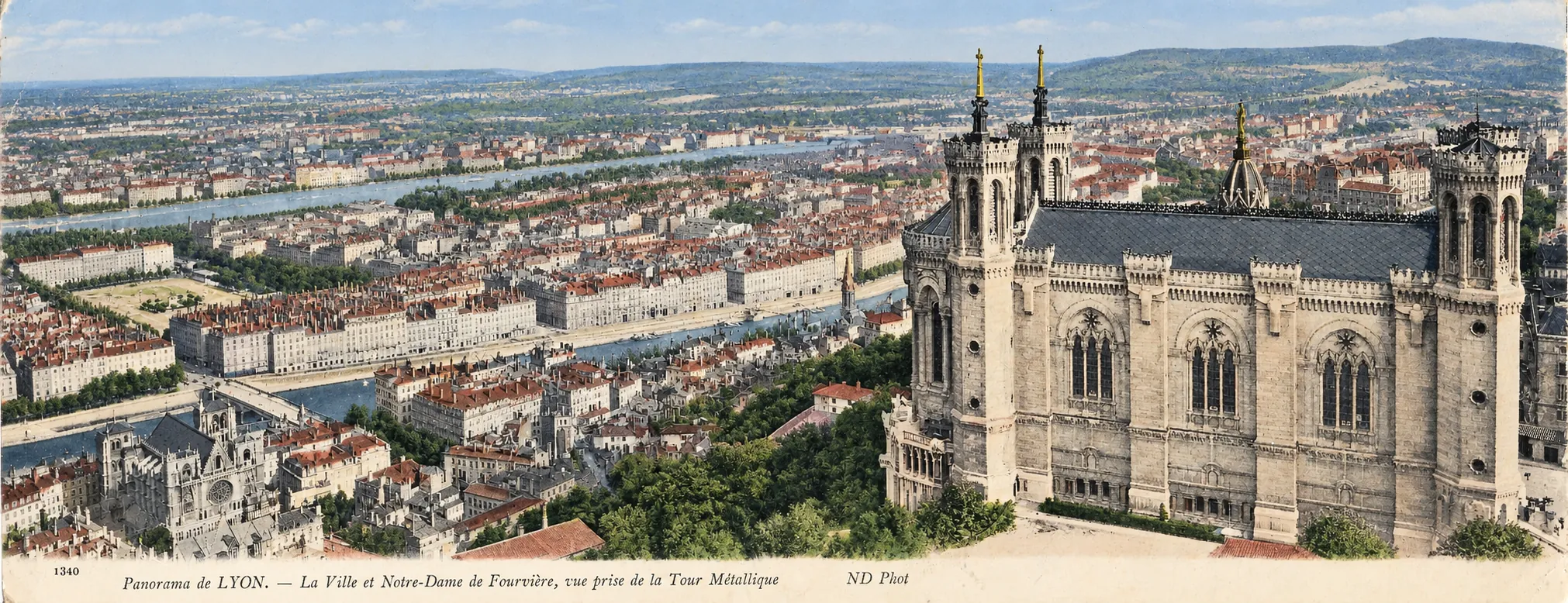
The panorama of Lyon from the Fourvière Metallic Tower provides a remarkable elevated view over the city, with the Basilica of Notre-Dame de Fourvière dominating the entire right-hand foreground. The postcard’s printed caption clearly identifies the viewpoint as the Tour Métallique, the metal observation tower standing immediately beside the Fourvière sanctuary.
Because the photographer was positioned above the basilica, the image reveals an unusually extensive view of its roof and long lateral elevation. Massive corner towers frame the building, while tall windows divide the walls into a succession of architectural bays. Notre-Dame de Fourvière combines Romanesque, Gothic and Byzantine influences; the basilica is approximately 86 metres long and its four corner towers rise to about 48 metres.
Far below, on the left side of the postcard, the Cathedral of Saint-Jean can be clearly recognised by its monumental western façade and large rose window. The cathedral stands in the heart of Old Lyon at the foot of Fourvière Hill. Built over several centuries between the late twelfth and fifteenth centuries, it combines Romanesque and Gothic architectural elements.
One of the main qualities of this postcard is the way it reveals Lyon’s distinctive geography. Immediately below Fourvière lies the tightly packed urban fabric of Vieux Lyon, with narrow streets and closely grouped buildings. The Saône River separates this historic district from the Presqu’île. Several bridges can be distinguished across the river, although the resolution of the postcard makes precise identification difficult. The bridge near Saint-Jean may be the former Pont Tilsitt, later replaced by the present Pont Bonaparte, but this should be regarded as a probable identification rather than a certainty.
Beyond the Saône stretches the Presqu’île, already densely built up with long lines of nineteenth-century apartment buildings and regular streets. Farther east, another broad strip of water corresponds to the Rhône, beyond which the city continues towards the eastern districts. This sequence — Fourvière and Old Lyon, followed by the Presqu’île and then the city spreading eastward — remains one of the defining features of Lyon’s landscape.
The postcard therefore functions almost like a geographical cross-section of Lyon. In a single view, it links Fourvière Hill, the medieval and Renaissance city, the Saône, the urban centre of the Presqu’île and the Rhône. The city was already a major metropolitan centre when the photograph was taken, but the skyline remained comparatively low and remarkably uniform. Rows of tiled roofs and buildings of similar height dominate the scene, without the modern high-rise structures that would later transform parts of Lyon’s eastern horizon.
In the distance, haze softens the outlines of the city and increases the impression of depth. The subdued colours should not be interpreted as those of an early colour photograph. The card has the appearance of a colourised photomechanical postcard, based on an originally monochrome photograph to which colour was subsequently applied or reproduced during printing. Red roofs, green vegetation and golden architectural details enliven the image while leaving the underlying photographic detail visible.
Historical description
The photograph must have been taken after 1894, since the postcard explicitly states that the view was captured from the Metallic Tower. The City of Lyon records that the tower was erected in 1894, reached a height of 86 metres and was inspired by the upper section of the Eiffel Tower. It originally included a panoramic restaurant and was converted into a television relay tower in 1953.
The neighbouring Basilica of Notre-Dame de Fourvière was itself a relatively recent addition to Lyon’s skyline. Its foundation stone was laid in 1872. The design was created by architect Pierre Bossan and the work was continued by Louis Sainte-Marie Perrin. The church was consecrated on 16 June 1896 and was granted the title of basilica the following year. At the time represented by this postcard, both the basilica and the Metallic Tower were therefore comparatively new landmarks overlooking the city.
A particularly useful clue for dating and identifying the card is the printed signature “ND Phot” beneath the caption. This mark is associated with the Paris photographic firm Neurdein Frères, one of France’s major publishers of photographic views and postcards around the turn of the twentieth century. Paris Musées catalogues postcards bearing the “ND Phot” mark as works published by Neurdein Frères. The Mucem also records ND Phot / Neurdein postcards within a 1903-1920 period.
Further confirmation comes from the Bibliothèque municipale de Lyon’s Numelyo collection. It preserves a closely related Neurdein postcard entitled Le Sanctuaire de Fourvière et la Ville ; vue prise de la Tour Métallique. That card bears the inscription “Collections ND Phot,” while its reverse identifies the Paris-based Établissements photographiques de Neurdein Frères. This demonstrates that the company produced several panoramic views of Fourvière and Lyon from the Metallic Tower.
A small catalogue or series number printed at the lower left of the present card appears to read 1310. It was presumably an internal publisher’s reference, although its precise catalogue meaning cannot be established from the front alone.
Taken together, the architecture, the 1894 construction date of the Metallic Tower, the ND Phot signature and the colourised postcard format strongly suggest an early twentieth-century edition, probably from the first decade of the century and possibly around 1905-1910. This remains an approximate dating rather than a documented year. Without a postal cancellation or additional information from the reverse, a more exact date would be speculative. The original photograph may also predate the printing of this particular postcard, since successful negatives were often reused for later editions.
The image is therefore much more than an attractive panorama. It records Lyon during the postcard’s golden age, combining the newly built monumental architecture of Fourvière with the centuries-old Cathedral of Saint-Jean, the dense historic city, the two rivers and the expanding urban landscape beyond them.