Lyon – Panorama of Place Bellecour and Fourvière
Geographic description
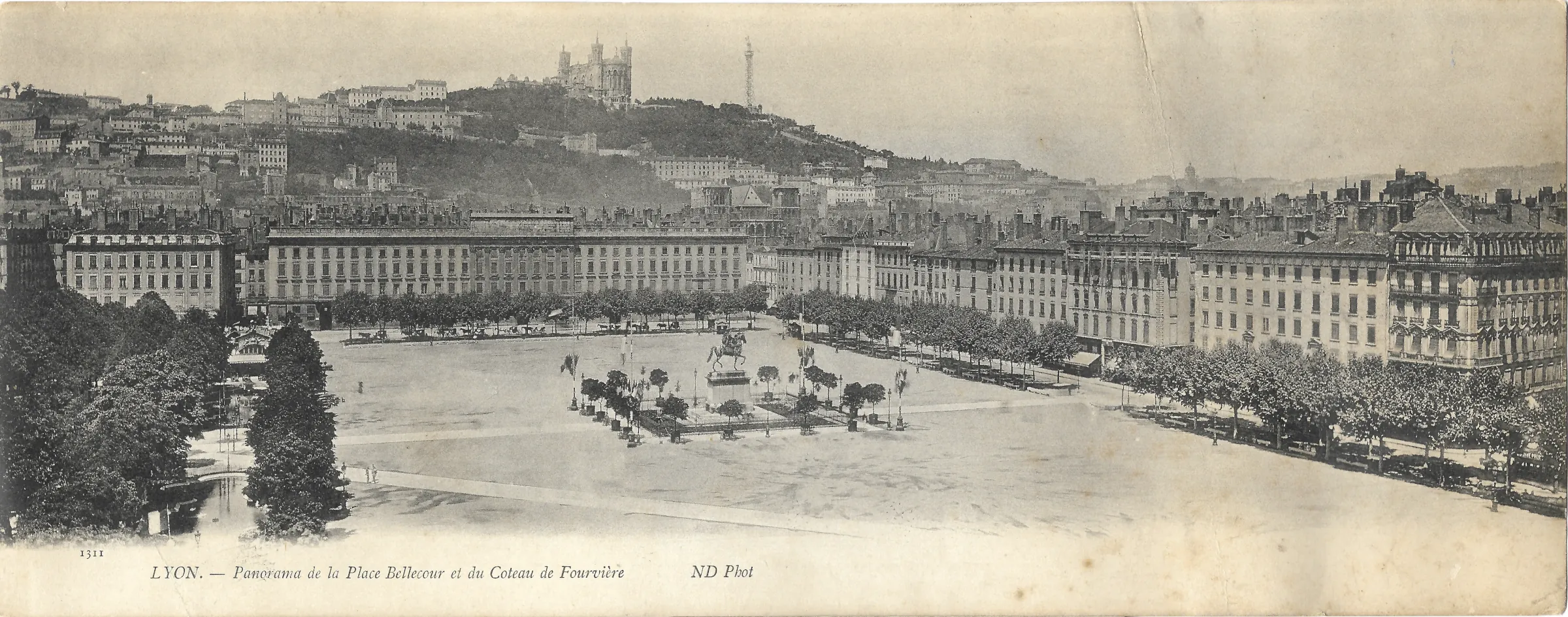
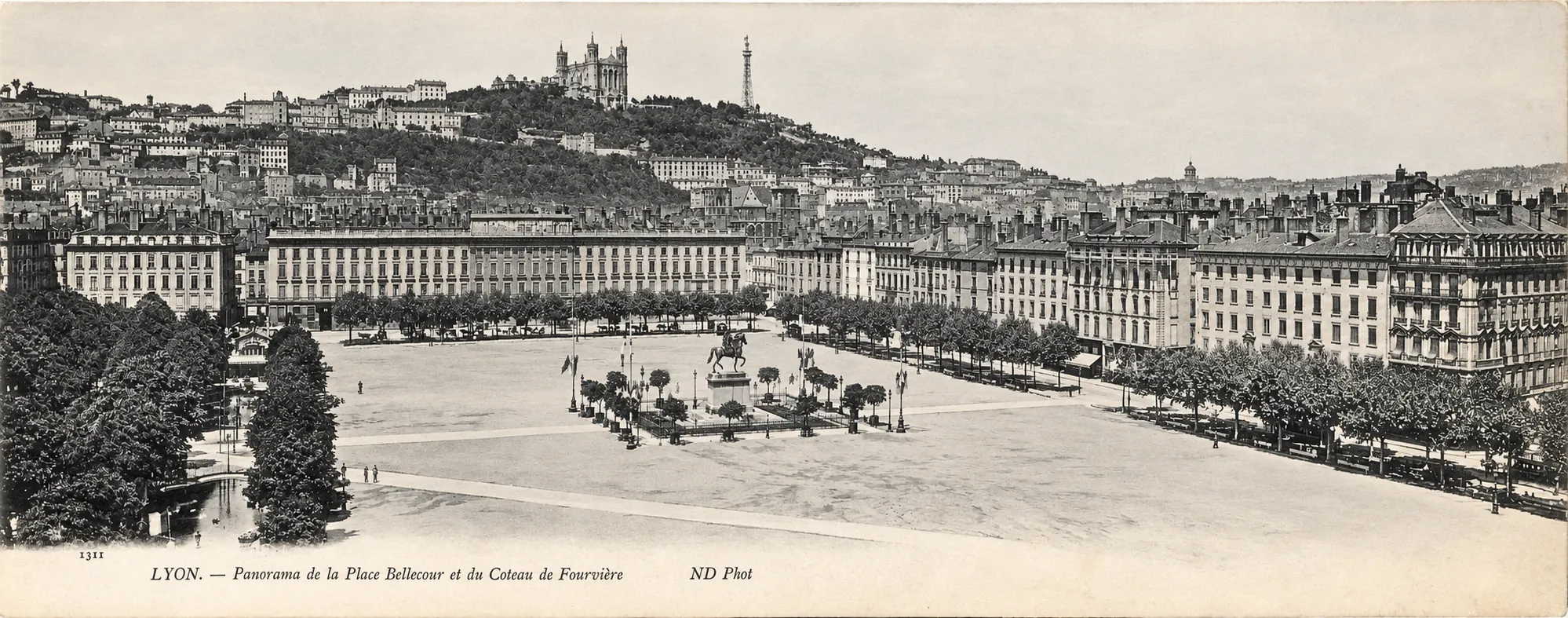
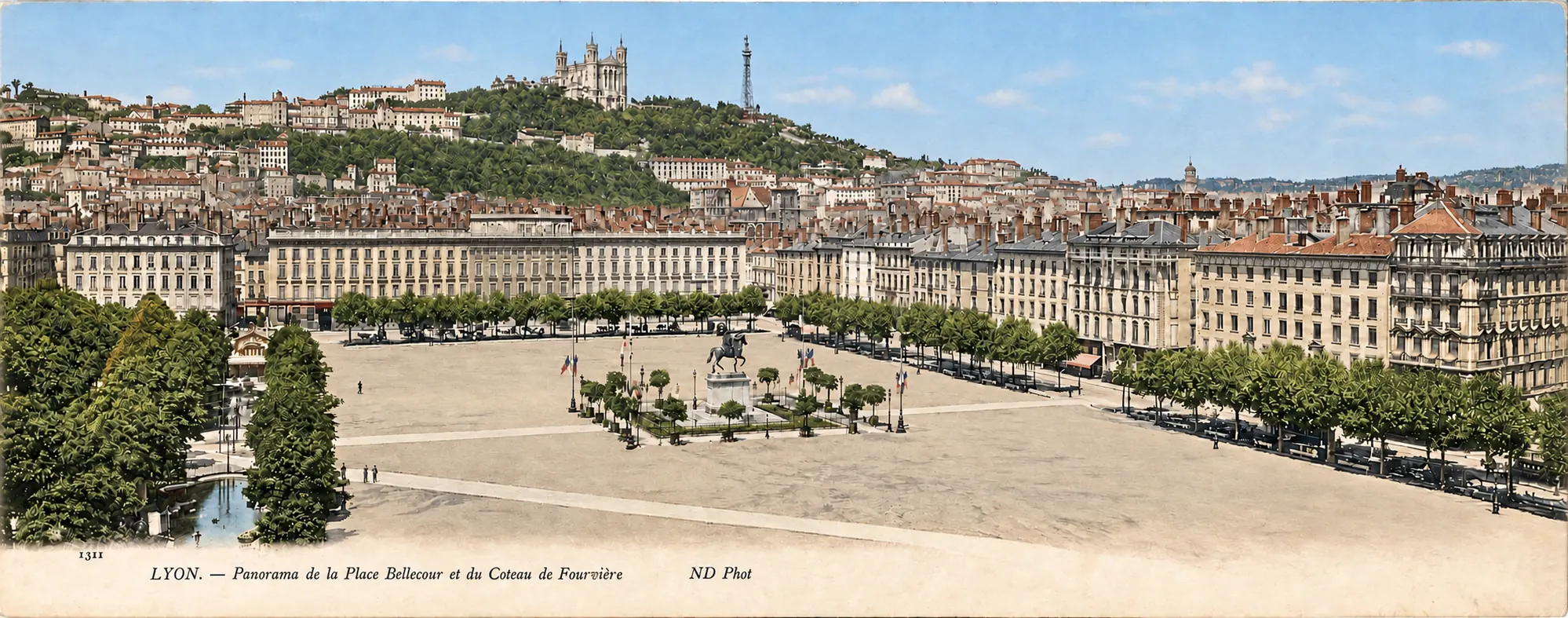
Place Bellecour and Fourvière in Lyon form the two principal elements of this remarkable panoramic view, photographed from the eastern side of the square looking west towards Fourvière Hill. The printed caption at the bottom identifies the scene explicitly as a panorama of Place Bellecour and the slopes of Fourvière.
The vast open surface of Place Bellecour dominates the foreground. Compared with the modern square, the scene appears particularly uncluttered, with extensive open areas bordered by lines of mature trees. This spacious layout draws the eye towards the equestrian monument standing almost exactly at the centre.
The rider is Louis XIV, represented by the monumental bronze statue created by François-Frédéric Lemot and installed in 1825. According to the City of Lyon, Lemot’s sculpture replaced an earlier royal monument that had been destroyed during the French Revolution.
Small planted areas, trees and pieces of street furniture surround the central monument. Only a limited number of people and vehicles can be distinguished across the square, reinforcing the sense of scale created by this enormous urban space.
Beyond the square is a continuous frontage of tall buildings with regular rows of windows. Their restrained façades form the architectural frame of Bellecour and illustrate the deliberate monumental character given to this central part of Lyon. The western façades were designed as a unified ensemble framing the royal square and the statue at its centre.
The landscape then rises dramatically towards Fourvière Hill. At the summit, the four distinctive towers of the Basilica of Notre-Dame de Fourvière provide the dominant landmark. Construction of the basilica began in 1872, and the church was consecrated in 1896 after approximately twenty-five years of work.
Another conspicuous structure appears close to the basilica: the slender Fourvière metallic tower. Built in 1894 and standing 86 metres high, it was inspired by the great iron structures of the late nineteenth century. It originally included a panoramic restaurant and was later converted into a television transmission tower. Its presence is especially useful when studying this postcard because it establishes a firm earliest possible date for the photograph.
The panorama also provides an excellent illustration of Lyon’s distinctive topography. Place Bellecour lies on the Presqu’île, the central peninsula between the Rhône and Saône rivers. Behind it, densely built neighbourhoods rise towards Fourvière. The photographer deliberately combines the monumental city centre below with the religious and architectural landmarks of the hill above.
As a result, this postcard does more than document a single square. It captures two complementary faces of Lyon in one image: the formal urban landscape of Bellecour in the foreground and the commanding silhouette of Fourvière overlooking the city.
Historical description
This postcard was probably produced around the turn of the twentieth century or during the early 1900s, although the front of the card does not provide enough evidence for an exact date.
The strongest chronological clue is the Fourvière metallic tower. Since it was erected in 1894, the photograph must have been taken after that year. The Basilica of Notre-Dame de Fourvière also appears as an established landmark on the skyline. The basilica had been under construction since 1872 and was consecrated in 1896.
A further clue is the printed credit “ND Phot” below the panorama. This mark is associated with Neurdein Frères, one of the major French photographic and postcard businesses of the period. The Bibliothèque nationale de France identifies Étienne and Louis-Antonin Neurdein as photographers, publishers and printers and records “ND phot.” among the firm’s commercial names. The “ND” mark was already being used from 1885, while the company remained active until 1918.
The BnF collections also contain extensive groups of photographs by the Neurdein company, including views of Lyon, urban landscapes and panoramic photographs. Taken together with the visual appearance and panoramic presentation of this card, these elements make approximately 1900-1910 a reasonable estimate, rather than a firmly established date.
The history represented in the photograph reaches much further back. Place Bellecour became closely associated with royal authority during the reign of Louis XIV. An earlier statue of the king once stood here but was destroyed during the French Revolution. Lyon itself suffered severe disruption in 1793, and parts of the architectural setting around Bellecour were subsequently reconstructed. The present equestrian statue by François-Frédéric Lemot was inaugurated in 1825.
The postcard therefore records a city in which several historical periods remained simultaneously visible. The monumental square and its classical façades preserved the legacy of seventeenth- and eighteenth-century planning; the nineteenth-century statue restored the royal monument to its central position; the basilica embodied the major religious building campaigns of nineteenth-century Lyon; and the newly built metallic tower introduced the engineering vocabulary of the industrial age.
The almost empty appearance of the central square is particularly striking to a modern viewer. Later generations would see Place Bellecour adapted repeatedly to changing transport, pedestrian and civic uses. The City of Lyon notes that a major redevelopment completed in 2010 restored aspects of its historic layout and tree-lined promenades.
This panoramic postcard is therefore an important visual record of Lyon at the transition between the nineteenth and twentieth centuries. Place Bellecour remains unmistakably monumental, Louis XIV still commands the centre of the composition, and above the rooftops the basilica and metallic tower of Fourvière already form the skyline that would become one of the city’s most recognizable views.