Immaculate Conception Church in Lake Charles, Louisiana
Geographic description
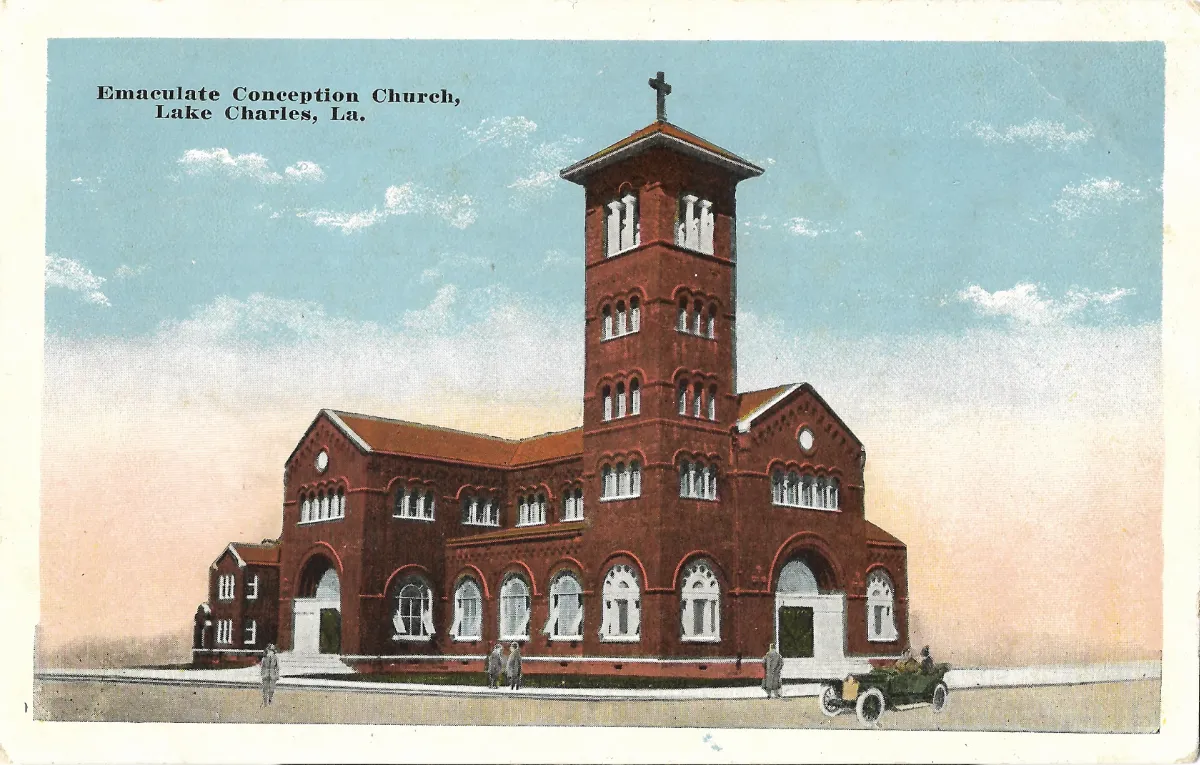
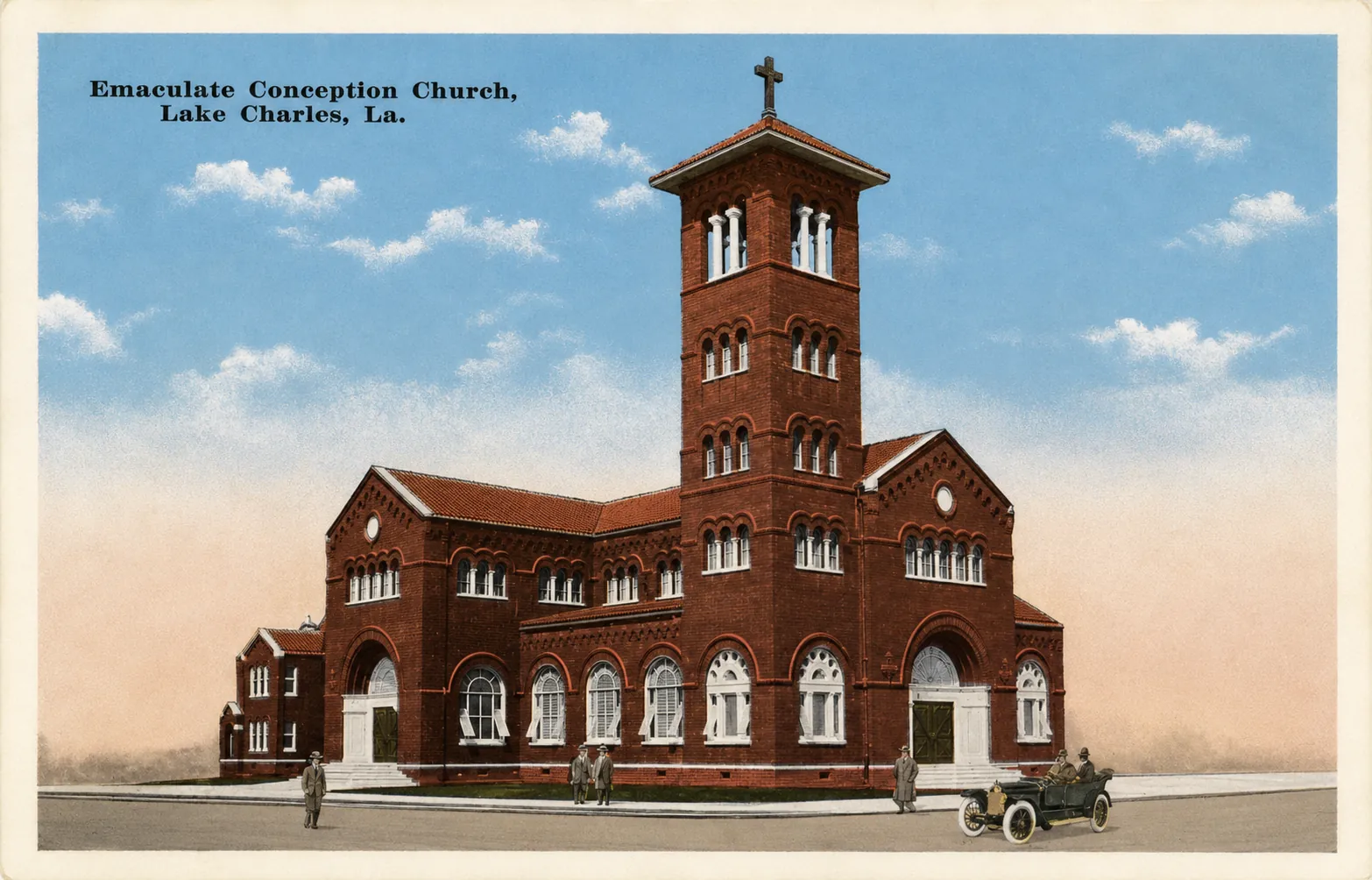
Immaculate Conception Church in Lake Charles dominates this historic postcard view. The printed caption at upper left reads “Emaculate Conception Church, Lake Charles, La.” The spelling “Emaculate” appears to be a printer’s error; the official name is Immaculate Conception. The building shown is the church now known as the Cathedral of the Immaculate Conception, located at 935 Bilbo Street in downtown Lake Charles, Louisiana, within Calcasieu Parish.
The photographer chose an oblique viewpoint that clearly reveals the church’s overall massing. Its most striking feature is the tall square bell tower rising near the center of the composition, capped by a broad overhanging roof and a cross. The building is constructed of dark red brick, while its façades are organized by repeated round arches, groups of narrow windows, and decorative arcading beneath the roofline. Large gabled sections project on either side of the tower, giving the church a broad and balanced profile.
These visible characteristics closely match the Romanesque Revival architecture documented by the National Park Service. The official historic record identifies a particular Lombard influence, visible in the red tile roof, the repeated arcades, and the bell tower designed in the manner of an Italian campanile rising in clearly defined stages. Round-arched openings and decorative corbel tables beneath the eaves are also characteristic features of the building.
The postcard is colorized rather than a straightforward natural-color photograph. Its pale blue sky, reddish-brown brickwork, red roof tiles, and patches of greenery were probably enhanced or interpreted during printing, so the exact colors should not be treated as firm documentary evidence. The architectural forms themselves, however, are reproduced clearly enough to provide a reliable view of the structure.
A sidewalk and broad roadway occupy the foreground. Several pedestrians can be seen near the church, while an open automobile stands at the right side of the image. Traffic is almost nonexistent, street furniture is minimal, and no modern signs or utilities distract from the architecture. The result is a remarkably open view of the building and its immediate surroundings.
National Park Service documentation describes the 1913 property as a two-story brick church with a five-story bell tower, together with an attached two-story rectory and a service structure. The church occupies a prominent corner site in downtown Lake Charles and forms part of a group of important buildings erected during the reconstruction of the city center after the Great Fire of 1910.
Historical description
The history of the building on this postcard is closely tied to one of the defining events in Lake Charles urban history. The Catholic parish dates to 1869, but the church seen here was not the first sanctuary on the site. An earlier Immaculate Conception Church, along with other nearby Catholic properties, was destroyed in the Great Fire of April 23, 1910. Lake Charles City Hall and the Calcasieu Parish courthouse were also among the major buildings lost as the fire swept through much of downtown.
In the aftermath, Lake Charles launched an ambitious rebuilding campaign. The Catholic parish commissioned the prominent New Orleans architectural firm Favrot & Livaudais to design the replacement church. The present building was completed in 1913, and local historic-preservation records state that the new Immaculate Conception Church was dedicated on December 18, 1913. The church therefore belongs directly to the wave of substantial new construction that reshaped downtown Lake Charles after the disaster.
The use of massive masonry construction also reflected the determination to rebuild more permanently after the destruction of so many wooden structures. Immaculate Conception Church, the new City Hall, and the new parish courthouse became architectural symbols of the city’s rapid recovery from the fire.
The postcard itself cannot be dated precisely from the front alone. It must, however, postdate 1913 because the church was not completed until that year. The open touring car at right—with its narrow wheels, separate fenders, and high body—looks more characteristic of automobiles from the 1910s or very early 1920s than of the lower, more enclosed cars that became common later. The colorized printing technique and the relatively uncluttered streetscape point in the same general direction.
A date in the later 1910s or early 1920s is therefore plausible, although this remains an estimate based solely on visible evidence. Without a postal cancellation, publisher’s imprint, or other information from the reverse, a more exact date would be speculative.
The postcard caption provides another interesting historical clue. It calls the building simply a “Church,” not a cathedral. That wording is entirely appropriate for the probable date of the card. The Diocese of Lake Charles was not established until 1980, when Immaculate Conception became the episcopal seat and therefore the Cathedral of the Immaculate Conception. The postcard thus shows the same building that serves as the cathedral today, but during its earlier life as a parish church.
Much of the church’s original exterior character survives. National Register documentation identifies 1913 as its principal period of architectural significance. Later changes were largely made inside: three Gothic-style marble altars were installed in 1923, further decorative work followed during the 1930s, and elaborate Viennese stained-glass windows were installed in 1939. These later interior features cannot be assessed from this exterior postcard, but they help place the image within the building’s longer architectural history.
This postcard is therefore more than a picturesque church view. It records one of the principal monuments created during Lake Charles’s recovery from the devastating fire of 1910, probably at a time when the new church was still only a few years old.