St. Patrick’s Sanitarium in Lake Charles, Louisiana
Geographic description
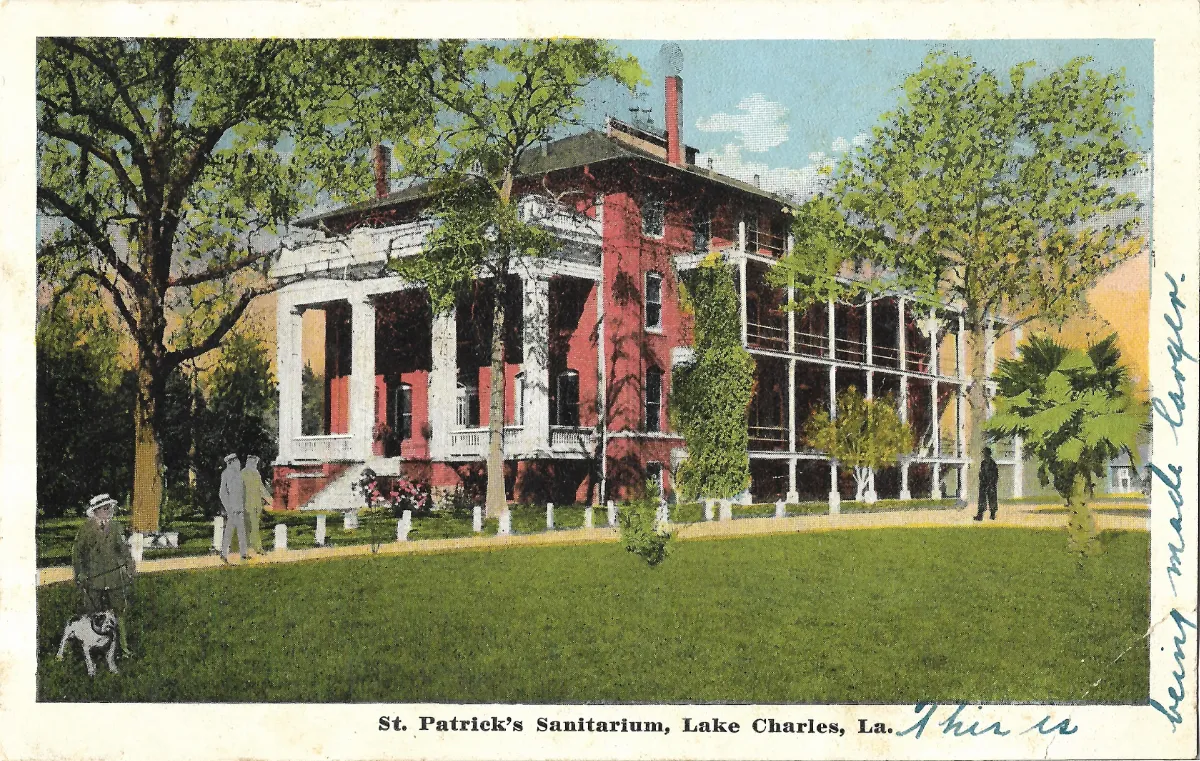
St. Patrick’s Sanitarium in Lake Charles is the large medical institution depicted on this vintage Louisiana postcard. Its identity is certain because the printed caption along the lower border reads “St. Patrick’s Sanitarium, Lake Charles, La.” Lake Charles lies in southwestern Louisiana, in Calcasieu Parish, within the Gulf Coast region and relatively close to the Texas state line.
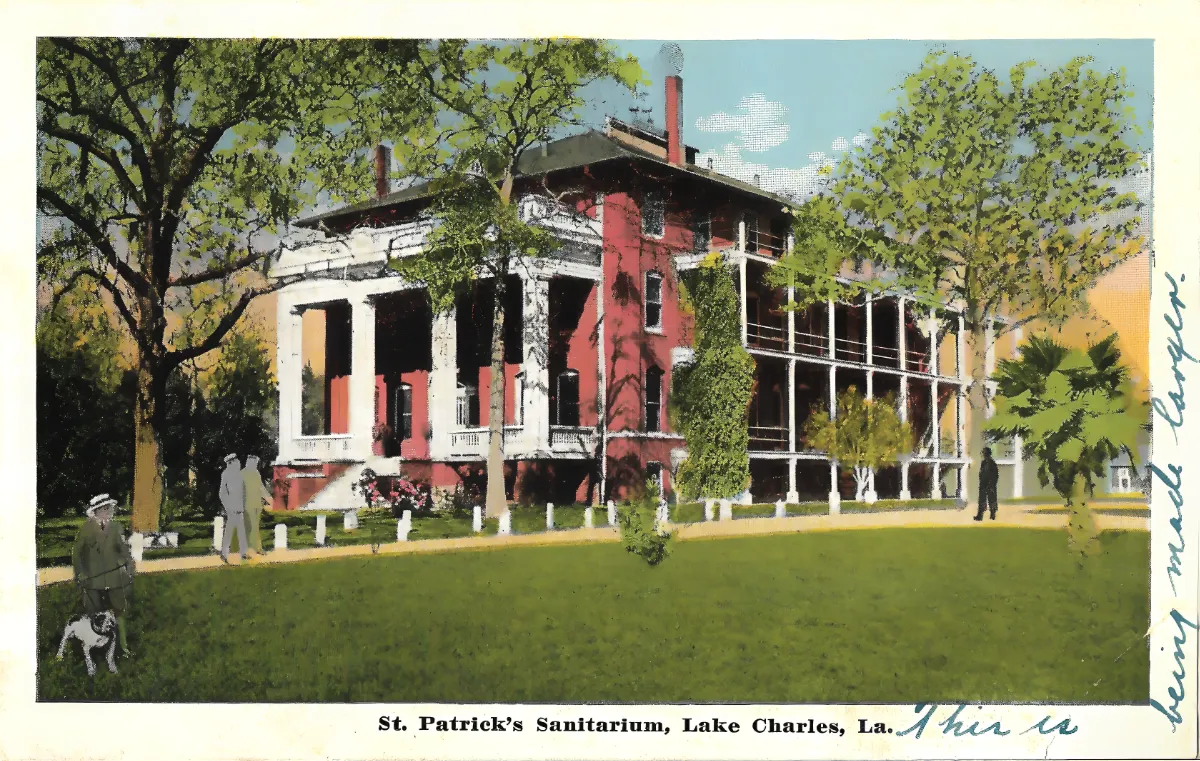
The postcard presents the sanitarium from its landscaped grounds. The main structure is a substantial red-brick building several stories high, combining a formal architectural appearance with features well suited to the hot, humid climate of southern Louisiana. On the left, a prominent white portico supported by tall columns creates an imposing entrance and gives this section of the hospital an almost residential character.
The long galleries extending along the right-hand side are especially noteworthy. They appear to be screened and extend across several levels. Large covered verandas were common in southern architecture, where they improved natural ventilation while providing shade and some protection against insects. In an early twentieth-century medical institution, such spaces may also have given patients access to fresh air without leaving the building. Their precise medical use, however, cannot be established from the postcard alone.
Several tall chimneys rise above the roofline, including a particularly conspicuous red stack near the center. These indicate the considerable heating and service infrastructure required by a large medical establishment during this period. The surrounding grounds are spacious and carefully maintained, with broad lawns, paths, mature shade trees, younger plantings, and palms. Several people are visible along the paths, providing a useful sense of scale and emphasizing the size of the institution.
A 1913 Lake Charles city directory lists St. Patrick’s Sanitarium at 2312 Ryan Street and states that it was conducted by the Sisters of Charity of the Incarnate Word. At the time, South Ryan Street formed part of Lake Charles’s southward expansion. A local history of the nearby Margaret Place district notes that a streetcar route ran along South Ryan after the devastating 1910 fire and explains that part of the former South Ryan corridor is now known as Dr. Michael DeBakey Drive.
The St. Patrick name remains part of Lake Charles’s medical landscape today. CHRISTUS Ochsner St. Patrick Hospital is currently listed at 524 Dr. Michael DeBakey Drive. This continuity of name should not be taken to mean that the exact building shown on the postcard survives unchanged. The hospital complex underwent extensive development, enlargement, and modernization during the twentieth century.
Historical description
The history of St. Patrick’s Sanitarium in Lake Charles reaches back to the opening years of the twentieth century. Historical accounts place the establishment of St. Patrick around 1908, associated with the Sisters of Charity of the Incarnate Word. By the time the eleventh edition of the Encyclopaedia Britannica described Lake Charles, St. Patrick’s sanatorium was already mentioned among the city’s principal buildings.
The word “Sanitarium” can be misleading to a modern reader. It should not automatically be interpreted as meaning a psychiatric institution or a tuberculosis sanatorium. In early twentieth-century American usage, the term could be applied more broadly to medical facilities. In this particular case, contemporary evidence is unusually clear: a nationwide hospital survey published in the Journal of the American Medical Association in 1929 classified St. Patrick’s Sanitarium in Lake Charles as a general hospital, with 75 beds.
The hospital’s connection with the Sisters of Charity of the Incarnate Word is well documented. The 1913 city directory identifies the congregation as the institution’s operator. The 1917 Official Catholic Directory likewise lists St. Patrick’s Sanitarium on South Ryan Street and records twelve sisters and three novices associated with the establishment. These contemporary references firmly anchor the postcard within the history of Catholic health care in Lake Charles.
St. Patrick was expanding rapidly during these years. In 1918, the Southern Medical Journal reported plans for a 35-bed addition costing $70,000 and announced that a nurses’ training school was to open on September 1. The expansion reflects the growing importance of professional hospital care at a time when Lake Charles itself was developing quickly as a regional center for transportation, commerce, and industry.
Without a postmark or other information from the reverse, the postcard cannot be assigned a precise date. Its visual characteristics nevertheless provide useful evidence. The generous white border, printed caption, carefully colorized appearance, and overall style are consistent with postcards circulated during the 1920s, although a date from the late 1910s or early 1930s remains possible. The large multi-story gallery wing could conceivably relate to one of the institution’s documented expansions, but there is not enough evidence to identify it specifically with the 1918 addition.
The colorist emphasized the deep red brickwork, brilliant white architectural details, blue sky, and lush green landscape. These choices present the hospital as bright, orderly, and peaceful. Such an image was well suited to the promotional character of postcards depicting hospitals and other civic institutions. The broad lawn, palms, shade trees, and airy galleries also conveyed a distinct sense of place, identifying the scene visually with the warm climate of southern Louisiana.
The postcard therefore records more than an attractive historic building. It preserves the appearance of an important Lake Charles medical institution during a formative period in its development. The St. Patrick name survived the major transformations of twentieth-century health care and remains in use today at CHRISTUS Ochsner St. Patrick Hospital.