Orléans – A Festive Day on Place du Martroi, c. 1910
Geographic description
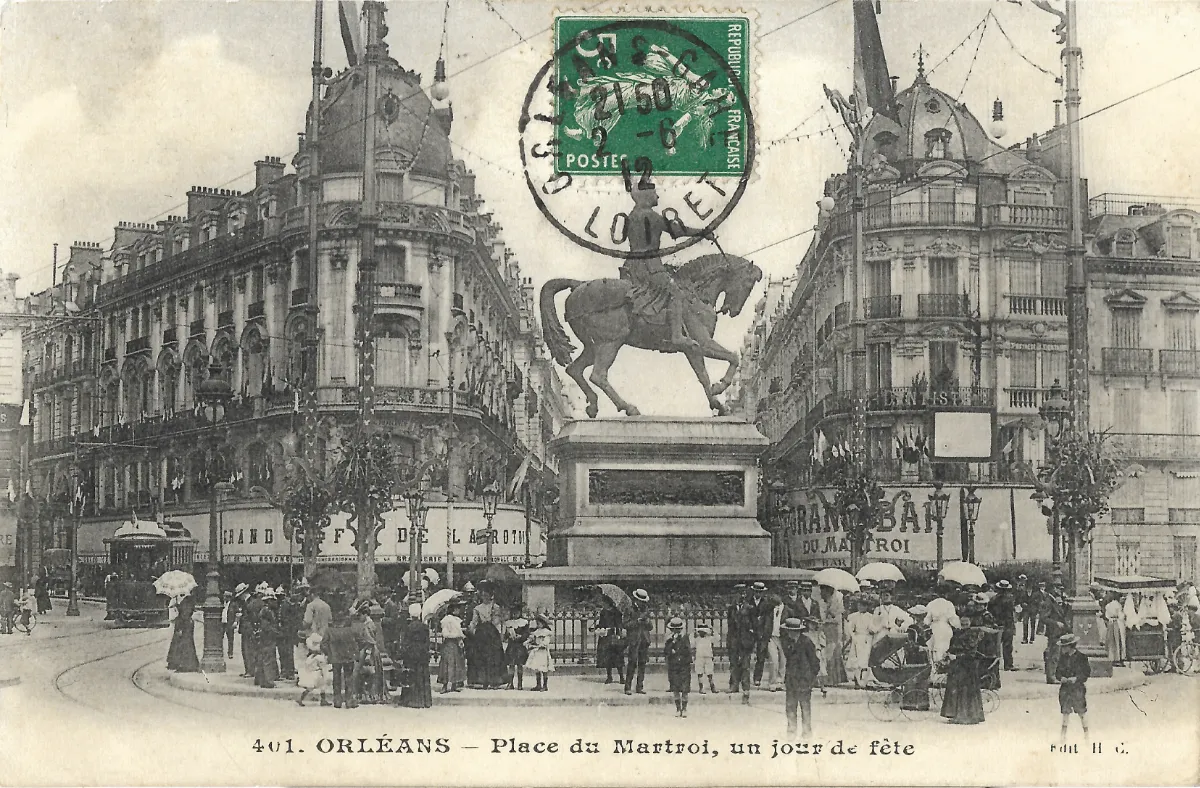
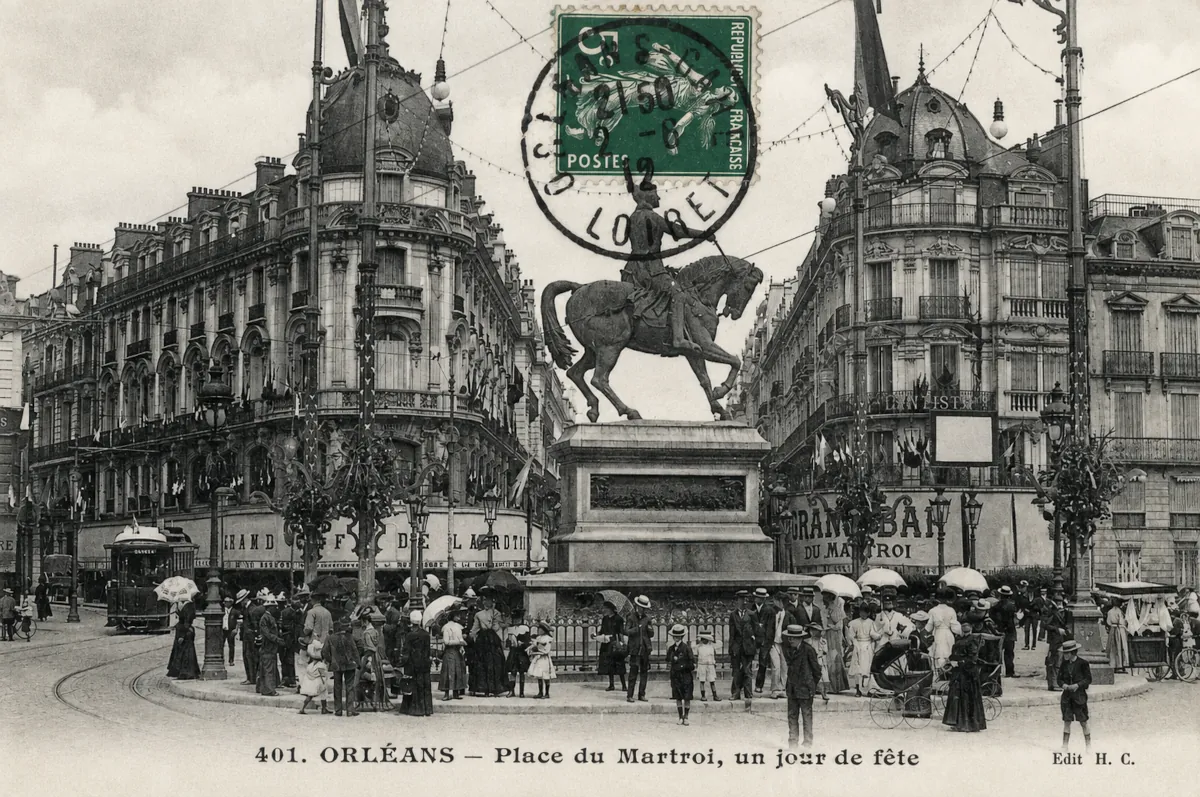
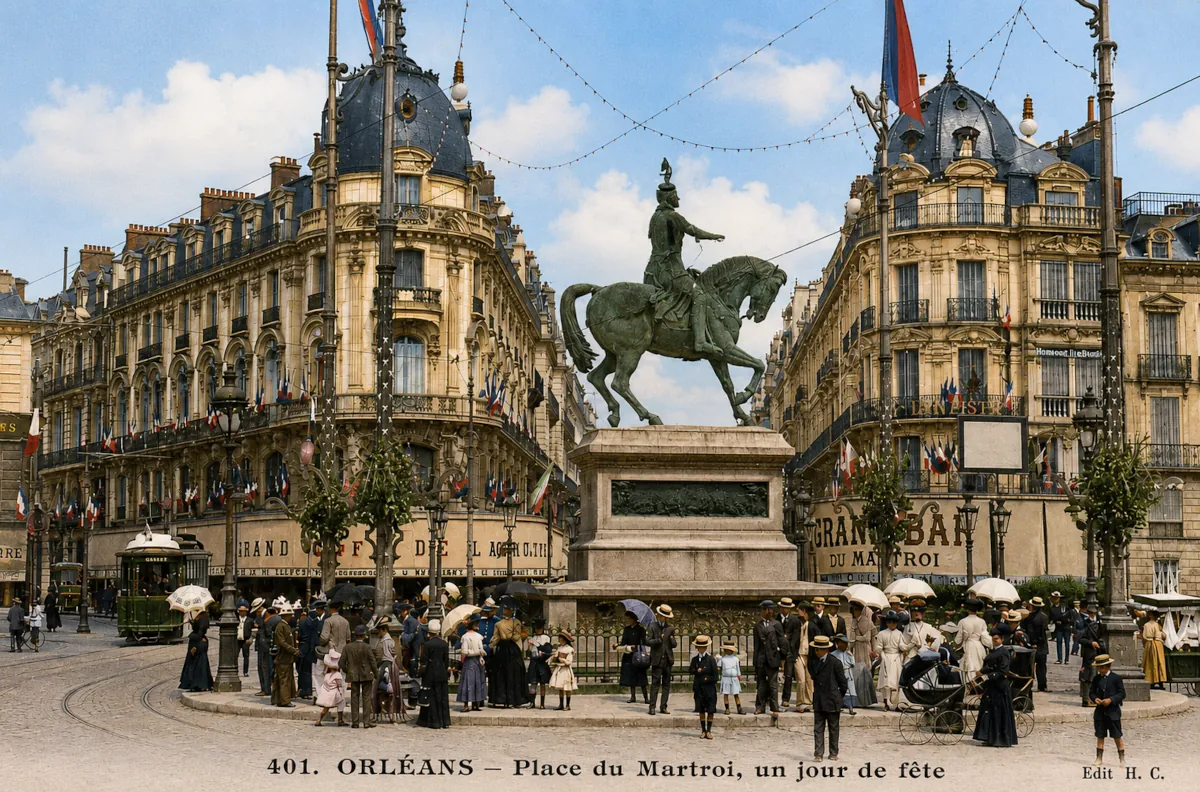
Place du Martroi in Orléans is shown here at an unusually lively moment, with the monumental equestrian statue of Joan of Arc forming the centrepiece of the scene. The printed caption, “401. ORLÉANS – Place du Martroi, un jour de fête,” securely identifies both the location and the festive character of the photograph.
The statue dominates the composition. Joan of Arc is shown on horseback above a massive stone pedestal enclosed by an iron railing. The monument was created by the French sculptor Denis Foyatier and inaugurated on 8 May 1855, replacing an earlier statue of Joan that had stood on the former Martroi since 1804. Relief panels associated with the monument were subsequently produced by Vital-Dubray and illustrate episodes from Joan’s life.
Behind the statue, a broad street perspective is framed by tall, elaborately decorated buildings. This is very probably the entrance to Rue de la République, the major street laid out between 1894 and 1905 to connect Orléans railway station with Place du Martroi. Its architecture was deliberately monumental: Orléans Métropole describes the street as Haussmann-inspired, with cutaway corners, rounded façades, balconies and richly designed late nineteenth-century buildings. These features correspond closely to the architecture visible in the postcard.
Transport infrastructure is another prominent feature. Tram rails curve through the foreground on the left, where a tramcar can also be seen. Above the streets is a network of electric overhead wires. Orléans opened its first tramway line in 1877. Originally horse-drawn, the system was electrified in 1899, and by 1909 four lines crossed at Place du Martroi. The postcard therefore preserves a valuable image of the square during the first great period of electric public transport in the city.
The crowd is equally informative. Men in dark suits and hats mingle with women wearing long dresses and broad hats, while several women carry parasols. Children stand close to the railings of the monument, and bicycles appear around the edges of the scene. Their clothing and the general appearance of the street are entirely consistent with the first decade or so of the twentieth century.
Decorations transform the normally urban setting into a ceremonial space. Flags and garlands hang from buildings and street fixtures, and temporary-looking commercial displays add to the festive atmosphere. To the right of the statue, the large words “GRAND BAR DU MARTROI” can be read, while a dentist’s sign is visible higher on the neighbouring building. Such details make the postcard particularly valuable, because it records not only the monumental architecture but also the everyday commercial life surrounding the square.
Historically, Place du Martroi had long developed as one of the principal civic spaces of Orléans. The area lay beyond the medieval walls known to Joan of Arc and became increasingly central to urban life after later expansions of the city. By the modern period it had become the city’s principal gathering place, a role that has continued into the present day.
Historical description
Several independent clues help date this view of Place du Martroi in Orléans. The completed appearance of Rue de la République suggests a photograph taken around or after 1905. Its electric tramway infrastructure also belongs to the period after 1899, when the Orléans system was converted from horse traction to electric operation. By 1909, Place du Martroi had become the junction of four tram routes.
The postage stamp attached to the upper part of the picture provides another useful clue. It is a green 5-centime Semeuse stamp, a French definitive showing the famous “Sower” design. This particular green 5-centime issue entered general use in March 1907 and remained on sale until 1921. Consequently, this individual postcard cannot have been mailed with this stamp before 1907.
The circular Orléans postmark is partly obscured by both the stamp design and the underlying photograph. “LOIRET” can be read in its lower section. The central date appears to end in “12”, which may indicate 1912, but the impression is not sufficiently clear to treat this as a certain reading. A date around 1912 is nevertheless compatible with every other visible clue.
Taken together, the architecture, electric tram, stamp and clothing suggest that the scene most probably belongs to the period c. 1907-1912, making “around 1910” a reasonable working date. The photograph itself may of course be slightly older than the postal cancellation, since postcards often remained on sale for several years after the original photograph was taken.
The precise celebration shown in the picture cannot be securely identified. The concentration of decorations around Joan of Arc’s monument and the large gathering of spectators naturally suggest a possible connection with Orléans’ traditional Joan of Arc celebrations. The monument itself was inaugurated on 8 May 1855 during those festivities. However, the postcard publisher deliberately used only the general wording “un jour de fête” — “a festive day.” Without another explicit inscription, it would be unsafe to identify the occasion as a particular 8 May celebration.
By the time this photograph was taken, Foyatier’s statue had already stood on the square for more than fifty years. The monument had been commissioned in the 1840s; its bronze figure was cast in 1853 using metal from nine cannon provided by the French War Ministry and was formally inaugurated two years later. The statue therefore links the early twentieth-century city represented in the postcard with the nineteenth-century revival of Joan of Arc as a major civic symbol of Orléans.
The photograph also captures an important stage in the transformation of the city centre. The new Rue de la République, electric tramways, commercial premises and fashionable turn-of-the-century buildings represent the modern city, while the equestrian statue acts as a reminder of Orléans’ historical identity. The dense crowd brings both worlds together, turning the square from a piece of urban architecture into a living public space.
The small publisher’s mark at the lower right appears to read “Édit. H. C.”, while 401 is clearly printed as the card number. The available evidence does not allow the abbreviated publisher’s identity to be expanded with confidence, so retaining the initials is preferable to assigning an unsupported name.