Antique Postcard Orleans France: Royal Bridge, circa 1910
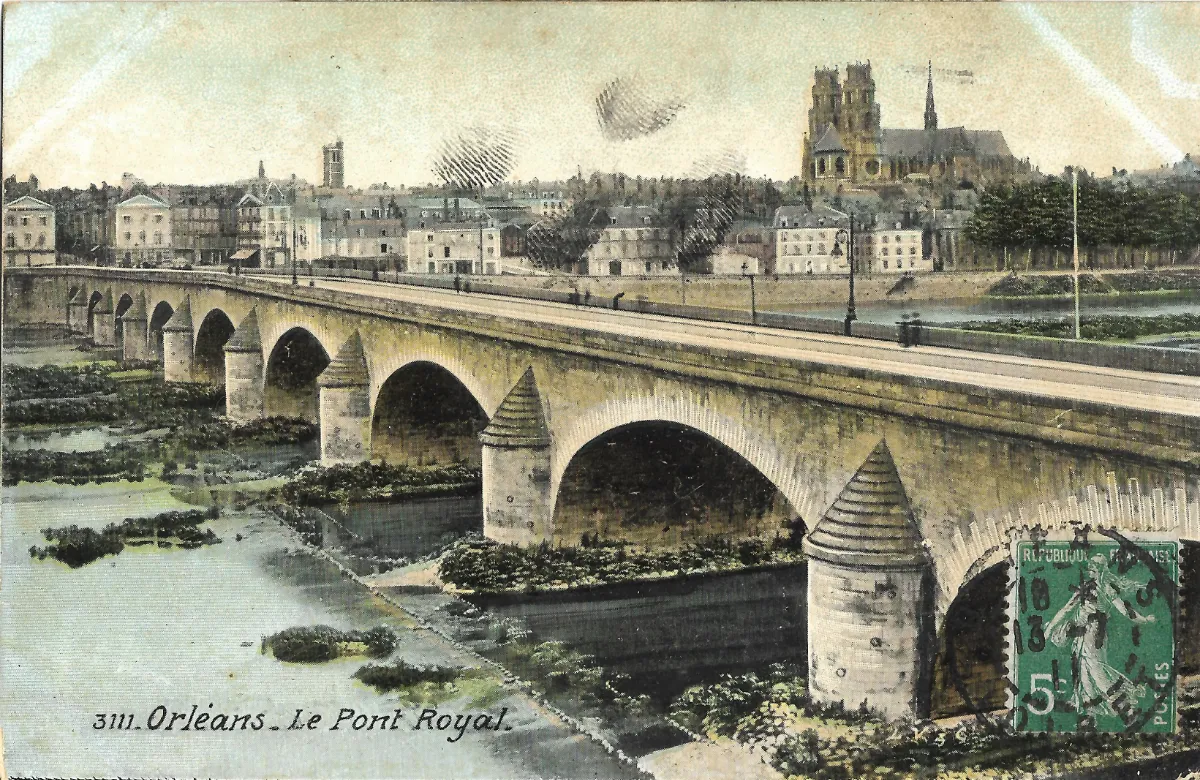
Geographic description: This antique postcard Orleans France shows the Pont Royal (Royal Bridge), one of the city’s most emblematic structures, spanning the Loire River in the foreground of the image. Built of dressed stone, the bridge is characterized by a regular series of round arches and by cylindrical cutwater turrets topped with conical roofs at each pier, an architectural feature typical of classical French bridges dating back to the eighteenth century, designed to protect the piers from the current and floating debris. On the roadway, a traffic lane is visible along with what appear to be tram rails, together with a small motorized or horse-drawn vehicle heading toward the town center.
In the background, the skyline is dominated by the massive silhouette of Orléans Cathedral (Sainte-Croix), recognizable by its two neo-Gothic western towers and its slender central spire rising above the rooftops. This cathedral, a major example of religious architecture in the Loire Valley, serves as the main visual landmark of the postcard and allows for a confident identification of the location, reinforced by the printed caption at the bottom of the image: “3111. Orléans. Le Pont Royal.” On the left side of the photograph, a more modest bell tower, likely belonging to a parish church in the old town center, completes the urban skyline.
Along the quays, a continuous row of three- to four-story bourgeois buildings lines the riverbank, with classical façades pierced by evenly spaced windows, typical of the urban development along the Loire quays rebuilt or reinforced during the nineteenth century following the river’s recurring floods. The visible vegetation in the foreground, on the sandbanks and riverbanks, together with the relatively low water level, suggests the photograph was taken during a period of low water, likely in late summer or autumn.
The hand-applied or chromolithographic coloring of the card accentuates the ochre tones of the bridge’s stonework and the blue-gray hues of the sky, an aesthetic treatment widely used in illustrated postcard publishing in the early twentieth century.
Historical description: Several clues allow for an approximate dating of this antique postcard Orleans France. The stamp affixed in the lower right corner is a green Semeuse “fond plein sans sillon” postage stamp with a face value of 5 centimes, a design issued by the French postal administration starting in 1903 and remaining in use into the 1930s; its presence alone therefore cannot precisely establish the year the card was mailed. The postmark, partially legible, shows numerals that may correspond to a day and month of cancellation, but the year is not clearly decipherable from the available image; it may fall within the 1910s, though this cannot be confirmed with certainty.
The card’s editorial style — the publisher’s reference number (“3111”), the italicized printed caption beneath the image, and the hand-coloring applied over a black-and-white photographic base — corresponds to common postcard publishing practices between roughly 1905 and 1918, a period marking the peak of illustrated postcard production in France. The absence of a white border around the image, a feature more typical of cards produced after 1915-1920, supports the hypothesis of a dating prior to the First World War, most likely between 1905 and 1914.
From an urban history perspective, the Pont Royal of Orléans, also known at certain periods as the Pont George V, is a structure whose origins date back to the eighteenth century; it underwent successive reconstructions and reinforcements over the centuries, notably following damage caused by flooding of the Loire. The rails visible on the bridge deck suggest the existence, at the time the photograph was taken, of a horse-drawn or electric tramway network serving the town center, an urban transport mode then in full expansion in mid-sized French cities.
Without access to the reverse side of the card, it is not possible to confirm the publisher’s name, the exact postmark date, or the content of any handwritten message, which constitutes an important methodological limitation for refining this dating. Verification through Orléans municipal archives or specialized deltiology databases could help clarify these elements.
All postcards in this category