Lake Charles – The Old U.S. Post Office on Broad Street
Geographic description
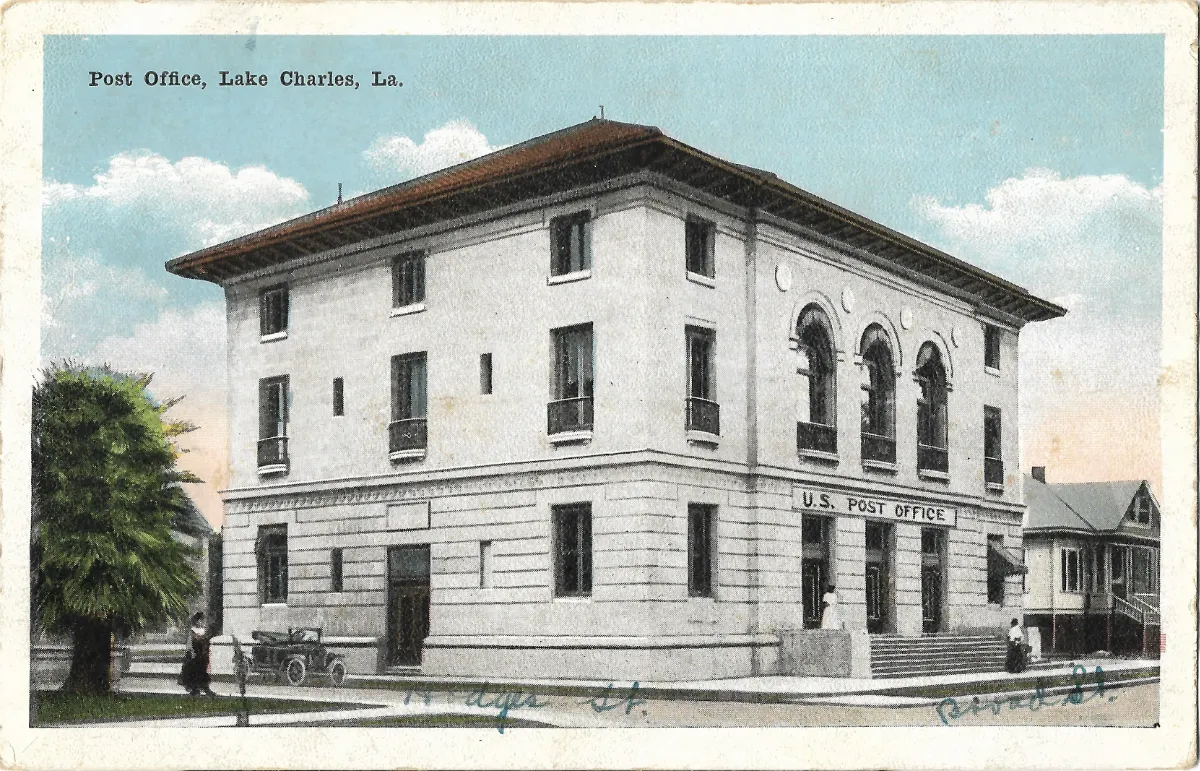
The Lake Charles Post Office shown on this postcard stands at 501 Broad Street in the historic center of Lake Charles, a city in southwestern Louisiana and the seat of Calcasieu Parish. The printed caption in the upper left corner, “Post Office, Lake Charles, La.,” clearly identifies the location. Local heritage sources provide a more complete name for the building: the former U.S. Post Office and Courthouse, located at the corner of Broad and Hodges streets.
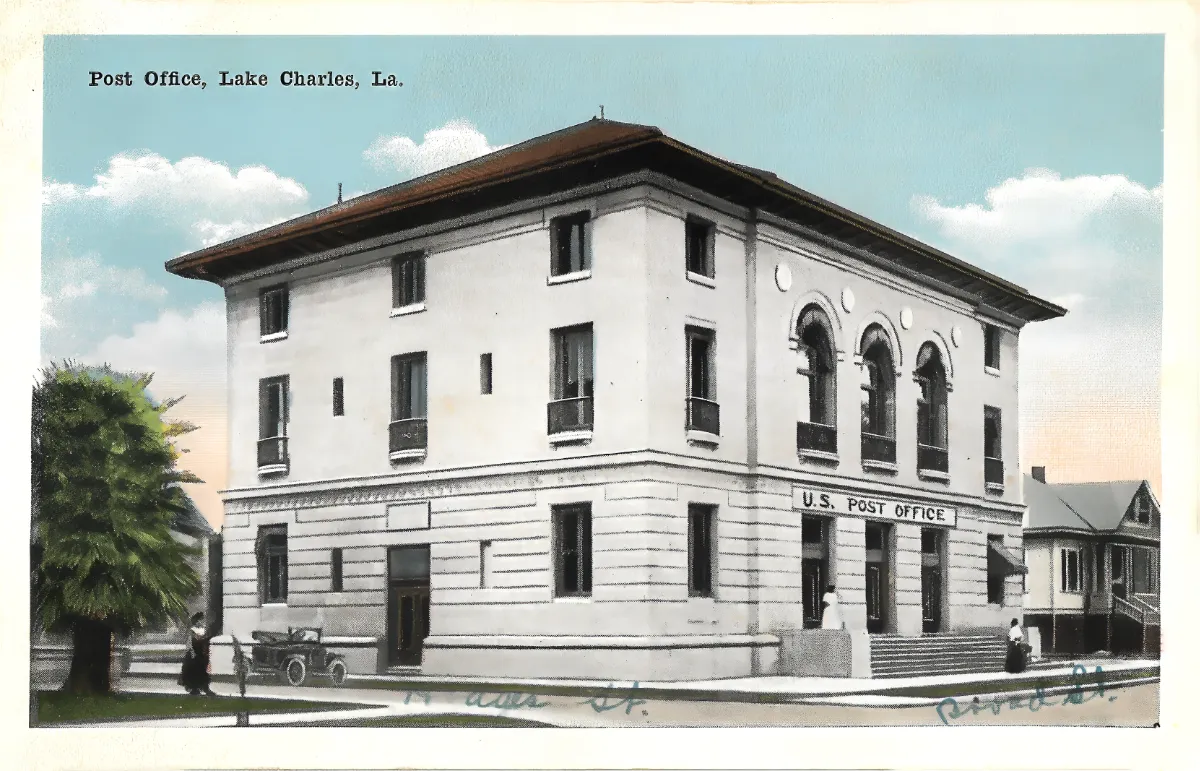
The federal building dominates the postcard. Viewed diagonally from across the street, it is considerably more imposing than the neighboring structures. The ground floor has strongly defined horizontal masonry courses, while the upper levels are smoother and more restrained. Three tall round-arched openings form the most distinctive feature of the principal façade. Circular decorative motifs appear above them, while a broad overhanging roof is supported by prominent brackets.
The reddish tiled roof, deep eaves, balanced elevations and arched windows correspond closely to the description published by the local heritage authority, which characterizes the old post office and courthouse as a refined Renaissance Revival building. Its strict symmetry and monumental proportions give it the appearance of a civic palace rather than that of an ordinary local post office.
The words “U.S. POST OFFICE” can be read directly above the main entrances. A broad flight of steps leads from the sidewalk to the doors. Several people are visible near the entrance and along the pavement, providing a useful sense of scale. An early automobile with large spoked wheels is parked against the left-hand side of the building, an important visual clue when considering the likely date of the photograph.
The surrounding neighborhood is much less monumental. Immediately to the right stands a timber house with a porch, while a large palm tree occupies the foreground on the left. The contrast between these relatively modest residential buildings and the massive masonry post office illustrates the changing character of Lake Charles during the early twentieth century, when substantial civic and commercial structures were appearing among an older townscape that was still largely domestic in scale.
The palm tree is also consistent with historical descriptions of Broad Street. Local heritage material describes Broad Street as an important east-west thoroughfare that was once lined with palms. The street later formed part of the Old Spanish Trail and the original route of U.S. Highway 90, linking Lake Charles with a much broader regional and national road network.
This particular postcard has been colorized, almost certainly from an originally monochrome photograph. The blue sky, green vegetation and warm reddish roof tiles make the scene more visually appealing, but the underlying photographic detail remains clear enough for architectural study.
The building itself has survived. Federal historic-preservation records identify the U.S. Post Office & Courthouse Building at 501 Broad Street as a rehabilitation project completed for office use in 2001. The postcard therefore records the structure during the era when its federal identity was still plainly expressed above the entrance.
Historical description
The history of the Lake Charles Post Office belongs to a period when Lake Charles was developing from a regional lumber town into an increasingly important administrative and commercial center in southwestern Louisiana. Lake Charles had become the seat of Calcasieu Parish in the nineteenth century. Originally known as Charleston, it adopted the name Lake Charles during the 1860s, and its growth accelerated dramatically during the lumber boom of the late nineteenth century.
Local heritage material identifies the building at 501 Broad Street as the old U.S. Post Office and Courthouse and dates it to approximately 1910. A municipal architectural inventory places its construction more broadly between 1910 and 1920. The surviving documentation therefore supports an early twentieth-century origin, although the sources do not all assign exactly the same construction date.
This was a particularly significant period in Lake Charles history. A devastating fire in 1910 destroyed a large portion of downtown, including major public and religious buildings and numerous businesses and homes. The years around the fire consequently became a major period of rebuilding and architectural modernization. The old post office belongs to this general phase of urban transformation, although the postcard itself does not establish that it was constructed specifically as a direct consequence of the fire.
Despite the simple wording printed on the postcard, the building served more than postal purposes. Heritage records call it the U.S. Post Office and Courthouse, indicating that federal postal and judicial functions were accommodated within the same structure. Such combined federal buildings were a familiar feature of American regional cities during this period, giving the federal government a highly visible architectural presence while concentrating several public functions in a single building.
The postcard probably dates from the building’s relatively early years. No exact date can be established from the front alone, but several visual clues are useful. The automobile has the tall body, narrow profile and large spoked wheels associated with cars of the 1910s and early 1920s. The building also appears clean and relatively new, while the postcard’s photographic colorization is typical of commercial cards produced during the same broad period. A reasonable estimate would therefore be the 1910s to early 1920s, although this should remain an approximate dating unless evidence from the reverse of the card provides a postmark, publisher information or another firm chronological clue.
The image also captures a city in transition. Motor vehicles were beginning to occupy the streets, yet the surrounding neighborhood still had many characteristics of an earlier urban landscape: wooden houses, generous vegetation, quiet sidewalks and little visible traffic. Against this setting, the post office’s monumental architecture would have appeared particularly impressive.
Its design was intended to do more than provide practical space for handling mail. The ordered façades, large arches, formal symmetry and broad entrance steps conveyed permanence and public authority. For residents entering the building to send or collect correspondence—or to conduct other federal business—it represented a tangible presence of the United States government in a rapidly growing Louisiana city.
The survival of the building makes the postcard especially valuable today. Federal preservation records show that the former U.S. Post Office and Courthouse was rehabilitated for office use in 2001. More than a century after the period represented here, the structure therefore remains part of Lake Charles’s architectural heritage, while this postcard preserves the appearance of both the building and its Broad Street surroundings during the early decades of the twentieth century.