Lake Charles – Calcasieu Parish Courthouse and Monument
Geographic description
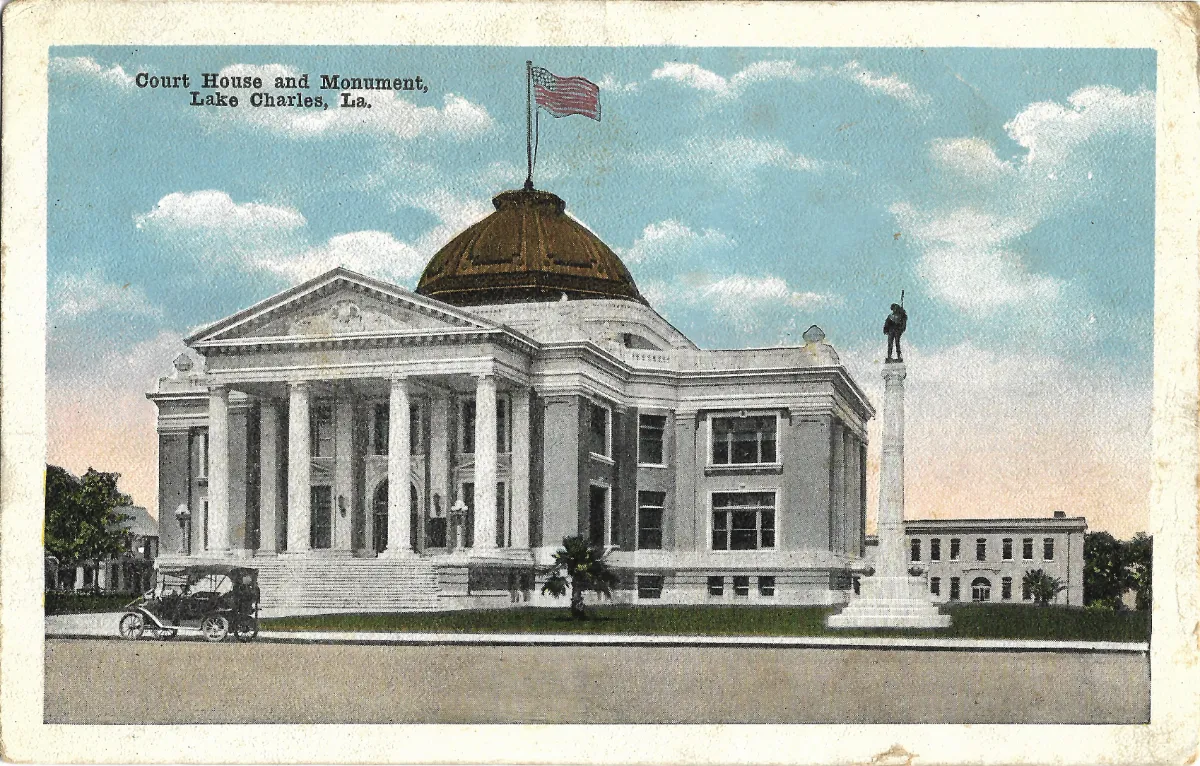
The Lake Charles Courthouse dominates this vintage postcard view of one of the principal civic landmarks of Lake Charles in southwestern Louisiana. The printed caption, “Court House and Monument, Lake Charles, La.,” identifies the scene clearly. The building is the Calcasieu Parish Courthouse in downtown Lake Charles.
The courthouse is shown from an oblique angle, allowing both the monumental entrance and one of the side wings to be seen. A broad flight of steps rises toward a classical portico formed by four massive columns supporting a triangular pediment. The strong symmetry and monumental proportions were characteristic of American civic architecture in the early twentieth century, when Classical Revival forms were frequently chosen for courthouses, city halls, and other public institutions.
The most distinctive feature is the large dome rising above the center of the building, crowned here by an American flag. Official Calcasieu Parish history describes the courthouse as a brick and terra-cotta structure with a solid copper dome, while its National Register documentation identifies its monumental Roman-Doric portico and strong Neo-Classical architectural character.
The postcard appears to have been produced from a black-and-white photograph subsequently colored for publication. The brown appearance of the dome and the bright blue sky should therefore not be interpreted as precise evidence of the building’s original colors. Hand-colored and mechanically tinted postcards often enhanced architectural photographs with idealized colors.
Standing prominently to the right of the courthouse is a tall pedestal surmounted by the figure of a soldier. This can be identified as the South’s Defenders Monument, erected on the courthouse grounds in 1915 to commemorate Confederate soldiers from southwestern Louisiana. Its presence provides one of the most useful chronological clues in the image.
The grounds are spacious and relatively open. A broad lawn separates the courthouse from the roadway, with only a few young ornamental trees and small palms visible around the building. The limited maturity of the landscaping may indicate a relatively early view of the courthouse grounds, although vegetation alone cannot provide a reliable date.
At the left edge of the scene an early automobile stands beside the road. Its narrow spoked wheels, high body and general proportions are consistent with cars commonly seen during the 1910s and early 1920s. The automobile therefore agrees well with the period indicated by the construction dates of the courthouse and monument.
There are almost no pedestrians and very little traffic. Such uncluttered compositions were common in architectural postcards because they emphasized civic buildings as symbols of prosperity, order, and local identity. Here the courthouse is deliberately presented as the dominant element of the cityscape, framed by lawns, sky, the American flag, and the neighboring memorial.
Historical description
The courthouse shown on this postcard was still comparatively new when the photograph was taken. An earlier Calcasieu Parish courthouse had been destroyed during the major fire that swept through downtown Lake Charles in April 1910. On April 4, 1911, parish authorities decided to construct a replacement on the former courthouse site. The new building was completed and dedicated in 1912 at a reported cost of approximately $200,000.
The architects were Favrot & Livaudais, a New Orleans firm responsible for a number of important Louisiana buildings. Calcasieu Parish’s official history compares the courthouse design with Andrea Palladio’s celebrated Villa Capra, or La Rotonda, near Vicenza, Italy. The Lake Charles building adapted this classical inspiration to the requirements of an American parish courthouse, creating a conspicuous civic landmark crowned by its copper dome.
The postcard must date from 1915 or later, because the monument standing beside the courthouse had not yet been erected when the courthouse opened in 1912. The South’s Defenders Monument was placed on the courthouse lawn in 1915 to commemorate Confederate war dead from the region, approximately half a century after the end of the American Civil War.
The early automobile, relatively young landscaping, postcard production style, and 1915 terminus all suggest that the original photograph was probably made between about 1915 and the early 1920s. This remains an approximate dating rather than a documented year. No clearly visible publisher’s date, postal cancellation, or other precisely dated evidence appears on the front of the card.
The monument gives the postcard additional documentary importance today. It remained a prominent feature of the courthouse grounds for more than a century and eventually became part of a wider public debate about Confederate memorials in the United States. In the summer of 2020, local officials considered demands for its removal. Shortly after the Calcasieu Parish Police Jury voted to leave the monument in place, Hurricane Laura struck Lake Charles on August 27, 2020, knocking the statue from its pedestal.
The courthouse itself survived later alterations. Calcasieu Parish records note the construction of additional courthouse facilities beginning in the 1950s and a major restoration and renovation program between 1993 and 1998. The historic 1912 building was ultimately recognized for its architectural significance through listing on the National Register of Historic Places.
The postcard therefore records an especially interesting moment in the development of Lake Charles. The city had recently replaced a courthouse lost in the devastating 1910 fire with an ambitious new civic building, while the 1915 memorial had only recently become part of the surrounding public landscape. The solitary motorcar also reflects a period when automobiles were beginning to reshape American streets. Together, these elements make the postcard more than a portrait of a building: it is a compact visual record of civic architecture, commemoration, and urban modernization in early twentieth-century Lake Charles.