Orléans – The Wedding Hall at Hôtel Groslot
Geographic description
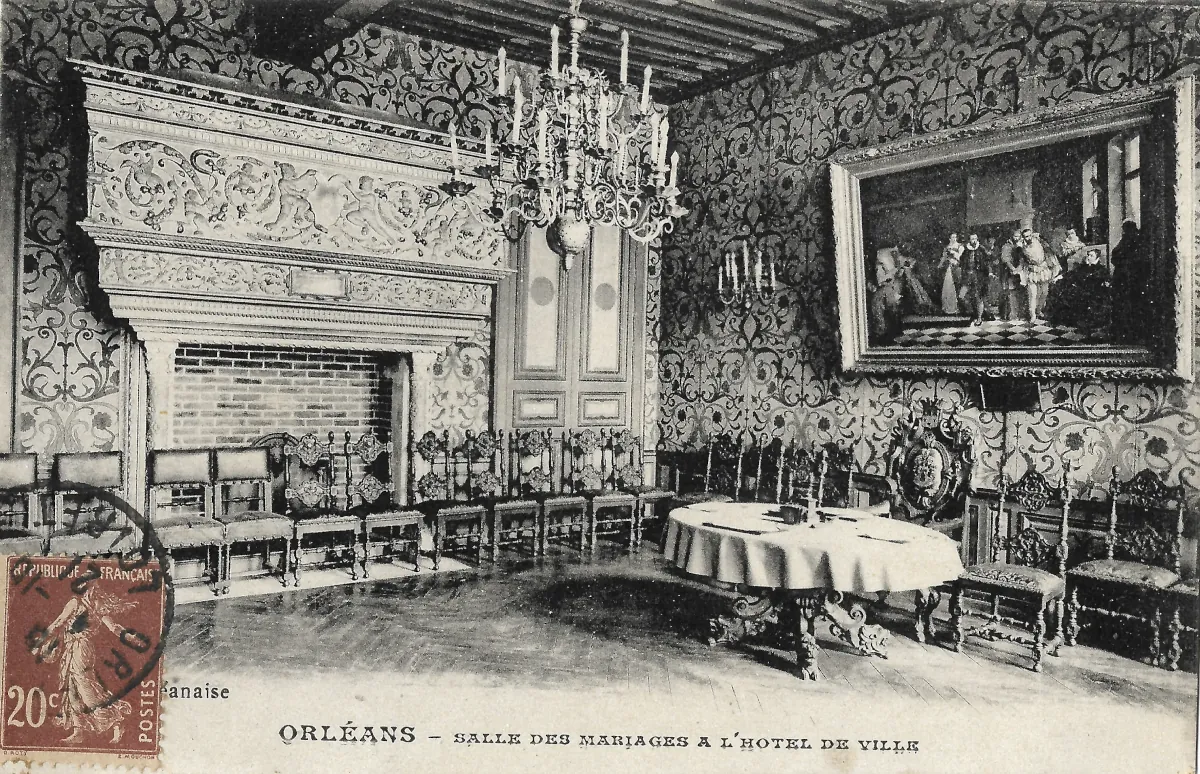
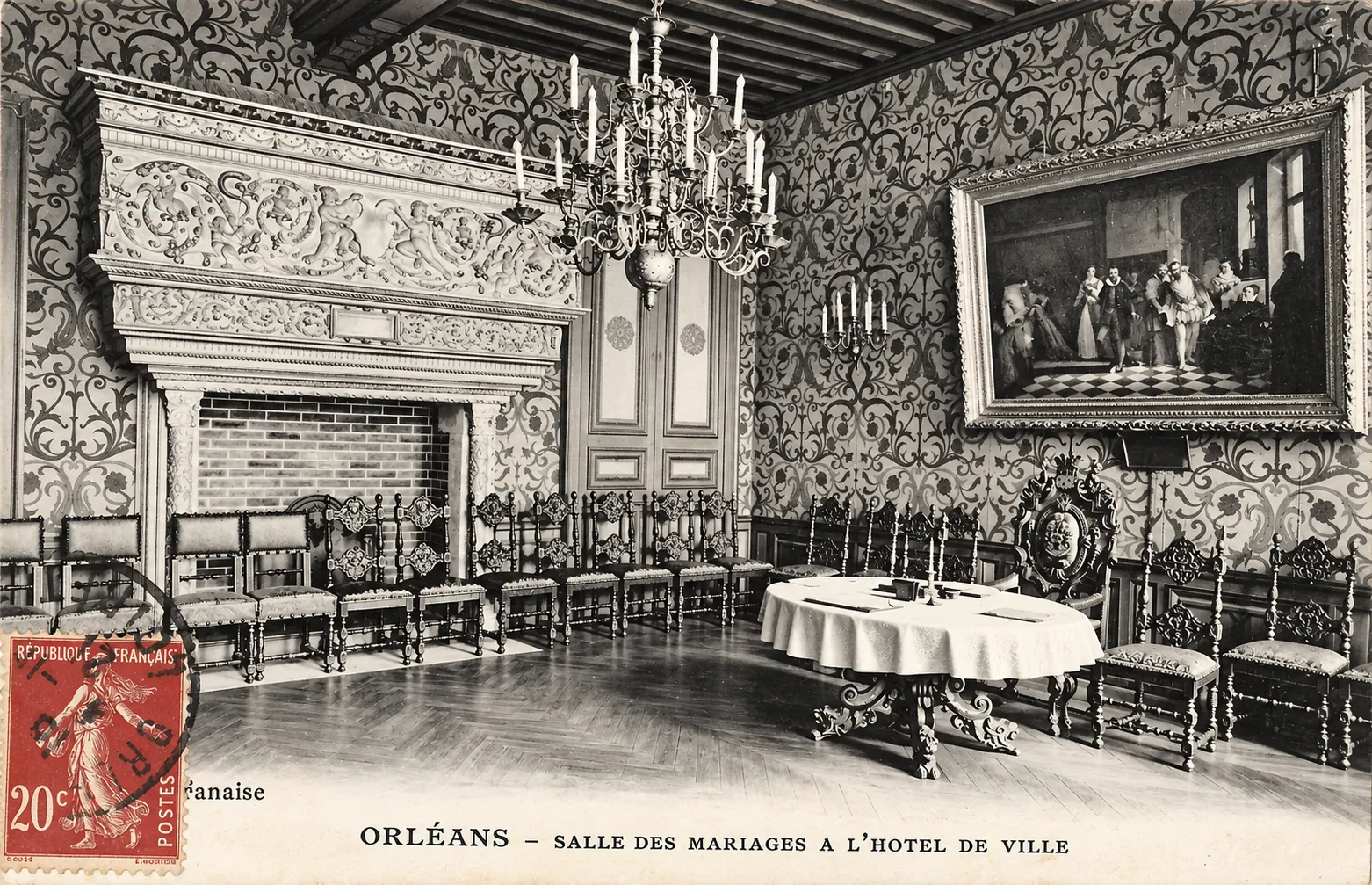
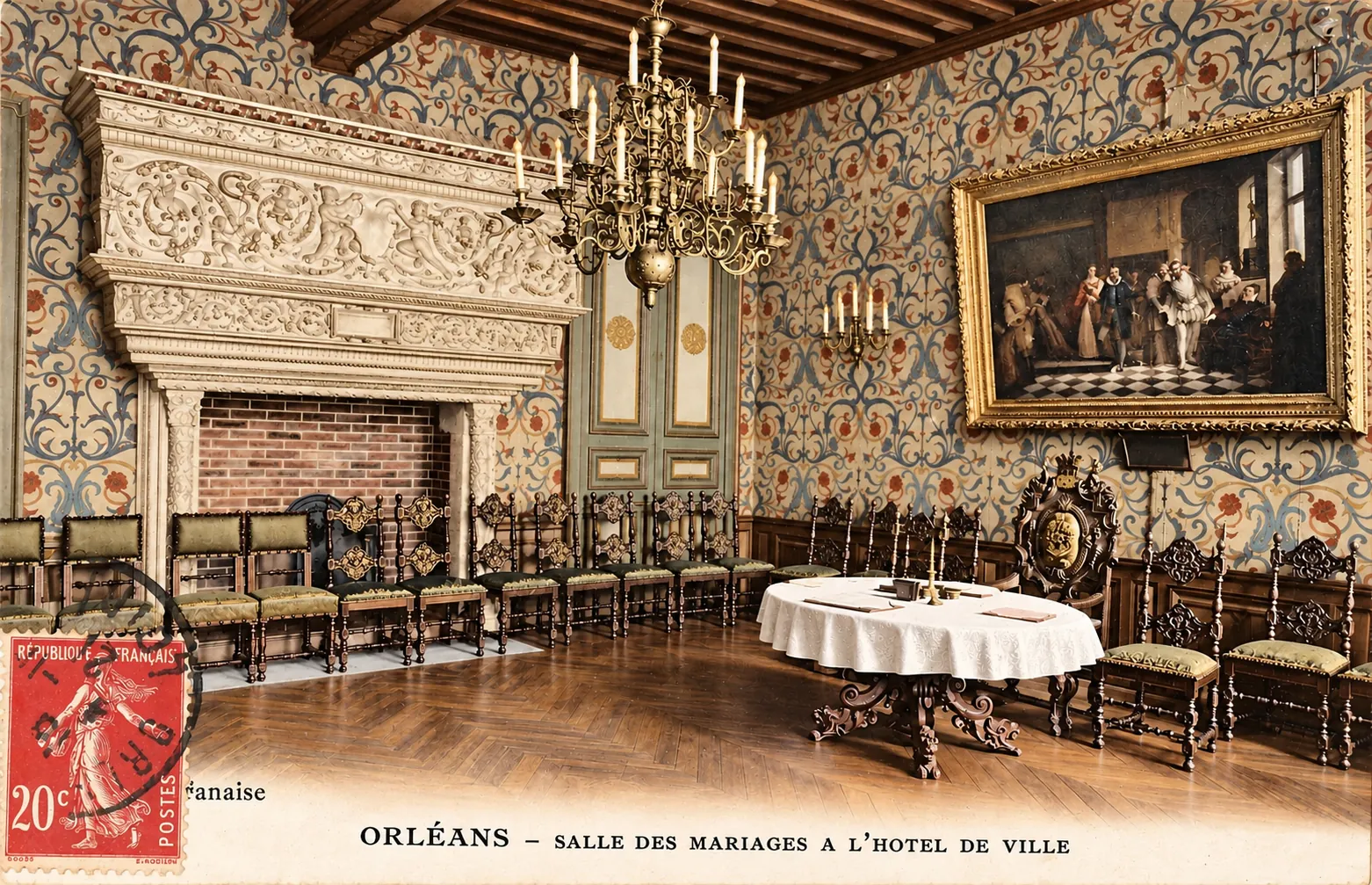
The Wedding Hall at Hôtel Groslot in Orléans is shown here as an exceptionally ornate ceremonial interior. The printed caption, “ORLÉANS – SALLE DES MARIAGES A L’HOTEL DE VILLE,” clearly identifies the room as the wedding hall of the town hall. At the time this postcard was produced, Hôtel Groslot was still the principal seat of Orléans municipal government, a role it retained until the opening of the new municipal centre in 1981.
The most prominent architectural feature is the monumental fireplace on the left. Its elaborately carved surround incorporates scrolling decoration, figures and Renaissance-inspired ornamentation. Although its appearance evokes the sixteenth century, the fireplace belongs to the nineteenth-century alterations made to the interior of Hôtel Groslot. Rows of carved chairs line the walls and the area immediately in front of the fireplace, while a large oval table covered with a cloth occupies the centre of the room.
The wall decoration is particularly striking. Dense scrolling motifs cover much of the surface and continue into a broad decorative band beneath the ceiling. Together with the panelled ceiling, carved furniture and elaborate lighting, they create the highly theatrical historicist character of the room. Modern heritage descriptions of Hôtel Groslot mention coffered ceilings, painted wall coverings, moulded woodwork and richly worked furnishings among the distinctive elements of its interior decoration.
A large multi-branch chandelier hangs from the ceiling, accompanied by candle-style wall lights. On the right-hand wall is an important historical painting. It can be identified as The Death of Francis II, painted by Pierre Dupuis in 1865 and depicting the final moments of the young French king at Orléans. Its location in this particular room gives the painting a direct connection with the history of the building rather than serving merely as decoration.
The furniture is arranged mainly around the perimeter, leaving the central part of the room relatively open for civic ceremonies. The combination of the table, rows of chairs and sumptuous decoration emphasizes the dual purpose of the room as both a historic interior and a functioning municipal ceremonial space. Its main decorative features remain readily recognizable in modern photographs of the Wedding Hall.
Historical description
Hôtel Groslot is one of the most important historic civic buildings in Orléans. The Renaissance residence was built in the sixteenth century for Jacques Groslot, bailiff of Orléans, beginning in 1549. According to the City of Orléans, construction took place between 1549 and 1558, and the design is traditionally attributed to architect Jacques Androuet du Cerceau. Following the French Revolution, the former private residence was converted into the city hall. It has been protected as a historic monument since 1862.
The interior seen in this postcard should not, however, be interpreted as an entirely preserved sixteenth-century setting. Major alterations were carried out during the nineteenth century under architect Albert Delton. These works created the highly decorative historicist interior, commonly described as Gothic Revival or “gothique troubadour,” combining medieval and Renaissance references with episodes from the history of Orléans. The room recorded by the postcard therefore owes much of its appearance to this nineteenth-century transformation.
The Wedding Hall also has a particularly important historical association. King Francis II died at Hôtel Groslot on 5 December 1560, while the royal court was staying in Orléans during the period of the Estates General. Three centuries later, Pierre Dupuis commemorated the event in the 1865 painting displayed prominently in the room and visible on the postcard.
The postcard itself appears to date from the early twentieth century. The 20-centime stamp attached to the picture side appears to be the brown-red Semeuse type, a denomination introduced in this form in 1907. This provides an earliest possible date rather than an exact date of use. The photographic presentation and typography are also consistent with postcards produced in the years before the First World War.
The cancellation is too indistinct in the surviving image to establish a precise postal date. Likewise, the publisher’s mark in the lower-left area is largely concealed by the stamp and cannot be read with sufficient confidence. A cautious dating of circa 1907-1914 is therefore preferable to assigning an unsupported exact year.