Orleans – Panoramic View of Place du Martroi and Rue de la République
Geographic description
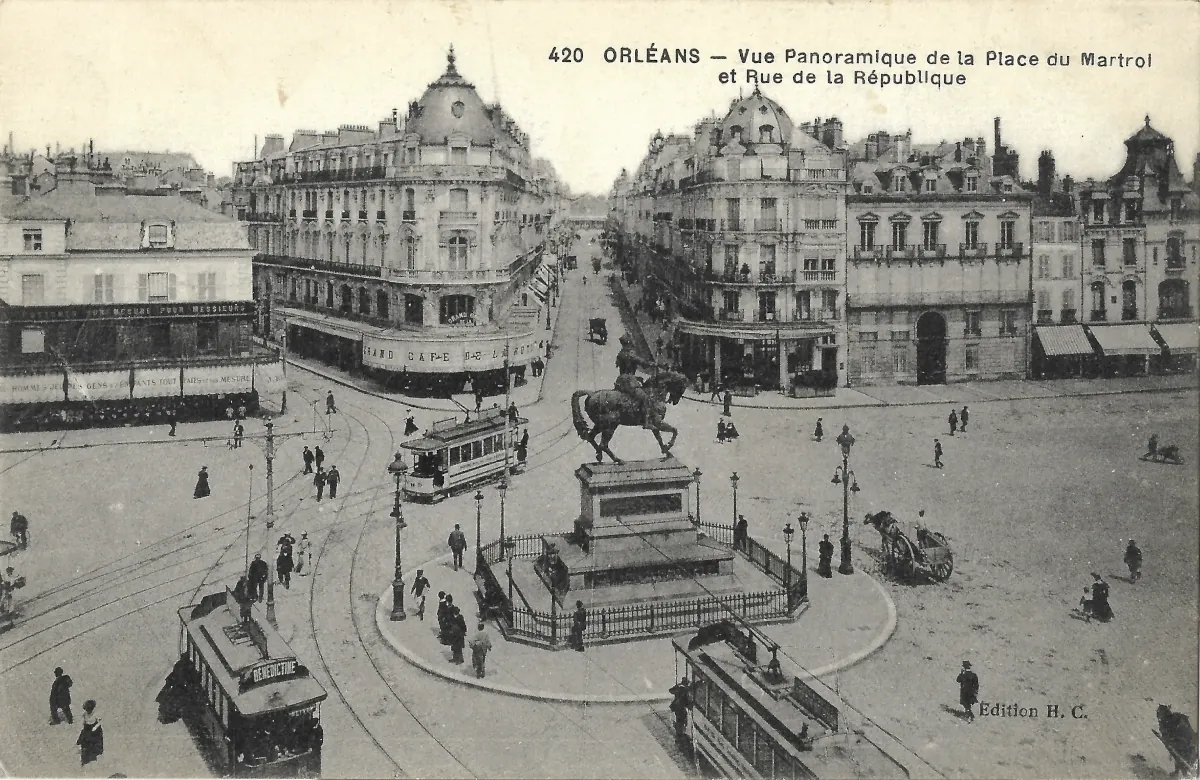
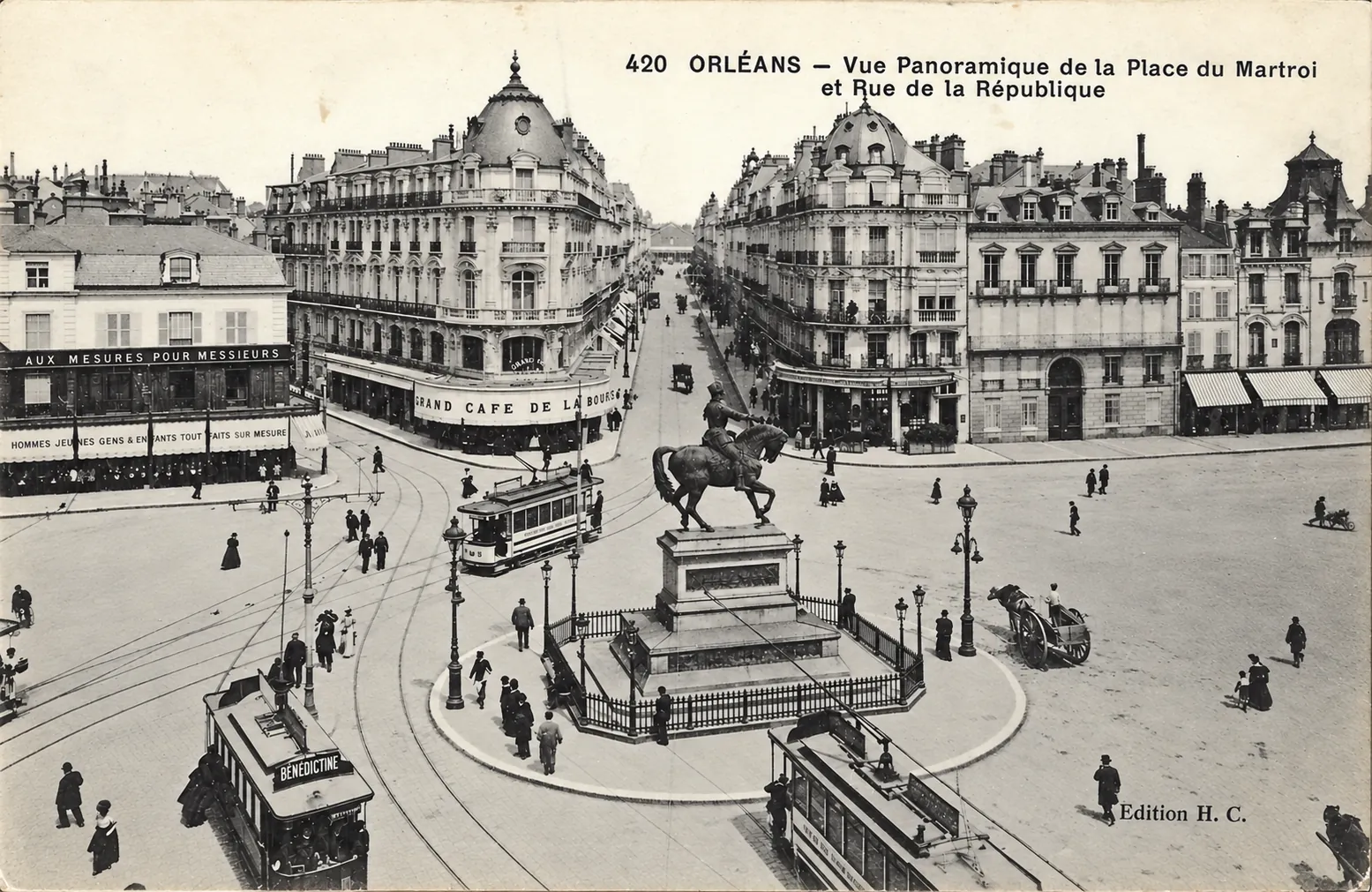
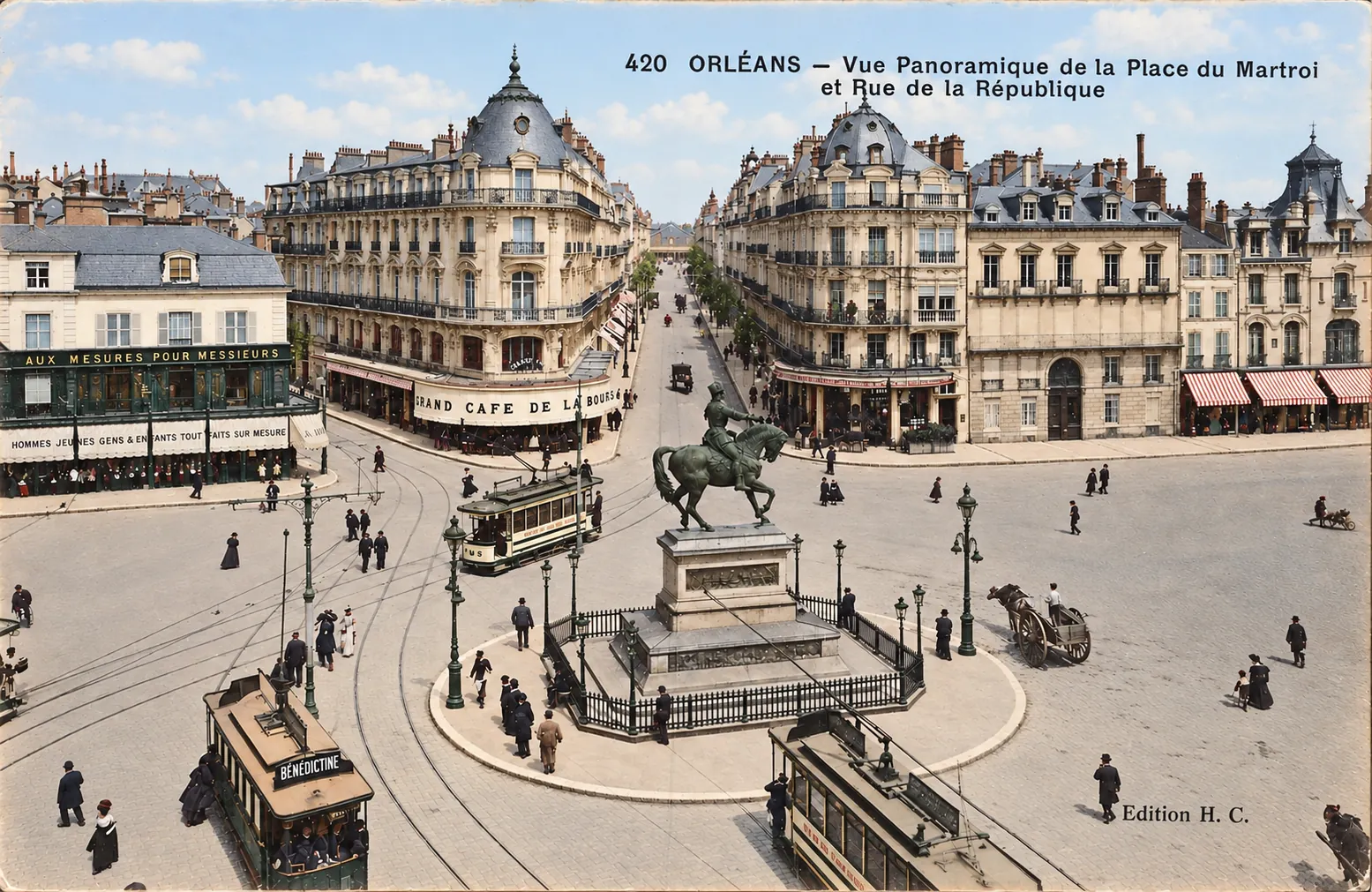
Place du Martroi Orleans is shown here in an impressive elevated panoramic view looking northwards along Rue de la République, the broad street opening in the centre of the photograph. The viewpoint appears to be from an upper floor of one of the buildings on the southern side of the square. Rue de la République forms a strong perspective leading towards the railway-station district and was one of the major urban improvements undertaken in Orleans around the turn of the twentieth century. Municipal planning records state that the new street linking Place du Martroi with the station was completed in 1903.
Dominating the foreground is the equestrian statue of Joan of Arc. The bronze figure stands on a substantial pedestal enclosed by an ornamental iron railing. The monument was created by the sculptor Denis Foyatier and officially inaugurated on 8 May 1855. It remains one of the most recognisable landmarks in central Orleans.
One of the postcard’s most striking features is the density of tramway infrastructure. Tracks curve and intersect across the square, while several electric tramcars can be seen at the same time. One is passing to the left of the statue, another occupies the lower-right foreground, and a further vehicle appears along the perspective of Rue de la République. Place du Martroi was therefore not simply a ceremonial square but a major public-transport junction.
Other forms of traffic coexist with the trams. A horse-drawn vehicle is clearly visible on the right-hand side of the square, while pedestrians walk between and across the tracks. Their movements illustrate an urban environment in which the strict separation of pedestrians, public transport and road vehicles was far less pronounced than it would become later.
A particularly interesting period detail appears on the tram in the foreground: a rooftop advertising board prominently displays the word “ÉLECTRICITÉ.” It seems almost symbolic in a photograph dominated by electric tramways, at a time when electricity was becoming an increasingly visible feature of everyday urban life.
The surrounding architecture reinforces the metropolitan character of the scene. Tall stone-fronted buildings with elaborate roofs, dormer windows and prominent corner pavilions frame the entrance to Rue de la République. Shops and cafés occupy many of the ground floors. The words “Grand Café” can be read on the corner building to the left of the street, underlining the commercial and social role of Place du Martroi.
The appearance of the square today is considerably different. A major redevelopment completed in 2013 transformed Place du Martroi into a fully pedestrianised public space, with new paving and a layout designed to emphasise walking, public events and the monumental setting around Joan of Arc’s statue. The rail-filled transport interchange seen on this postcard has consequently given way to a large pedestrian esplanade.
Historical description
Place du Martroi has been one of the principal centres of Orleans for centuries. Its name is thought to derive from the Latin martyrium, possibly referring to a Gallo-Roman burial ground formerly located in this area. The square became incorporated into the enlarged town during the construction of new fortifications in the sixteenth century. Following the disappearance of the old Porte Bannier and its defensive works, the resulting open space was used in particular for a grain market. Over time, and especially from the eighteenth century onwards, the commercial and civic centre of Orleans increasingly shifted towards the Martroi.
The equestrian monument seen in the middle of the photograph was sculpted by Denis Foyatier and inaugurated on 8 May 1855. Joan of Arc occupies a unique position in the city’s historical identity because of her role in the lifting of the English siege of Orleans in 1429. Her statue consequently became both a prominent urban landmark and a powerful symbol of the city.
The tramway system provides one of the most useful clues for dating the postcard. Orleans opened its first tram line in 1877. The original system used horse-drawn cars, but it was electrified in 1899. The network continued to expand, and by 1909 four lines were crossing at Place du Martroi. This original Orleans tram network remained in service until the end of the 1930s.
The photograph can therefore be dated with reasonable confidence to the early twentieth century, although no exact year can be established from the front of the postcard alone. Since Rue de la République was completed in 1903, the scene must be later than, or very close to, that year. The developed electric tram network, the continued presence of horse-drawn traffic, the clothing of the pedestrians and the apparent scarcity of motor cars all point towards the years before the First World War.
A date range of approximately 1903–1914, probably centred on the first decade of the twentieth century, is therefore plausible. This remains an informed estimate rather than a confirmed postal date.
Other visual details support such a dating. Many men wear hats and dark formal clothing, the street lighting and tram infrastructure have a distinctly Belle Époque appearance, and traditional horse-drawn vehicles still share the square with modern electric transport. The scene captures a particularly interesting transitional moment when nineteenth-century forms of travel and daily life were coexisting with technologies that would reshape the twentieth-century city.
The printed caption identifies the location precisely: “420 ORLÉANS – Vue Panoramique de la Place du Martroi et Rue de la République.” The lower-right corner bears the imprint “Édition H. C.” These initials identify the postcard series or publisher’s mark, but the visible evidence alone is insufficient to establish with certainty the full identity behind “H. C.”, so no attribution should be made without additional documentary evidence.
More than a picturesque view of Orleans, this postcard records a major stage in the city’s urban development. The historic Place du Martroi, the nineteenth-century monument to Joan of Arc, the newly completed Rue de la République and the electric tramway all meet in a single image. It is therefore an especially valuable record of Orleans as it entered the modern urban age during the Belle Époque.